Other Issues
Luke-Acts, Paul, and Marcionite Priority
Are Canonical Luke-Acts and the Pauline Letters a Second-Century Answer to Marcion?
The Question
A reader of The Case for the Core New Testament recently put a question that deserves a sustained answer, because it is being asked with increasing frequency in online discussion of early Christianity. A number of scholars working on Marcion and the formation of the New Testament, among them Markus Vinzent, Matthias Klinghardt, Jason BeDuhn, David Trobisch, Mark Bilby, Jack Bull, and M. David Litwa, have challenged the conventional account of how the Gospels and the Pauline letters reached their present form. Their positions differ considerably, but a common thread runs through the more ambitious versions: Marcion’s shorter Gospel and his ten-letter Pauline collection preserve an earlier textual form, and the canonical forms of Luke, Paul, and above all Acts are products of second-century editorial work designed to bind Paul to the Jerusalem apostles and to the Jewish Scriptures, in conscious reply to Marcion.1 This article calls that view the Marcionite priority hypothesis: the claim that Marcion’s texts came first and the canonical texts were derived from them.
The reader’s central question was this: what independent evidence allows us to establish that canonical Luke-Acts represents an earlier historical tradition, rather than a second-century editorial construction intended to reconcile Paul with the wider apostolic church and to respond to Marcionite Christianity?
This article answers that question, and the related question about Paul’s letters that the same scholars raise. It builds on two earlier studies, “Answering Skeptics on Paul and Acts” and “Marcion’s Premises and Their Limits,” and takes up the specific arguments now in circulation: the contrast that Vinzent and Bilby draw between Paul’s letters as Marcion had them (which they call “Marcionite Paul”) and the letters as they stand in the New Testament (“canonical Paul”), the test cases of 1 Corinthians 15:1–4 and Luke 24:25–27, Trobisch’s theory of a second-century canonical edition, the place of Polycarp and Irenaeus, and the silence of Acts about Paul’s letters.2
The answer in brief has four parts:
- What is conceded. The New Testament writings have a transmission history. Luke was composed from earlier sources and its text gathered interpolations in transmission, some Pauline letters have not come down in their original form, and Marcion’s text at points preserves readings older than Marcion himself. None of this is in dispute here.
- What does not follow. That the canonical forms were produced in response to Marcion is a conjecture about motive laid on top of a conjectural reconstruction of a lost text. The reconstruction is too incomplete to show that a passage was missing from Marcion’s text merely because no ancient writer quotes it from there. And where it is possible to test which form of a passage came first, the tests do not favor the Marcionite priority hypothesis.
- What can be shown independently. Acts is attested before and alongside Marcion, was known to the Marcionites and rejected by them for stated theological reasons, shows no knowledge of the Pauline letter collection it supposedly was written to frame, and is occupied throughout with the controversies of the middle of the first century rather than those of the middle of the second.
- What survives every reconstruction. The apostolic proclamation (the kerygma) carried in Paul’s earliest letters and in the speeches of Acts is present in Marcion’s own text. The Marcionite priority hypothesis, even if granted, does not reach it.
The article first sorts the claims and tests the evidence for Marcion’s text. It then examines Acts and the theory of a second-century edition of the New Testament. It ends with what is conceded about the transmission of Paul’s letters and with what remains on any view.
Sorting the Claims
The scholars grouped together in this discussion do not hold one position, and the differences matter for assessing the evidence.
Jason BeDuhn, whose The First New Testament remains the most accessible English reconstruction of Marcion’s scriptures, does not argue that canonical Luke and Paul were written against Marcion. His thesis is that Marcion received his Gospel and his Pauline collection in forms that already existed before him, so that the differences between Marcion’s texts and the texts used by the wider church arose “probably before the time of Marcion” from ordinary literary causes rather than from ideology on either side.3 On Acts, BeDuhn reports that recent scholarship favoring a second-century date places it in the first quarter of that century, “in the lifetime of Marcion, but not written in response to him.”4
Matthias Klinghardt and Markus Vinzent go much further. For Klinghardt, Marcion’s Gospel is the oldest Gospel and the source from which all four canonical Gospels derive. For Vinzent, Marcion himself composed it, and the Synoptic Gospels are responses to him.5 The view that Acts in particular was written to domesticate Paul against Marcion was proposed by John Knox in 1942 and revived by Joseph Tyson in 2006.6 David Trobisch argues on different grounds, from the physical and editorial features of the manuscripts, that the New Testament was published as a single edited collection in the second century. And Mark Bilby and Jack Bull, translating Vinzent’s Greek reconstruction of Marcion’s Pauline collection, argue from patterns in that reconstruction that the canonical letters of Paul and Acts are “elaborate, programmatic, cross-referencing expansions” of the letters as Marcion had them.7
For the strong form of the Marcionite priority hypothesis to succeed, three things must be true. The reconstruction of Marcion’s text must be reliable enough to show not only what it contained but what it lacked. The direction of change must run from the shorter text to the longer. And the longer forms, including Acts, must be absent from the record before Marcion’s activity in the 140s. Each of these can be examined.
It should be said plainly where this site already agrees with these scholars. The Case for the Core New Testament holds four things that bear on the question:8
- Luke was composed from sources already assembled, one of them a narrative beginning at Luke 3:1, and its text later gathered interpolations.
- The Pauline letters “may have undergone some second-hand editing, merging, and expansion during their transmission.”
- The fourfold Gospel is a second-century construction of the emerging mainstream church.
- Marcion “did not invent the Luke-Paul framework but inherited it from an earlier tradition.”
The disagreement is not over whether the texts have a history. It is over whether that history can be reconstructed in the detail claimed, whether Marcion was its cause, and whether Acts belongs to it at all.
The Evidence Problem: A Text Known Only Through Its Opponents
No copy of Marcion’s Gospel or of his Pauline collection survives. Both must be reconstructed from writers who quoted them in order to refute them: Tertullian’s Against Marcion (Books 4 and 5), Epiphanius’s Panarion 42, the Dialogue of Adamantius, and scattered remarks elsewhere. These writers quoted what served their arguments. They did not transcribe the text, and they did not supply a list of what it lacked. Tertullian is quoted throughout this article from the nineteenth-century translation in the Ante-Nicene Fathers, which uses older English (“spake,” “hath,” “ye”).
The consequence was stated by Ekkehard Mühlenberg and is endorsed by BeDuhn: “We are not furnished with a list of omissions, so that the argumentum e silentio cannot be admitted.”9 That is, the argument from silence fails: no one may conclude that Marcion’s text lacked a passage simply because the surviving sources do not mention it. BeDuhn applies the caution in both directions. The anti-Marcionite writers passed over passages that did not serve them, giving a false impression of absence, and they also failed to mention real absences. He adds that this holds especially for “the very perfunctory attention Tertullian and Epiphanius give to some of Paul’s letters.”9 Modern reconstructions differ accordingly. Harnack, Schmid, BeDuhn, Roth, Klinghardt, and Vinzent do not print the same text, because each must decide what to do with the large portion of Luke and Paul about which the sources say nothing.10
This bears directly on the argument from Marcion’s “restricted literary world.” Bilby and Bull observe that in the reconstructed text of Marcion’s collection of Paul’s letters, place names appear almost only in letter openings, personal names are few, and autobiographical and itinerary notices are sparse, whereas the canonical letters share with Acts a dense network of cities, companions, and journeys. From this they infer that the names and itineraries were added later as part of a single proto-orthodox program.7
The inference mistakes the character of the sources for the character of the text. Tertullian’s fifth book is a doctrinal argument. He cites the verses in which the Creator, the law, the prophets, the flesh of Christ, and the resurrection are at issue. He had no reason to cite the greetings of Romans 16, the travel plans of 1 Corinthians 16, or the list of companions in Colossians 4, because nothing in them could be turned against Marcion’s doctrine of two gods. Epiphanius offers only forty short excerpts for the entire Pauline collection. A corpus assembled from the doctrinally contested sentences of ten letters will be poor in names and itineraries by construction. Counting names of people and places in such a corpus, however carefully, measures the interests of Tertullian and Epiphanius. It does not measure what stood in Marcion’s codex. The same sampling problem affects any computational comparison that treats unattested text as absent text.
Where the sources do speak, moreover, they contradict the picture of a Paul detached from Jerusalem. Tertullian, working through Marcion’s Galatians, reports that Paul “fourteen years after ... went up to Jerusalem” to confer with the other apostles about his gospel, that Titus was not circumcised, and that “those who preceded him in the apostolate gave him their right hands of fellowship.”11 Tertullian also reports that Marcion made the confrontation of Galatians 2 a centerpiece of his own case, “finding the Epistle of Paul to the Galatians (wherein he rebukes even apostles)” and turning it against the Gospels that bore the apostles’ names.12 BeDuhn draws the conclusion without hesitation: “Marcion did not alter Paul’s description of his cooperation with the Jerusalem leadership, and their partnership in a dual mission to Jews and Gentiles, in Gal 2.1–10.”13 The translation by Bilby and Bull likewise prints the Jerusalem visit, Titus, and the agreement with Peter in the Marcionite column.
The relationship between Paul and the Jerusalem apostles, with its mixture of recognition and conflict, is therefore not a feature that first appears in the canonical letters and Acts. It stands in Marcion’s own text of Galatians. Acts did not have to invent it.
Two Test Cases
1 Corinthians 15:1–4
In the reconstruction translated by Bilby and Bull, the Marcionite form of Paul’s summary of the gospel reads, “that the Anointed died, and he was buried, and he was raised on the third day,” without the canonical “for our offenses,” without “what I also received,” and without the twice-repeated “according to the scriptures.” The canonical additions, it is suggested, place Christ’s death and resurrection inside the framework of Israel’s Scriptures in a way suited to answering Marcion.
Four observations are in order.
First, the evidence for the shorter reading is weak. The principal witness is Epiphanius, who cites the passage in abbreviated and rearranged form while assembling a proof of the bodily resurrection. BeDuhn, who has no stake in defending the canonical text, notes that Epiphanius “is compressing a string of clauses into a neat rhetorical proof,” that in the same place he also gives a fuller quotation that includes “on behalf of our misdeeds in accord with the scriptures” with no remark about any omission by Marcion, and that the supporting passages cited by Harnack from Tertullian and Adamantius cannot be assumed to come from Marcion’s text. On the related omission in verse 3 he concludes that “even the claim that the words were omitted in Marcion’s text cannot be confirmed.”14 The test case rests on an editorial decision in a modern reconstruction, not on an attested Marcionite reading.
Second, the phrase is not the kind of thing a second-century editor imitating Paul would write. “According to the scriptures” (kata tas graphas) occurs in Paul only in this passage. Paul’s own habit, dozens of times over, is “as it is written.” Together with the technical vocabulary of handing on and receiving tradition, the fourfold “that” structure, the Aramaic name Cephas, and the reference to “the twelve,” this unusual phrase is one of the standard indications that 1 Corinthians 15:3–5 is a formula older than the letter, received by Paul and passed on to his churches.15 The phrase is evidence of early tradition, and it is poorly explained as later Pauline pastiche.
Third, a scriptural framework did not need to be added to Paul’s letters after Marcion, because it is abundantly present in the letters as Marcion had them. BeDuhn lists two dozen explicit quotations of the Jewish Scriptures that are attested for the Marcionite collection, among them Galatians 3:10, 3:11, and 3:13, 1 Corinthians 1:19, 9:9, and 14:21, and, in this very chapter, 1 Corinthians 15:45 and 15:54–55. He adds that the review of Moses and Israel in 1 Corinthians 10:1–10 was left intact, and that “not once is either a quotation or its context altered in order to treat the text critically or negatively.”16 A Paul who quotes Isaiah and Hosea on the resurrection later in the same chapter gains nothing new in kind from the words “according to the scriptures” at its head.
Fourth, and most important for this article, the proclamation itself stands in both forms. Christ died, he was buried, he was raised on the third day, he appeared. That is the kerygma. Whatever the original wording of the surrounding clauses, the Marcionite text as reconstructed by its most sympathetic editors is a witness to the same apostolic announcement as the canonical text.
Luke 24:25–27
The second test case is the rebuke on the road to Emmaus. Canonical Luke reads, “slow of heart to believe all that the prophets have spoken,” followed by the exposition “beginning with Moses and all the prophets.” Marcion’s Gospel is reported to have read “that which He spake unto you” (so Tertullian) or “all that I spoke to you” (so Epiphanius and Adamantius). The emphasis falls on Christ’s own words in one form and on the prophets in the other.
Here the Marcionite reading is genuinely attested, and the question of direction can be put to it. Three considerations point the same way.
The first is narrative coherence. The scene depends on the travelers not knowing who is speaking to them. Tertullian reports that Marcion’s Gospel kept this feature: the Lord joined the two without appearing to be himself and feigned ignorance of what had happened. Epiphanius reports that Marcion’s Gospel also kept the recognition at the breaking of the bread.17 In that setting, a stranger who rebukes the two for not believing “all that I spoke to you” has identified himself before the recognition scene and emptied it. The canonical wording fits the story. The Marcionite wording strains against a story that Marcion’s Gospel itself retained. It is also readily explained as an adjustment toward the angels’ words a few verses earlier, which stood in Marcion’s Gospel too: “Remember how He spake unto you when He was yet in Galilee.”17
The second is the pattern into which the variant falls. According to Epiphanius, Marcion’s Gospel lacked Luke 11:49–51 (the Wisdom of God sending prophets), 18:31–34 (“everything that is written through the prophets about the Son of Man will be accomplished”), 20:37–38 (Moses at the bush), and 21:21–22 (“that all things written may be fulfilled”). Luke 24:44–46 is unattested, and BeDuhn judges it “likely to have been cited by Tertullian or Epiphanius if present.”18 These passages share one theme: the suffering and vindication of Christ as the fulfillment of what the prophets wrote. That is the precise point at which Marcion’s theology, by every ancient account, parted from other Christians. Tertullian devotes the whole of his third book to it. When the differences between two texts cluster on the one doctrine that is known to separate their users, the difference has an ideological explanation on at least one side.
The third is what Marcion’s Gospel kept. Tertullian observed, with some satisfaction, that Marcion “was unwilling to expunge from his Gospel some statements which even made against him.”19 In the same chapter the travelers still say they had thought Jesus was “the Redeemer of Israel,” the risen Christ still says “a spirit hath not bones, as ye see me have,” and the angels still say that the Son of Man “must be delivered up, and be crucified.” Elsewhere the Marcionite Gospel still had Jesus cite the prophet’s words about John the Baptist (“Behold, I send my messenger,” Luke 7:27) and still had Abraham say, “They have Moses and the prophets; let them hear them” (Luke 16:29).20 A text in which the appeal to Moses and the prophets survives in some places and is missing or reworded in others is what an incomplete revision looks like. If a later editor in the wider church had been inserting the scriptural framework into a Gospel that originally lacked it, the presence of that framework in Marcion’s own copy would be without explanation.
BeDuhn reads this unevenness differently. For him it shows that Marcion did little or no editing and inherited a text that already differed from the one that became canonical.3 That is a reasonable reading of the evidence, and it should be noticed what it implies. If the Marcionite readings are pre-Marcionite, then the canonical readings are not replies to Marcion either. Both forms were already in circulation, and the debate becomes an ordinary text-critical one about variant readings in the early second century. On neither reading of the evidence does canonical Luke 24 emerge as an anti-Marcionite composition.
Testing the Direction of Dependence
Arguments from theological motive can be turned either way. One party says Marcion removed the appeals to the prophets, and the other says his opponents added them. The question is whether anything outside the two texts can decide the matter. Several things can.
Marcion’s own account of what he was doing
Marcion did not claim to possess a Gospel that had always existed in the form he published. According to Tertullian, who cites Marcion’s Antitheses as his source, Marcion claimed that the Gospel in use among other Christians had been “interpolated by the defenders of Judaism, for the purpose of such a conglomeration with it of the law and the prophets,” and presented his own text as its correction. Tertullian’s reply remains to the point: Marcion “could not have so argued about it, unless he had found it (in such a form) ... Emendation never precedes the fault.”21 Elsewhere Tertullian reports the Marcionite defense that Marcion “did not so much innovate on the rule (of faith) by his separation of the law and the gospel, as restore it after it had been previously adulterated.”
This is testimony from the Marcionite side about the sequence of events. When Marcion published, a Gospel joined to “the law and the prophets” was already in the hands of the churches, and Marcion knew it. One may believe Marcion’s theory that it was a corruption of something purer. What cannot be said on this evidence is that the scripturally framed Gospel came into existence as a reaction to his.22
The scriptural framework before Marcion
The claim that Christ’s death and resurrection fulfilled the Scriptures of Israel is documented across independent streams of Christian writing that are earlier than Marcion or untouched by him. First Clement, written from Rome around 95–96 CE, argues from the Jewish Scriptures on nearly every page. Polycarp, writing to Philippi, sets side by side “the apostles who preached the Gospel unto us” and “the prophets who proclaimed beforehand the coming of the Lord” (Philippians 6.3). The Epistle to the Hebrews, which Clement uses, is an extended argument from Scripture. First Peter, which Polycarp uses, says that the prophets testified beforehand to the sufferings of Christ (1 Peter 1:10–12). The Epistle of Barnabas is devoted to the subject. Justin, a contemporary of Marcion in Rome, presents the proof from prophecy as what Christians had been taught, not as a new defense.23
Marcion’s separation of the gospel from the Scriptures was the innovation, and it was recognized as such when it appeared. A framework that was universal before him did not need him as its cause.
A check from the other Gospels
Marcion’s Gospel passed directly from the dating notice of Luke 3:1 to Jesus’s appearance in Capernaum at 4:31. It had no ministry of John, no baptism of Jesus, no genealogy, and no temptation. Tertullian remarks on the abruptness: “From heaven straight to the synagogue.”24
The baptism and the temptation are not peculiar to Luke. They stand in Mark and in Matthew. If the canonical form of Luke were a post-Marcionite expansion, these episodes would have to be additions made after the 140s, and their presence in Mark and Matthew would require those Gospels to be later still. Knox saw the difficulty. As BeDuhn summarizes the position of Knox and Tyson, they hold Marcion responsible for removing passages “deeply rooted in the Synoptic tradition,” the baptism and the temptation among them, because their absence from an earlier edition of the Gospel would be hard to explain.25 Klinghardt and Vinzent accept the alternative and date all four canonical Gospels after Marcion.
That alternative collides with the evidence that the other Gospels and their traditions were in circulation earlier: the sayings of Jesus cited in First Clement and Polycarp in forms close to Luke and Matthew, the testimony of Papias to written works associated with Mark and Matthew, the Didache, and Justin’s statement around 155 CE that the memoirs of the apostles were read in the Sunday assemblies “in cities or in the country” alongside the prophets, a settled custom that presupposes decades rather than years.26
On the view of Gospel origins defended on this site, the check is tighter still. Mark and Matthew are literarily dependent on Luke, and Mark draws on Acts as well.27 The baptism and temptation narratives that Marcion’s Gospel lacked were therefore in Luke before Mark and Matthew were written. The same analysis shows why Marcion’s Gospel cannot simply be equated with a source lying behind Luke. A source narrative opening with the sixfold date of 3:1 runs on naturally into John’s preaching and the baptism. Marcion’s Gospel has the date and then nothing until Capernaum. It is that narrative with its opening removed.
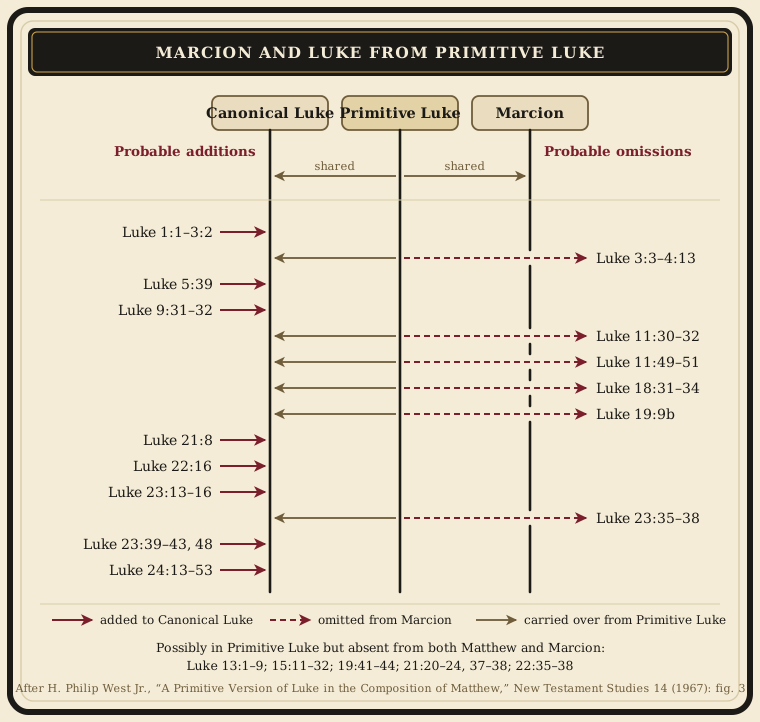
This is not a new observation. H. Philip West Jr., in the 1967 study that proposed a “Primitive Luke” as a source used by Matthew, compared Marcion’s Gospel, canonical Luke, and Matthew passage by passage. His working rule was that material now found in both Matthew and Luke but absent from Marcion stood in Primitive Luke and was omitted from Marcion’s Gospel. On that basis he identified as probable Marcionite omissions Luke 3:3–4:13 (John’s ministry, the baptism, the genealogy, and the temptation), 11:30–32, 11:49–51, 18:31–34, 19:9b, and 23:35–38. He also identified probable additions in canonical Luke, among them 1:1–3:2 and parts of the passion and resurrection narratives.28
West’s judgment on the Marcionite omissions is the one defended here. Marcion’s Gospel resembles an earlier form of the Lukan narrative in content and arrangement, but it is not identical to it. West’s further proposal, that Luke 1:1–3:2 was added to a Primitive Luke at a later stage, is not adopted in this article, for the reasons given under “The infancy narrative” below. The omissions West assigns to Marcion include two of the prophetic-fulfillment passages discussed above (11:49–51 and 18:31–34), identified by comparison with Matthew and not by an appeal to Marcion’s theology.
The infancy narrative
Luke 1–2 requires separate comment. The Case for the Core New Testament observes that the formal dating at Luke 3:1 reads like the opening of a source, and that Luke, as his preface says, worked from materials already assembled. That is an observation about the sources Luke drew on. It is not a claim that the infancy narrative was added to the Gospel after it was written. On the view taken here, the Gospel as Luke composed it began with the infancy material and was put together from more than one source.
Marcion’s Gospel offers no evidence against this. Marcion had compelling reasons of his own to begin where he did: a Christ who was conceived, born, circumcised, and presented in the Temple in fulfillment of promises to Abraham and David contradicts both his docetism (the teaching that Christ only appeared to have a human body) and his dualism (the teaching that the Father of Christ is a different God from the Creator). His omission therefore cannot show that the chapters were absent from the copies available to him, and it is best explained by his theology. Nor is there room for them to have been composed afterward as an answer to him. Justin quotes the annunciation (Luke 1:35) within about a decade of Marcion’s break with the Roman church, the Protevangelium of James builds on Luke’s infancy narrative around the middle of the century, and Irenaeus reports Valentinian teachers allegorizing Simeon, Anna, and the twelve-year-old Jesus in the Temple.29 Material that rival schools were already interpreting was not a recent proto-orthodox insertion.
The manuscript tradition
Finally, the manuscripts. If the canonical forms of Luke and Paul were mid-second-century expansions of shorter originals, the shorter originals circulated for the better part of a century, in many churches, before the expansions existed. No Greek manuscript, no early version, and no church father outside the Marcionite controversy preserves them as a text. The earliest substantial papyrus manuscripts of Paul’s letters and of Luke, from around the end of the second century and the beginning of the third, carry the longer forms.30
This argument has limits, and they should be acknowledged. The first century of transmission is poorly documented for every New Testament writing. A number of readings attested for Marcion do reappear in the wider tradition, especially in the manuscripts and early translations that textual critics group as the “Western” text, which is why Clabeaux, Schmid, and BeDuhn conclude that Marcion’s text often reflects an older form that he received.31 Individual Marcionite readings may well be early. That is a different claim from the thesis that the canonical text as a whole is a systematic secondary expansion. The first is ordinary textual criticism. The second requires a coordinated revision that left no dissenting copy behind.
Acts on Its Own Evidence
The Marcionite priority hypothesis treats Acts as the keystone of the supposed second-century program: a narrative composed or substantially rewritten to reconcile Paul with the Jerusalem apostles and to supply the frame in which his letters would be read. Acts can be examined independently of any theory about the text of Luke or Paul.
The Marcionites knew Acts and rejected it
The inference from Marcion’s canon to the non-existence of Acts assumes that he omitted it because it was not there. The ancient evidence says otherwise. Tertullian, addressing the Marcionites directly as he works through Marcion’s Galatians, writes:
“Now, since the Acts of the Apostles thus agree with Paul, it becomes apparent why you reject them. It is because they declare no other God than the Creator, and prove Christ to belong to no other God than the Creator.” (Tertullian, Against Marcion 5.2)32
Tertullian does not accuse the Marcionites of ignorance of Acts. He accuses them of rejecting it, and he names the reason. Irenaeus, a generation earlier, presses the same point from the other side: those who accept Luke’s testimony in the Gospel have no ground for refusing the rest of his narrative, and he lists the “we” passages of Acts to show that its author was Paul’s companion.33 Both writers treat Acts as a known book whose authority the Marcionites declined, not as a recent production.
The motive is not obscure, and it has been set out more fully in “Marcion’s Premises and Their Limits.” The speeches of Acts argue from Moses and the prophets at every turn. The mission begins in Jerusalem and moves outward under the direction of the Twelve. Paul is shown as a Pharisee who worships “the God of our fathers, believing everything laid down by the Law and written in the Prophets” (Acts 24:14), who takes vows, circumcises Timothy, and proclaims at Athens the God “who made the world and everything in it” (Acts 17:24). The resurrection is bodily. Marcion’s system required a Paul who was the sole true apostle of a God previously unknown. No amount of editing could have made Acts serve that purpose, as editing could with Luke and the letters. It could only be left out. As The Case for the Core New Testament puts it, Marcion’s silence on Acts is “the silence of a hostile editor, not a historical witness to absence.”34
Attestation before and alongside Marcion
“Answering Skeptics on Paul and Acts” sets out the evidence in detail, and it need only be summarized here with some additions. On the account of Gospel origins defended on this site, the Gospel of Mark draws vocabulary and narrative motifs from Acts, which places Acts before Mark.27 First Clement, around 95–96 CE, commends the Corinthians for being “more willing to give than to receive” (2.1), a maxim preserved elsewhere only in Paul’s speech at Miletus (Acts 20:35), and cites the description of David as “a man after Mine own heart” in a combination of Psalm 89:20 and 1 Samuel 13:14 that appears in the same combined form in Paul’s speech at Pisidian Antioch (1 Clement 18.1; Acts 13:22). Polycarp reproduces the distinctive phrase “having loosed the pangs of death” from Peter’s Pentecost speech (Philippians 1.2; Acts 2:24). Justin presupposes the forty days of post-resurrection instruction and the mission from Jerusalem.35
One further piece of early evidence bears on the supposed purpose of Acts. First Clement 5 holds up Peter and Paul together as “the greatest and most righteous pillars” and as joint examples for the Roman and Corinthian churches. That was written half a century before Marcion’s break with Rome. The pairing of Peter and Paul as partners in a common mission, which the Marcionite priority hypothesis treats as the achievement of an anti-Marcionite Acts, was already the settled view of the Roman church in the 90s.
The silence of Acts about Paul’s letters
It has been suggested that a second-century origin would help explain why Acts never mentions Paul’s letters. The observation points in the opposite direction.
By the time of Marcion, Paul was known to the churches chiefly as a writer of letters. Clement tells the Corinthians to “take up the epistle of the blessed Apostle Paul.” Polycarp reminds the Philippians of what Paul wrote to them when absent. Second Peter speaks of “all his letters.” Marcion’s entire case rested on the letters, and they made up most of his canon. An author composing Acts in that setting, in order to control how the letters were read, had every reason to mention them, to show Paul writing them, and above all to bring his narrative into visible agreement with them. Acts does none of these things. It never refers to a letter of Paul. It shows no awareness that a collection exists.
The details confirm the independence. Acts knows nothing of Paul’s sojourn in Arabia (Galatians 1:17), and its account of his visits to Jerusalem is notoriously hard to align with Galatians 1–2. It records one imprisonment before Jerusalem and one shipwreck, where Paul by the time of 2 Corinthians counts “far more imprisonments,” five synagogue floggings, and three shipwrecks (2 Corinthians 11:23–25). It mentions the great collection for Jerusalem, which occupies Paul in four letters, in a single passing clause (Acts 24:17). It all but withholds from Paul the title “apostle,” on which he insists in nearly every letter. And it never names Titus, who is Paul’s test case in Galatians 2 and his chief agent in 2 Corinthians.
The data compiled by Bilby and Bull underline the point. Their tables show that Titus is absent from Acts, that the canonical letters mention Arabia, Illyricum, Dalmatia, and Spain while Acts ignores them, and that the canonical letters prefer the name Cephas while Acts never uses it.36 These are odd results for what is described as a coordinated, cross-referencing program. Editors who were expanding the letters and composing Acts as companion pieces would have aligned them. What the evidence shows instead is two bodies of material that agree in broad outline and in many incidental particulars, such as Aquila and Priscilla, Crispus, the escape from Damascus, and the movements of Timothy between Macedonia, Athens, and Corinth, while diverging in ways that no harmonizing editor would have left.37 That is the profile of independent witnesses to the same events. It is best explained if Acts was written before the letters were gathered and circulated as a collection, by someone whose knowledge of Paul came from another source than his correspondence.
The concerns of Acts are not the concerns of the second century
A book written to answer Marcion would be expected to engage what Marcion taught. Acts never mentions a second god, never defends the goodness of creation against those who denied it, never argues that Christ came in real flesh, and never asserts the authority of the Scriptures against anyone who rejected them. Its speeches assume the Scriptures. They do not defend them.
The questions Acts does labor over are the questions of the first Christian generation: whether Gentiles must be circumcised, whether Jewish and Gentile believers may eat together, what standing the Temple has, how the movement relates to the synagogue, and whether its preachers are guilty of anything under Roman law. The church order it reflects is equally early. The same Ephesian leaders are called elders and overseers without distinction (Acts 20:17, 28), and there is no single bishop. Its Christology uses titles that soon fell out of use, such as God’s “servant” and “a man attested to you by God” (Acts 2:22; 3:13). Its local knowledge of magistrates’ titles, provincial arrangements, and sea routes fits the middle of the first century, and the proconsulship of Gallio at Corinth (Acts 18:12) is fixed by the Delphi inscription to 51–52 CE.38 The narrative ends with Paul alive in Rome and says nothing of his death, of the fire of Rome in 64 CE, or of the destruction of Jerusalem in 70 CE.
How much weight the ending can carry for a date before 70 is a matter on which careful scholars differ, and “Answering Skeptics on Paul and Acts” described the inference as reasonable rather than decisive. Most critical scholars place Acts between 70 and 90. Even the leading advocate of a second-century date, Richard Pervo, puts it around 115, before Marcion’s public career.39 The specific thesis that Acts was written against Marcion is a minority position even among those who date it late, and nothing in the content of Acts supports it.
A Second-Century Edition? Trobisch, Polycarp, and Irenaeus
David Trobisch has argued that the New Testament was published as a single edited collection in the second century. He points to the uniform titles of the books, to shared manuscript conventions (the codex format and the abbreviated sacred names), to the fixed grouping of the writings into four units (the Gospels, Acts with the general letters, the letters of Paul, and Revelation), and to editorial cross-references between them. He has suggested that Polycarp of Smyrna may have been its publisher.40
Much of this is compatible with the argument of this site, and some of it supports it. That the twenty-seven-book collection is a second-century construction, assembled and arranged with deliberate purpose, is the thesis of the chapter of The Case for the Core New Testament on the development of the canon. The fourfold Gospel in particular is there argued to be a late and contested arrangement.
Three qualifications are needed.
First, an edition is not a composition. Titles, sequence, and format are the work of collectors. They presuppose the writings they organize. Evidence that someone gathered Luke, Acts, and the letters of Paul into a collection in the second century is not evidence that any of them was written then, any more than Marcion’s own edition shows that he wrote Galatians.
Second, the evidence for a single authoritative edition is weaker than the theory needs. The order of the Gospels varies in the manuscripts and lists. The position of Hebrews moves. The standing of 2 Peter, 2 and 3 John, Jude, and Revelation was disputed into the fourth century and beyond, and the Syriac churches long read a shorter canon.41 A definitive published edition of twenty-seven books around the middle of the second century is difficult to reconcile with two further centuries of disagreement about its contents.
Third, Polycarp’s own letter counts against the stronger reading of his role. Polycarp does not introduce the writings he uses. He assumes that the Philippians already possess Paul’s letters and can study them, and he echoes Pauline letters, 1 Peter, 1 John, and the Pentecost speech of Acts as language his readers will recognize. A church that owned its own copy of Paul’s letter was not dependent on a new edition from Smyrna for its text. And if Polycarp did have a hand in gathering such a collection, the result is to tie it to a man who, by Irenaeus’s account, had been taught by those who had seen the Lord, and who opposed Marcion to his face.42
Irenaeus is the first writer to make extensive use of Acts by name and the first to defend four Gospels and only four. His importance for the history of the canon is not in question, and The Case for the Core New Testament treats his fourfold Gospel as an innovation. But he is a witness to the end of the process, not its beginning. He argues from Acts as from a book his opponents ought to accept, written by a companion of Paul, and he does so in Gaul, having come from Asia, within a generation of Marcion. That is not how one writes about a work that has just been produced.
A Transmission History, but Not Necessarily a Marcionite One
It would be a mistake to answer the Marcionite priority hypothesis by claiming that the canonical text of Paul’s letters is the text Paul dictated. The evidence does not support that claim, and this article does not make it.
Several Pauline letters show signs of having been edited after they left Paul’s hand. Second Corinthians is widely analyzed as a combination of more than one letter. First Corinthians 14:34–35 changes position in the manuscripts and is suspected by many of being an insertion. Romans circulated in a fourteen-chapter form, and its doxology is found in several different places. Ephesians lacks its address in the oldest witnesses and was known to Marcion as the letter to the Laodiceans. The Pastoral Epistles (1 and 2 Timothy and Titus) are absent from Marcion’s collection and from the early papyrus manuscript of Paul’s letters known as P46, and are regarded by many as later compositions in Paul’s name.43 There is, in other words, good reason to think that the Pauline corpus was shaped by collectors and editors between Paul’s lifetime and the end of the second century, and that the letters as they stand are not uniformly in their original form.
What the evidence does not show is who made which changes, when, and why. For the decisive period, from the 50s CE to the middle of the second century, there are no manuscripts at all. Every account of what was added or removed in that period, and for what purpose, is an inference from the end product. The claim that the changes were made in reaction to Marcion selects one possible motive and one possible moment out of a century of copying, collecting, and combining. Some of the features it appeals to have other explanations that are at least as probable: letters were merged when they were gathered into a collection, local details were generalized for wider reading, and marginal comments entered the text. BeDuhn himself, comparing the two forms, entertains non-ideological explanations of exactly this kind.44 To attribute the differences to an anti-Marcionite program is to go well beyond what can be known.
The same caution applies in the other direction. Marcion’s motives are better documented than those of any hypothetical editor on the other side, because his opponents quote his own stated principles. But the extent of his editing is uncertain too, and the older picture of Marcion systematically rewriting a text identical to the modern critical edition is no longer tenable. The claims this article makes about Marcion’s own hand are therefore limited to two: that the passages on prophetic fulfillment which are missing or reworded in his Gospel follow his stated theology, and that he left Acts out. Neither depends on the view that he systematically rewrote Paul’s letters.
The proper conclusion is a modest one. The detailed history of the Pauline text before about 200 CE is largely beyond recovery, and confident reconstructions of it, whether traditional or revisionist, are conjecture. That is the reason this article does not rest its case on the wording of contested passages. It rests it on what is attested in every form of the text.
That common ground is substantial. In Paul’s letters as Marcion had them, as in the canonical letters, Christ died, was buried, and was raised on the third day. Paul persecuted the assembly and was called by revelation. He went up to Jerusalem, laid his gospel before those who were apostles before him, and received the right hand of partnership. He argued from the Law and the Prophets, proclaimed one God “from whom are all things,” and expected the resurrection of the dead. These are the elements of the primitive proclamation that The Case for the Core New Testament identifies as the kerygma, carried in the pre-Pauline formulae of Paul’s earliest letters and in the apostolic speeches of Acts.45 The emphasis belongs there. A reader who grants every uncertainty about the transmission of the letters still holds the core of what they proclaim, and holds it on the testimony of Marcion’s text as well as the church’s.
Conclusion
The question was what independent evidence establishes that canonical Luke-Acts represents an earlier historical tradition and not a second-century construction designed to reconcile Paul with the wider church and to answer Marcion. The evidence can now be gathered.
The Marcionites knew Acts and rejected it, and their opponents state the reason. Acts is echoed by Clement of Rome and Polycarp and presupposed by Justin, and on this site’s account of Gospel origins it was used by Mark. It is ignorant of Paul’s letter collection and diverges from the letters in ways no coordinating editor would have allowed. Its debates, its church order, its Christology, and its local knowledge belong to the first century, and it engages none of Marcion’s distinctive teachings. The pairing of Peter and Paul and the appeal to the Scriptures of Israel, which the Marcionite priority hypothesis assigns to an anti-Marcionite program, are both documented in Rome half a century before Marcion.
On the direction of dependence between Marcion’s Gospel and canonical Luke, the reconstruction is too uncertain to support arguments from absence, and where a Marcionite reading is securely attested, as in Luke 24:25, the canonical reading fits the narrative that Marcion’s own Gospel retained. The passages that differ cluster on the single doctrine that divided Marcion from other Christians. Marcion’s Gospel lacks the baptism and temptation that Mark and Matthew share with Luke. And Marcion himself, by claiming to correct a Gospel that had been combined with the law and the prophets, testifies that such a Gospel existed before his own.
On the Pauline letters, a more reserved conclusion is warranted. Some of them have not reached us in their original form, and Marcion’s collection sometimes preserves older readings. But what was changed, by whom, and for what reason is largely hidden, and the theory that the changes were made to answer Marcion is one conjecture among several. It is not needed to explain the evidence, and the key example offered for it, 1 Corinthians 15:3–4, rests on an omission that BeDuhn’s reconstruction declines to affirm.
What does not depend on any of these judgments is the apostolic proclamation itself. That Christ died, was buried, and was raised on the third day, that he appeared to Cephas and to others, that Paul received this message and delivered it, and that he and the Jerusalem apostles recognized one another’s mission: all of this stands in Marcion’s text as surely as in the church’s. Marcion’s canon, read as evidence and not as a rival, confirms what this site has argued throughout. The foundation of the New Testament is Luke-Acts and Paul, and beneath them both lies the kerygma that neither Marcion nor his opponents invented.
Companion Articles
- “Answering Skeptics on Paul and Acts,” NTcanon.com.
- “The Development of the New Testament Canon,” in The Case for the Core New Testament.
- “The Kerygma: The Core Gospel Message,” in The Case for the Core New Testament.
- “Luke-Acts and Paul as Foundational Authorities,” in The Case for the Core New Testament.
- “Mark Borrows from Luke-Acts,” NTcanon.com.
- “Paul Attests to Luke-Acts Primacy,” NTcanon.com.
- “Historical Reliability of Luke-Acts,” NTcanon.com.
- “Answering Luke-Acts Objections,” NTcanon.com.
- “Justin Martyr Favored Luke over John,” NTcanon.com.
- “Marcion’s Premises and Their Limits,” BasedTheology.com.
- “Primitive Luke Is Not Identical to Marcion,” BasedTheology.com.
Footnotes
- Representative works: Markus Vinzent, Marcion and the Dating of the Synoptic Gospels, Studia Patristica Supplements 2 (Leuven: Peeters, 2014); Matthias Klinghardt, The Oldest Gospel and the Formation of the Canonical Gospels, 2 vols. (Leuven: Peeters, 2021; German original 2015); Jason D. BeDuhn, The First New Testament: Marcion’s Scriptural Canon (Salem, OR: Polebridge Press, 2013); David Trobisch, The First Edition of the New Testament (Oxford: Oxford University Press, 2000); Mark G. Bilby, trans., and Jack Bull, ed., Paul’s Literary Metamorphosis: Translations of Marcion’s Apostolos and Canonical Counterparts, LODLIB v1.01 (2023), based on the Greek reconstruction by Markus Vinzent. ↩
- Josiah E. Verkaik, “Answering Skeptics on Paul and Acts,” NTcanon.com; Josiah E. Verkaik, “Marcion’s Premises and Their Limits,” BasedTheology.com, September 2025. ↩
- BeDuhn, First New Testament, 213: “very few of the differences between the Evangelion and Luke have an obvious ideological motive, leading to the strong likelihood that the two versions of the gospel arose out of non-ideological literary causes, probably before the time of Marcion.” See also the introduction to his chapter 3 on the competing models of the relationship between Marcion’s Gospel and Luke. ↩
- BeDuhn, First New Testament, 349 (chapter notes), summarizing the position of Richard I. Pervo, Dating Acts: Between the Evangelists and the Apologists (Santa Rosa, CA: Polebridge Press, 2006). ↩
- Klinghardt, Oldest Gospel; Vinzent, Marcion and the Dating of the Synoptic Gospels. For a critical assessment of both from a specialist in the reconstruction of Marcion’s Gospel, see Dieter T. Roth, “Marcion’s Gospel and the History of Early Christianity: The Devil Is in the (Reconstructed) Details,” Zeitschrift für die neutestamentliche Wissenschaft 108 (2017): 280–297. ↩
- John Knox, Marcion and the New Testament: An Essay in the Early History of the Canon (Chicago: University of Chicago Press, 1942); Joseph B. Tyson, Marcion and Luke-Acts: A Defining Struggle (Columbia: University of South Carolina Press, 2006). ↩
- Bilby and Bull, Paul’s Literary Metamorphosis, Prolegomena, “Propaedeusis in Early Pauline Pattern Recognition” and “Summary.” ↩
- Josiah E. Verkaik, “Luke-Acts and Paul as Foundational Authorities” and “The Development of the New Testament Canon,” in The Case for the Core New Testament, NTcanon.com. ↩
- BeDuhn, First New Testament, 52–53, citing Ekkehard Mühlenberg, “Marcion’s Jealous God,” in Disciplina Nostra: Essays in Memory of Robert F. Evans, ed. Donald F. Winslow (Cambridge, MA: Philadelphia Patristic Foundation, 1979), 93–113. ↩
- Adolf von Harnack, Marcion: Das Evangelium vom fremden Gott, 2nd ed. (Leipzig: J. C. Hinrichs, 1924); Ulrich Schmid, Marcion und sein Apostolos, ANTF 25 (Berlin: Walter de Gruyter, 1995); Dieter T. Roth, The Text of Marcion’s Gospel, NTTSD 49 (Leiden: Brill, 2015); BeDuhn, First New Testament; Klinghardt, Oldest Gospel, vol. 2. ↩
- Tertullian, Against Marcion 5.3, trans. Peter Holmes, in Ante-Nicene Fathers, vol. 3, ed. Alexander Roberts and James Donaldson (NT Archive). Quotations of Tertullian in this article follow this translation. For the Latin text with a modern translation, see Ernest Evans, Tertullian: Adversus Marcionem, 2 vols. (Oxford: Clarendon Press, 1972), 5.3.1–6. ↩
- Tertullian, Against Marcion 4.3 (NT Archive). ↩
- BeDuhn, First New Testament, 213. ↩
- BeDuhn, First New Testament, 285–286 (text notes on 1 Corinthians 15:3a and 15:3b–4), discussing Epiphanius, Panarion 42, Scholion 24 and Elenchos 24 on the Apostle; Tertullian, Against Marcion 3.8 (NT Archive); Dialogue of Adamantius 5.6. ↩
- On the pre-Pauline character of 1 Corinthians 15:3–5, see Josiah E. Verkaik, “The Kerygma: The Core Gospel Message,” in The Case for the Core New Testament, with the literature cited there, especially James D. G. Dunn, Unity and Diversity in the New Testament, and C. H. Dodd, The Apostolic Preaching and Its Developments (London: Hodder and Stoughton, 1936). ↩
- BeDuhn, First New Testament, 211–213. ↩
- Tertullian, Against Marcion 4.43 (NT Archive); Epiphanius, Panarion 42, Scholia 76 and 77 on the Gospel. See BeDuhn, First New Testament, 195–196 (text notes on Luke 24:13–31), who notes that Tertullian’s form of the reading (“he spoke”) “is more logical in context.” ↩
- Epiphanius, Panarion 42, Scholia 28, 52, 56–57, and 59 on the Gospel; BeDuhn, First New Testament, text notes on the respective passages and on Luke 24:44b–46. ↩
- Tertullian, Against Marcion 4.43 (NT Archive). ↩
- Tertullian, Against Marcion 4.18 (Luke 7:27) and 4.34 (Luke 16:29) (NT Archive); Epiphanius, Panarion 42, Scholion 9 (Luke 7:27) and Scholia 44–46 (Luke 16:19–31) on the Gospel. See BeDuhn, First New Testament, text notes on Luke 7:27 and 16:19–31. ↩
- Tertullian, Against Marcion 4.4; compare 1.20 (NT Archive). ↩
- Vinzent meets this difficulty by proposing that Marcion’s Gospel was copied and expanded by others before Marcion formally published it with the Antitheses. The proposal is possible, but it is an auxiliary hypothesis introduced to save the theory, with no ancient testimony behind it. ↩
- 1 Clement, passim; Polycarp, Philippians 6.3; Justin Martyr, First Apology 31–53, all in Ante-Nicene Fathers, vol. 1 (NT Archive). For the Greek texts with a modern translation, see Michael W. Holmes, ed. and trans., The Apostolic Fathers: Greek Texts and English Translations, 3rd ed. (Grand Rapids: Baker Academic, 2007). ↩
- Tertullian, Against Marcion 4.7 (NT Archive); BeDuhn, First New Testament, 129 (text note on the omission of Luke 3:2–4:15). ↩
- BeDuhn, First New Testament, 90–91, summarizing Knox, Marcion and the New Testament, and Tyson, Marcion and Luke-Acts. ↩
- 1 Clement 13.2 and 46.8; Polycarp, Philippians 2.3; Papias in Eusebius, Ecclesiastical History 3.39.15–16; Justin Martyr, First Apology 67 (NT Archive). ↩
- See Josiah E. Verkaik, “Mark Borrows from Luke-Acts,” “Progressive Embellishment, Luke→Mark→Matthew,” and “Proto-Luke and Lukan Priority,” NTcanon.com. ↩
- H. Philip West Jr., “A Primitive Version of Luke in the Composition of Matthew,” New Testament Studies 14 (1967): 75–95, summarized in Josiah E. Verkaik, “Primitive Luke Is Not Identical to Marcion,” BasedTheology.com, December 2022. West cautions that Matthew and Marcion may each have omitted a pericope for different reasons and that the status of each must be decided individually. His list of probable additions in canonical Luke includes the Emmaus narrative (24:13–53). Since that narrative stood in Marcion’s Gospel as well, the comparison of readings in Luke 24:25 made above concerns two forms of a text that both sides had received, whatever its ultimate origin. See also the discussion of West in “The Case for Lukan Priority.” ↩
- Justin Martyr, First Apology 33; Irenaeus, Against Heresies 1.3.2 and 1.8.4 (Valentinian exegesis), and 3.14.3–4 (NT Archive), where Irenaeus lists the material known through Luke alone, including the testimony of Simeon and Anna, and says of the Valentinians that they must either accept the rest of Luke’s narrative or give up these parts as well. See also Josiah E. Verkaik, “Justin Martyr Favored Luke over John,” NTcanon.com. ↩
- P46 (the Pauline letters) and P75 (Luke and John) are generally dated around 200 CE, with wider ranges proposed in recent paleographic discussion. ↩
- John J. Clabeaux, A Lost Edition of the Letters of Paul: A Preliminary Study, CBQMS 21 (Washington, DC: Catholic Biblical Association of America, 1989); Schmid, Marcion und sein Apostolos; BeDuhn, First New Testament, 203–227. ↩
- Tertullian, Against Marcion 5.2 (NT Archive; 5.2.7 in Evans’s edition). Compare Tertullian, Prescription against Heretics 22–23 (NT Archive), on “those who reject The Acts of the Apostles.” ↩
- Irenaeus, Against Heresies 3.14.1–4; compare 3.12.12, where Marcion and his followers are said to have taken to “not acknowledging some books at all,” and 3.15.1 (NT Archive). ↩
- Verkaik, “The Development of the New Testament Canon.” ↩
- 1 Clement 2.1, 5, 18.1, and 47.1; Polycarp, Philippians 1.2 (NT Archive), where the older translation renders the phrase “having loosed the bands of the grave.” The parallels are weighed in The New Testament in the Apostolic Fathers, by a Committee of the Oxford Society of Historical Theology (Oxford: Clarendon Press, 1905). For documentation and secondary literature (Hagner, Berding, Hartog, Gregory), see Verkaik, “Answering Skeptics on Paul and Acts.” On 1 Clement 18.1 and Acts 13:22, see Donald A. Hagner, The Use of the Old and New Testaments in Clement of Rome, NovTSup 34 (Leiden: Brill, 1973), and Andrew F. Gregory, The Reception of Luke and Acts in the Period before Irenaeus, WUNT 2/169 (Tübingen: Mohr Siebeck, 2003), who is cautious about whether literary dependence can be demonstrated. ↩
- Bilby and Bull, Paul’s Literary Metamorphosis, Prolegomena, “Geographical Named Entities” and “Personal Named Entities.” ↩
- The classic collection of such incidental agreements is William Paley, Horae Paulinae (London, 1790) (NT Archive). Compare 1 Corinthians 1:14 with Acts 18:8; 1 Corinthians 16:19 and Romans 16:3 with Acts 18:2, 18, 26; 2 Corinthians 11:32–33 with Acts 9:23–25; 1 Thessalonians 3:1–6 with Acts 17:14–18:5. See also Verkaik, “Paul Attests to Luke-Acts Primacy.” ↩
- William M. Ramsay, The Bearing of Recent Discovery on the Trustworthiness of the New Testament (London: Hodder and Stoughton, 1915) (NT Archive); Colin J. Hemer, The Book of Acts in the Setting of Hellenistic History, ed. Conrad H. Gempf, WUNT 49 (Tübingen: J. C. B. Mohr, 1989); Craig S. Keener, Acts: An Exegetical Commentary, 4 vols. (Grand Rapids: Baker Academic, 2012–2015). See also Verkaik, “Historical Reliability of Luke-Acts.” ↩
- Pervo, Dating Acts; Tyson, Marcion and Luke-Acts, proposes c. 120–125. For the classic argument from the ending of Acts to a date in the early 60s, see Adolf von Harnack, The Date of the Acts and of the Synoptic Gospels (London: Williams and Norgate, 1911) (NT Archive). ↩
- Trobisch, First Edition of the New Testament; David Trobisch, “Who Published the New Testament?” Free Inquiry 28, no. 1 (2007–2008): 30–33. ↩
- See Verkaik, “The Development of the New Testament Canon,” and “Issues with Jude,” NTcanon.com. ↩
- Polycarp, Philippians 3.2; Irenaeus, Against Heresies 3.3.4, and the letter to Florinus in Eusebius, Ecclesiastical History 5.20.4–8 (NT Archive). ↩
- Harry Y. Gamble, The New Testament Canon: Its Making and Meaning (Philadelphia: Fortress Press, 1985); Harry Y. Gamble, The Textual History of the Letter to the Romans, Studies and Documents 42 (Grand Rapids: Eerdmans, 1977). See the discussion in “Luke-Acts and Paul as Foundational Authorities.” ↩
- BeDuhn, First New Testament, 213–227, where the alternatives considered include a generalizing redaction that removed local and occasional details, and alternative editions of the letters already in circulation. ↩
- The items listed are attested for Marcion’s text in Tertullian, Against Marcion 5.2–5.10; see BeDuhn, First New Testament, 229–242 and 260–290, noting his remark (p. 213) that the characterization of God as creator of all things in 1 Corinthians 8:6 was not omitted. ↩