Issues with John
Issues with Dating John Before 100 AD
Issues with Dating the Fourth Gospel Before 100 CE
While traditional apologetics and many conservative introductions place the composition of the Fourth Gospel in the 80s or 90s CE (and a small minority argues for a pre-70 CE date), substantial external and internal difficulties weigh against dating the finished Gospel prior to the turn of the second century. Arranged in reverse chronological tiers—before 100 CE, before 90 CE, before 80 CE, and before 70 CE—the evidence surveyed below explains why a wide stream of critical scholarship assigns the Gospel's final composition and redaction to the opening decades of the second century (c. 100–125 CE, or up to c. 140 CE; see also Dating of John and Dating of John: P52 Error).1
Scarcity of Early Patristic Citation and Recognition Before c. 150–170 CE
The sharpest obstacle to a first-century publication date by an eyewitness apostle is the pattern of early second-century Christian reception. Whereas the Synoptic Gospels (and Pauline letters) are unmistakably echoed or cited across the Apostolic Fathers and quoted some 170 times by Justin Martyr around 150–160 CE as the authoritative "Memoirs of the Apostles," no surviving Christian writer prior to c. 170–180 CE explicitly attributes the Fourth Gospel to John the son of Zebedee, and alleged pre-150 CE parallels consist almost entirely of fluid liturgical or Sapiential phrases.2
Benjamin Wisner Bacon, The Fourth Gospel in Research and Debate (1910; 2nd ed. 1918)
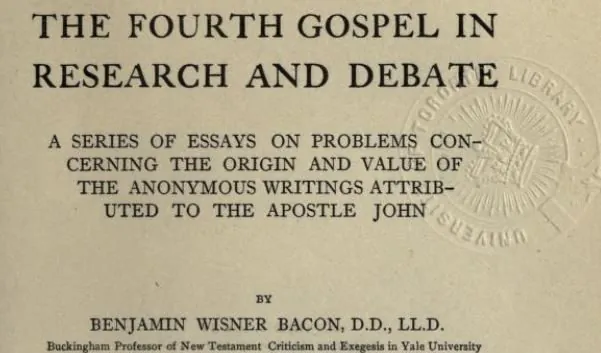
In Chapter I of The Fourth Gospel in Research and Debate (first published in 1910; second edition 1918, pp. 19–42), Yale New Testament critic Benjamin Wisner Bacon subjected the external patristic evidence—and the apologetic appeals of William Sanday and James Drummond—to a searching critique, drawing extensively on Edwin A. Abbott and Paul Wilhelm Schmiedel:3
The most thorough and scholarly treatment of the external evidence accessible to the English reader, from the point of view of those who repudiate the traditional authorship, is that of the veteran scholar Edwin A. Abbott of London, in §§83 to 107 of the article "Gospels" in the Encyclopaedia Biblica. Abbott discusses seriatim [in series] all the alleged traces of the influence of the Johannine writings upon Clement of Rome (ca. 96 A.D.), the Didache (80–110), Barnabas (132), Simon Magus (90–100), Ignatius (110–117), Polycarp (110–117), Papias (Harnack: 145–160, Abbott: 120–130), Epistle to Diognetus (Lightfoot: former part 117–147; latter part 180–210), Hermas (114–156), Basilides (117–138), Marcion (125–135), and Valentinus (141–156), and compares these with the use made at first of Matthew, or Matthew and Mark, later of Luke. He reaches the following conclusion:
"Up to the middle of the second century, though there are traces of Johannine thought and tradition, and immature approximations to the Johannine Logos-doctrine, yet in some writers (e.g., Barnabas and Simon) we find rather what John develops, or what John attacks, than anything that imitates John, and in others (e.g., Polycarp, Ignatius and Papias) mere war-cries of the time, or phrases of a Logos-doctrine still in flux, or apocalyptic traditions of which John gives a more spiritual and perhaps a truer version. There is nothing to prove, or even suggest, that 'John was recognized as a gospel.'"4
The relatively voluminous treatises of Justin Martyr (153–160 A.D.) form a class by themselves for all students of the external evidence. The surprising non-appearance of the Fourth Gospel among his recognized authorities, at least in a degree approximating his "more than one hundred" employments of the Synoptics, is one of the admitted difficulties of the supporters of tradition. Drummond, Character and Authorship, p. 100, counts "somewhere about 170 citations from or references to the Gospels." Among these, he probably includes what he regards as "three apparent quotations" from John.5 Drummond, for example, after accumulating all possible traces of the use of John, meets the question "Why has Justin not quoted the Fourth Gospel at least as often as the other three?" with certain analogies whose validity we must test hereafter. Abbott, on the other hand, meets the alleged traces of the Fourth Gospel in Justin with an analysis even more thorough than Drummond's, resulting in the following summary:
"It appears, then, that (1) when Justin seems to be alluding to John, he is really alluding to the Old Testament, or Barnabas, or some Christian tradition different from John, and often earlier than John; (2) when Justin teaches what is practically the doctrine of the Fourth Gospel, he supports it, not by what can easily be found in the Fourth, but by what can hardly, with any show of reason, be found in the Three; (3) as regards Logos-doctrine, his views are alien from John. These three distinct lines of evidence converge to the conclusion that Justin either did not know John, or, as is more probable, knew it, but regarded it with suspicion, partly because it contradicted Luke his favorite Gospel, partly because it was beginning to be freely used by his enemies the Valentinians. (4) It may also be fairly added that literary evidence may have weighed with him. He seldom or never quotes (as many early Christian writers do) from apocryphal works. The title he gives to the Gospels ('Memoirs of the Apostles') shows the value he set on what seemed to him the very words of Christ noted down by the apostles. Accepting the Apocalypse as the work of (Trypho 81) the Apostle John he may naturally have rejected the claim of the Gospel to proceed from the same author. This may account for a good many otherwise strange phenomena in Justin's writings. He could not help accepting much of the Johannine doctrine, but he expressed it, as far as possible, in non-Johannine language; and, where he could, he went back to earlier tradition for it, such as he found, for example, in the Epistle of Barnabas."6
As between the inferences drawn by "defenders" and by opponents of the Johannine Authorship only a careful study of the literature itself can enable us to judge. What we are now attempting to make clear is the common ground of agreement, the fact that in our day the debate concerns not date, but authorship; because the most radical opponent can easily afford to grant the utmost claims the conservative scholar is able to make from the external evidence as respects the mere "existence well before the end of the first century of a compact body of teaching like that which we find in the Fourth Gospel." An early example of this coincidence of radical and conservative in the mere matter of dating was furnished by Keim, as already shown. In our day Zahn, "the prince of conservative scholars," is still arguing for the date 80–90 A.D., for the work in its present form, while Wellhausen on purely internal grounds is arguing for substantially the same date, with the difference that for him, it only marks the beginnings of a literary process which culminated, through a series of supplementations and reconstructions, not earlier than 135 A.D., in our canonical Fourth Gospel. What Wellhausen thinks of the Johannine Authorship appears from his statement that Schwartz has "proved" the death of John the son of Zebedee along with James his brother in Jerusalem in 44 A.D.7
Schmiedel, in Professor Sanday's view, "understates the (external) evidence for the Fourth Gospel" prior to the year 180; but he esteems him a competent and sincere scholar, albeit "cold and severe," a "lawyer who pursues his adversary from point to point with relentless acumen." Professor Sanday is "not so sure as he (Schmiedel) is that there is no allusion to the Gospel in Barnabas or Hermas, where it is found (e.g.) by Keim, or in the Elders of Papias, where it is found (e.g.) by Harnack."8 But at least Schmiedel cannot be ruled out of court as unqualified to pronounce an opinion on the external evidence, and to understand what questions are, and what are not, now regarded as within its capacity, we must hear also the opinion of Schmiedel.
After emphasizing the "distinction between testimonies expressly favorable to the apostolic authorship, and those which only vouch for the existence of the Fourth Gospel, without conveying any judgment as to its authorship," Schmiedel protests against the heaping up of alleged testimonies of the latter class as if they belonged to the former, as follows:
"Most of the early Christian writings which were held (by apologists of the last generation) to bear testimony to the Fourth Gospel—and of these precisely the oldest and therefore most important—in reality do not justify the claim based upon them. (a) They show manifold agreements with Jn., but these consist only of single, more or less characteristic words or formulas, or other coincidences which might equally well have passed into currency by the channel of oral tradition. The great number of such agreements does in very deed prove that the Johannine formulas and catch-words were very widely diffused, and that the Johannine ideas had been, so to speak, for decennia in the air. We should run great danger of allowing ourselves to be misled, however, if, merely because it so happens that such phrases and turns of expression first became known and familiar to ourselves through the Fourth Gospel, we were at once to conclude that the writers in question can have taken them from that source alone. The true state of the case may very easily be quite the opposite; the words and phrases circulated orally; as they circulated they received an ever more pregnant, pointed, memorable form, and the writer of the Fourth Gospel, not as the first but as the last in the series of transmitters, set them down in a form and in a connection which excelled that of the others, and thus his work came to appear as if it were the source of the others."9
Examination of all these resemblances, and estimate of their bulk and importance as compared with the use made by the same early writers of the other gospels, and as compared with what on the traditional theory of authorship we might have reason to expect, leads Schmiedel to the following conclusion:
"If we were dealing with a book attributed to an undistinguished man, such as, for example, the Epistle of Jude, it could not be held to be very surprising that proofs of acquaintance with it do not emerge until some considerable time after its production. The case is very different, however, with a gospel written by an eyewitness. Papias noticed defects in the Gospel of Mark; the third evangelist noticed them in the writings of all his predecessors (cf. GOSPELS, §§65, 153). The writing of an eyewitness would immediately on its publication have been received with the keenest interest, however violently it may have conflicted with the gospels hitherto known. It would at least by these contradictions have attracted attention and necessarily have given occasion to such remarks as that 'the gospels seem to contradict one another' of Claudius Apollinaris (§§42 and 54b). No mention of the Fourth Gospel which we can recognize as such carries us back further than to 140 A.D. As late as 152 (Acad., 1st Feb., 1896, p. 98), Justin, who nevertheless lays so great stress upon the 'Memorabilia of the Apostles,' regards Jn.—if indeed he knows it at all—with distrust and appropriates from it but a very few sayings. Therefore, notwithstanding the fact that conservative theology still cherishes the belief that the external evidence supplies the best possible guarantee for the genuineness of the Fourth Gospel, we find ourselves compelled not only to recognize the justice of the remark of Reuss that 'the incredible trouble which has been taken to collect external evidences only serves to show that there really are none of the sort which were really wanted,'10 but also to set it up even as a fundamental principle of criticism that the production of the Fourth Gospel must be assigned to the shortest possible date before the time at which traces of acquaintance with it begin to appear. Distinct declarations as to its genuineness begin certainly not earlier than about 170 A.D. (§42)."
From the foregoing extracts summarizing the conclusions of representative scholars on both sides it will be apparent that the road to agreement does not lie along the line of heaping up more or less fanciful resemblances to Johannine thought or phraseology, from the period before the Gospel attains to its wide dissemination and authoritative standing about 170 A.D. Neither does it lie along the line of adding to the already abundant testimonies from the period of the half century of conflict following Tatian (170 A.D.), during which its ardent advocates were triumphantly overpowering the weak opposition offered at first to its claims at Rome. . . . Whether, then, we attribute the Gospel directly, or indirectly to John, or to some wholly different writer, what we seek today from the external evidence is not so much the Gospel's "date" in the old sense of the word; for on this the evidence we have is incapable of shedding more than a very limited amount of light. Today we inquire for its "formative period"; and the "formative period" of the Fourth Gospel has already been determined as closely as the data available, or likely to become available, admit. It is approximately the close of the first century and opening decades of the second. Proconsular Asia with the great headquarters of the Pauline mission field, Ephesus, as its metropolis, was the region in which the group of writings attributed to the Apostle John first came into circulation, in supplementation of the Epistles of Paul, and probably the Gospels of Matthew and Mark and the so-called First Epistle of Peter. In the threefold form of Gospel, Epistles, and Prophecy, or Apocalypse, these writings served the purpose of a canon of New Testament scripture to "the churches of Asia." The ancient tradition which assigns the origin of the "Johannine" writings to this region and this approximate date is therefore in substance correct.
Since, then, the modern form of the Johannine question is but slightly, if at all, a question of date or provenance, it is a primary condition of clear thinking as regards the external evidence that we distinguish between (1) evidences which bear on "the existence of a body of teaching like that which we find in the Fourth Gospel," evidences which for the period anterior to 181 A.D. consist of mere resemblances to its doctrine or phraseology, and (2) evidences which bear upon the question of authorship; these latter being either confined to the period of dissemination beginning with Tatian and Theophilus (170–180), or consisting of inferences to be drawn from the mode and measure of unacknowledged employment in the earlier time.
It is also vitally important to define our terminology and to use it consistently with the recognized practice of criticism, not classifying as "quotations" mere resemblances of thought or language, more or less remote, which may or may not be due to acquaintance with the Fourth Gospel. For mere resemblances of this kind we propose to employ the term "echo," or "influence," reserving the term "quotation" for instances where appeal is directly made to a definite writing so described as to be recognizable, and attributed to a particular author mentioned by name, or otherwise defined as the authority to whom appeal is made. . . . Professor Stanton, who alone of the "defenders" makes serious attempts to grapple with the objection from the neglect of John in the earliest period, considers that "the absence of any mention of the Apostle John is very strange only in the Epistles of Ignatius." Others might prefer to say "in Polycarp," considering how all the Johannine tradition is made to hang on the alleged relation between John and Polycarp. Still others might find the neglect of Papias harder to account for, seeing that Papias explicitly acknowledges the defective and secondary character of Synoptic tradition. In reality the phenomena are the same in all the writers of the early period, and the more the number is increased by the addition of remote and dubious echoes and influences from still other writers, the more serious becomes the problem. . . . Starting with Justin, whose one resemblance in employing Johannine phraseology to combine the deutero-Pauline doctrine of the "bath of regeneration" with the teaching of Jesus, makes us practically certain that he was really acquainted with the Fourth Gospel, we pass backward through Valentinus, Papias, Basilides, Polycarp, Ignatius, Hermas, to Barnabas, the Didache and Clement of Rome. In Papias as in Justin we have true "quotation" of Revelation, and probable use of First John, with a much disputed possibility, or probability, of employment of the Fourth Gospel. As to Basilides (133 A.D.) and Valentinus (150–160 A.D.) Sanday himself can go no further than to say, "There remains in my own mind a slight degree of probability that they used the Gospel." In Polycarp there is found one "battle-cry" from First John. In Ignatius a very few much disputed echoes and a diffused and equally disputed influence of the Gospel. In Hermas Stanton thinks he can detect traces, and Sanday is "not so sure" as Schmiedel that there are none. As to Barnabas his feeling is the same, although even the famous Oxford committee, who have certainly not erred in the direction of radicalism, "must regard Barnabas as unacquainted with the Fourth Gospel."11 He finds also in the eucharistic prayer of the Didache a resemblance in the phrase, "Remember, Lord, thy Church to deliver it from all evil and to perfect it in thy love" to 1 Jn. 4:17, 18; Jn. 17:23, which again, in spite of the silence of the Oxford Society's Committee, he thinks "cannot be wholly accidental." None of these really responsible "defenders" consents to follow the rash echo-chasers who wander up and down the disappointing pages of Clement of Rome.
Now in answer to these phenomena of steady decrease in the employment and recognition of the Fourth Gospel by those who might reasonably be supposed to know it, as we approach the date and region where its currency and authority should be at a maximum, it is not enough to utter general disparagements of "the argument from silence"; because the external evidence, from the moment we pass into the debated period, back of the time of express and undisputed quotations, becomes of necessity an "argument from silence." . . . We may use . . . the very passage of Drummond's book which Professor Sanday twice adduces as "perhaps the most important and the most far-reaching of all the corrections of current practice":
"But why, then, it may be asked, has Justin not quoted the Fourth Gospel at least as often as the other three? I cannot tell, any more than I can tell why he has never named the supposed authors of his Memoirs, or has mentioned only one of the parables, or made no reference to the Apostle Paul, or nowhere quoted the Apocalypse, though he believed it to be an apostolic and prophetical work. His silence may be due to pure accident, or the book may have seemed less adapted to his apologetic purposes; but considering how many things there are about which he is silent, we cannot admit that the argumentum a silentio possesses in this case any validity."12
Passing over the objection that it is not the silence of Justin alone, but of all his predecessors as well, which is in question, we confine ourselves to two points of the above comparison. . . . (1) In Justin's time, or even earlier, it was known that none of the Synoptic Gospels in their current form could be directly ascribed to apostolic authors. "Mark" and "Luke" were not names to conjure with; "Matthew's" could be applied only indirectly to the current Greek Gospel. In later times church fathers torment the ancient tradition in various ways to evade, or at least to minimize, the unwelcome admission. Instead of being indifferent to the apostolic authority of his Memoirs, Justin adopts just that form of description, "Memoirs of the apostles," "Memoirs called gospels, which were written by apostles and their companions," which enables him to make the maximum claim of apostolic authority, without directly doing violence to the tradition. These Memoirs he uses as authoritative, quoting and employing them, according to Drummond's own count, some 170 times. Is the mode and measure of his employment of these, then, really parallel to his treatment of the Fourth Gospel, which he has never referred to, and from which even Drummond can find but three "apparent quotations"?
(2) . . . First of all we are repeatedly informed that Justin "has nowhere quoted the Apocalypse." Here, as in the other cases, the whole argument depends upon the exact choice of terms. Drummond does not deny, he rather takes pains to assert, that Justin employs Rev. 20–21. He does not deny that Justin appeals to it by name as "a revelation." He admits that he refers to it as authoritative and names its author. It is the "prophecy" of "one of ourselves, John, an apostle of Christ" [Dialogue 81.4]. But all this in the case of Revelation is not sufficient to meet the high requirements of the term "quotation." That term Principal Drummond reserves for three correspondences with the Fourth Gospel, one of which as an admitted "echo" we have already discussed. It is the reference to baptism as typifying "regeneration," for Christ also said, "Unless ye be regenerated ye shall not enter into the kingdom of heaven" [1 Apology 61.4]. There is here no mention of John, no appeal to his authority, no reference to so much as the existence of a writing. Some even remain doubtful whether in the passage Justin was influenced at all by this Gospel. Such, however, is the first of Drummond's three "quotations."
The second "quotation" is not even a probable echo. It is only a possible influence. In his Dialogue (ch. lxxxviii [88.7]) Justin refers to the Baptist's testimony to Christ, using the Synoptic form, but with the peculiarity of employing the first person: "Even he himself cried, I am not the Christ, but a voice crying; for there shall come he who is stronger than I, whose sandals I am not worthy to take off." This might be due to unconscious reminiscence of Jn. 1:20, 23; but, as Edwin Abbott had already pointed out in the very article referred to by Drummond a few pages before, it may equally well be due to the influence of Acts 13:25: "And as John was fulfilling his course he said, What suppose ye that I am? I am not he, but there cometh one after me, the shoes of whose feet I am not worthy to unloose."
The third "quotation" is the furthest of all from deserving the name. Several pages are occupied with an elaborate effort to insert a Johannine foundation under Justin's language. In his First Apology [35.6] Justin maintains that there was a fulfilment of Isa. 58:2, "they now ask of me judgment," in the fact that the Jews "in mockery set him (Jesus) upon the judgment seat and said, 'Judge us.'" Such an incident is related nowhere in any of our four Gospels. But in a fragment found in 1892 [discovered 1886–1887, published 1892] of the Ev. Petri [Gospel of Peter 3.7], which in the same manner as Luke transfers the story of the mockery of Jesus to the account of "the Jews," it is related that "they arrayed him in purple, and set him on a throne of judgment, saying, Judge justly, O King of Israel." Drummond, however, will not admit that Justin can be referring to this, although it presents both points of correspondence with the Isaianic passage, viz., that it is "the Jews" who are guilty of the mockery, and that the nature of it was that they "asked of him judgment." Drummond still clings to the contention he had supported long before the discovery of Ev. Petri, that Justin's language can only be accounted for as a misunderstanding of the statement of Jn. 19:13 that Pilate led Jesus forth and sat down on the judgment seat. He gives instances to prove that the word "sat down" could be used transitively. Whence Justin derived the statement that the Jews said "Judge us" he does not explain. As regards this alleged "quotation" of the Fourth Gospel we will simply refer to another "defender" . . . Stanton's "defense," appearing but a few weeks before Drummond's, had given the following verdict on the alleged "quotation": "It has in the past been thought by some that Justin had come to imagine it through a misunderstanding or misremembering of Jn. 19:13. But any appearance of probability which this explanation may once have had has now been destroyed through our finding it again in 'Peter.'"13
Whether we follow or reject the acute, and to the present writer convincing, argument of Stanton that the true derivation of the "fulfillment" both in Ev. Petri and in Justin, is the Acts of Pilate, the judgment of Stanton on the fate of Drummond's argument is manifestly true. A comparison of Drummond's use of the word "quotation" as applied to Justin's use of the Gospel and Revelation respectively will enable the reader to form his own judgment. . . . It is indeed important that we distinguish mere "echoes" and "influences," such as make no reference to a recognizable document, and mention no author, from "quotations" which describe some recognizable written source, and appeal to the author by name as authority. In the former case it is equally important that we exercise the keenest, most impartial, most critical judgment as to the mode and measure of employment of the source. Such impartial verdicts, however, are not illustrated in the statement that Justin "has nowhere quoted the Apocalypse," but has three apparent "quotations" from the Fourth Gospel. (pp. 19–42)
Evaluating the Critical Dating Window (90–140 CE)
Across modern critical introductions, the outer chronological window for the Fourth Gospel's final composition and publication is routinely placed between c. 90 CE and c. 120–140 CE.14 Insisting on a pre-100 CE date presses the Gospel right against its earliest plausible terminus a quo, leaving minimal time for the circulation and assimilation of Mark and Luke, the multi-stage redactional history attested within the Johannine corpus itself (including the Johannine Epistles and the secondary addition of John 21), and the gradual emergence of the Gospel into wider second-century view. Placing final composition and publication in the opening decades of the second century (c. 100–120 CE) accommodates all three lines of evidence without strain.
Hellenistic Judaism, Ephesian Milieu, and Second-Century Proto-Gnostic Controversies
Church tradition associates the Johannine corpus with Ephesus in Roman Asia Minor—a cosmopolitan center where Diaspora Judaism, Greek civic institutions, imperial cultic propaganda, and Middle Platonic Logos speculation intersected. As Craig L. Blomberg notes in summarizing Sjef van Tilborg's monograph Reading John in Ephesus (1996), the Gospel's imagery and polemics resonate deeply with the civic and religious environment of Ephesus at the turn of the first and second centuries.15 At the same time, early twentieth-century scholars observed that the Fourth Gospel's simultaneous use of Hellenistic/Philonic Logos categories and engagement with incipient docetic or proto-Gnostic tendencies point past the apostolic era into the early second century.
Paul Wilhelm Schmiedel, The Johannine Writings (1908)
Others, who place the Gospel of Lk. (and so the Gospels of Mk. and Mt. also) earlier, think that, when this estimation is taken into consideration, the Gospel of John may have been composed as early as about the year 100. But here again we have to remember that the Gnosticism with which the Fourth Evangelist is familiar, and which he vigorously opposes, did not force its way into the Christian communities until about the year 100. We learn this from Hegesippus, who wrote his "memorials" about the year 180, and as he was of a great age was still able to afford correct information on the matter.16 John, on the other hand, already had to do with a more developed form of Gnosticism (p. 205). Only, he does not seem to be acquainted with the forms which appeared after about the year 140. (p. 192)
Henry Latimer Jackson, The Problem of the Fourth Gospel (1918)
There are two extreme positions. In the one case our Gospel has been definitely claimed for Gnosticism; in the other it is said to be characterized throughout by a pronounced antagonism to Gnostic modes of thought. The truth, however, does not appear to lie in either quarter, and it is far more reasonable to decide that, in some degree sympathetic, it also tells plainly of a discriminating mind. That it is not untinged by Gnostic influences might be admitted; its author has occasional resort to a terminology in use in Gnostic circles, he makes room for an 'intellectualism' of a certain kind, elements of dualism are perceptible in his conceptions, the idealized portrait of his Christ is suggestive of a Docetism from which he himself is not altogether free. On the other hand it must be as readily admitted that, by no means blind to momentous issues, he fastens on and repudiates errors detected by him in Gnostic doctrines which were making their appearance in his day. (p. 90)
Our Evangelist is no advanced Gnostic. As for his Gospel, it is not the work of one who, realizing the gravity of the situation, is constrained to grapple with and refute a Gnosticism which has arrived at the hey-day of its development. What might be allowed perhaps is that, not definitely hostile to Gnosticism in its earlier stages, he occasionally reveals a discriminating sympathy; yet it must be added that, alive to errors creeping in and already fraught with mischief, he is bold to speak his mind. That his Gospel is altogether strange to the Gnostic movement it is hard to believe. (p. 91)17
Wilbert Francis Howard, The Fourth Gospel in Recent Criticism and Interpretation (1931)
Summarizing Jean Réville's 1901 study Le quatrième Évangile (which dated John between 100 and 125 CE), Wilbert Francis Howard similarly underscored the philosophical character of the Prologue and discourses:18
The gospel itself must be interpreted in the light of the Prologue, and is seen to be steeped in the Philonic philosophy. There is a sense in which the Evangelist treats of historical data, but to accept his symbolic interpretation as though it were reliable history would be like treating Philo as a fresh historical source for our knowledge of Moses. (p. 99)
Additional Issues with Dating John Before 90 CE
1. Patristic Tradition and Internal Evidence Place John After Luke
Unbroken patristic testimony holds that the Fourth Gospel was the last of the four canonical Gospels to be composed. Irenaeus of Lyons (Adversus Haereses 3.1.1) places John's publication in Ephesus explicitly after Matthew, Mark, and Luke; the late second-century Muratorian Fragment (lines 2–34) designates Luke as the third book of the Gospel and John as the fourth; Clement of Alexandria (Hypotyposes, in Eusebius, Hist. eccl. 6.14.7) reports from the "primitive elders" that "last of all, John, perceiving that the external facts had been made plain in the Gospel, being urged by his friends and inspired by the Spirit, composed a spiritual Gospel"; and Origen (in Eusebius, Hist. eccl. 6.25.4–6) likewise affirms that John wrote "last of all."19 By the fourth century, the sequence Matthew, Mark, Luke, John had become standard across canonical lists—including Athanasius (Festal Letter 39, 367 CE), Gregory of Nazianzus, Amphilochius of Iconium, and Canon 60 appended to the Council of Laodicea—while occasional Western variations (such as Codex Bezae's Matthew, John, Luke, Mark or the North African Cheltenham/Mommsen List's Matthew, Mark, John, Luke, c. 360 CE) reflect grouping by apostolic rank rather than chronological order.20
This unanimous external testimony is corroborated by internal literary criticism: across at least eighteen narrative and Passion parallels—from Mary and Martha of Bethany and the foot-anointing to Annas, Pilate's triple declaration of innocence, the unlaid tomb, and the Jerusalem appearance—John presupposes and reshapes material distinctive to the Gospel of Luke (see Luke–John: Johannine Dependence on Luke). Because Luke is widely dated between 70 and 90 CE (or slightly earlier on Lukan-priority reconstructions, with subsequent circulation required across the Aegean), John's literary use of Luke militates strongly against dating the Fourth Gospel prior to c. 90 CE.21
2. Expulsion from the Synagogue (Aposynagōgos) and Post-70 Institutional Parting
Three times the Fourth Gospel employs the distinctive compound adjective ἀποσυνάγωγος ("put out of the synagogue")—coined specifically in Johannine Greek—to describe a settled policy of Jewish authorities expelling anyone who confesses Jesus as the Christ (John 9:22; 12:42; 16:2). As C. K. Barrett (1978, p. 127) and J. Louis Martyn (1968; 3rd ed. 2003) famously argued, such formalized synagogue exclusion is anachronistic during Jesus' Galilean and Jerusalemite ministry around 30 CE (and differs markedly from the ongoing synagogue participation depicted throughout Acts); Barrett and Martyn linked it to the formulation of the Birkat ha-Minim ("Benediction against Heretics") by Samuel the Small under Rabban Gamaliel II at Yavneh around 85–90 CE (b. Berakhot 28b–29a), treating c. 90 CE as a firm terminus post quem.22 Even though scholarship since Reuven Kimelman (1981) has demonstrated that the Yavnean Birkat ha-Minim did not instantly expel Christians from every Diaspora synagogue by central rabbinic fiat, scholars broadly agree that the bitter institutional rupture reflected in John 9:22, 12:42, and 16:2 presupposes post-70 CE synagogue consolidation—whether in the late first century or even further into the early second century.23
Additional Issues with Dating John Before 80 CE
Literary Mastery of the Gospel of Mark
Beyond its relationship to Luke, a broad critical consensus holds that the Fourth Evangelist knew the Gospel of Mark, had thoroughly absorbed its narrative sequence and phrasing (compare, for example, the rare πιστικῆς and three hundred denarii in Mark 14:3–5 // John 12:3–5, the two hundred denarii and grass in Mark 6:37–40 // John 6:7–10, and the walking on the sea immediately following the feeding of the five thousand in Mark 6:45–52 // John 6:16–21), and assumed that his audience already knew foundational Synoptic traditions (such as John the Baptist's imprisonment in John 3:24 or Andrew being Simon Peter's brother in John 1:40).24 As C. K. Barrett observed in fixing his lower boundary, since Mark is widely dated shortly before or soon after 70 CE, allowing realistic time for Mark to circulate to the Johannine community and be thoroughly studied pushes the composition of John past 80 CE, with "90 [CE] . . . perhaps a safer estimate."25
Refutation of Arguments for Dating John Before 70 CE
A small minority of twentieth-century scholars—most notably John A. T. Robinson in Redating the New Testament (1976)—attempted to date the Fourth Gospel prior to the Roman destruction of Jerusalem in 70 CE.26 Significantly, even conservative evangelical commentators who defend traditional Johannine authorship have rejected pre-70 CE arguments as unconvincing.
Craig L. Blomberg (2001) and the Grammatical Debate Over John 5:2
In The Historical Reliability of John's Gospel (2001, pp. 42–44), Craig L. Blomberg systematically evaluates the principal arguments advanced for a pre-70 CE date and finds each inconclusive:27
- Arguments from silence (omission of the Temple's fall in 70 CE, the Sadducees, the Lord's Prayer, etc.): Writing at the end of the first century (or in the early second century), an author twenty-five to forty years removed from 70 CE had no obligation to narrate the Roman siege explicitly—especially when John 11:48 ("the Romans will come and take away both our place [Temple] and our nation") already deploys unmistakable post-70 dramatic irony!
- Present-tense ἔστιν ("there is") in John 5:2: Pre-70 advocates frequently appeal to the present indicative verb in John 5:2 ("Now there is [ἔστιν] in Jerusalem by the Sheep Gate a pool, in Aramaic called Bethesda, which has five roofed colonnades"), citing Daniel B. Wallace's 1990 Biblica study arguing that John does not elsewhere use εἰμί as a narrative historical present.28 As Blomberg and other grammarians point out, however, historical presents naturally cluster in verbs of speech and motion rather than stative verbs; moreover, rock-cut cisterns and pools did not vanish in 70 CE, post-70 authors (such as Josephus and the author of Hebrews) routinely use topographical and liturgical present tenses when describing pre-70 Jerusalem, and retention of a pre-70 source note would tell us nothing about the date of the finished Gospel.
- Palestinian topographical knowledge and archaic Christological motifs: Even where the Evangelist preserves genuine pre-70 Palestinian traditions or memories, accurate geographical recollection (or reliance on an earlier Signs/Passion tradition) cannot establish when the final Greek Gospel was composed and edited.
Blomberg summarizes why even conservative scholarship declines to follow pre-70 proposals:
It is an attractive apologetic for conservative scholars to opt for an earlier date, but the evidence is not nearly strong enough to do so with any confidence. . . . It may be, too, that the finished Gospel of John has a late date but that its underlying sources take us back to a much earlier time. (p. 44)29
Notes
- Compare Werner Georg Kümmel, Introduction to the New Testament, rev. ed., trans. Howard Clark Kee (Nashville: Abingdon Press, 1975), pp. 246–247; C. K. Barrett, The Gospel According to St. John, 2nd ed. (Philadelphia: Westminster Press, 1978), pp. 127–128; Andrew T. Lincoln, The Gospel According to Saint John, BNTC (London: Continuum, 2005), pp. 17–26, 89–92; and Urban C. von Wahlde, The Gospel and Letters of John, 3 vols. (Grand Rapids: Eerdmans, 2010), 1:50–55. ↩
- For the classic critical case that second-century orthodox caution toward the Fourth Gospel reflects its comparatively late emergence and early Gnostic popularity, see J. N. Sanders, The Fourth Gospel in the Early Church: Its Origin and Influence on Christian Theology up to Irenaeus (Cambridge: Cambridge University Press, 1943), and T. E. Pollard, Johannine Christology and the Early Church, SNTSMS 13 (Cambridge: Cambridge University Press, 1970), pp. 23–45. For a vigorous defense of wider second-century proto-orthodox use prior to Irenaeus, see Charles E. Hill, The Johannine Corpus in the Early Church (Oxford: Oxford University Press, 2004); for critical engagement with Hill's maximalist criteria for identifying literary dependence, compare Titus Nagel, Die Rezeption des Johannesevangeliums im 2. Jahrhundert, ABG 2 (Leipzig: Evangelische Verlagsanstalt, 2000), and Andrew F. Gregory and Christopher M. Tuckett, eds., The Reception of the New Testament in the Apostolic Fathers (Oxford: Oxford University Press, 2005). ↩
- Benjamin Wisner Bacon, The Fourth Gospel in Research and Debate: A Series of Essays on Problems Concerning the Origin and Value of the Anonymous Writings Attributed to the Apostle John (New York: Moffat, Yard & Co., 1910; 2nd ed. New Haven: Yale University Press, 1918), pp. 19–42. ↩
- Edwin A. Abbott, "Gospels," in Encyclopaedia Biblica, ed. T. K. Cheyne and J. Sutherland Black, Vol. 2 (London: Adam and Charles Black; New York: Macmillan, 1901), §104, col. 1836 (reviewing §§83–107, cols. 1809–1837). ↩
- James Drummond, An Inquiry into the Character and Authorship of the Fourth Gospel (London: Williams & Norgate, 1903), p. 100. ↩
- Abbott, "Gospels," in Encyclopaedia Biblica, Vol. 2 (1901), §107, col. 1837 (see also Justin Martyr Favored Luke over John). ↩
- Bacon refers respectively to Theodor Keim, Geschichte Jesu von Nazara, Vol. 1 (Zurich: Orell, Füssli & Co., 1867), pp. 146–172; Theodor Zahn, Einleitung in das Neue Testament, Vol. 2 (Leipzig: Deichert, 1899); Julius Wellhausen, Das Evangelium Johannis (Berlin: Georg Reimer, 1908); and Eduard Schwartz, Über den Tod der Söhne Zebedaei: Ein Beitrag zur Geschichte des Johannesevangeliums, Abhandlungen der Königlichen Gesellschaft der Wissenschaften zu Göttingen, Phil.-hist. Klasse, n.F. 7/5 (Berlin: Weidmann, 1904), together with Schwartz's "Aporien im vierten Evangelium," Nachrichten von der Königlichen Gesellschaft der Wissenschaften zu Göttingen (1907): 342–372; (1908): 115–148, 149–188, 497–560. ↩
- William Sanday, The Criticism of the Fourth Gospel (Oxford: Clarendon Press, 1905), pp. 194–205, 240. ↩
- Paul Wilhelm Schmiedel, "John, Son of Zebedee," in Encyclopaedia Biblica, ed. T. K. Cheyne and J. Sutherland Black, Vol. 2 (London: Adam and Charles Black, 1901), §45, col. 2544; the immediately following quotation is from §49, cols. 2547–2548. ↩
- Quoting Eduard Reuss, Histoire de la théologie chrétienne au siècle apostolique, 3rd ed., 2 vols. (Strasbourg: Treuttel et Wurtz, 1864), 2:392; on Claudius Apollinaris of Hierapolis (c. 170 CE), see Chronicon Paschale (PG 92:80–81). ↩
- Vincent Henry Stanton, The Gospels as Historical Documents, Part I: The Early Use of the Gospels (Cambridge: Cambridge University Press, 1903), p. 20; Sanday, Criticism of the Fourth Gospel, pp. 199–202; and Oxford Society of Historical Theology, The New Testament in the Apostolic Fathers (Oxford: Clarendon Press, 1905), p. 16 (classifying alleged traces of John in Barnabas as unconvincing). ↩
- Drummond, Inquiry into the Character and Authorship of the Fourth Gospel, pp. 157–158, quoted in Sanday, Criticism of the Fourth Gospel, p. 33 (and p. 240). ↩
- Stanton, Gospels as Historical Documents, Part I (1903), p. 102, comparing Justin Martyr, 1 Apology 35.6, with the Akhmim fragment of the Gospel of Peter 3.7 (first published by Urbain Bouriant in 1892). ↩
- See Barrett, Gospel According to St. John, 2nd ed., pp. 127–128 (outer limits of 90–140 CE); Kümmel, Introduction to the New Testament, pp. 246–247 (90–100 CE); Lincoln, Gospel According to Saint John, pp. 18, 89–92 (90–110 CE); and Bart D. Ehrman, The New Testament: A Historical Introduction to the Early Christian Writings, 7th ed. (New York: Oxford University Press, 2020), pp. 188–190 (90–95 CE, following multi-stage composition). ↩
- Sjef van Tilborg, Reading John in Ephesus, Supplements to Novum Testamentum 83 (Leiden: E. J. Brill, 1996); summarized in Craig L. Blomberg, The Historical Reliability of John's Gospel: Issues & Commentary (Downers Grove, IL: InterVarsity Press, 2001), p. 41. ↩
- Paul Wilhelm Schmiedel, The Johannine Writings, trans. Maurice A. Canney (London: Adam and Charles Black, 1908), p. 192; on Hegesippus's Hypomnēmata ("Memorials"), see Eusebius, Historia ecclesiastica 3.32.7–8 and 4.22.4–6. ↩
- Henry Latimer Jackson, The Problem of the Fourth Gospel (Cambridge: Cambridge University Press, 1918), pp. 90–91. ↩
- Wilbert Francis Howard, The Fourth Gospel in Recent Criticism and Interpretation (London: Epworth Press, 1931; 4th ed. rev. C. K. Barrett, 1955; repr. Eugene, OR: Wipf & Stock, 2009), p. 99, summarizing Jean Réville, Le quatrième Évangile, son origine et sa valeur historique (Paris: Ernest Leroux, 1901). (Earlier drafts of this page inadvertently attached this sentence of Howard to the preceding excerpt from Jackson.) ↩
- Irenaeus, Adversus Haereses 3.1.1 (= Eusebius, Hist. eccl. 5.8.4); Muratorian Fragment, lines 2–34; Clement of Alexandria, Hypotyposes, in Eusebius, Hist. eccl. 6.14.5–7; and Origen, Commentary on Matthew Book 1, in Eusebius, Hist. eccl. 6.25.4–6. Compare also Eugène Jacquier, History of the Books of the New Testament, Vol. 2: The Synoptic Gospels, trans. J. Duggan (London: Kegan Paul, Trench, Trübner & Co., 1907), pp. 8–12. ↩
- See Athanasius, Festal Letter 39 (367 CE); Gregory of Nazianzus, Carmina Dogmatica 1.12.5 (PG 37:474); Amphilochius of Iconium, Iambi ad Seleucum, lines 289–295; and Council of Laodicea, Canon 60 (often regarded as an early canonical appendix to Canon 59). On the Cheltenham List (Mommsen Catalogue, c. 360 CE, which orders the Gospels Matthew, Mark, John, Luke) and Western manuscripts placing John second after Matthew, see Bruce M. Metzger, The Canon of the New Testament: Its Origin, Development, and Significance (Oxford: Clarendon Press, 1987), pp. 210–214, 231–232, 296–297. ↩
- See John A. Bailey, The Traditions Common to the Gospels of Luke and John, NovTSup 7 (Leiden: E. J. Brill, 1963); Andrew Gregory, "The Third Gospel and the Fourth Gospel: Conservative Rearguard or Radical Vanguard?" in John and the Synoptics; and Keith L. Yoder, "John's Use of Luke's Passion Narrative," Novum Testamentum 64, no. 2 (2022): 184–209. ↩
- Barrett, Gospel According to St. John, 2nd ed., p. 127; J. Louis Martyn, History and Theology in the Fourth Gospel, 3rd ed. (Louisville: Westminster John Knox Press, 2003 [1st ed. 1968]), pp. 46–66; cf. b. Berakhot 28b–29a. ↩
- See Reuven Kimelman, "Birkat Ha-Minim and the Lack of Evidence for an Anti-Christian Jewish Prayer in Late Antiquity," in Jewish and Christian Self-Definition, Vol. 2, ed. E. P. Sanders, A. I. Baumgarten, and Alan Mendelson (Philadelphia: Fortress Press, 1981), pp. 226–244; Steven T. Katz, "Issues in the Separation of Judaism and Christianity after 70 C.E.: A Reconsideration," Journal of Biblical Literature 103, no. 1 (1984): 43–76; Ruth Langer, Cursing the Christians? A History of the Birkat HaMinim (Oxford: Oxford University Press, 2012), pp. 16–39; and Jonathan Bernier, Aposynagōgos and the Historical Jesus in John: Rethinking the Historicity of the Johannine Expulsion Passages, BibInt 122 (Leiden: Brill, 2013) (engaged critically by Jörg Frey and Adele Reinhartz, Befriending the Beloved Disciple [New York: Continuum, 2001], pp. 37–53). ↩
- See Barrett, Gospel According to St. John, 2nd ed., pp. 42–54, 127; Wendy E. Sproston North, A Journey Round John: Tradition, Interpretation and Context in the Fourth Gospel, LNTS 534 (London: Bloomsbury T&T Clark, 2015); and Eve-Marie Becker, Helen K. Bond, and Catrin H. Williams, eds., John's Transformation of Mark (London: T&T Clark, 2021). ↩
- Barrett, Gospel According to St. John, 2nd ed., p. 127. ↩
- John A. T. Robinson, Redating the New Testament (London: SCM Press; Philadelphia: Westminster Press, 1976), pp. 254–311; cf. Robinson, The Priority of John, ed. J. F. Coakley (London: SCM Press, 1985), pp. 36–92. ↩
- Craig L. Blomberg, The Historical Reliability of John's Gospel: Issues & Commentary (Downers Grove, IL: InterVarsity Press, 2001), pp. 42–44 (favoring a date in the late 80s or 90s CE over pre-70 proposals). ↩
- Daniel B. Wallace, "John 5,2 and the Date of the Fourth Gospel," Biblica 71, no. 2 (1990): 177–205 (esp. pp. 197–205); cf. Daniel B. Wallace, Greek Grammar Beyond the Basics: An Exegetical Syntax of the New Testament (Grand Rapids: Zondervan, 1996), p. 531 n. 47. Against taking ἔστιν in John 5:2 as proof of pre-70 composition, see Barrett, Gospel According to St. John, 2nd ed., p. 251; Raymond E. Brown, The Gospel According to John (I–XII), AB 29 (Garden City, NY: Doubleday, 1966), p. 206; and Lincoln, Gospel According to Saint John, p. 193 (noting archaeological continuity of the Bethesda twin pools after 70 CE). ↩
- Blomberg, Historical Reliability of John's Gospel, p. 44. ↩