Lukan Priority
Proto-Luke and Lukan Priority
What Is Proto-Luke?
Even at the height of twentieth-century support for Markan priority, several leading source critics recognized that large stretches of the Third Gospel—including its central narrative and Passion account—could not plausibly be derived from the Gospel of Mark. To account for this non-Markan backbone, scholars proposed the Proto-Luke hypothesis: the view that canonical Luke rests primarily upon an earlier, continuous Gospel narrative that existed independently of Mark and preserved traditions at least as primitive as anything in Mark.
Once the strength of that non-Markan Lukan framework is appreciated, a crucial question follows: if Proto-Luke already formed a coherent Gospel narrative extending through the Passion and Resurrection, and if the supposed traces of Markan influence in those chapters prove minimal or reversible, does Markan priority retain any real explanatory necessity over Lukan priority?
Streeter Endorses the Concept of Proto-Luke
In 1924, Burnett Hillman Streeter published The Four Gospels: A Study of Origins, Treating of the Manuscript Tradition, Sources, Authorship, & Dates (London: Macmillan and Co., 1924; 4th rev. impr., 1930, repr. 1936), the work that consolidated English-language support for Markan priority and the hypothetical sayings source Q. Expanding the standard Two-Document model into a Four-Document Hypothesis, Streeter proposed that Matthew and Luke also drew upon special sources (“M” and “L”). Crucially, however, Streeter argued that Luke did not weave scattered Q and L fragments into a Markan outline; rather, Q and L had already been combined into a substantial written Gospel—Proto-Luke—which served as Luke’s foundational framework:
I desire to interpolate a stage between Q and the editor of the Third Gospel. I conceive that what this editor had before him was, not Q in its original form … but Q + L, that is, Q embodied in a larger document, a kind of “Gospel” in fact, which I will call Proto-Luke. (B. H. Streeter, The Four Gospels: A Study of Origins [London: Macmillan and Co., 1924; 2nd impr. 1925], p. 208)
Although Streeter retained Markan priority in principle, he repeatedly observed that wherever Luke’s non-Markan narrative overlapped with Markan episodes, Luke preferred his non-Markan source over Mark:
A further reason for supposing that Luke found the Q and the L elements in the non-Marcan sections already combined into a single written source is to be derived from a consideration of the way in which he deals with incidents or sayings in Mark, which he rejects in favour of other versions contained either in the Q or the L elements of that source. (Streeter, The Four Gospels, p. 209)
Summarizing Luke’s consistent preference for this independent narrative—both in wording and in event sequence—Streeter concluded that Proto-Luke constituted a complete Gospel larger than Mark itself:
It would look, then, as if Luke tends to prefer the non-Marcan to the Marcan version, and this whether it be the longer or the shorter, and whether it belongs to that element in the source which we can further analyse as being ultimately derived from Q or from the element which we call L. But such a preference, especially where it is a preference in regard to the order of events, is much more explicable if Q and L were already combined into a single document. For the two combined together would make a book distinctly longer than Mark, and would form a complete Gospel. Such a work might well seem to Luke a more important and valuable authority than Mark. But this would not be true of either Q or L in separation. The conclusion, then, that Q + L lay before the author of the Third Gospel as a single document, and that he regarded this as his principal source, appears to be inevitable. (Streeter, The Four Gospels, pp. 211–212)
Streeter characterized Proto-Luke as a “scientific hypothesis” open to empirical verification that had already won the support of “not a few” New Testament scholars (p. 218; compare the quantitative analysis in Statistical Validation of Lukan Priority). In mid-twentieth-century German scholarship, both Friedrich Rehkopf (Die lukanische Sonderquelle: Ihr Umfang und Sprachgebrauch, WUNT 5 [Tübingen: J. C. B. Mohr (Paul Siebeck), 1959]) and Joachim Jeremias (The Eucharistic Words of Jesus, trans. Norman Perrin [London: SCM Press, 1966]) likewise defended a continuous pre-Markan Lukan Passion and narrative source (see Georg Strecker, History of New Testament Literature, trans. Calvin E. Roetzel [Harrisburg, PA: Trinity Press International, 1997], p. 117). Other scholars—beginning with William Lockton (“The Origin of the Gospels,” Church Quarterly Review 94 [July 1922]: 216–239) and continuing with Robert Lisle Lindsey and the Jerusalem School—went one step further by dispensing with Markan priority altogether and recognizing Luke (or Proto-Luke) as prior to both Mark and Matthew (see Lukan Priority and the Jerusalem School).
Regarding authorship, Streeter argued that Paul’s companion Luke the physician compiled Proto-Luke during Paul’s Caesarean imprisonment (ca. AD 57–59) and later expanded his own work into canonical Luke and Acts:
I suggest that the author of Proto-Luke—the person, I mean, who combined together in one document Q and the bulk of the material peculiar to the Third Gospel—was no other than Luke the companion of Paul. And I suggest that this same Luke some years afterwards expanded his own early work by prefixing the stories of the Infancy and by inserting extracts from Mark—no doubt at the same time making certain minor alterations and additions. For reasons summarised in the last chapter of this volume, I hold that the author of the Third Gospel and the Acts was Luke the companion of Paul, who kept the diary which forms the basis of the so-called “we sections” or “travel document” in the latter part of Acts. (Streeter, The Four Gospels, p. 218)
Streeter emphasized that the literary outlook, ethos, and stylistic unity across Proto-Luke, the final Gospel, and the “we-sections” of Acts remained “exactly the same throughout” (p. 219):
Again, there is throughout the Lucan writings an atmosphere of extraordinary tenderness, somehow made quite compatible with the sternest call to righteousness, sacrifice, and effort—an atmosphere which can be felt rather than demonstrated—and finding expression in a unique sympathy for the poor, for women, for sinners, and for all whom men despise. But this attitude can be felt equally in the Infancy stories, in Proto-Luke, and in the Acts; it is also what determines many of those omissions from Mark which can only be due to the final editor of the Gospel … a subtle individuality which reflects, not a Church tradition, but a personality of a very exceptional kind. (Streeter, The Four Gospels, p. 221)
Whether or not one accepted Lukan self-redaction, Streeter insisted that “the historical importance of the identification of a source of the Third Gospel entirely independent of Mark is obvious” (p. 221) and concluded that “far more weight will have to be given by the historian in the future to the Third Gospel, and in particular to those portions of it which are peculiar to itself” (p. 222).
Streeter’s Further Admission of Lukan Priority
In the Preface to the Fourth Impression of The Four Gospels (1930; repr. 1936, pp. xv–xx), Streeter reinforced the Proto-Luke hypothesis by pointing to four Lukan narratives—the Call of Peter (Luke 5:1–11), the Anointing of Jesus (Luke 7:36–50), the Great Commandment (Luke 10:25–28), and the Last Supper (Luke 22:14–27)—each of which unites motifs that appear scattered across unrelated episodes in Mark, and does so without any plausible editorial motive for recombining Mark:
In oral tradition it is very easy for details which properly belong to one story to get connected with another. In the passages I am about to quote, it will be noticed that the Lucan account combines details from events which in Mark are quite separate in a way most naturally explicable on this hypothesis. They are not equally explicable as arbitrary recombinations by Luke of material in Mark; for there is no obvious motive for the rearrangement, as there is for the bringing together by Matthew (and to a less extent by Luke) of sayings of Christ which deal with the same topics.
(1) Luke’s account of the Call of Peter (Luke 5:1 ff., cf. Mk. 1:16 ff.) embodies the incident of Christ teaching from a boat, which in Mark 4:1 is the occasion of the Parable of the Sower, and which Luke omits when he reproduces that parable at the same point as in Mark’s narrative. It also includes an account of a miraculous draught of fishes, similar to that in John 21, along with a protest by Peter, “Depart from me, for I am a sinful man.”
(2) In Luke’s version of the Anointing (Luke 7:36 ff., cf. Mk. 14:3 ff.) there is included a pronouncement by our Lord of forgiveness, which evokes from His opponents the protest, “Who is this that forgives sins?” which Mark connects with the healing of the paralytic (Mk. 2:5 ff.). There is also included—though this is less significant—the saying which occurs elsewhere in Mark: “Thy faith hath saved thee, go in peace” (in Mk. 5:34 addressed to the woman with an issue of blood)—though the Greek word used for “go” is not the same. The words, “Go, thy faith hath saved,” occur also (addressed to Bartimaeus), Mk. 10:52.
(3) Luke’s account of the Great Commandment (Luke 10:25 ff.) would seem to be derived from a tradition independent of Mark 12:28 ff., in that the formulation of the summary, “Thou shalt love the Lord thy God … and thy neighbour as thyself,” is made by the lawyer and approved by Christ, not vice versa. The point, however, to which I would call attention is that it is introduced not, as in Mark, by the question, “What commandment is the first of all?” but by the question, “What shall I do to inherit eternal life?” which occurs in Mark, but in connection with a different incident (cf. Mk. 10:17).
(4) Luke’s account of the Last Supper—if, with WH [Westcott and Hort], we accept the shorter text in Lk. 22:19–20—reflects a tradition (found also in the Didache) which reverses the order of the Bread and the Cup. … Luke also appends to his account of the Last Supper a saying (about the Kings of the Gentiles and the greater acting as servant) which in substance corresponds to the reply given by Christ in Mark’s story of the ambitious request of James and John (Mk. 10:42 ff.)—an incident which Luke omits. Where actual sayings of Christ are concerned, Luke usually reproduces fairly closely the wording of Mark; hence, the verbal differences being here very great, it is more probable that his version in this case comes from another source than that it is a rewriting of that in Mark.
… Luke’s general preference of his non-Marcan source, both as regards context and version, as well as the considerable omissions which he makes from Mark, are more readily explicable if all (or practically all) of his non-Marcan material stood in a single work, which in that case would be so substantial that he would naturally regard it as an authority of equal or greater value than Mark. … Proto-Luke was the document with which he started, and which he preferred to Mark where they differed. For that reason I have styled Proto-Luke his “primary,” Mark his “secondary” source. (B. H. Streeter, The Four Gospels: A Study of Origins, 4th rev. impr. [London: Macmillan and Co., 1930; repr. 1936], pp. xv–xx)
Streeter’s Attribution of Various Passages
In assigning Lukan chapters and Passion verses to their respective sources (The Four Gospels, pp. 222–223), Streeter attributed the vast body of Luke 3–24 to Proto-Luke while isolating only a tiny fraction of verses in Luke 22–24 as putative insertions from Mark:
- Passages assigned by Streeter to Proto-Luke (pp. 222–223): Luke 3:1–4:30; Luke 5:1–11; Luke 6:14–16; Luke 6:20–8:3; Luke 9:51–18:14; Luke 19:1–27; Luke 19:37–44; Luke 21:18, 34–36; and Luke 22:14 through the end of Luke 24 (apart from the isolated verses listed below).
- Passion and Resurrection verses attributed by Streeter to Mark (p. 222):
- Luke 22:18 (cf. Mark 14:25)
- Luke 22:22 (cf. Mark 14:21)
- Luke 22:42 (cf. Mark 14:36)
- Luke 22:46–47 (cf. Mark 14:37–38)
- Luke 22:52–62* (cf. Mark 14:46–52, 66–72; v. 62 flagged as a probable textual assimilation)
- Luke 22:71 (cf. Mark 14:63–64)
- Luke 23:3 (cf. Mark 15:2)
- Luke 23:22 (cf. Mark 15:12–15)
- Luke 23:25–26 (cf. Mark 15:7, 15)
- Luke 23:33–34b (cf. Mark 15:22–24, 27)
- Luke 23:38 (cf. Mark 15:26)
- Luke 23:44–46 (cf. Mark 15:33–37)
- Luke 23:52–53 (cf. Mark 15:43)
- Luke 24:6* (v. 6a flagged as a probable Western non-interpolation)
- Verses regarded as uncertain—either derived from Mark or representing Proto-Luke partially assimilated to Mark (pp. 222–223): Luke 22:69; Luke 23:35, 49, 51; Luke 24:1–3, 9–10*.
- Text-critical note (*): In his footnotes on p. 222, Streeter observed that Luke 22:62 is omitted in Old Latin witnesses as an assimilation to Matthew 26:75, and that Luke 24:6a and Luke 24:9 (or 24:12) are Western non-interpolations omitted in Codex Bezae (D) and the Old Latin, remarking: “It is notable that all three omissions reduce the extent of Luke’s debt to Mark” (Streeter, The Four Gospels, p. 222 n. 1).
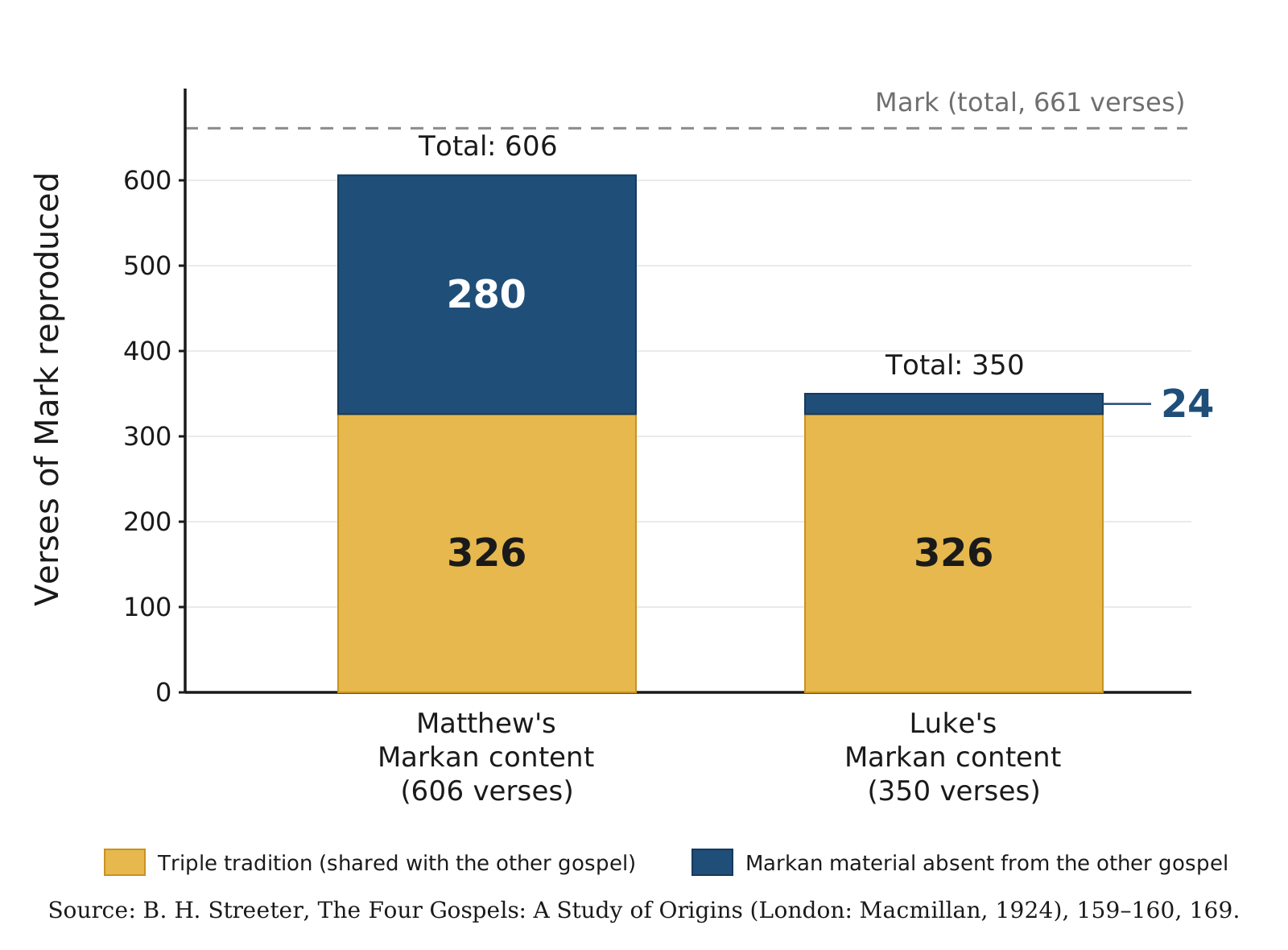
This breakdown exposes how slender the thread of Lukan dependence on Mark becomes even within Streeter’s own system. Across the entire Gospel of Mark (661 verses), Matthew reproduces roughly 606 verses (326 Triple Tradition verses plus 280 verses shared exclusively with Mark), whereas Luke parallels only about 350 verses—just 24 of which fall outside the Triple Tradition—and within the entire Passion and Resurrection narrative Streeter could point to barely two dozen verses of alleged Markan borrowing (compare also the progressive narrative expansion documented in Progressive Embellishment, Luke→Mark→Matthew).
Even in the handful of Passion verses that Streeter assigned to Mark, philological analysis conducted by Jerusalem School scholars Joshua N. Tilton and David N. Bivin (“LOY Excursus: Catalog of Markan Stereotypes and Possible Markan Pick-ups,” Jerusalem Perspective, jerusalemperspective.com/13743/) points in the opposite direction—showing Mark borrowing characteristic Lukan and Acts idioms from non-parallel contexts and inserting them into his Passion narrative:
Mark 14:21 ← Luke 17:1–2
In Luke 22:22, Jesus pronounces a restrained woe upon his betrayer without adding an “it would be better for that man if he had not been born” clause. Mark 14:21 appends that expansion, echoing the pairing of a “woe” saying with an “it would be better for him” construction found in Luke 17:1–2 and matching Mark’s broader fondness for multiplying “it is better” formulas (cf. Mark 9:42, 43, 45, 47). Rather than Luke truncating Mark 14:21, Mark expanded Luke 22:22 using phrasing drawn from earlier Lukan teaching.
Mark 14:46 ← Luke 21:12 + Acts 4:3; 5:18; 12:1; 21:27
Luke repeatedly describes authorities arresting Jesus’ followers with the idiomatic expression “to lay hands on” (ἐπιβάλλειν τὰς χεῖρας: Luke 21:12; Acts 4:3; 5:18; 12:1; 21:27; cf. Luke 20:19), yet omits that phrase in his own account of Jesus’ arrest in Luke 22:54. Mark 14:46, however, introduces “they laid hands on him” at Jesus’ arrest—an unmistakable pickup of characteristic Lukan-Acts arrest terminology (Tilton and Bivin, 2023; see Mark Borrows from Luke-Acts).
Mark 14:68 ← Acts 19:15
The Greek verb ἐπίστασθαι (“to know, understand”) is a distinctly Lukan-Acts word: it appears nine times in Acts (Acts 10:28; 15:7; 18:25; 19:15, 25; 20:18; 22:19; 24:10; 26:26) out of only fourteen occurrences in the entire New Testament, and nowhere else in the Gospels outside Mark 14:68. In Peter’s denial, both Luke 22:57 and Matthew 26:70 agree against Mark in using the ordinary verb οἶδα without ἐπίστασθαι, whereas Mark 14:68 compounds both verbs (“I neither know [οἶδα] nor understand [ἐπίσταμαι] what you mean”). As Tilton and Bivin note, Mark’s pleonastic pairing reflects characteristic Markan amplification drawing upon Lukan vocabulary (cf. Acts 19:15).
Once these alleged Markan insertions in Luke 22–24 turn out instead to be Markan adaptations of Lukan material, the rationale for splitting canonical Luke into an pre-Markan “Proto-Luke” plus secondary Markan patches disappears. Luke (or Proto-Luke) stands directly prior to Mark, yielding the linear sequence Luke → Mark → Matthew. As William R. Farmer concluded after surveying the nineteenth- and twentieth-century rise of the Markan-priority consensus in The Synoptic Problem: A Critical Analysis (New York: Macmillan, 1964):
The only sound historical judgment that can be rendered in a critical review of the history of the Synoptic Problem is that “extra-scientific” or “nonscientific” factors exercised a deep influence in the development of a fundamentally misleading and false consensus. (William R. Farmer, The Synoptic Problem: A Critical Analysis [New York: Macmillan, 1964], p. 190)
Modern Embodiments of Lukan Priority Include Proto-Luke
Streeter was neither the first nor the last twentieth-century scholar to argue that the substance of Luke rested on an early non-Markan Gospel. Twelve years before Streeter, Eric Rede Buckley had already proposed an early unified source behind Luke’s special and double-tradition material (An Introduction to the Synoptic Problem [London: Edward Arnold, 1912], acknowledged by Streeter, The Four Gospels, p. 201 n. 1). Two years after Streeter, Vincent Taylor devoted an entire monograph—Behind the Third Gospel: A Study of the Proto-Luke Hypothesis (Oxford: Clarendon Press, 1926)—to demonstrating through detailed verbal statistics and structural analysis that Luke’s Passion and central narrative existed as a coherent written Gospel around AD 60–65 prior to any use of Mark. Nearly half a century later, in his posthumously published The Passion Narrative of St Luke: A Critical and Historical Investigation, ed. Owen E. Evans, SNTSMS 19 (Cambridge: Cambridge University Press, 1972, p. 3), Taylor noted that major German critics—including Paul Feine, G. H. Müller, Bernhard Weiss, Johannes Weiss, Paul Ewald, Julius Wellhausen, Adolf Jülicher, Karl Ludwig Schmidt, and Rudolf Bultmann—had likewise recognized substantial non-Markan Passion or narrative sources underlying Luke.
While Buckley, Streeter, and Taylor stopped just short of abandoning Markan priority, their contemporary William Lockton carried the same observations to their logical conclusion: if the foundational Lukan narrative predates Mark, then the Synoptic Gospels were written in the sequence Luke → Mark → Matthew, and “it could be illustrated over and over again that the development of thought is to be found in this sequence” (William Lockton, “The Origin of the Gospels,” Church Quarterly Review 94 [July 1922]: 222). As summarized in Robert K. MacEwen’s survey of modern Matthean-posteriority scholarship (Matthean Posteriority: An Exploration of Matthew’s Use of Mark and Luke as a Solution to the Synoptic Problem, LNTS 501 [London: Bloomsbury T&T Clark, 2015], pp. 6–8), Lockton advanced several enduring arguments for placing Luke first and Matthew last:
- Narrative and doctrinal differences across parallel episodes consistently develop along the trajectory Luke → Mark → Matthew (Lockton, “The Origin of the Gospels,” CQR 94 [1922]: 222; The Three Traditions in the Gospels [London: Longmans, Green, 1926], pp. 3–4, 32–37).
- Matthew displays the most topical, liturgical, and artificially symmetrized arrangement of the three Synoptic Gospels (Lockton, The Three Traditions in the Gospels, pp. 3–4, 32–37).
- The shared vocabulary of the double tradition is markedly more characteristic of Lukan style than of Matthean style, indicating that Matthew drew directly upon Luke rather than a lost Q document (Lockton, “The Origin of the Gospels,” CQR 94 [1922]: 222; cf. MacEwen 2015, p. 7).
Lockton’s 1920s studies thus bridged the Proto-Luke tradition and full Lukan priority, anticipating the linguistic and statistical demonstrations later developed by Robert Lisle Lindsey and the Jerusalem School (see Lukan Priority and the Jerusalem School).