Issues with Mark
Mark Borrows From Luke-Acts
Mark's Reliance on Luke-Acts
Close lexical comparison across the New Testament indicates that the author of Mark drew extensively upon earlier written Christian and Jewish texts. Working in the homiletical and associative manner of ancient Jewish midrash, the Second Evangelist routinely replaced roughly half of the wording in his primary narrative source—the Gospel of Luke—with synonyms, Septuagintal allusions, and phrases culled from other scriptural books.1
As Robert L. Lindsey discovered during his Hebrew translation of Mark and as David N. Bivin and Joshua N. Tilton subsequently cataloged in detail, Mark frequently rewrote Lukan pericopes using distinctive vocabulary absorbed from non-parallel portions of Luke that Mark chose to omit, as well as from the Book of Acts, the Pauline Epistles, and the Epistle of James.2 Lindsey termed these displaced expressions “Markan pick-ups”: phrases lifted from other New Testament contexts that enabled Mark to weave echoes of the apostolic church's later experiences back into the ministry of Jesus. Alongside these lexical pick-ups, Mark's redaction displays consistent patterns of synonym substitution, chiastic inversion, and narrative expansion.3
The first section below traces Mark's editorial method sequentially through Mark 1, following Lindsey's compositional analysis.4 The second section surveys representative examples from Mark 2–14 in which Mark borrows expressions from non-parallel contexts across Luke-Acts, drawing on the philological catalog compiled by Bivin and Tilton.5
Examination of Mark 1: Tracing Mark's Editorial Method
Although Mark's opening narrative begins opposite Luke 3, two striking details elsewhere in Mark indicate that the Second Evangelist was acquainted with Luke's infancy narrative (Luke 1–2) even though he omitted those two chapters from his own Gospel:
- Mark 6:3 vs. Luke 4:22: In the Nazareth synagogue scene, Luke's townspeople ask, “Is not this Joseph's son?” (Luke 4:22; cf. Matt 13:55), whereas Mark alters the question to “Is not this the carpenter, the son of Mary…?” (Mark 6:3). Mark's avoidance of calling Jesus the son of Joseph points to his familiarity with the virginal-conception account in Luke 1–2.
- Mark 7:31–37 and Luke 1:63–64: Mark's unique healing of the deaf-mute in the Decapolis (Mark 7:31–37) shows verbal familiarity with the Western textual reading of Zechariah's recovery of speech in Luke 1:63–64 preserved in Codex Bezae (D, 05). In Codex Bezae's arrangement of Luke 1:63–64, Zechariah writes John's name, “immediately his tongue was loosed, and all marveled”—making the crowd's amazement a reaction to the sudden loosing of his tongue rather than to his choice of name. Mark 7:35, 37 incorporates this exact sequence and vocabulary (“the bond of his tongue was loosed… and they were astonished beyond measure”).6
Within Mark 1 itself, Lindsey identified a continuous series of redactional moves in which Mark modified Luke's text by appealing to secondary scriptural models:
Mark 1:1 ← Luke 1:2; 3:1–4; Hosea 1:2 (LXX)
- Luke 3:1–2 introduces John the Baptist with the classical chronological formula of the Hebrew prophets (comparable to Haggai 1:1: “In the second year of Darius the king, in the sixth month, on the first day of the month, the word of the Lord came by the hand of Haggai the prophet…”; cf. Jer 1:1–3).
- Omitting Luke's chronological synchronisms, Mark fashioned a compact title in Mark 1:1 (“The beginning of the gospel of Jesus Christ”) by combining vocabulary from Luke's prologue—“from the beginning” (ap' archēs) and “ministers of the word” (tou logou, Luke 1:2)—with the unusual Septuagintal superscription of Hosea 1:2 (Archē logou Kyriou, “The beginning of the word of the Lord”). Treating Pauline euangelion (“gospel”) as an equivalent for logos (“word”) and substituting “Jesus Christ” for “Lord,” Mark produced his distinctive opening line.
Mark 1:2–3 ← Luke 3:3–4; 7:27; Exodus 23:20; Malachi 3:1
- Luke 3:3 first narrates John's arrival in “all the region around the Jordan, proclaiming a baptism of repentance for the forgiveness of sins,” and then in Luke 3:4 introduces the prophetic proof-text from “the book of the words of Isaiah the prophet” (Isa 40:3–5).
- Mark inverts Luke's sequence—placing the scriptural citation (Mark 1:2–3) ahead of the description of John's baptizing and preaching (Mark 1:4)—in a characteristic chiastic reversal.
- Before quoting Isaiah 40:3, Mark inserts the conflated Exodus 23:20 / Malachi 3:1 prophecy (“Behold, I send my messenger before your face, who will prepare your way”), lifting it out of Jesus' later eulogy of John in Luke 7:27 without updating the introductory attribution to Isaiah.
- At the same time, Mark replaces Luke's thoroughly Hebraic citation formula (“in the book of the words of Isaiah the prophet,” en biblō logōn Ēsaiou tou prophētou) with the non-Hebraic shorthand “in Isaiah the prophet” (en tō Ēsaia tō prophētē).
Mark 1:5 ← Luke 3:7; Acts 19:18; 26:20; James 5:16
- Mark compresses Luke 3:7–17 sharply, retaining the verb “went out” (exeporeueto, cf. Luke 3:7) while reshaping the description of John's audience around Pauline speech in Acts 26:20 (“throughout all the region of Judea and also to those in Jerusalem”).
- Mark's participial phrase “confessing their sins” (exomologoumenoi tas hamartias autōn) blends Acts 19:18 (“confessing and divulging their practices”) with James 5:16 (“confess your sins to one another”).
Mark 1:6 ← Luke 1:17; 2 Kings 1:8 (LXX)
- Prompted by the angelic announcement in Luke 1:17 that John would go before the Lord “in the spirit and power of Elijah,” Mark supplies an explicit physical portrait of John's clothing and diet in Mark 1:6, borrowing the Septuagintal description of Elijah's leather waist-belt directly from 2 Kings 1:8 LXX (zōnēn dermatinēn peri tēn osphyn autou; cf. Zech 13:4).
Mark 1:9–11 ← Luke 3:21–22; Acts 10:11–16
- In rewriting Jesus' baptism (Luke 3:21–22), Mark replaces Luke's “heaven was opened” with the dramatic participle “seeing the heavens being torn open” (schizomenous tous ouranous) and introduces his signature connective euthys (“immediately”), which appears some forty-one times across his Gospel.
- As Lindsey observed, Mark's cluster of imagery in Mark 1:10—coming up immediately, seeing heaven opened, and a descending object—draws verbal inspiration from Peter's rooftop vision in Acts 10:11–16, where euthys concludes the ascent of the vessel into heaven (Acts 10:16).
Mark 1:12–13 ← Luke 4:1–2; Testament of Naphtali 8:4
- Abbreviating the Temptation narrative to two verses, Mark replaces Luke's “was led” (ēgeto, Luke 4:1) with his dramatic verb “drives out” (ekballei, Mark 1:12) and substitutes “Satan” (Mark 1:13) for Luke's “devil” (diabolos, Luke 4:2).
- Mark's added motifs—“he was with the wild beasts, and the angels were ministering to him” (Mark 1:13)—reflect Jewish paraenetic tradition preserved in the Testament of Naphtali: “the devil will flee from you, and the wild beasts will fear you, and the Lord will love you, and the angels will cleave to you” (T. Naph. 8:4).7
Mark 1:14 ← Luke 3:19–20
- Before narrating Jesus' baptism, Luke topically rounds off his portrait of John the Baptist by noting that Herod the tetrarch shut John up in prison (Luke 3:19–20; contrast John's active ministry presupposed in Luke 7:18–23). Treating Luke's topical summary as a strict chronological sequence, Mark makes John's arrest the explicit chronological trigger for Jesus' Galilean ministry: “Now after John was arrested, Jesus came into Galilee” (Mark 1:14).
Mark 1:14–15 ← Luke 4:14–15, 21; 10:9; Romans 1:16; 15:16; 1 Thessalonians 2:2, 8–9
- Where Luke 4:14–15 summarizes the start of Jesus' Galilean ministry simply—Jesus returned in the power of the Spirit to Galilee and taught in their synagogues—Mark constructs a programmatic four-part proclamation in Mark 1:14–15: proclaiming “the gospel of God” and saying, (1) “The time is fulfilled,” (2) “and the kingdom of God is at hand;” (3) “repent” (4) “and believe in the gospel.”
- Aside from “the kingdom of God has come near” (picked up from Jesus' mission charge in Luke 10:9), each phrase reflects secondary synthesis: “the gospel of God” is distinctly Pauline (Rom 15:16; 1 Thess 2:2, 8–9; 2 Cor 11:7); “the time is fulfilled” adapts the fulfillment motif of Luke 4:21; the bare imperative “repent” converts Lukan narrative summaries into direct slogan; and “believe in the gospel” compresses Pauline soteriological language such as Romans 1:16 (“the gospel… is the power of God for salvation to everyone who believes”).
Mark 1:16 ← Luke 5:1; 6:13–16
- Mark substitutes the geographical designation “Sea of Galilee” (Mark 1:16) for Luke's exact local term “Lake of Gennesaret” (Luke 5:1).
- Whereas Luke's call narrative along the shore focuses on Simon (naming James and John only as partners in Luke 5:10 and introducing Andrew solely in the apostolic list of Luke 6:14), Mark imports Andrew alongside Simon in Mark 1:16 and builds a symmetrical call scene for James and John in Mark 1:19–20.
Mark 1:17 ← Luke 5:10; Jeremiah 16:16
- In Luke 5:10, Jesus reassures Simon with the striking Greek phrasing “from now on you will be catching people alive” (anthrōpous esē zōgrōn).
- Mark recasts the promise into the more conventional metaphor “I will make you become fishers of men” (halieis anthrōpōn, Mark 1:17), echoing the prophetic pairing of “fishers” and “hunters” in Jeremiah 16:16.
Mark 1:19 ← Luke 5:3
- Luke 5:3 uses the adverbial accusative oligon (“a little”) when Jesus asks Simon to put out “a little” from the land in his boat. Mark detaches the word from the boat detail and redeploys it in Mark 1:19 as Jesus “going on a little farther” (probas oligon) along the shore.
Mark 1:20 ← Luke 5:32
- Luke 5:32 preserves the idiomatic Hebraic syntax of calling someone to a purpose: “I have not come to call the righteous, but sinners to repentance” (kalesai… eis metanoian). Mark 1:20 uses the verb absolutely without complement: “and immediately he called them” (ekalesen autous).
Mark 1:21 ← Luke 4:31
Entering the Capernaum synagogue narrative (Luke 4:31), Mark inserts another redactional euthys (“immediately on the Sabbath he entered the synagogue and was teaching,” Mark 1:21), recasting Luke's smoother Semitic-Greek clause structure.
Mark 1:22 ← Luke 4:32
- Luke 4:32 reports concisely, “and they were astonished at his teaching, for his word possessed authority.”
- Mark 1:22 expands this into a polemical contrast: “for he was teaching them as one who had authority, and not as the scribes” (subsequently adopted by Matt 7:29). Since Jewish scribes were revered precisely for transmitting authoritative Torah tradition, Mark's added comparison reflects later Christian polemical contrast rather than the baseline synagogue report preserved in Luke.
Mark 1:26 ← Luke 4:35; 7:33
Mark repeatedly substitutes “unclean spirit” (pneuma akatharton) in narratives where Luke (often supported by Matthew) writes “demon” (daimonion):
- Mark 1:23, 26 vs. Luke 4:33, 35 (where Luke 4:33 combines “spirit of an unclean demon” and 4:35 writes simply “the demon”)
- Mark 5:2, 8, 13 vs. Luke 8:27, 29, 33 and Matt 8:28, 31
- Mark 6:7 vs. Luke 9:1
- Mark 9:25 vs. Luke 9:42 and Matt 17:18
- Mark 3:30 (unique to Mark, likely influenced by the accusation “He has a demon” in Luke 7:33)
Although “unclean spirit” occurs occasionally in Luke, its twenty-three occurrences in Mark (compared with six in Matthew and six in Luke) identify it as characteristic Markan redactional vocabulary.
Mark 1:27 ← Luke 4:36; Acts 17:19; 2 Corinthians 13:10
- In Luke 4:36, the synagogue bystanders exclaim, “What is this word? For with authority and power (en exousia kai dynamei) he commands the unclean spirits, and they come out!”
- Mark 1:27 rewrites the exclamation into abrupt questions: “What is this? A new teaching with authority (didachē kainē kat' exousian)! He commands even the unclean spirits, and they obey him.”
- Treating didachē (“teaching”) and logos (“word”) as interchangeable, Mark reshaped Luke's “What is this word?” under the verbal influence of Acts 17:19, where the Athenians ask Paul, “May we know what this new teaching (hē kainē hautē… didachē) is that you are presenting?”
- At the same time, as Lindsey pointed out, Luke's prepositional phrase en exousia renders literally the rabbinic Hebrew idiom בִּרְשׁוּת (bireshūt, “with permission,” hence “with authority”), whereas Mark substitutes the more literary Greek idiom kat' exousian, parallel to Paul's kata tēn exousian in 2 Corinthians 13:10.8
Mark 1:30 ← Luke 4:38; Acts 28:8
In describing Simon's mother-in-law afflicted with fever, each Synoptic Evangelist employs a different Greek verb:
- Luke 4:38 — ἦν συνεχομένη (“was gripped / afflicted”)
- Mark 1:30 — κατέκειτο (“lay sick”)
- Matt 8:14 — βεβλημένην (“lying”)
Mark's replacement of Luke's medical idiom synechomenē with katekeito matches Luke's healing account on Malta in Acts 28:8, where the father of Publius “lay sick” (katekeito) with fever and dysentery (pyretois kai dysenteria synechomenon).
Mark 1:31 ← Luke 8:54; 24:16; Acts 2:24; 3:11; 24:6
In Mark 1:31, Jesus heals Simon's mother-in-law after “grasping her hand” (kratēsas tēs cheiros autēs)—a gesture borrowed from Jesus' raising of Jairus's daughter in Luke 8:54 (kratēsas tēs cheiros autēs). Both Luke and Matthew lack kratein in parallel healings where Mark introduces it:
- Mark 1:31 vs. Luke 4:39 and Matt 8:15
- Mark 9:27 vs. Luke 9:42 and Matt 17:18
Elsewhere in Luke-Acts, Luke uses kratein freely (Luke 8:54; 24:16; Acts 2:24; 3:11; 24:6; 27:13), yet never in parallel agreement with Mark outside Jairus's daughter. Even more striking, Luke's Gospel never uses kratein in the sense of “to arrest,” whereas Mark introduces it eight times in arrest contexts where Luke employs different verbs (compare Mark 6:17 vs. Luke 3:20; Mark 12:12 vs. Luke 20:19; Mark 14:1 vs. Luke 22:2; Mark 14:44, 46, 49 vs. Luke 22:47, 53)—likely echoing Luke's usage in Acts 24:6.
Mark 1:41 ← Luke 7:13; 10:33; 15:20
Luke and Mark never agree in parallel on the verb “to feel compassion” (splanchnizesthai). Luke uses the verb three times exclusively in non-Markan narratives that Mark omitted—the Widow of Nain (Luke 7:13), the Good Samaritan (Luke 10:33), and the Prodigal Son (Luke 15:20)—whereas Mark deploys it four times as an emotional intensification in rewritten narratives (Mark 1:41; 6:34; 8:2; 9:22), suggesting that Mark absorbed the term from Special Luke and redistributed it across his own scenes.
Mark 1:45 ← Luke 9:22
Mark employs the neuter plural polla adverbially (“much, greatly, strictly”) at least twelve times across his Gospel (including Mark 1:45; 3:12; 5:10, 23, 38, 43; 6:20; 9:26; 15:3; alongside substantive uses in 6:34; 8:31; 9:12), yet Luke parallels this wording only in Jesus' passion prediction that the Son of Man must “suffer many things” (polla pathein, Luke 9:22 // Mark 8:31). Adverbial polla thus functions as a clear Markan stereotype multiplying emphasis across rewritten scenes.
Examples of Borrowing from Other Contexts of Luke-Acts
Across the remainder of his Gospel, Mark repeatedly incorporated distinctive expressions drawn from non-parallel passages in Luke and Acts. As documented in Bivin and Tilton's lexical catalog of Markan stereotypes and pick-ups, these displaced Lukan phrases show that Mark was composing with Luke-Acts already in his literary repertoire rather than transmitting a pre-Lukan oral substratum.9 Representative examples from Mark 2–14 include the following:
Mark 2:2 ← Acts 4:29, 31
The missionary expression “to speak the word” (lalein ton logon) occurs eight times in Acts (Acts 4:29, 31; 8:25; 11:19; 13:46; 14:25; 16:6, 32) and three times in Mark (Mark 2:2; 4:33; 8:32), yet neither Matthew nor Luke ever uses it in parallel with Mark. Three times in Acts “the word” stands unqualified just as in Mark (Acts 11:19; 14:25; 16:6), while Mark 8:32 (“and he spoke the word plainly,” parrēsia ton logon elalei) closely echoes the apostolic prayer of Acts 4:29, 31 to “speak your word with all boldness” (meta parrēsias pasēs lalein ton logon sou).
Mark 2:4 ← Acts 5:15; 9:33
Three converging observations indicate that Mark's colloquial term for a mattress or pallet (krabattos, Mark 2:4, 9, 11, 12; 6:55) is a lexical pick-up from Acts:
- Krabattos never occurs anywhere in Matthew or Luke (which use klinē and klinidion in the paralytic narrative; outside Mark and Acts, krabattos appears in the New Testament only in John 5:8–11).
- Both Mark 2:1–12 and Peter's miracle in Acts 9:33–34 recount the healing of a paralyzed man lying on a krabattos.
- Both Acts 5:15 and Mark 6:55 deploy krabattos in summary healing scenes where crowds carry the sick out on pallets so that the healer may pass near them.
Mark 3:11 ← Luke-Acts
The verb “to behold, observe” (theōrein) occurs seven times in Mark and seven times in Luke's Gospel—plus fourteen times in Acts—yet Mark and Luke never once agree on using it in a parallel verse. Luke plainly had no stylistic objection to theōrein, confirming that Mark redistributed a familiar Lukan verb as a redactional stereotype in new contexts.
Mark 4:1 ← Acts 1:1
Mark uses the auxiliary construction “he began to teach” (ērxato didaskein) four times (Mark 4:1; 6:2, 34; 8:31), whereas neither Matthew nor Luke ever writes the combination in their Gospels. Its sole non-Markan New Testament occurrence is the opening verse of Acts (“all that Jesus began to do and teach,” ērxato ho Iēsous poiein te kai didaskein, Acts 1:1), the probable model for Mark's stereotype.
Mark 4:8 ← Acts 6:7; 12:24; 19:20
In the Parable of the Sower, both Luke 8:8 and Matthew 13:8 lack Mark's participial phrase describing the seed “growing up and increasing” (anabainonta kai auxanomena, Mark 4:8). Since Mark's subsequent interpretation equates the seed explicitly with “the word” (Mark 4:14), his insertion of auxanein echoes the three summary statements in Acts where “the word of God/the Lord continued to increase” (ēuxanen, Acts 6:7; 12:24; 19:20).
Mark 4:31 ← Luke 17:6
Whereas Luke's Parable of the Mustard Seed states, “It is like a grain of mustard seed” (homoia estin kokkō sinapeōs, Luke 13:19), Mark writes “as a grain of mustard seed” (hōs kokkō sinapeōs, Mark 4:31)—reproducing the comparative particle + noun phrase from a non-parallel saying of Jesus that Mark omitted (“faith as a grain of mustard seed,” hōs kokkon sinapeōs, Luke 17:6).
Mark 5:16 ← Acts 9:27; 12:17
Mark 5:16 concludes the Gerasene exorcism with eyewitnesses reporting what had happened: “those who had seen it described to them how…” (diēgēsanto autois pōs). Outside Mark 5:16, this exact Greek phrasing occurs in the New Testament only in Acts 9:27 and Acts 12:17, where Barnabas and Peter recount how the Lord intervened miraculously.
Mark 5:21 ← Acts 21:2
Mark 5:21 introduces Jesus' return voyage across the lake with the participial phrase “when Jesus had crossed over again in the boat” (diaperasantos… en tō ploiō), echoing the travel notice in Acts 21:2 concerning a ship “crossing over to Phoenicia” (diaperōn eis Phoinikēn).
Mark 5:22 ← Luke-Acts
Eleven times Mark introduces an individual character with the partitive formula heis (“one”) + genitive plural (e.g., “one of the rulers of the synagogue,” Mark 5:22; cf. 9:17; 12:28; 13:1; 14:43, 66), and eight times Luke and Matthew agree together against Mark in omitting or phrasing the designation differently. Yet Luke uses the same construction independently in non-Markan passages (e.g., Luke 5:12; 11:45; 13:10; Acts 11:28), showing once again that Mark turned an occasional Lukan turn of phrase into a recurring narrative stereotype.
Mark 5:40 ← Acts 9:40
In the Raising of Jairus's Daughter, Mark 5:40 (followed by Matt 9:25) describes Jesus “putting them all outside” (ekbalōn pantas) before entering the child's room—a detail absent from Luke 8:51–54 (in major manuscripts) yet central to Peter's raising of Tabitha (Dorcas) in Acts 9:40 (“But Peter put them all outside,” ekbalōn de exō pantas ho Petros).
Mark 5:41 ← Acts 9:40
Immediately following that detail, Mark's Aramaic healing command “Talitha cumi… ‘Little girl, I say to you, arise’” (Mark 5:41; contrast Luke 8:54, “Child, arise!”) closely parallels Peter's Aramaic-linked address in the very same verse of Acts: “Tabitha, arise!” (Tabitha, anastēthi, Acts 9:40).
Mark 5:43 ← Acts 15:24
Mark employs the middle verb diastellesthai (“to give strict orders, command”) five times as a secrecy or warning stereotype (Mark 5:43; 7:36 [twice]; 8:15; 9:9). The verb never appears in Luke's Gospel (nor in Matthew save Matt 16:20), occurring elsewhere in the New Testament only in Acts 15:24 and Hebrews 12:20.
Mark 6:8–9 ← Acts 12:8; Exodus 12:11
Where Luke 10:4 and Matthew 10:10 forbid missionary disciples to carry sandals or a staff, Mark 6:8–9 reverses both prohibitions, permitting a staff and instructing them to go “strapped with sandals” (hypodedemenous sandalia). That exact participle-plus-noun phrase occurs nowhere else in the New Testament except Acts 12:8, where the angel commands Peter during his Passover prison escape, “Strap on your sandals” (hypodēsai ta sandalia sou). As commentators have long observed, both Acts 12 and Mark 6:8–9 evoke the Passover readiness of Exodus 12:11 (sandals on the feet and staff in hand), indicating that Mark adapted his mission instructions via Luke's Passover deliverance scene in Acts 12.10
Mark 6:48 ← Acts 27:4
In the Walking on the Water narrative, Mark explains the disciples' distress by noting, “for the wind was against them” (ēn gar ho anemos enantios autois, Mark 6:48; cf. Matt 14:24). Although the adjective enantios never appears in Luke's Gospel, Mark's clause directly mirrors Luke's nautical note in Paul's sea voyage: “because the winds were against us” (dia to tous anemous einai enantious, Acts 27:4).
Mark 7:6 ← Acts 28:25
Mark 7:6 introduces Jesus' citation of Isaiah 29:13 with the exclamation, “Well did Isaiah prophesy of you hypocrites” (Kalōs eprophēteusen Ēsaias peri hymōn)—closely patterned on Paul's climactic citation formula in Rome at the end of Acts: “Well did the Holy Spirit speak through Isaiah the prophet to your fathers” (Kalōs to pneuma to hagion elalēsen dia Ēsaiou tou prophētou pros tous pateras hymōn, Acts 28:25).
Mark 8:3 ← Luke
The prepositional phrase “on the way” (en tē hodō) occurs six times in Mark (Mark 8:3, 27; 9:33, 34; 10:32, 52) and six times in Luke (Luke 9:57; 10:4; 12:58; 18:35 [v.l.]; 24:32, 35), yet never once in parallel agreement, while Matthew and Luke concur four times in omitting Mark's phrase. Mark evidently absorbed en tē hodō from non-parallel Lukan passages (such as the Emmaus road narrative) and deployed it as a recurring travel motif.
Mark 8:6 ← Luke 22:19; 24:35; Acts 2:42; 27:35; 1 Corinthians 11:24
Mark's second feeding miracle—the Feeding of the Four Thousand (Mark 8:1–9)—incorporates early Christian Eucharistic terminology drawn from Luke-Acts and Paul. Where the Triple-Tradition feeding of the five thousand uses “blessed” (eulogēsen, Luke 9:16 // Mark 6:41 // Matt 14:19), Mark 8:6 introduces the exact liturgical sequence “having given thanks, he broke” (eucharistēsas eklasen), found elsewhere in the New Testament only in the Pauline-Lukan institution of the Lord's Supper (Luke 22:19; 1 Cor 11:24; cf. Paul's meal aboard ship in Acts 27:35 and “the breaking of bread” in Luke 24:35 and Acts 2:42).
Mark 9:1 ← Luke 21:27
Parallel to Luke 9:27 (“until they see the kingdom of God”) and Matthew 16:28, Mark 9:1 expands the saying to “until they see the kingdom of God after it has come with power” (en dynamei), importing the prepositional phrase from Jesus' eschatological prophecy in Luke 21:27 (“coming in a cloud with power,” meta dynameōs).
Mark 9:15 ← Acts 3:11
The compound verb “to be greatly amazed / alarmed” (ekthambeisthai) occurs four times in Mark (Mark 9:15; 14:33; 16:5, 6) and nowhere else in the New Testament. Its closest New Testament cognate is the adjective ekthambos (“utterly astounded”) in Acts 3:11, where the temple crowd rushes together to Peter and John after the healing of the lame man—providing the lexical catalyst for Mark's recurring amazement verb.
Mark 9:22 ← Acts 16:9
Mark 9:22 and Acts 16:9 are the only two verses in the Greek New Testament containing the exact imperative plea “Help us!” (boēthēson hēmin). The distraught father's cry in Mark's expanded epileptic-boy narrative echoes the Macedonian man's appeal in Paul's night vision at Troas (Acts 16:9).
Mark 11:12–14 ← Luke 13:6–9
Mark's narrative of Jesus cursing a fruitless fig tree (Mark 11:12–14, 20–21)—completely absent from Luke—converts Luke's Parable of the Barren Fig Tree (Luke 13:6–9) into an enacted miracle story, preserving all four core elements: a fig tree, a seeker looking for fruit on it, the discovery of no fruit, and judgment pronounced on account of its fruitlessness.11
Mark 13:9 ← Acts 22:19
In rewriting Jesus' persecution warning (Luke 21:12), Mark 13:9 specifies, “and in synagogues you will be beaten” (kai eis synagōgas darēsesthe). The pairing of derein (“to beat”) with synagōgē occurs only once elsewhere in the New Testament—in Paul's retrospective confession in Acts 22:19 that he used to imprison and beat (derōn kata tas synagōgas) those who believed in Jesus.
Mark 13:14 ← Luke 21:20; Daniel 9:27 (LXX)
Where Luke 21:20 speaks concretely of Jerusalem surrounded by armies so that “its desolation (hē erēmōsis autēs) has come near,” Mark 13:14 replaces Jerusalem's military siege with the cryptic apocalyptic phrase “the abomination of desolation” (to bdelygma tēs erēmōseōs), blending Luke's noun erēmōsis with Daniel's Septuagintal phrase to bdelygma tōn erēmōseōn (Dan 9:27; cf. 11:31; 12:11; 1 Macc 1:54).
Mark 13:15 ← Luke 17:31
Conflating Luke's discourse on the fall of Jerusalem (Luke 21:20–24) with Luke's earlier discourse on the Day of the Son of Man (Luke 17:22–37), Mark 13:15–16 imports the warning from Luke 17:31—“let the one who is on the housetop, with his goods in the house, not come down to take them away, and likewise let the one who is in the field not turn back”—directly into the flight from Judea.
Mark 13:20 ← Acts 1:2, 24
Mark 13:20 adds the pleonastic relative clause “for the sake of the elect, whom he chose” (hous exelexato). That exact relative clause appears elsewhere in the New Testament exclusively in Acts 1:2 (“the apostles whom he had chosen”) and Acts 1:24 (“show which one of these two you have chosen”).
Mark 13:32 ← Luke 9:26; Acts 1:7
Mark 13:32 (“But concerning that day or that hour, no one knows, not even the angels in heaven, nor the Son, but only the Father”) synthesizes two Lukan passages: the risen Jesus' declaration in Acts 1:7 (“It is not for you to know times or seasons that the Father has fixed by his own authority”) and the triad of the Son of Man, the Father, and the holy angels in Luke 9:26.
Mark 14:2 ← Acts 12:4
Whereas Luke 22:2 notes simply that the chief priests and scribes were seeking how to put Jesus to death because they feared the people, Mark 14:2 adds a specific festival calculation: “Not during the feast, lest there be an uproar from the people.” This timing motif reflects Herod Agrippa I's calculation in Acts 12:3–4, arresting Peter during the Days of Unleavened Bread while intending “after the Passover to bring him out to the people.”
Mark 14:21 ← Luke 17:1–2
To Luke's woe upon Jesus' betrayer (Luke 22:22), Mark 14:21 appends the solemn judgment, “It would have been better for that man if he had not been born”—adapting the “it would be better for him” (lysitelei autō / kalon autō) woe formula from Jesus' non-parallel warning against causing little ones to stumble in Luke 17:1–2.
Mark 14:46 ← Luke 21:12; Acts 4:3; 5:18; 12:1; 21:27
Five times Luke uses the idiom “to lay hands on” (epiballein tas cheiras) when describing the arrest of Jesus' followers (Luke 21:12; Acts 4:3; 5:18; 12:1; 21:27; cf. Luke 20:19), yet omits it from Jesus' own arrest in Luke 22:54 (“Then they seized him”). Mark 14:46 imports this characteristic Lukan-Acts persecution idiom directly into Gethsemane (“And they laid hands on him and seized him”).
Mark 14:58 ← Acts 6:13–14
Luke's Sanhedrin hearing (Luke 22:66–71) contains no allegation of false witnesses accusing Jesus of threatening to destroy the temple—because Luke reserves that exact charge for the trial of Stephen in Acts 6:13–14 (“they set up false witnesses who said, ‘This man never ceases to speak words against this holy place… for we have heard him say that this Jesus of Nazareth will destroy this place’”). Mark 14:56–58 retrojects the Stephen accusation directly into a nocturnal trial of Jesus.
Mark 14:63 ← Acts 14:14
Unlike Luke 22:71, Mark 14:63 dramatizes the high priest's reaction by having him tear his garments (diarrēxas tous chitōnas autou; followed by Matt 26:65). Outside this Markan-Matthean scene, the only New Testament episode in which Jewish observers tear their own garments in horror at perceived blasphemy or idolatry is Barnabas and Paul's reaction at Lystra in Acts 14:14 (diarrēxantes ta himatia heautōn; contrast the Roman magistrates stripping prisoners' clothes before beating in Acts 16:22).
Mark 14:64 ← Acts 6:11
Complementing the temple-destruction charge, Mark 14:64 frames the Sanhedrin's verdict around formal “blasphemy” (“You have heard the blasphemy!”—absent from Luke 22:71), echoing the instigators' charge at Stephen's trial in Acts 6:11 (“We have heard him speak blasphemous words against Moses and God”).
Mark 14:68 ← Acts 19:15
The Atticizing verb “to know, understand” (epistasthai) occurs nine times in Acts (Acts 10:28; 15:7; 18:25; 19:15, 25; 20:18; 22:19; 24:10; 26:26) out of fourteen New Testament occurrences, yet never in Luke's Gospel or Matthew's parallel to Peter's denial (Luke 22:57; Matt 26:70). Mark 14:68 alone puts the pleonastic double verb “I neither know nor understand” (oute oida oute epistamai) on Peter's lips, echoing the paired verbs of recognition in Acts 19:15 (“Jesus I know [ginōskō], and Paul I recognize [epistamai]”).
Mark 14:72 ← Acts 10:15
Unique among all four Gospels, Mark introduces a double cock-crow into Peter's denial narrative (“before the rooster crows twice,” Mark 14:30; “and immediately the rooster crowed a second time [ek deuterou],” Mark 14:72). Outside Mark 14:72, Mark never uses ek deuterou, which recalls Peter's vision in Acts 10:15 (“And the voice came to him again a second time [ek deuterou]”; cf. Acts 11:9).
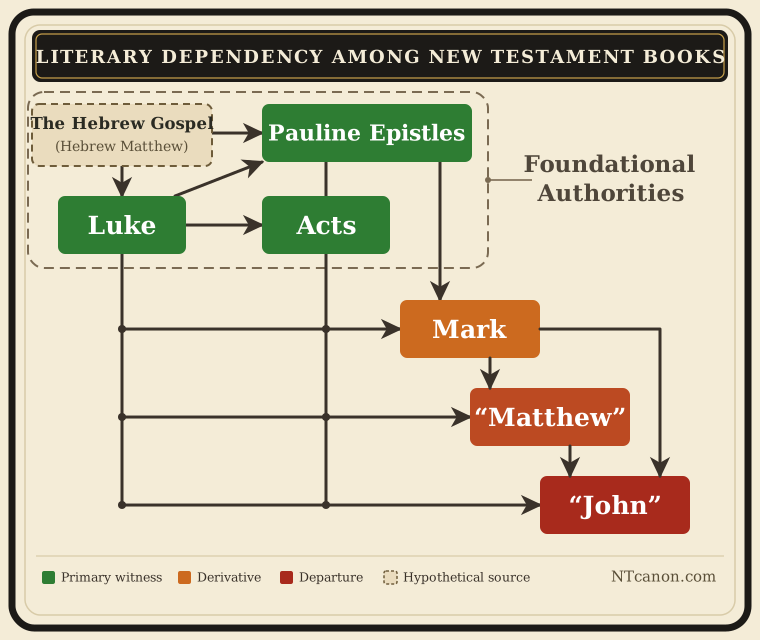
Literary Dependency Diagram
The stemma below illustrates Mark's literary dependence upon both Luke and Acts—alongside the Pauline Epistles—within the broader sequence of New Testament Gospel composition advanced across the Luke Primacy studies on this site.
Notes
- Robert L. Lindsey, A Hebrew Translation of the Gospel of Mark, 2nd ed. (Jerusalem: Dugith Publishers, 1973; 1st ed. 1969), “Introduction,” pp. 9–66; Lindsey, “My Search for the Synoptic Problem's Solution (1959–1969),” Jerusalem Perspective (2013), jerusalemperspective.com/11483. For Lindsey's initial statistical and philological case, see Robert Lisle Lindsey, “A Modified Two-Document Theory of Synoptic Dependence and Interdependence,” Novum Testamentum 6, no. 4 (1963): 239–263, and Lindsey, Jesus, Rabbi and Lord: The Hebrew Story of Jesus Behind Our Gospels (Oak Creek, WI: Cornerstone Publishing, 1990). ↩
- David N. Bivin, “LOY Excursus: Mark's Editorial Style,” Jerusalem Perspective (2021), jerusalemperspective.com/12312; David N. Bivin and Joshua N. Tilton, “LOY Excursus: Catalog of Markan Stereotypes and Possible Markan Pick-ups,” Jerusalem Perspective (updated 2023), jerusalemperspective.com/13743. ↩
- On Mark's midrashic and targumic rewriting habits, see also Halvor Ronning, “A Statistical Approach to the Synoptic Problem: Part 4—Non-Linear Hypotheses,” Jerusalem Perspective (2016), jerusalemperspective.com/15729, and companion article Mark the “Re-write Man”. ↩
- The sequential analysis of Mark 1 in this section summarizes and adapts Robert L. Lindsey, “From Luke to Mark to Matthew: A Discussion of the Sources of Markan ‘Pick-ups’ and the Use of a Basic Non-canonical Source by All the Synoptists,” Jerusalem Perspective (2014), jerusalemperspective.com/4231. ↩
- The lexical data, frequency comparisons, and pick-up identifications across Mark 1–14 draw on Bivin and Tilton, “LOY Excursus: Catalog of Markan Stereotypes and Possible Markan Pick-ups” (updated 2023), alongside Lindsey, A Hebrew Translation of the Gospel of Mark (1973), pp. 29–58. ↩
- For the Western rearrangement of Luke 1:63–64 in Codex Bezae (D, 05; supported in part by Old Latin manuscripts a, b, g1), see Barbara Aland, Kurt Aland, Johannes Karavidopoulos, Carlo M. Martini, and Bruce M. Metzger, eds., Novum Testamentum Graece, 28th rev. ed. (Stuttgart: Deutsche Bibelgesellschaft, 2012), apparatus ad loc., and Lindsey, “From Luke to Mark to Matthew” (2014). ↩
- See Testament of Naphtali 8:4 in H. W. Hollander and Marinus de Jonge, The Testaments of the Twelve Patriarchs: A Commentary, Studia in Veteris Testamenti Pseudepigrapha 8 (Leiden: Brill, 1985), pp. 316–318; cited in connection with Mark 1:13 by Lindsey, “From Luke to Mark to Matthew” (2014). ↩
- Lindsey, “From Luke to Mark to Matthew” (2014); see also Bivin, “LOY Excursus: Mark's Editorial Style” (2021), on Luke's Semitic prepositional idiom en exousia reflecting rabbinic Hebrew בִּרְשׁוּת (bireshūt) versus Mark's idiomatic Greek kat' exousian. ↩
- Each individual entry in this section adapts philological comparisons documented in Bivin and Tilton, “LOY Excursus: Catalog of Markan Stereotypes and Possible Markan Pick-ups” (updated 2023), jerusalemperspective.com/13743. ↩
- On the Passover typology of Exodus 12:11 in Mark 6:8–9 and Acts 12:8, see T. W. Manson, The Sayings of Jesus (London: SCM Press, 1949), p. 181; Joel Marcus, Mark 1–8: A New Translation with Introduction and Commentary, Anchor Bible 27 (New York: Doubleday, 2000), pp. 383, 389; and Bivin and Tilton, “Catalog of Markan Stereotypes and Possible Markan Pick-ups” (2023). ↩
- See Vincent Taylor, The Gospel According to St. Mark, 2nd ed. (London: Macmillan, 1966), pp. 458–459; Rudolf Bultmann, The History of the Synoptic Tradition, trans. John Marsh (Oxford: Basil Blackwell, 1963), p. 218; and David N. Bivin, “Selected Examples of Rewriting in Mark's Account of Jesus' Last Week,” in Jesus' Last Week: Jerusalem Studies in the Synoptic Gospels—Volume One, ed. R. Steven Notley, Marc Turnage, and Brian Becker (Leiden: Brill, 2006), pp. 211–224. ↩