Issues with Matthew
The Sermon on the Mount : The Matthean Jesus Is Not the Historical Jesus
Introduction: The Sermon on the Mount as Scribal Composition
Spanning three full chapters (Matthew 5–7), the Sermon on the Mount is the most famous discourse in the First Gospel, positioned at the outset of Jesus’ public ministry as the inaugural summary of his ethical demand (see Donald Senior, The Gospel of Matthew [Nashville: Abingdon Press, 1997], p. 99). Yet historical-critical comparison of Matthew 5–7 with Luke’s much shorter “Sermon on the Plain” (Luke 6:20–49)—as well as with sayings scattered across chapters 11, 12, 13, 14, and 16 of Luke and isolated verses in Mark—demonstrates that the Sermon on the Mount was never delivered by the historical Jesus as a continuous address on a Galilean mountainside. Rather, as the first of five great discourses constructed by the anonymous Jewish-Christian scribe who authored canonical Matthew, it weaves disparate traditional sayings together with substantial pre-Matthean and Matthean redactional additions to establish a binding community catechism.
Georg Strecker’s Exegetical Analysis of Matthew 5–7
One of the most thorough tradition-historical and redaction-critical investigations of this discourse is The Sermon on the Mount: An Exegetical Commentary, translated by O. C. Dean Jr. (Nashville: Abingdon Press; Edinburgh: T&T Clark, 1988; German original, Die Bergpredigt: Ein exegetischer Kommentar [Göttingen: Vandenhoeck & Ruprecht, 1984]; Internet Archive), by Georg Strecker (1929–1994), longtime Professor of New Testament at the University of Göttingen and author of foundational studies on Matthean redaction (Der Weg der Gerechtigkeit, 1962), New Testament literature, and theology.
Strecker states the fundamental conclusion of two centuries of critical research on the opening page of his commentary:
“No proper exegesis of the Sermon on the Mount can ignore the results of more than two hundred years of historical-critical research into the New Testament. One of these results is the determination that the Sermon on the Mount in the First Gospel is not a speech made by Jesus but the literary work of the Evangelist Matthew, for between the historical Jesus and the composition of the New Testament Gospels there is a broad domain of oral and written tradition within the early Christian communities.” (Strecker 1988, p. 11)
Luke’s Sermon on the Plain as Witness to the More Primitive Tradition
Although Strecker worked within the standard German Two-Document Hypothesis (attributing shared non-Markan material in Luke and Matthew to Q rather than Matthew’s direct use of Luke), his verse-by-verse comparisons repeatedly arrive at a conclusion directly congenial to Lukan priority and Matthean posteriority: wherever Matthew 5–7 and Luke run parallel, Luke regularly preserves the shorter, more primitive wording and structure, whereas Matthew expands, ethicizes, and reorganizes the material:
“The basic content of Matthew 5–7 can be traced back to the Q source, as a comparison with the Lukan parallel, the Sermon on the Plain of Luke 6:20–49, will demonstrate. Not only the framework (setting and epilogue) and the basic elements of the composition, but also above all the essential units of tradition in the Sermon on the Mount (the beatitudes, the commandments to love one’s enemy, the Golden Rule, the closing parables, and more) are passed on by Matthew and Luke. If we compare the outlines of the Sermon on the Mount and the Sermon on the Plain, the far-reaching correspondences will become clear.” (Strecker 1988, pp. 11–12)
As charted by Strecker (1988, p. 12), the structural backbone of Matthew 5–7 follows the exact sequence of Luke’s Sermon on the Plain (Luke 6:12, 20–49; 7:1), into which Matthew interpolates large blocks of sayings found elsewhere in Luke (such as the Lord’s Prayer from Luke 11:2–4 and the anxiety warnings from Luke 12:22–31) along with special Matthean redaction:
- Narrative Setting: Matthew 5:1–2 // Luke 6:12, 20a
- Beatitudes: Matthew 5:3–4, 6, 11–12 // Luke 6:20b–23
- Love of Enemies and Imitation of God: Matthew 5:39–40, 42–48; 7:12 (Golden Rule) // Luke 6:27–36
- Interpolated Prayer Instruction (Lord’s Prayer): Matthew 6:9–13 // Luke 11:2–4
- Interpolated Cares-of-Life Discourse: Matthew 6:25–34 // Luke 12:22–31
- Warning Against Judging and Speck/Log Image: Matthew 7:1–5 // Luke 6:37–38, 41–42
- Good and Bad Trees / “Lord, Lord”: Matthew 7:16–21 // Luke 6:43–46
- Closing Parable of the Two Builders: Matthew 7:24–27 // Luke 6:47–49
- Narrative Epilogue (Entry into Capernaum): Matthew 7:28–8:5 // Luke 7:1–2
Because multiple stages of community transmission and editorial rewriting stand united inside Matthew’s text, Strecker emphasizes that “the way ‘back to Jesus’ cannot be traveled without taking into account the various layers of tradition that are united in one text” (Strecker 1988, p. 13).
Section-by-Section Redactional Overview of Matthew 5–7
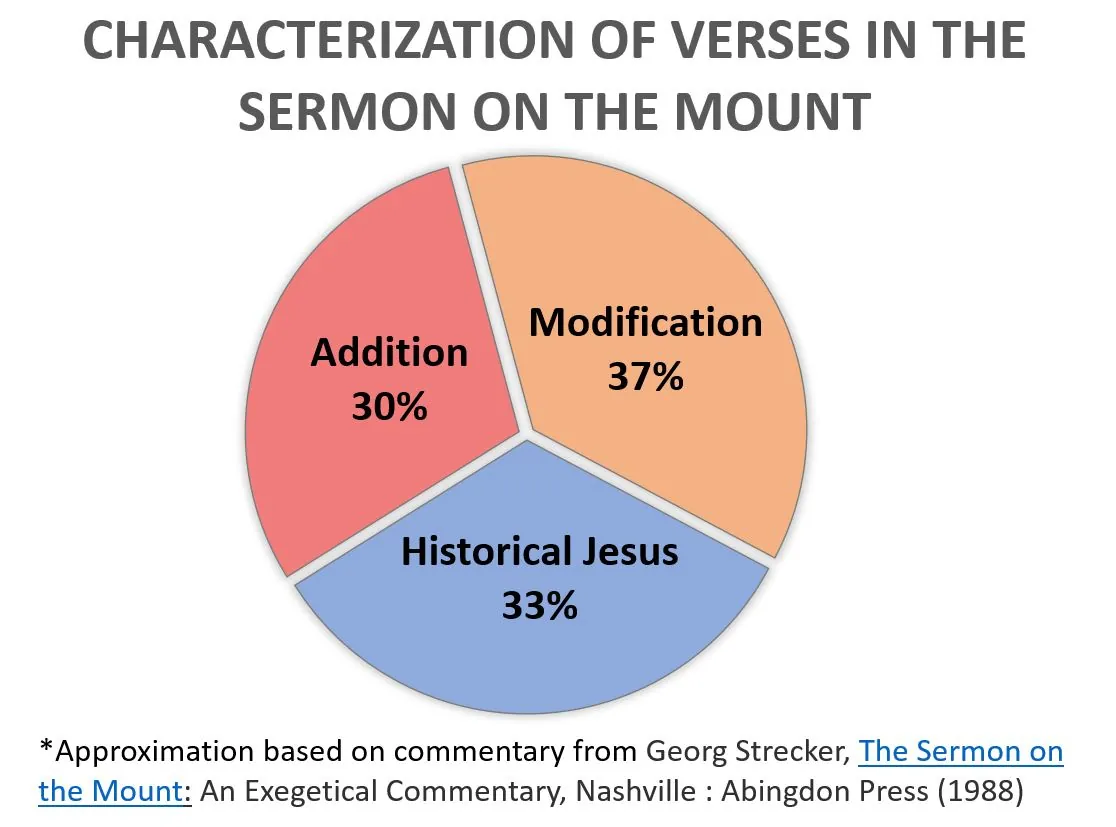
Across the 107 verses of Matthew 5–7, roughly a quarter parallel Luke’s Sermon on the Plain (Luke 6:20–49), roughly a third parallel dispersed sayings in later chapters of Luke (Luke 11–16) or isolated verses of Mark (Mark 1:22; 4:24; 9:43–50; 11:25), and the remaining verses consist of special Matthean (Sondergut / M) traditions and direct compositions by the First Evangelist. Below is an analytical synthesis of Strecker’s section-by-section findings (Strecker 1988, pp. 24–173).
1. Matthew 5:1–2 — The Mountain Setting (Strecker 1988, pp. 24–26)
Whereas Luke 6:17 situates Jesus’ teaching on “a level place” surrounded by crowds after descending from nocturnal prayer on a mountain (Luke 6:12), Matthew alone relocates the sermon itself onto “the mountain” (τὸ ὄρος) and seats Jesus in the authoritative posture of a Jewish teacher instructing his disciples. As Strecker shows (pp. 24–26), the mountain functions throughout Matthew as a theological stage of divine epiphany and eschatological revelation—echoing Sinai here (Matt 5:1), recurring in the mountain healings of Matt 15:29, and culminating in the risen Lord’s universal commission on a Galilean mountain in Matt 28:16–20.
2. Matthew 5:3–12 — Ethicization of the Beatitudes (Strecker 1988, pp. 29–47)
Comparison with Luke’s four beatitudes (Luke 6:20–23) reveals that only the core three beatitudes of reversal—promising God’s eschatological kingdom to the destitute (Matt 5:3 // Luke 6:20b), mourners (Matt 5:4 // Luke 6:21b), and the hungry (Matt 5:6 // Luke 6:21a), supplemented at a secondary stage by the beatitude on persecuted disciples (Matt 5:11–12 // Luke 6:22–23)—belong to the oldest accessible layer (Strecker 1988, pp. 29–34). Matthew transforms these unconditional apocalyptic promises into ethical entrance conditions in two ways: (a) inserting qualifying moral glosses into the original beatitudes (“poor in spirit” in v. 3; “hunger and thirst for righteousness” in v. 6), and (b) adding a second series of virtues—the meek, merciful, pure in heart, peacemakers, and those persecuted “for righteousness’ sake” (Matt 5:5, 7–10)—so that sufferers are replaced by ethical “doers of the word” (pp. 31–34).
3. Matthew 5:13–16 — Salt and Light Metaphors (Strecker 1988, pp. 47–52)
Matthew next assembles originally independent wisdom/image sayings—witnessed separately in Mark 9:50 // Luke 14:34–35 (salt) and Mark 4:21 // Luke 8:16; 11:33 (lamp on a stand), alongside a pre-Matthean “city on a hill” proverb (Matt 5:14b)—shifting them from impersonal third-person aphorisms into direct second-person plural exhortation (“You are the salt of the earth... You are the light of the world”). Verse 16 (“let your light shine before others, so that they may see your good works and give glory to your Father who is in heaven”) exhibits thoroughly Matthean diction and was composed by the evangelist as an ethical bridge to verses 17–20 (Strecker 1988, pp. 47–52).
4. Matthew 5:17–20 — Programmatic Defense of the Torah (Strecker 1988, pp. 52–61)
Positioned as the programmatic thesis of the entire discourse, Matthew 5:17–20 shows heavy redactional construction. On linguistic and structural grounds, Strecker demonstrates (pp. 53–56) that the evangelist composed both framing verses—verse 17 (“Do not think that I have come to abolish the Law or the Prophets; I have come not to abolish them but to fulfill them”) and verse 20 (“unless your righteousness exceeds that of the scribes and Pharisees, you will never enter the kingdom of heaven”)—around adapted Jewish-Christian legal sayings in verses 18–19 (cf. Luke 16:17), staking out a Torah-affirming christological ethic in sharp contrast to Paul’s teaching that Christ is the end of the Mosaic law.
5. Matthew 5:21–48 — Six Antitheses Expanding Three Core Sayings (Strecker 1988, pp. 61–97)
In verses 21–48, Matthew organizes six teachings under a recurring rabbinic-style antithetical formula (“You have heard that it was said... But I say to you”). Crucially, Luke’s Sermon on the Plain parallels only the material in the fifth and sixth units—non-retaliation and love of enemies (Luke 6:27–36 // Matt 5:38–48)—without any “You have heard / But I say” antithetical framework (Strecker 1988, pp. 61–65). Distinguishing secondary framing from underlying sayings, Strecker concludes that only three core radicalizations—anger/murder (5:21–22), lust/adultery (5:27–28), and refusal of oaths (5:33–37)—preserve genuine pre-Matthean/Jesus-tradition antitheses, which the evangelist expanded to a symmetrical 2 × 3 set of six by casting divorce (5:31–32, adding the Matthean unchastity exception; cf. Luke 16:18; Mark 10:11–12), retaliation (5:38–42), and enemy-love (5:43–48, replacing Luke’s “merciful” [Luke 6:36] with Matthean “perfect” [τέλειος, v. 48]) into matching antithetical form.
6. Matthew 6:1–18 — Cultic Piety and Expansion of the Lord’s Prayer (Strecker 1988, pp. 96–129)
Departing entirely from the sequence of Luke 6 after Matt 5:48 (resumed only at Matt 7:1 // Luke 6:37), Matthew introduces a three-part catechesis on almsgiving (6:2–4), prayer (6:5–8), and fasting (6:16–18) headed by an unmistakably redactional thesis verse: “Beware of practicing your righteousness [δικαιοσύνη] before other people in order to be seen by them, for then you will have no reward from your Father who is in heaven” (Matt 6:1; Strecker 1988, pp. 96–99). Into the middle of the prayer unit, Matthew inserts a liturgically expanded version of the Lord’s Prayer (Matt 6:9–13 // Luke 11:2–4), adding the solemn address “Our Father in heaven,” the third petition (“Your will be done, on earth as it is in heaven”), and the seventh petition (“deliver us from evil”), followed by a forgiveness saying relocated from Mark 11:25 (Matt 6:14–15):
“In all probability, the Lukan version of the Lord’s Prayer is generally closer to the oldest layer of tradition, for it is revealing that the whole of the Lukan text of the Lord’s Prayer fits into the Matthean version. This is also true of the five petitions; the expansions in Matthew belong to a later stage of tradition.” (Strecker 1988, p. 107)
7. Matthew 6:19–7:12 — Dispersed Sayings Capped by the Golden Rule (Strecker 1988, pp. 130–155)
Across Matthew 6:19–7:12, the evangelist stitches together sayings found across disparate Lukan chapters—treasures in heaven (Luke 12:33–34), the sound eye (Luke 11:34–36), serving God and mammon (Luke 16:13), freedom from anxiety (Luke 12:22–31), judging (Luke 6:37–42), and asking/seeking/knocking (Luke 11:9–13). Most revealingly, Matthew lifts the Golden Rule (Matt 7:12) out of the enemy-love paragraph where it stands in Luke 6:31 and places it at the close of the sermon’s main body, framing it with a redactional “Therefore whatever” (πάντα οὖν ὅσα) and appending the programmatic inclusio “for this is the Law and the Prophets”—explicitly tying 7:12 back to 5:17 to create a unified literary body (5:17–7:12; Strecker 1988, p. 154).
8. Matthew 7:13–29 — Eschatological Warnings and Markan Epilogue (Strecker 1988, pp. 155–173)
In the closing admonitions (Matt 7:13–27), Matthew pairs the Two Ways image (Matt 7:13–14; cf. Luke 13:23–24) with warnings against false prophets and charismatic antinomians (Matt 7:15–23, expanding Luke 6:43–46 and 13:25–27 with anti-enthusiastic church polemic against “workers of lawlessness” [οἱ ἐργαζόμενοι τὴν ἀνομίαν, v. 23]), before concluding—just as Luke 6:47–49 does—with the Parable of the Two Builders (Matt 7:24–27). Finally, in Matthew 7:28–29, the evangelist inserts his first Pentateuchal transition formula (“And when Jesus finished these sayings,” borrowed from Septuagintal narrative idiom) and reconnects directly to Mark 1:22 (“the crowds were astonished at his teaching, for he was teaching them as one who had authority, and not as their scribes”), closing the massive three-chapter insertion he had opened at Mark 1:21 (Strecker 1988, pp. 171–173).
Conclusion: The Matthean Jesus vs. the Historical Jesus
Tradition-historical analysis of Matthew 5–7 confirms that the Matthean Jesus of the Sermon on the Mount is a theological portrait painted by a late first-century Jewish-Christian scribe rather than a direct historical transcript of Jesus of Nazareth. Not only does Matthew assemble dispersed sayings from multiple contexts and stamp them with non-Pauline legal perfectionism (Matt 5:17–20, 48; 7:21–23), but only a limited core within these three chapters reaches back to the historical proclamation of Jesus:
“Through probability judgments... the oldest material in the Sermon on the Mount can be shown to be a component of the proclamation of the historical Jesus... This historical core is... not as encompassing as presupposed in conservative-fundamentalist interpretation. Included above all are the three oldest beatitudes, a series of three antitheses, the Lord’s Prayer, and other verbal material that in the course of tradition history has experienced manifold changes before the redactor Matthew put it into its final form.” (Georg Strecker, The Sermon on the Mount: An Exegetical Commentary, trans. O. C. Dean Jr. [Nashville: Abingdon Press, 1988], p. 174; see also p. 179)