Issues with Mark
Countering Arguments for Markan Priority
Countering Arguments for Markan Priority
What follows is a critical response to seven of the most common arguments advanced for Markan (or Marcan) priority by modern New Testament scholars, commentators, and Christian apologists. As source critics such as William R. Farmer, E. P. Sanders, and Hans-Herbert Stoldt demonstrated in detail, many of the textbook proofs for Markan priority are reversible and fail to establish the direction of literary dependence once tested against the full Synoptic data.1
1. The Argument That Mark Is the Shortest Gospel
Because Mark is the shortest canonical Gospel in overall word count, popular treatments regularly assume that Matthew and Luke expanded Mark. Yet when parallel pericopes are compared side by side, Mark’s individual narratives are almost consistently longer and wordier than Luke’s—a phenomenon documented as early as 1866 by Hajo Uden Meijboom and highlighted by statistical researcher Halvor Ronning:
“The stories Mark told are almost always (literally 80% of the time) longer than the parallel accounts in Luke and Matthew. Mark is the longest Gospel, not the shortest in terms of the actual stories he decided to incorporate. Mark is shortest only in terms of overall length, but that is only because of the stories and sayings he chose to omit. Mark’s expansionist style fits his character as a sophisticated targumic story teller.”2
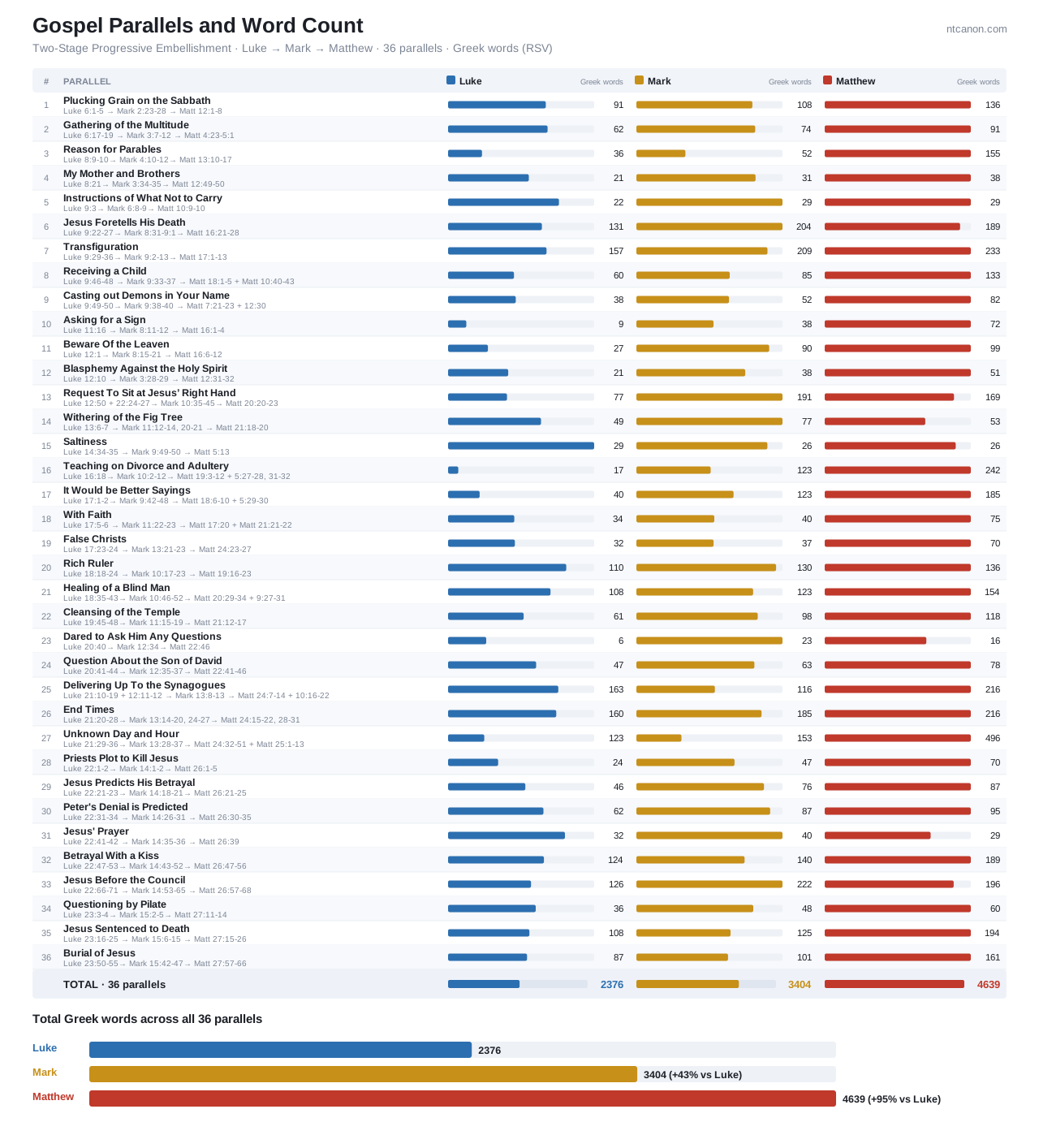
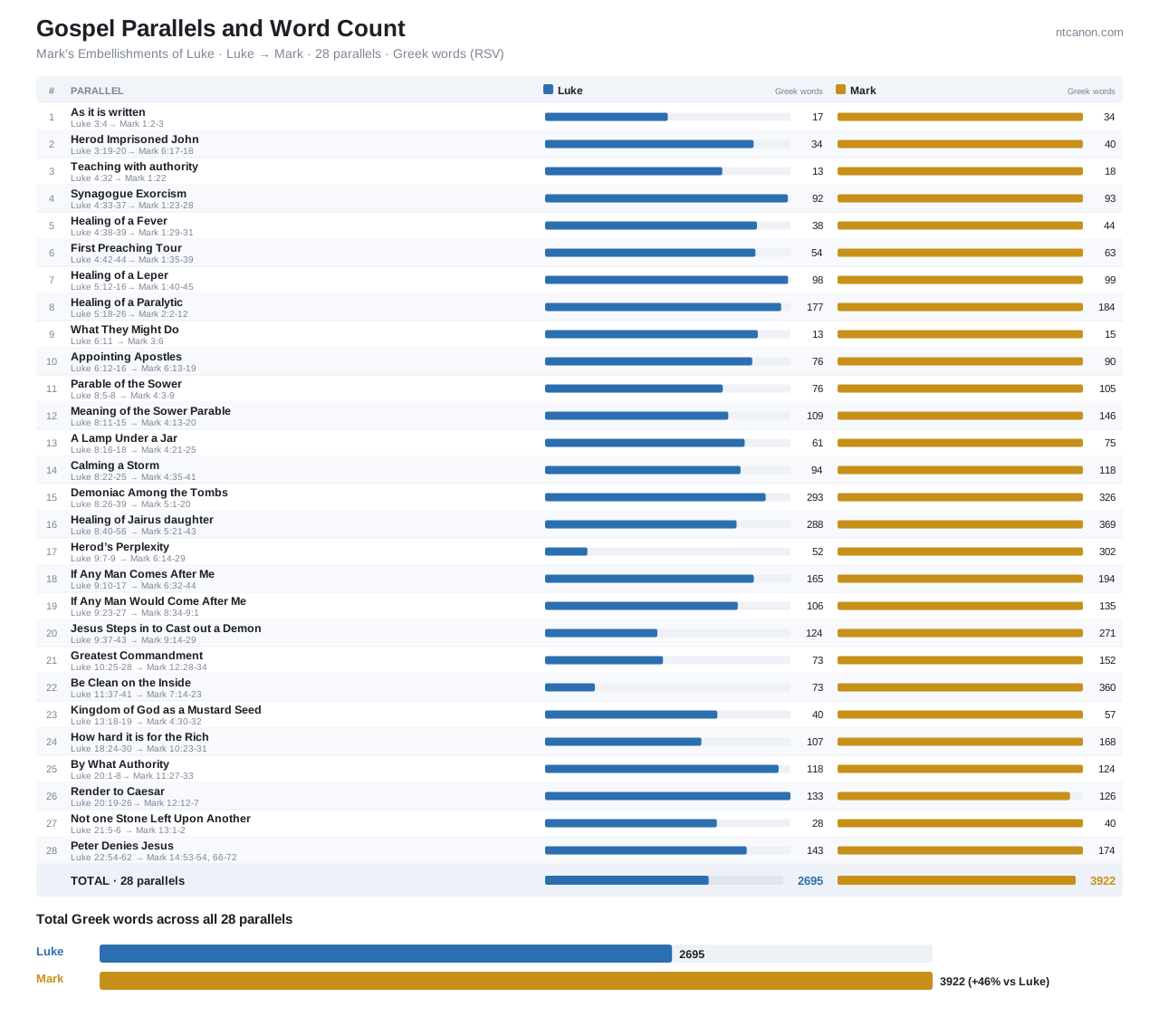
The companion study Progressive Embellishment, Luke→Mark→Matthew (together with the articles in Issues with Mark) examines 36 Triple-Tradition parallels shared by Luke, Mark, and Matthew alongside 28 further parallels between Luke and Mark. Measured in the critical Greek text (NA28 / SBLGNT), Mark is more than 46% longer than Luke across these 64 parallel pericopes, which together account for roughly 65% of the entire Gospel of Mark.
The two charts below provide a quantitative view of Mark’s expansionist habit. Not only does Mark employ substantially more Greek words per episode than Luke, he repeatedly amplifies scenes with added dialogue, heightened suspense, and picturesque detail. Judging chronological priority from total book length confuses scope with style: Mark is shorter overall only because its author omitted large blocks of Jesus’ teaching and biographical material in order to construct a fast-moving, dramatic narrative.
2. The Argument That Mark Is a Transcription of Oral Tradition
Because of Mark’s rapid pace, paratactic syntax, and abrupt transitions, defenders of Markan priority frequently portray the Second Gospel as a fresh, unvarnished transcription of oral preaching. Close lexical and redactional comparison with Luke-Acts, the Septuagint, and the New Testament epistles points in the opposite direction.
As examined in Mark the “Re-Write Man”, Jerusalem School scholar Robert L. Lindsey found that Mark systematically reworked his Vorlage using midrashic techniques of synonym substitution, conflation, and verbal association—weaving phrases drawn from the Septuagint, Acts, Paul, and James into his retelling of Lukan episodes. Summarizing a decade of concordance and translation work, Lindsey wrote:
“Mark’s principal method was to replace about half of Luke’s earlier and more authentic wording with a variety of synonyms and expressions he culled from certain Old and New Testament books that, today, we can identify usually simply by consulting Greek and Hebrew concordances of the Bible… Like the rabbis, Mark loved to find linguistic parallels to the text he was copying in other, often unrelated, books, and then mix words and phrases taken from these parallels with others of his sources. This method resulted in an amplified text that many scholars had thought gave an authenticity to Mark’s work, but which, in reality, should be described as a fascinating but rather inauthentic dramatization of the Gospel story. Due to Mark’s quite normal midrashic and aggadic Jewish methods, his Gospel is the ‘first cartoon life of Christ.’ Mark was a ‘re-write man.’” (Robert L. Lindsey, “My Search for the Synoptic Problem’s Solution (1959–1969),” Jerusalem Perspective, 2013)
Halvor Ronning reached the same conclusion from his statistical study of verbal agreement sequences across the Synoptics:
“As a Jewish author, Mark simply followed in the footsteps of good targumic style: he dramatized his source by substituting synonyms, adding words from elsewhere, and rearranging and reversing word orders; anything to hold the reader’s attention and fascination. (Mark also demonstrates that he had an intensely active associative mind by recalling of words and phrases and ideas from the Septuagint and the writings of Paul and working these words and ideas into his paraphrase of Luke’s text.)” (Halvor Ronning, “A Statistical Approach to the Synoptic Problem: Part 4—Non-Linear Hypotheses,” Jerusalem Perspective, 2016)
David N. Bivin, in an excursus for the Life of Yeshua (LOY) project, similarly characterizes Mark’s redactional method:
“Scholars often refer to the editorial alterations of Mark (alterations often followed by Matthew) as ‘vivid detail’ or ‘freshness,’ assuming these ‘primitive’ readings to be a sign of Mark’s originality. However, once Mark’s Gospel is recognized as dependent on Luke’s, Mark’s editorial style becomes unmistakable.
“The author of Mark’s modus operandi was to make almost every kind of change to his text that an editor can make. Often, his changes appear to be without purpose—simply change for the sake of change. Yet, although to post-Enlightenment western readers Mark’s treatment of his sources may seem arbitrary and even indefensible, there are ancient Jewish models for Mark’s editorial techniques in the later rabbinic aggadic midrashim and in the targumim…” (David N. Bivin, “LOY Excursus: Mark’s Editorial Style,” Jerusalem Perspective, 2021)
Rather than representing an unedited transcript of oral tradition, Mark’s vivid, breathless delivery reflects a deliberate literary recasting of Luke’s more restrained historical narrative.
3. The Argument That Mark Employs Aramaic Transliterations
While common Semitic loanwords shared by Hebrew and Aramaic—such as amen, korban, mammon, and rabbi—appear across the Gospels, David Bivin and Robert Lindsey observed that Mark is the only canonical Gospel to insert multi-word phrases and healing commands that are unambiguously Aramaic transliterations accompanied by Greek translations.3 Advocates of Markan priority often cite these transliterated Aramaic expressions as proof of Mark’s proximity to Jesus’ native speech.
Under closer philological scrutiny, however, Mark’s Aramaic insertions function not as relics of an Aramaic source—especially given that Luke’s underlying narrative syntax is far more consistently Hebraic—but as a Hellenistic storytelling device designed to lend local color, solemnity, and dramatic immediacy to miracle and passion scenes.4 Ancient rhetorical theory recognized the stylistic power of foreign or unfamiliar words to elevate diction above ordinary prose, as Aristotle noted in the Poetics:
“That diction, on the other hand, is lofty and raised above the commonplace which employs unusual words. By unusual, I mean strange (or rare) words, metaphorical, lengthened—anything, in short, that differs from the normal idiom… A diction that is made up of strange (or rare) terms is a jargon. A certain infusion, therefore, of these elements is necessary to style; for the strange (or rare) word, the metaphorical, the ornamental, and the other kinds above mentioned, will raise it above the commonplace and mean, while the use of proper words will make it perspicuous.”5
Mark’s repeated need to translate every Aramaic expression with an explanatory gloss (“which means…”) demonstrates that his intended Greek-speaking audience knew no Aramaic. Representative examples illustrate their secondary literary character:
- Mark 5:41 — Talitha koum (ταλιθα κουμ): Taking the deceased girl’s hand, Jesus says, “Talitha koum, which means, ‘Little girl, I say to you, arise’” (ESV; absent in Luke 8:54, which has simply “Child, arise”). As Lindsey and Randall Buth pointed out, Mark’s Aramaic noun talitha appears to be an associative echo of Peter’s miracle in Acts 9:40 (“Tabitha, arise” [Ταβιθά, ἀνάστηθι], where Tabitha is an Aramaic name).6
- Mark 7:34 — Ephphatha (Ἐφφαθά): Healing a deaf-mute man in a uniquely Markan miracle story, Jesus groans and commands, “Ephphatha, that is, ‘Be opened.’” Including the foreign imperative alongside its Greek gloss heightens the vividness and mystery of the healing formula, a technique well attested in Hellenistic wonder accounts.
- Mark 3:17 — Boanerges (Βοανηργές): Mark adds a parenthetical epithet for James and John—“Boanerges, that is, Sons of Thunder”—absent from both Luke 6:14 and Matthew 10:2, supplying a dramatic, symbolic aside unnecessary to the apostolic list itself.
Similarly, the honorific Rabbi appears in Mark (Mark 9:5; 10:51 [Rabbouni]; 11:21; 14:45) as well as Matthew and John, yet never once in Luke, who consistently renders respectful address to Jesus with Greek epistatēs (“Master”) or didaskalos (“Teacher”). Formal use of Rabbi as a fixed title gained currency in the post-70 CE rabbinic movement following the destruction of the Second Temple, as Yehuda Shurpin summarizes:
“It was not until the second century that ‘rabbi,’ which literally means ‘my master’ or ‘my teacher,’ became an official title. Until that time, even the greatest Jewish sages and prophets were not given an honorific… At the time that these titles [Rabbi, Rab, Rabban] developed, the Jewish nation was in turmoil. The first to bear them saw the destruction of the second temple in 70 CE, and the institution of an oppressive Roman occupation in Israel.”7
Luke’s avoidance of Rabbi accords with pre-70 usage, whereas Mark’s deployment of the title reflects a later linguistic environment.
At the same time, Mark contains the highest concentration of Latin loanwords and Latinizing idioms among the Gospels, pointing to a Roman or strongly Romanized setting of composition:8
- κεντυρίων (Latin centurio), “centurion” (Mark 15:39, 44, 45 — where Luke 23:47 uses Greek ἑκατοντάρχης)
- δηνάριον (Latin denarius), Roman silver coin (Mark 6:37; 12:15; 14:5)
- φραγελλόω (Latin flagellare), “to scourge, flog” (Mark 15:15)
- μόδιος (Latin modius), grain measure / basket (Mark 4:21 — absent in Luke 8:16)
- λεγιών (Latin legio), “legion” (Mark 5:9, 15)
- σπεκουλάτωρ (Latin speculator), military courier / executioner (Mark 6:27)
- ξέστης (Latin sextarius), dry or liquid measure / pitcher (Mark 7:4)
- κῆνσος (Latin census), imperial poll tax (Mark 12:14 — where Luke 20:22 uses Greek φόρος)
- κοδράντης (Latin quadrans), Roman bronze coin (Mark 12:42, glossing Luke’s two lepta for Roman readers!)
- πραιτώριον (Latin praetorium), governor’s residence (Mark 15:16)
By contrast, Luke employs far fewer Latinisms and prefers idiomatic Greek equivalents (such as φόρος for tax and ἑκατοντάρχης for centurion). Just as Mark’s Latinisms reflect the later Roman milieu of his audience rather than Palestinian antiquity, his occasional Aramaic glosses reflect deliberate narrative coloration rather than source priority.
4. The Argument That Mark Contains Unflattering Statements About Jesus or the Disciples
Defenders of Markan priority since Edwin A. Abbott and B. H. Streeter have appealed to passages in Mark that seem humanizing or unflattering toward Jesus or the Twelve, arguing from the “criterion of embarrassment” that Matthew and Luke must have toned down or omitted Mark’s rawer portrait.9 Commonly cited examples include:
- Jesus’ family saying, “He is out of his mind” (Mark 3:21)
- Jesus’ inability to perform mighty works in Nazareth apart from healing a few sick people (Mark 6:5)
- The two-stage healing of the blind man at Bethsaida (Mark 8:22–26)
- Repeated emphasis on the disciples’ hardness of heart and failure to understand (Mark 6:52; 8:17–21; 9:32)
- Vivid depictions of Jesus’ anger, sighing, or indignation (Mark 1:43; 3:5; 7:34; 8:12; 10:14)
- The total flight of the disciples at Jesus’ arrest (Mark 14:50–52)
- Jesus’ cry of dereliction from the cross (Mark 15:34)
As Farmer demonstrated, several of Abbott’s and Streeter’s showcase examples carry weight only when comparing Mark with Matthew (who frequently smooths Mark), whereas Luke either shares the supposedly difficult saying without embarrassment (e.g., “Why do you call me good?” in Luke 18:19 // Mark 10:18) or preserves a simpler narrative wholly untouched by Mark’s secondary dramatizations.10 Viewed within Mark’s midrashic and dramatic storytelling technique, heightened emotional reactions, stark misunderstandings by the disciples, and mysterious two-stage wonders are purposeful literary devices that intensify narrative tension and irony.
Furthermore, since William Wrede’s classic 1901 study The Messianic Secret, critical scholarship has recognized that Mark’s systematic portrayal of obtuse disciples and strict commands to silence is not naive historical reportage, but an overarching theological construction.11 Alongside the Messianic Secret, Mark crafts a stark passion arc of progressive abandonment—from the crowds to the Twelve to Peter—culminating in Psalm 22:1 on the cross (Mark 15:34). Far from proving Markan primitivity, these programmatic motifs point to a bold redactor reshaping Luke’s more restrained account.
5. The Argument That Mark Contains Rougher Greek and Poorer Grammar
A fifth staple argument maintains that Mark’s colloquial Greek was stylistically upgraded by both Matthew and Luke. While Matthew regularly polishes Mark’s phrasing, comparing parallel sayings of Jesus in Luke and Mark reveals the reverse relationship between the Third and Second Gospels: Luke frequently preserves terser, more Semitic, and less rhetorically elaborated forms of Jesus’ sayings, whereas Mark expands, clarifies, or theologizes them.
| # | Primitive Jesus Sayings in Luke (ESV) | Expanded or Reworked Parallels in Mark (ESV) |
|---|---|---|
| 1 | “Truly, I say to you, no prophet is acceptable in his hometown.” (Luke 4:24) | “A prophet is not without honor, except in his hometown and among his relatives and in his own household.” (Mark 6:4) |
| 2 | “Do not be afraid; from now on you will be catching men.” (Luke 5:10) | “Follow me, and I will make you become fishers of men.” (Mark 1:17) |
| 3 | “No one tears a piece from a new garment and puts it on an old garment. If he does, he will tear the new, and the piece from the new will not match the old.” (Luke 5:36) | “No one sews a piece of unshrunk cloth on an old garment. If he does, the patch tears away from it, the new from the old, and a worse tear is made.” (Mark 2:21) |
| 4 | “And as for what fell among the thorns, they are those who hear, but as they go on their way they are choked by the cares and riches and pleasures of life, and their fruit does not mature.” (Luke 8:14) | “And others are the ones sown among thorns. They are those who hear the word, but the cares of the world and the deceitfulness of riches and the desires for other things enter in and choke the word, and it proves unfruitful.” (Mark 4:18–19) |
| 5 | “Take care then how you hear, for to the one who has, more will be given, and from the one who has not, even what he thinks that he has will be taken away.” (Luke 8:18) | “Pay attention to what you hear: with the measure you use, it will be measured to you, and still more will be added to you. For to the one who has, more will be given, and from the one who has not, even what he has will be taken away.” (Mark 4:24–25) |
| 6 | “For what does it profit a man if he gains the whole world and loses or forfeits himself?” (Luke 9:25) | “For what does it profit a man to gain the whole world and forfeit his soul? For what can a man give in return for his soul?” (Mark 8:36–37) |
| 7 | And a voice came out of the cloud, saying, “This is my Son, my Chosen One; listen to him!” (Luke 9:35) | And a cloud overshadowed them, and a voice came out of the cloud, “This is my beloved Son; listen to him.” (Mark 9:7) |
| 8 | “Let these words sink into your ears: The Son of Man is about to be delivered into the hands of men.” (Luke 9:44) | “The Son of Man is going to be delivered into the hands of men, and they will kill him. And when he is killed, after three days he will rise.” (Mark 9:31) |
| 9 | “For he who is least among you all is the one who is great.” (Luke 9:48) | “If anyone would be first, he must be last of all and servant of all.” (Mark 9:35) |
| 10 | “Everyone who speaks a word against the Son of Man will be forgiven, but the one who blasphemes against the Holy Spirit will not be forgiven.” (Luke 12:10) | “Truly, I say to you, all sins will be forgiven the children of man, and whatever blasphemies they utter, but whoever blasphemes against the Holy Spirit never has forgiveness, but is guilty of an eternal sin.” (Mark 3:28–29) |
| 11 | “Salt is good, but if salt has lost its taste, how shall its saltiness be restored? It is of no use either for the soil or for the manure pile. It is thrown away.” (Luke 14:35) | “Salt is good, but if the salt has lost its saltiness, how will you make it salty again? Have salt in yourselves, and be at peace with one another.” (Mark 9:50) |
| 12 | “If you had faith like a grain of mustard seed, you could say to this mulberry tree, ‘Be uprooted and planted in the sea,’ and it would obey you.” (Luke 17:6) | “Have faith in God. Truly, I say to you, whoever says to this mountain, ‘Be taken up and thrown into the sea,’ and does not doubt in his heart, but believes that what he says will come to pass, it will be done for him. Therefore I tell you, whatever you ask in prayer, believe that you have received it, and it will be yours.” (Mark 11:22–24) |
| 13 | And they will say to you, “Look, there!” or “Look, here!” Do not go out or follow them. (Luke 17:23) | And then if anyone says to you, “Look, here is the Christ!” or “Look, there he is!” do not believe it. For false christs and false prophets will arise and perform signs and wonders, to lead astray, if possible, the elect. (Mark 13:21–22) |
| 14 | “Truly, I say to you, there is no one who has left house or wife or brothers or parents or children, for the sake of the kingdom of God, who will not receive many times more in this time, and in the age to come eternal life.” (Luke 18:29–30) | “Truly, I say to you, there is no one who has left house or brothers or sisters or mother or father or children or lands, for my sake and for the gospel, who will not receive a hundredfold now in this time, houses and brothers and sisters and mothers and children and lands, with persecutions, and in the age to come eternal life.” (Mark 10:29–30) |
| 15 | “By your endurance you will gain your lives.” (Luke 21:19) | “But the one who endures to the end will be saved.” (Mark 13:13) |
| 16 | “And then they will see the Son of Man coming in a cloud with power and great glory. Now when these things begin to take place, straighten up and raise your heads, because your redemption is drawing near.” (Luke 21:27–28) | “And then they will see the Son of Man coming in clouds with great power and glory. And then he will send out the angels and gather his elect from the four winds, from the ends of the earth to the ends of heaven.” (Mark 13:26–27) |
| 17 | “Look at the fig tree, and all the trees. As soon as they come out in leaf, you see for yourselves and know that the summer is already near.” (Luke 21:29–30) | “From the fig tree learn its lesson: as soon as its branch becomes tender and puts out its leaves, you know that summer is near.” (Mark 13:28) |
| 18 | “The kings of the Gentiles exercise lordship over them, and those in authority over them are called benefactors. But not so with you. Rather, let the greatest among you become as the youngest, and the leader as one who serves. For who is the greater, one who reclines at table or one who serves? Is it not the one who reclines at table? But I am among you as the one who serves.” (Luke 22:24–27) | “You know that those who are considered rulers of the Gentiles lord it over them, and their great ones exercise authority over them. But it shall not be so among you. But whoever would be great among you must be your servant, and whoever would be first among you must be slave of all. For even the Son of Man came not to be served but to serve, and to give his life as a ransom for many.” (Mark 10:42–45) |
| 19 | “I tell you, Peter, the rooster will not crow this day, until you deny three times that you know me.” (Luke 22:34) | “Truly, I say to you, this very night, before the rooster crows twice, you will deny me three times.” (Mark 14:30) |
| 20 | “Father, if you are willing, remove this cup from me. Nevertheless, not my will, but yours, be done.” (Luke 22:42) | “Abba, Father, all things are possible for you. Remove this cup from me. Yet not what I will, but what you will.” (Mark 14:36) |
| 21 | “If I tell you, you will not believe, and if I ask you, you will not answer. But from now on the Son of Man shall be seated at the right hand of the power of God.” (Luke 22:67–68) | “I am, and you will see the Son of Man seated at the right hand of Power, and coming with the clouds of heaven.” (Mark 14:62) |
| 22 | “Father, into your hands I commit my spirit!” (Luke 23:46) | “Eloi, Eloi, lema sabachthani?” which means, “My God, my God, why have you forsaken me?” (Mark 15:34) |
Although Luke demonstrates a command of Periodic Greek in his literary preface (Luke 1:1–4), inside the Gospel narrative he adheres closely to the simple, Semitic syntax of his sources. Conversely, where Mark departs from standard Greek syntax in narrative—for instance, stacking redundant dual time expressions such as Mark 1:32 (“That evening, at sunset…,” compared with Luke 4:40, “Now when the sun was setting…”)—his choppy constructions serve the pacing of a popular dramatic retelling:
- Historical present verbs (over 150 occurrences in Mark, such as “he says” instead of “he said”) create vivid theatrical immediacy—a device common in Latin narrative and popular Greek storytelling.
- Paratactic καί (“and”) strings episodes together in rapid succession.
- The adverb εὐθύς (“immediately”) occurs 41 times in Mark (against just once in Luke, at Luke 6:49), propelling the action relentlessly forward.
Moreover, as William R. Farmer showed in his critique of B. H. Streeter and Edwin A. Abbott, non-literary Koine grammar is no proof of early composition.12 Streeter’s claim that Mark’s Greek was demonstrably more “crude” and “vulgar” drew directly upon Abbott’s influential 1879 Encyclopædia Britannica article “Gospels,” which listed nine Markan words condemned by the second-century Atticist grammarian Phrynichus Arabius in his Ecloga.13 Yet Farmer pointed out that eight of those nine expressions appear elsewhere in the New Testament (including Acts, Paul, and John), and seven occur in Matthew or Luke-Acts; Atticist purists compiled such lists precisely because Hellenistic writers of the second through fourth centuries regularly used those vernacular forms. Even more tellingly, when Abbott cited two syntactic “barbarisms” in Mark, he himself conceded that both “idioms are common in the Acta Pilati, and perhaps indicate Latin influence”—aligning Mark’s vernacular traits not with primitive Palestinian Aramaic, but with later Latinized and apocryphal Christian prose.14
Oxford scholar Cuthbert Hamilton Turner, in his landmark study of “Marcan Usage,” likewise asked, “Whence did Mark derive his occasional use of an order of words so fundamentally alien to the Greek language?” and answered:
“Greek puts the emphatic words in the forefront of the sentence, and the verb therefore cannot be left to the last. Latin, on the other hand, habitually closes the sentence with the verb. The conclusion seems irresistible that … Mark introduces in the Greek of his Gospel a Latinizing order.”15
As E. P. Sanders independently confirmed in The Tendencies of the Synoptic Tradition (1969), post-canonical and apocryphal Christian texts routinely exhibit rougher vernacular Greek, heightened specificity, and Latinizing syntax relative to earlier works.16 Mark’s colloquialisms and Latinisms therefore point to a later popularizer reworking Luke for a Romanized audience, not to the earliest Gospel source.
6. The Argument That Mark Lacks an Infancy Narrative and Genealogy
Another frequent argument contends that Mark must predate Matthew and Luke because Mark lacks both a birth narrative and a genealogy of Jesus. Yet the absence of infancy traditions in Mark is fully explained by Mark’s literary purpose and target audience: the Gospel opens directly with John the Baptist and Jesus’ empowerment at his baptism in order to focus entirely on Jesus’ public miracles, exorcisms, and passion. As Brad H. Young observes regarding Mark’s design for a Gentile environment:
“A shortened edition of the gospel could have performed some important functions. For one thing, it certainly could have provided an effective tool for communicating the gospel to Hellenistic society. The instruction of Jesus would probably be less important to a non-Jewish, pagan audience. Conversely, the miracles and activities of Jesus would be considered a better vehicle of communication.”17
Three considerations underscore why omitting Jesus’ birth and lineage cannot establish Markan priority:
- Mark consistently bypasses biographical background and extended discourse material in favor of rapid public action.
- Gentile readers in a Roman milieu had far less interest in Davidic or Levitical birth narratives and tribal genealogies than in Jesus’ deeds of power.
- The Gospel of John likewise omits both an infancy narrative and a human genealogy, beginning public narration at John the Baptist’s witness—yet virtually all scholars date John after Luke and Matthew.
Furthermore, a number of scholars—including John Knox and Joseph B. Tyson—have argued that Luke 1–2 may represent a secondary stage in the composition of Luke-Acts, added to an earlier edition of Luke that began in Luke 3:1 (though internal Lukan style across chapters 1–2 is also defended by scholars such as Raymond E. Brown, and several lexical pick-ups suggest canonical Mark knew Luke 1–2 as well).18 Either way, Mark’s decision to open with John’s ministry has no bearing on priority across the body of Triple-Tradition parallels.
With respect to the genealogy in Luke 3:23–38, manuscript and structural anomalies have also led some textual critics to question whether the pedigree stood in the earliest form of Luke:19
- In the early Greek uncial Codex Washingtonianus (W, 032), verses 3:24–38 of the genealogy are omitted entirely after Luke 3:23a.
- In the Graeco-Latin Codex Bezae (D, 05), Luke’s genealogy is replaced by a harmonized adaptation of Matthew’s royal genealogy arranged in descending/reverse sequence.
- Across the Greek and versional manuscript tradition, the name-list of Luke 3:23–38 exhibits an unusually dense concentration of spelling, omission, and harmonization variants.
- Structurally, Luke 3:23–38 interrupts the immediate narrative sequence linking Jesus’ baptism and reception of the Holy Spirit (Luke 3:21–22) with his being led “full of the Holy Spirit” from the Jordan into the wilderness (Luke 4:1).
Even if the genealogy belonged to canonical Luke from the outset, its omission by Mark accords entirely with Mark’s streamlined dramatic architecture.
7. The Argument That Mark’s Resurrection Account Is More Primitive
Finally, Markan priorists argue that Mark’s abrupt termination at the empty tomb in Mark 16:8 (“for they were afraid,” ἐφοβοῦντο γάρ) represents a more primitive stage of resurrection tradition than the appearance narratives of Luke 24 and Matthew 28.
Yet two distinct scholarly explanations account for Mark 16:8 without assuming Markan priority. First, on literary grounds, many commentators view 16:8 as an intentional suspenseful ending consistent with Mark’s pervasive motifs of awe, secrecy, and human failure—inviting readers who already know the apostolic proclamation (cf. Mark 14:28; 16:7) to respond in faith where the fleeing onlookers faltered. Second, on codicological and redactional grounds, the original conclusion of Mark may have been detached or lost early in transmission; Evan Powell, in The Unfinished Gospel (1994), argued specifically that Mark’s lost Galilean appearance narrative (foreshadowed in Mark 14:28 and 16:7) was adapted and appended to the Fourth Gospel as John 21:1–19 in order to rehabilitate Simon Peter alongside the Beloved Disciple.20
At the same time, textual criticism of Luke 24 shows that Luke’s own resurrection chapter circulated in a noticeably shorter, more concise form in early Western witnesses. In their 1881 Greek New Testament, B. F. Westcott and F. J. A. Hort famously singled out nine readings in Luke 24—termed “Western non-interpolations”—that are absent from Codex Bezae (D, 05) and Old Latin manuscripts (ita, b, d, e, ff², l, r¹, with partial Old Syriac support in syrs, c):21
- Luke 24:3: “of the Lord Jesus”
- Luke 24:6: “He is not here, but has risen.”
- Luke 24:12: Peter’s run to the empty tomb and inspection of the linen cloths
- Luke 24:36: “and said to them, ‘Peace to you!’”
- Luke 24:40: “And when he had said this, he showed them his hands and his feet.”
- Luke 24:51: “and was carried up into heaven”
- Luke 24:52: “worshiped him and”
(Related Western omissions also occur at Luke 24:7 [“sinful”] and 24:30 [“with them”].) Although the discovery of Papyrus 75 ($\mathfrak{P}^{75}$, ca. 200 CE) demonstrated early Alexandrian support for the longer text, prominent textual critics including D. C. Parker and Bart D. Ehrman have continued to weigh the shorter Western readings seriously as evidence of early christological and harmonistic expansion in Luke 24.22 Regardless of which variants in Luke 24 are judged original, Mark’s breaking off at the women’s departure from the tomb in 16:8 reflects either deliberate dramatic curtailment or early loss/redaction of Mark’s Galilean ending—not chronological priority over Luke.
The Unreliability of Patristic Tradition Regarding Mark
Comparing Mark’s internal literary character with second- through fourth-century church fathers also exposes deep contradictions across the patristic traditions invoked to connect Mark directly with the apostle Peter. The earliest surviving notice—Papias’s citation of “the Presbyter,” preserved by Eusebius—portrays Mark as recording Peter’s anecdotal preaching from memory:
“Regarding Mark, the writer of the Gospel, he [Papias] states: ‘The Presbyter used to say this also: “Mark became Peter’s interpreter and wrote down accurately, but not in order, all that he remembered of the things said and done by the Lord. For he had not heard the Lord or been one of his followers, but later, as I said, a follower of Peter. Peter used to teach as the occasion demanded, without giving systematic arrangement to the Lord’s sayings, so that Mark did not err in writing down some things just as he recalled them. For he had one overriding purpose: to omit nothing that he had heard and to make no false statements in his account.”’”23
Not only does internal analysis refute the claim that Mark merely transcribed oral anecdotes without literary artifice, later patristic witnesses contradict one another over when Mark wrote and how Peter responded. Around 180 CE, Irenaeus explicitly places Mark’s composition after the deaths (“departure,” ἔξοδος) of Peter and Paul:
“After their departure, Mark, the disciple and interpreter of Peter, did also hand down to us in writing what had been preached by Peter.”24
Irenaeus’s post-64 CE dating after Peter’s death clashes directly with Clement of Alexandria (ca. 200 CE), who claimed in Book 6 of his Hypotyposes (quoted in Eusebius, Ecclesiastical History 6.14.6–7) that Mark composed the Gospel during Peter’s lifetime in Rome while Peter remained curiously indifferent to the result:
“Clement has included a tradition of the earliest elders regarding the order of the Gospels… that Mark originated as follows. When, by the Spirit, Peter had publicly proclaimed the Gospel in Rome, his many hearers urged Mark, as one who had followed him for years and remembered what was said, to put it all in writing. This he did and gave copies to all who asked. When Peter learned of it, he neither objected nor promoted it.”25
Clement’s statement—not to mention Eusebius’s own divergent paraphrase of Clement in Ecclesiastical History 2.15.1–2, where Peter instead delights in their zeal and ratifies the book for church reading!—strains credulity: if Peter were alive and present as Mark’s source, his neutrality toward a Gospel circulating in Rome would be inexplicable. Writing around 392–393 CE, Jerome resolved the embarrassment by adopting the affirmative version of Petrine ratification outright:
“Mark the disciple and interpreter of Peter wrote a short gospel at the request of the brethren at Rome embodying what he had heard Peter tell. When Peter had heard this, he approved it and published it to the churches to be read by his authority…”26
This progressive apologetic inflation—from Papias’s defensive apology for Mark’s lack of order, to Irenaeus’s post-mortem composition, to Clement’s ambivalent living Peter, to Eusebius’s and Jerome’s formal apostolic authorization—shows second- and fourth-century writers attempting to secure apostolic prestige for a sub-apostolic Gospel. Even Eusebius himself judged Papias an uncritical collector of traditions, remarking directly before quoting the Mark fragment:
“He was a man of very limited intelligence, as is clear from his books.”27
Notes
- William R. Farmer, The Synoptic Problem: A Critical Analysis (New York: Macmillan, 1964; repr. Dillsboro, NC: Western North Carolina Press, 1976); E. P. Sanders, The Tendencies of the Synoptic Tradition, SNTSMS 9 (Cambridge: Cambridge University Press, 1969); Hans-Herbert Stoldt, History and Criticism of the Marcan Hypothesis, trans. Donald L. Niewyk (Macon, GA: Mercer University Press, 1980; German orig. 1977). ↩
- Halvor Ronning, “A Statistical Approach to the Synoptic Problem: Part 4—Non-Linear Hypotheses,” Jerusalem Perspective (2016), https://www.jerusalemperspective.com/15729/, citing Hajo Uden Meijboom, A History and Critique of the Origin of the Marcan Hypothesis, 1835–1866, trans. John J. Kiwiet, New Gospel Studies 8 (Macon, GA: Mercer University Press, 1993; Dutch orig. 1866), pp. 105–115. ↩
- David N. Bivin, “LOY Excursus: Mark’s Editorial Style,” Jerusalem Perspective (2021), https://www.jerusalemperspective.com/12312/; Robert L. Lindsey, A Hebrew Translation of the Gospel of Mark, 2nd ed. (Jerusalem: Dugith Publishers, 1973), Introduction, pp. 9–66. ↩
- Cf. Farmer, The Synoptic Problem (1964), pp. 172–173, noting Hellenistic healing accounts and second-century Christian texts (including Acts of Pilate 11.1 and Gnostic formulas reported in Irenaeus, Against Heresies 1.21.3) that insert foreign Semitic expressions with Greek translations for solemn or dramatic effect. ↩
- Aristotle, Poetics 22 (1458a), trans. S. H. Butcher, The Poetics of Aristotle, 4th ed. (London: Macmillan, 1911), p. 83. ↩
- See David N. Bivin and Joshua N. Tilton, “LOY Excursus: Catalog of Markan Stereotypes and Possible Markan Pick-ups,” Jerusalem Perspective (updated 2023), https://www.jerusalemperspective.com/13743/ (entry on Mark 5:41), and Randall Buth’s philological analyses of Mark’s Aramaic transliterations in Jerusalem Perspective. ↩
- Yehuda Shurpin, “What Is a Rabbi? A Brief History of Rabbinic Ordination,” Chabad.org, https://www.chabad.org/library/article_cdo/aid/1933944/jewish/What-Is-a-Rabbi.htm; cf. John P. Meier, A Marginal Jew: Rethinking the Historical Jesus, vol. 1 (New York: Doubleday, 1991), pp. 270–271, 307 n. 47. ↩
- On Mark’s Latin loanwords and Latinizing idioms, see C. H. Turner, “Marcan Usage: Notes, Critical and Exegetical, on the Second Gospel,” Journal of Theological Studies 29 (July 1928): 346–361; Farmer, The Synoptic Problem (1964), pp. 120–130; and Bivin, “LOY Excursus: Mark’s Editorial Style” (2021). ↩
- Edwin A. Abbott, “Gospels,” in Encyclopædia Britannica, 9th ed., vol. 10 (Edinburgh: A. & C. Black, 1879), p. 802b; B. H. Streeter, The Four Gospels: A Study of Origins (London: Macmillan, 1924), p. 162. ↩
- Farmer, The Synoptic Problem (1964), pp. 152–158. ↩
- William Wrede, The Messianic Secret, trans. J. C. G. Greig (Cambridge: James Clarke, 1971; German orig. Das Messiasgeheimnis in den Evangelien, Göttingen: Vandenhoeck & Ruprecht, 1901). ↩
- Farmer, The Synoptic Problem (1964), pp. 121–125. ↩
- Streeter, The Four Gospels (1924), p. 163; Abbott, “Gospels,” Encyclopædia Britannica, 9th ed., vol. 10 (1879), p. 801, referencing Phrynichus Arabius, Ecloga (2nd century CE). ↩
- Abbott, “Gospels,” Encyclopædia Britannica, 9th ed., vol. 10 (1879), p. 801, quoted and analyzed in Farmer, The Synoptic Problem (1964), pp. 123–124. ↩
- Cuthbert Hamilton Turner, “Marcan Usage: Notes, Critical and Exegetical, on the Second Gospel,” Journal of Theological Studies 29 (July 1928): 346–361, at p. 355 (quoted in Farmer, The Synoptic Problem [1964], p. 124). ↩
- E. P. Sanders, The Tendencies of the Synoptic Tradition (Cambridge: Cambridge University Press, 1969), pp. 272–279. ↩
- Brad H. Young, Jesus and His Jewish Parables: Rediscovering the Roots of Jesus’ Teaching (Mahwah, NJ: Paulist Press, 1989; repr. Tulsa, OK: Gospel Research Publications, 1999), p. 138. ↩
- John Knox, Marcion and the New Testament: An Essay in the Early History of the Canon (Chicago: University of Chicago Press, 1942); Joseph B. Tyson, Marcion and Luke-Acts: A Defining Struggle (Columbia, SC: University of South Carolina Press, 2006), ch. 4; for critique and defense of the unity of Luke 1–2 with Luke-Acts, see Raymond E. Brown, The Birth of the Messiah, new updated ed. (New York: Doubleday, 1993), pp. 239–243. ↩
- See Nestle-Aland, Novum Testamentum Graece, 28th rev. ed. (Stuttgart: Deutsche Bibelgesellschaft, 2012), critical apparatus ad Luke 3:23–38; Henry A. Sanders, The New Testament Manuscripts in the Freer Collection: Part I, The Washington Manuscript of the Four Gospels (New York: Macmillan, 1912), p. 18 (noting the omission of Luke 3:24–38 in Codex W); and David C. Parker, Codex Bezae: An Early Christian Manuscript and Its Text (Cambridge: Cambridge University Press, 1992), along with Parker, The Living Text of the Gospels (Cambridge: Cambridge University Press, 1997). ↩
- Evan Powell, The Unfinished Gospel: Notes on the Quest for the Historical Jesus (Westlake Village, CA: Symposium Books, 1994), chs. 2–3, pp. 85–122; see further The Various Endings of Mark. ↩
- B. F. Westcott and F. J. A. Hort, The New Testament in the Original Greek, vol. 2: Introduction, Appendix (Cambridge: Macmillan, 1881), pp. 175–177, Appendix pp. 70–73; Bruce M. Metzger, A Textual Commentary on the Greek New Testament, 2nd ed. (Stuttgart: Deutsche Bibelgesellschaft, 1994), pp. 156–166. ↩
- Bart D. Ehrman, The Orthodox Corruption of Scripture: The Effect of Early Christological Controversies on the Text of the New Testament (New York: Oxford University Press, 1993), pp. 212–221; David C. Parker, The Living Text of the Gospels (Cambridge: Cambridge University Press, 1997), pp. 148–174. ↩
- Eusebius, Ecclesiastical History 3.39.15, trans. Paul L. Maier, Eusebius: The Church History (Grand Rapids, MI: Kregel Publications, 1999), p. 114. ↩
- Irenaeus, Against Heresies 3.1.1, trans. Alexander Roberts and William Rambaut, in Ante-Nicene Fathers, vol. 1 (Buffalo, NY: Christian Literature Publishing Co., 1885), p. 414. ↩
- Eusebius, Ecclesiastical History 6.14.6–7, trans. Paul L. Maier, Eusebius: The Church History (Grand Rapids, MI: Kregel Publications, 1999), p. 204; contrast Eusebius’s earlier paraphrase of Clement in Ecclesiastical History 2.15.1–2, which claims Peter formally sanctioned the work for church reading. ↩
- Jerome, On Illustrious Men (De Viris Illustribus) 8, trans. Ernest Cushing Richardson, in Nicene and Post-Nicene Fathers, Second Series, vol. 3 (Buffalo, NY: Christian Literature Publishing Co., 1892), p. 364 (continuing: “…as Clemens in the sixth book of his Hypotyposes and Papias, bishop of Hierapolis, record”). ↩
- Eusebius, Ecclesiastical History 3.39.13, trans. Paul L. Maier, Eusebius: The Church History (Grand Rapids, MI: Kregel Publications, 1999), p. 114. ↩