Lukan Priority
Refutation of The Farrer Hypothesis
Overview of the Farrer Hypothesis
The Farrer hypothesis—also called the Farrer–Goulder–Goodacre hypothesis—proposes solving the Synoptic Problem under Markan priority without appealing to the hypothetical sayings source Q. On this model, the Gospel of Mark was composed first, canonical Matthew used Mark as a narrative framework while expanding it with discourse material, and the author of Luke subsequently drew directly upon both Mark and canonical Matthew. First sketched in modern British scholarship by Austin M. Farrer in “On Dispensing with Q” (in Studies in the Gospels: Essays in Memory of R. H. Lightfoot, ed. D. E. Nineham [Oxford: Basil Blackwell, 1955], pp. 55–88), the theory was developed on a large scale by Michael D. Goulder in Luke: A New Paradigm (2 vols., JSNTSup 20 [Sheffield: JSOT Press, 1989]) and popularized by Mark Goodacre in The Case Against Q: Studies in Markan Priority and the Synoptic Problem (Harrisburg, PA: Trinity Press International, 2002).
A centerpiece of Goodacre’s case for both Markan priority and Lukan dependence on Matthew is the diagnostic of “editorial fatigue”—instances where a secondary writer allegedly alters a source at the outset of a pericope but inadvertently slips back into the source’s wording or presuppositions partway through. Yet a close examination of every passage adduced by Goodacre demonstrates that while editorial fatigue genuinely exposes Matthew’s secondary reworking of earlier sources, the alleged examples against Luke consistently fail. Instead, textual brevity, narrative coherence, lexical distribution, and Synoptic conflation patterns point to Lukan priority (Luke written first) and Matthean posteriority (canonical Matthew written last in light of both Luke and Mark).
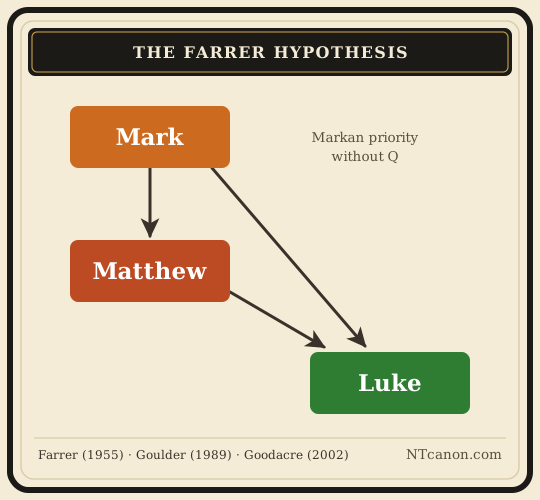
Refutation of Mark Goodacre’s Claims of Lukan Editorial Fatigue
In his influential article “Fatigue in the Synoptics” (New Testament Studies 44, no. 1 [1998]: 45–58; online text), Mark Goodacre defines editorial fatigue as an involuntary lapse occurring when an author who is reshaping a written source fails to sustain an initial modification and drifts back toward the wording or plot assumptions of his exemplar (Goodacre 1998, pp. 45–46). Below we examine each passage Goodacre adduces—first in the triple tradition and then in the double tradition—to test whether Luke ever betrays dependence on Mark or Matthew.
Herod: “King” or “Tetrarch”?
Goodacre opens (1998, pp. 46–47) with a classic example earlier highlighted by G. M. Styler in “The Priority of Mark” (Excursus IV in C. F. D. Moule, The Birth of the New Testament [London: A. & C. Black, 1962], pp. 223–232; 3rd ed. 1981, pp. 285–316): the account of John the Baptist’s execution (Mark 6:14–29 // Matthew 14:1–12 // cf. Luke 9:7–9). Throughout Mark 6:14–29, Herod Antipas is styled “king” (βασιλεύς, Mark 6:14, 22, 25, 26, 27). Matthew introduces him accurately at Matthew 14:1 as “Herod the tetrarch” (τετραάρχης)—matching the official title granted by Augustus and consistently used by Flavius Josephus (Antiquities 17.188; 18.102, 109, 122)—yet halfway through the narrative slips into calling him “the king” at Matthew 14:9, paralleling Mark 6:26.
Crucially, however, this lapse incriminates Matthew’s dependence on Mark, not Luke’s. Throughout his two volumes, Luke’s royal and tetrarchal titulature is historically exact: he reserves “king” for Herod the Great (Luke 1:5, “in the days of Herod, king of Judea”) and for Herod Agrippa I, who actually held the royal title under Claudius (Acts 12:1), whereas he consistently designates Herod Antipas “the tetrarch” across every single appearance (Luke 3:1, 3:19, 9:7; Acts 13:1). Under Lukan priority, the progression across the three Gospels is straightforward:
- Luke accurately distinguishes King Herod the Great (Luke 1:5) from Herod Antipas the tetrarch (Luke 3:1, 19; 9:7).
- Mark, expanding the brief notice of Antipas’s perplexity (Luke 9:7–9) into a vivid court tale of the banquet (Mark 6:14–29), applies the popular colloquial title “king” throughout for dramatic color.
- Matthew incorporates Mark’s banquet narrative, corrects Antipas’s opening title to “tetrarch” (Matthew 14:1) in light of Luke 9:7 (or general historical knowledge), and then lapses into Mark’s “the king” at Matthew 14:9.
Styler and Goodacre (1998, p. 47) also point to a second genuine contradiction inside Matthew’s account: whereas Mark 6:19–20 states that Herodias sought to kill John while Herod protected him, Matthew 14:5 asserts that Herod himself wanted to put John to death—yet four verses later Matthew 14:9 repeats from Mark 6:26 that “the king was sorry” to order John’s execution! Once again, this editorial self-contradiction demonstrates Matthew’s secondary compression of Mark, while Luke (who omits the entire banquet tale at Luke 3:19–20 and 9:7–9) exhibits zero trace of fatigue.
The Cleansing of the Leper
A second standard case involves the Cleansing of the Leper (Luke 5:12–16 // Mark 1:40–45 // Matthew 8:1–4; Goodacre 1998, p. 47). Returning to narrative material immediately after the Sermon on the Mount, Matthew 8:1 transitions by stating, “When he came down from the mountain, great crowds followed him.” Yet three verses later (Matthew 8:4), Jesus commands the healed leper, “See that you say nothing to anyone, but go, show yourself to the priest”—an injunction to secrecy rendered incongruous if great crowds had just witnessed the healing. In both Luke 5:12–14 and Mark 1:40–44, no crowds accompany Jesus into the scene, so the command to tell no one fits naturally. Like the death of John the Baptist, this example exposes Matthean editorial fatigue caused by splicing a narrative transition onto an earlier private healing pericope; it furnishes no evidence whatever against Lukan priority.
Jesus’ Mother and Brothers
Goodacre’s third preliminary case concerns the arrival of Jesus’ mother and brothers (Luke 8:19–21 // Mark 3:31–35 // Matthew 12:46–50; Goodacre 1998, pp. 47–48). In Mark, Jesus enters a house earlier at Mark 3:20, so when his mother and brothers arrive at Mark 3:31 “standing outside” (ἔξω στήκοντες), they stand outside the house. Goodacre notes that Matthew 12:46–47 retains “standing outside” without having retained Mark 3:20’s house transition after Jesus departed the synagogue (Matthew 12:15), and suggests a looser tension in Luke.
In Luke 8:19–20, however, the spatial relationship is self-contained and unambiguous: “Then his mother and his brothers came to him, but they could not reach him because of the crowd. And he was told, ‘Your mother and your brothers are standing outside, desiring to see you.’” Here “standing outside” (ἑστήκασιν ἔξω) refers directly to standing on the outer fringe of the dense crowd pressing around Jesus, not outside an unmentioned building. The Greek adverb ἔξω simply denotes being outside a given boundary—whether a crowd, a city, or a vineyard, as in Mark 11:19 (“they went out [ἔξω] of the city”) and Mark 12:8 (“they threw him out [ἔξω] of the vineyard”).
From the perspective of Lukan priority, Mark expanded the scene by inserting Mark 3:20–21 (where crowds press in at home—εἰς οἶκον—so heavily that Jesus cannot even eat, and his family seeks to seize him) to frame the Beelzebul controversy as a sandwich structure (intercalation) before resuming Jesus’ family at Mark 3:31–35. Matthew then drew on Mark’s sequence, dropped Mark 3:20–21’s unflattering family notice, omitted Luke’s explicit explanation (“because of the crowd”), and left “standing outside” (Matthew 12:46–47) hanging awkwardly while adding the dramatic gesture of Jesus stretching out his hand toward his disciples (Matthew 12:49). Rather than Lukan fatigue, the Greek word counts (NA28 / SBLGNT) display classic two-stage expansion from Luke 8:19–21 (54 words) to Mark 3:31–35 (79 words) to Matthew 12:46–50 (90 words).

The Parable of the Sower and Its Interpretation
Turning specifically to alleged Lukan fatigue in using Mark, Goodacre (1998, pp. 49–50) points to three differences between the Parable of the Sower and its subsequent interpretation in Luke 8:4–15 as compared with Mark 4:1–20 (// Matthew 13:1–23):
- In Mark 4:5, seed falling on rocky ground springs up immediately “since it had no depth of soil,” matching Mark 4:16–17; Luke 8:6 states more succinctly that it fell on the rock and withered as it grew up, before explaining in the interpretation (Luke 8:13) that such hearers receive the word with joy yet “have no root.”
- In Luke 8:6, the sprout withers “because it had no moisture,” whereas Luke 8:13 explains figuratively that “these have no root; they believe for a while, and in time of testing fall away” (paralleling Mark 4:17).
- In Mark 4:6, the rising sun scorches the plant, anticipating “tribulation or persecution” in Mark 4:17, whereas Luke 8:6 omits the scorching sun while Luke 8:13 speaks of “a time of testing” (ἐν καιρῷ πειρασμοῦ).
Goodacre’s argument assumes what it seeks to prove—namely, that an ancient parable must originally exhibit rigid one-to-one symmetry between every botanical image in the story and every moral clause in its explanation. In reality, rocks lack moisture precisely because roots cannot penetrate stone to reach groundwater; “lack of moisture” in the botanical story (Luke 8:6) and “lack of root” under “time of testing” in the spiritual application (Luke 8:13) are complementary facets of Palestinian agronomy, not a contradiction. On standard text-critical and redaction-critical principles (lectio difficilior potior), a concise, less symmetrical parable (Luke 8:5–8) is far more likely to have been filled out by a later storyteller (Mark 4:5–6) so that every detail of the allegory (shallow soil, scorching sun, rootlessness) was explicitly foreshadowed in advance, than for a careful stylist like Luke to strip vivid imagery out of Mark’s parable while retaining its interpretation. Once again, the Greek word counts (NA28 / SBLGNT) reflect steady expansion from Luke 8:4–15 (251 words) to Mark 4:1–20 (368 words) to Matthew 13:1–23 (444 words).

Healing of the Paralytic
Goodacre’s next triple-tradition example is the Healing of the Paralytic (Luke 5:17–26 // Mark 2:1–12; Goodacre 1998, pp. 50–51). Whereas Mark 2:1–2 opens by reporting that Jesus was “at home” (ἐν οἴκῳ) in Capernaum and that such a crowd gathered “that there was no more room, not even at the door,” Luke 5:17–19 describes Jesus teaching before seated Pharisees and teachers of the law and then notes that men carrying a paralytic, “finding no way to bring him in, because of the crowd, went up on the roof and let him down with his bed through the tiles into the midst before Jesus.” Goodacre contends that Luke omitted Mark’s house setting in v. 17 only to presuppose a house roof in v. 19.
That objection mistakes narrative economy for narrative incoherence. In Mediterranean storytelling, describing Jesus teaching a seated gathering of scholars indoors and stating that bearers could not “bring him in” (εἰσενεγκεῖν αὐτόν, Luke 5:18–19) because of the crowd already presupposes a domestic interior without requiring a separate preliminary sentence announcing that Jesus had entered a house. Compare the opening verses directly:
Luke 5:17–19 (ESV): 17 On one of those days, as he was teaching, Pharisees and teachers of the law were sitting there, who had come from every village of Galilee and Judea and from Jerusalem. And the power of the Lord was with him to heal. 18 And behold, some men were bringing on a bed a man who was paralyzed, and they were seeking to bring him in and lay him before Jesus, 19 but finding no way to bring him in, because of the crowd, they went up on the roof and let him down with his bed through the tiles into the midst before Jesus.
Mark 2:1–4 (ESV): 1 And when he returned to Capernaum after some days, it was reported that he was at home. 2 And many were gathered together, so that there was no more room, not even at the door. And he was preaching the word to them. 3 And they came, bringing to him a paralytic carried by four men. 4 And when they could not get near him because of the crowd, they removed the roof above him, and when they had made an opening, they let down the bed on which the paralytic lay.
Notice the reverse difficulty that Mark’s opening creates: Mark 2:1–2 replaces Luke 5:17’s crucial mention of the seated Pharisees and teachers of the law with a picturesque crowd blocking the doorway—leaving the sudden appearance of “some of the scribes sitting there” at Mark 2:6 unintroduced! Under Lukan priority, Luke 5:17’s hyper-Semitic introduction (cf. James R. Edwards, The Hebrew Gospel, 2009, p. 145) properly introduces the legal authorities who will shortly charge Jesus with blasphemy (Luke 5:21), while Mark rewrites the opening transition to dramatize the packed doorway and roof-digging (see Mark the “Re-Write Man”).
Goodacre (1998, p. 51) adds a subsidiary objection to Luke 5:21–22: in Luke 5:21 the scribes and Pharisees “began to question, saying [λέγοντες], ‘Who is this who speaks blasphemies?’” whereas Luke 5:22 continues, “When Jesus perceived their thoughts [τοὺς διαλογισμοὺς αὐτῶν], he answered them, ‘Why do you question in your hearts?’” Goodacre argues that “saying” in v. 21 clashes with Jesus perceiving their unspoken thoughts in v. 22, betraying incomplete editing of Mark 2:6–8 (“questioning in their hearts… immediately Jesus, perceiving in his spirit that they thus questioned within themselves…”). Yet in biblical Hebrew idiom—frequently preserved in Special and Proto-Lukan Greek—interior deliberation is routinely expressed with the participle lēʾmōr (לֵאמֹר, rendered λέγοντες, “saying [to themselves]”), or else murmured exchanges among seated scholars prompt Jesus to expose the deeper unbelief of their hearts. Mark 2:8, introducing Mark’s favorite connective “immediately” (εὐθύς) and “perceiving in his spirit that they thus questioned within themselves,” heightens the supernatural mind-reading motif by eliminating any possibility of murmured speech.
Feeding of the Five Thousand
What Goodacre calls one of his strongest cases of Lukan fatigue against Mark occurs in the Feeding of the Five Thousand (Luke 9:10–17 // Mark 6:30–44 // Matthew 14:13–21; Goodacre 1998, pp. 51–52). In Luke 9:10, Jesus takes the returning apostles and withdraws privately toward “a town called Bethsaida” (εἰς πόλιν καλουμένην Βηθσαϊδά); yet two verses later, as evening approaches, the Twelve say to him, “Send the crowd away to go into the surrounding villages and countryside to find lodging and get provisions, for we are here in a desolate place [ἐν ἐρήμῳ τόπῳ]” (Luke 9:12). Goodacre contends that Luke placed the miracle inside the town of Bethsaida at v. 10 and then absentmindedly copied “desolate place” from Mark 6:31, 35 at v. 12.
Both classical commentators and modern textual critics have long pointed out why no contradiction exists between Luke 9:10 and 9:12:
- Directional and Territorial Usage: Withdrawing “to” or “toward” (εἰς / ὑπεχώρησεν) a named polis in Hellenistic geography regularly designates entering that city’s rural territory (chōra) rather than its walled street grid. When the crowds learn of Jesus’ withdrawal and follow him (Luke 9:11), the gathering naturally occurs in the uncultivated pasturelands belonging to Bethsaida’s district.
- Traditional Exegetical Consensus: Early modern and nineteenth-century exegetes independently recognized this territorial sense long before the Farrer debate. The 1599 Geneva Bible marginal note on Luke 9:10 observed that the “desert” denoted open fields under Bethsaida’s jurisdiction rather than the town proper; John Gill in his Exposition of the New Testament (London: Aaron Ward, 1746–1748, on Luke 9:10) likewise explained it as the uncultivated pastureland belonging to Bethsaida; and The Pulpit Commentary: St. Luke (ed. H. D. M. Spence-Jones, vol. 1 [London: Kegan Paul, Trench & Co., 1889], on Luke 9:10) pointed specifically to the secluded grassy plain (modern el-Bateiha) just southeast of Bethsaida Julias, refounded by Philip the Tetrarch (cf. Josephus, Antiquities 18.28; see also H. A. W. Meyer, Critical and Exegetical Handbook to the Gospels of Mark and Luke [New York: Funk & Wagnalls, 1884], on Luke 9:10).
- Ancient Textual Variation at Luke 9:10: As Bruce M. Metzger documents in A Textual Commentary on the Greek New Testament (2nd ed. [Stuttgart: Deutsche Bibelgesellschaft / United Bible Societies, 1994], p. 122; cf. NA28 apparatus), while 𝔓75, Vaticanus (B), L, W, Ξ, and 33 read εἰς πόλιν καλουμένην Βηθσαϊδά (“to a city called Bethsaida”), Codex Sinaiticus (א*), Θ, and the Curetonian Syriac (syc) omit “city called Bethsaida” in favor of εἰς τόπον ἔρημον (“to a desolate place”), Codex Bezae (D) reads εἰς κώμην λεγομένην Βηθσαϊδά, and the Byzantine majority combines both (εἰς τόπον ἔρημον πόλεως καλουμένης Βηθσαϊδά, “into a desolate place belonging to a city called Bethsaida”).
Far from exposing Luke as a careless copyist who forgot within thirty words whether Jesus was standing in a city square or an uninhabited pasture, comparison of Luke 9:10–17 (175 Greek words in NA28; cf. Matthew 14:13–21 at 157 words) with Mark 6:30–44 (252 Greek words) reveals vivid Markan narrative amplification at every turn (Markan additions bolded):
- Luke 9:11 (ESV): When the crowds learned it, they followed him…
Mark 6:33 (ESV): Now many saw them going and recognized them, and they ran there on foot from all the towns and got there ahead of them. - Luke 9:13 (ESV): They said, “We have no more than five loaves and two fish—unless we are to go and buy food for all these people.”
Mark 6:37–38 (ESV): And they said to him, “Shall we go and buy two hundred denarii worth of bread and give it to them to eat?” And he said to them, “How many loaves do you have? Go and see.” And when they had found out, they said, “Five, and two fish.” - Luke 9:14 (ESV): And he said to his disciples, “Have them sit down in groups of about fifty each.”
Mark 6:39–40 (ESV): Then he commanded them all to sit down in groups on the green grass. So they sat down in groups, by hundreds and by fifties. - Luke 9:16–17 (ESV): And taking the five loaves and the two fish, he looked up to heaven and said a blessing over them. Then he broke the loaves and gave them to the disciples to set before the crowd. And they all ate and were satisfied. And what was left over was picked up, twelve baskets of broken pieces.
Mark 6:41–44 (ESV): And taking the five loaves and the two fish, he looked up to heaven and said a blessing and broke the loaves and gave them to the disciples to set before the people. And he divided the two fish among them all. And they all ate and were satisfied. And they took up twelve baskets full of broken pieces and of the fish. And those who ate the loaves were five thousand men.

Not Lukan Fatigue, but Markan Revision
While editorial fatigue genuinely illuminates several places where Matthew compresses or adapts Mark, the evidence across triple-tradition narratives points consistently to Markan expansion of an earlier Lukan or Proto-Lukan base text. Robert L. Lindsey summarized this discovery from his Hebrew retroversion work in Jerusalem:
Rather than assuming that Luke used Mark as the basis of his Gospel, as is commonly held by most New Testament scholars, it appears that the opposite is true. Mark employed Luke’s Gospel, along with another early source, and the result is a Gospel that is almost as much annotation and comment as original story. Mark’s principal method was to replace about half of Luke’s earlier and more authentic wording with a variety of synonyms and expressions he culled from certain Old and New Testament books that, today, we can identify usually simply by consulting Greek and Hebrew concordances of the Bible… Like the rabbis, Mark loved to find linguistic parallels to the text he was copying in other, often unrelated, books, and then mix words and phrases taken from these parallels with others of his sources. This method resulted in an amplified text that many scholars had thought gave an authenticity to Mark’s work, but which, in reality, should be described as a fascinating but rather inauthentic dramatization of the Gospel story. Due to Mark’s quite normal midrashic and aggadic Jewish methods, his Gospel is the “first cartoon life of Christ.” Mark was a “re-write man.” (Robert L. Lindsey, “My Search for the Synoptic Problem’s Solution (1959–1969),” Jerusalem Perspective, 2013)
Halvor Ronning likewise contrasts Luke’s conservative preservation of Semitic source syntax with Mark’s targumic storytelling:
In relation to … Jewish writers, we can judge that Luke was more steady and less innovative in relation to his sources. Even though we do not have copies of Luke’s sources we can observe how Luke preserved whole blocks of material that are more consistently easy to translate into Hebrew than the parallel material in Mark or Matthew. Luke does not share the same degree of erratic character with respect to Hebrew retroversion as does Mark. Like Luke, Matthew is also generally easier to revert to Hebrew than Mark, except where Matthew has a Markan parallel. Where Matthew has a Markan parallel, Matthew is just as difficult to revert to Hebrew as Mark. These observations are the origin of Lindsey’s insights regarding the dependence of Matthew on Mark, and the independence of Luke from either. Mark’s Gospel, on the other hand, exhibits the expansionist characteristics of a Jewish midrashic or targumistic storyteller. Like a targumist, Mark absolutely refused to replicate the wording of Luke… Mark’s editorial activity is not a matter of high theological interference with his sources. As a Jewish author, Mark simply followed in the footsteps of good targumic style: he dramatized his source by substituting synonyms, adding words from elsewhere, and rearranging and reversing word orders; anything to hold the reader’s attention and fascination. (Mark also demonstrates that he had an intensely active associative mind by recalling of words and phrases and ideas from the Septuagint and the writings of Paul and working these words and ideas into his paraphrase of Luke’s text.)
Due to this “targumic” activity the stories Mark told are almost always (literally 80% of the time) longer than the parallel accounts in Luke and Matthew. Mark is the longest Gospel, not the shortest in terms of the actual stories he decided to incorporate. Mark is shortest only in terms of overall length, but that is only because of the stories and sayings he chose to omit. Mark’s expansionist style fits his character as a sophisticated targumic story teller. (Halvor Ronning, “A Statistical Approach to the Synoptic Problem: Part 4—Non-Linear Hypotheses,” Jerusalem Perspective, 2016; citing Hajo Uden Meyboom [Meijboom], A History and Critique of the Origin of the Marcan Hypothesis, 1835–1866, trans. John J. Kiwiet [Macon, GA: Mercer University Press, 1993; Dutch orig. 1866], pp. 105–115)
For further documentation of Mark’s redactional habits, see Mark the “Re-Write Man”, Embellishments of Mark, and List of Markan Stereotypes and Pick-ups.
Claims of Lukan Fatigue with Respect to Matthew in the Double Tradition
To dispense with Q, Goodacre (1998, pp. 52–56) also attempts to find cases where Luke allegedly betrays editorial fatigue in copying canonical Matthew directly. None of these examples withstands scrutiny.
Jesus Sends Forth the Twelve for Ministry
In the Mission Charge to the Twelve (Luke 9:1–6 // Mark 6:6b–13 // Matthew 10:5–15; Goodacre 1998, pp. 53–54), Matthew 10:11–14 instructs the apostles: “And whatever town or village you enter, find out who is worthy in it, and stay there until you depart. As you enter the house, greet it… And if anyone will not receive you or listen to your words, shake off the dust from your feet when you leave that house or town.” Luke 9:4–5 reads more concisely: “And whatever house you enter, stay there, and from there depart. And wherever they do not receive you, when you leave that town, shake off the dust from your feet as a testimony against them.”
Goodacre claims that because Luke 9:4 mentions entering a “house” without first mentioning entering a “town,” Luke 9:5’s reference to leaving “that town” is a fatigued vestige of Matthew 10:11, 14. Yet comparison with Mark 6:6b, 10–11 reveals the actual three-stage editorial trajectory (Luke → Mark → Matthew):
Mark 6:6b, 10–11 (ESV): 6b And he went about among the villages teaching… 10 And he said to them, “Whenever you enter a house, stay there until you depart from there. 11 And if any place will not receive you and they will not listen to you, when you leave, shake off the dust that is on your feet as a testimony against them.”
Notice that Mark 6:10, just like Luke 9:4, speaks directly of entering a “house” without mentioning prior entry into a town (confirming that ancient readers understood houses to stand in towns, especially with Luke 9:6 immediately adding that they went “through the villages”). Mark 6:11 then generalizes Luke’s “that town” (τῆς πόλεως ἐκείνης) to “any place” (τόπος), creating slight ambiguity as to whether a rejecting household or an entire settlement is meant. Matthew 10:11–14 systematically resolves both earlier texts by inserting an explicit town/village entry at v. 11 and conflating the departure formula at v. 14 into “that house or town” (τῆς οἰκίας ἢ τῆς πόλεως ἐκείνης). As Evan Powell observes in The Myth of the Lost Gospel (Las Vegas, NV: Symposium Press, 2006, Chapter 3, p. 69), tying up perceived “loose ends” and ambiguities left standing in Luke and Mark is a hallmark of Matthean posteriority:
One of the curious features of the Gospels of Mark and Luke is that they contain stories which, if left on their own without explanation, had the potential to create theological confusion or historical skepticism. These may be viewed as the “loose ends” of the traditions. An editorial objective of Matthew was to tie up these loose ends by resolving tensions which were left standing in the earlier Gospels, and providing new solutions to puzzling questions. The existence of this unique explanatory material in Matthew constitutes more evidence that Matthew was the last of the Synoptic Gospels to have been composed. (Evan Powell, The Myth of the Lost Gospel, 2006, p. 69)

Parable of the Pounds (Minas) and the Talents
Goodacre’s principal double-tradition test case is the Parable of the Minas / Talents (Luke 19:11–27 // Matthew 25:14–30; Goodacre 1998, pp. 54–55). In Matthew 25:14–30, a man going on a journey entrusts five talents, two talents, and one talent to three servants; the first two double their sums and receive identical commendations (“enter into the joy of your master”), while the third buries his single talent, forfeits it to the servant with ten talents, and is cast into outer darkness. In Luke 19:11–27, a nobleman traveling to receive a kingdom entrusts ten minas to ten servants (one mina apiece) while hostile citizens send a delegation opposing his rule; upon his return as king, three representative servants are examined—one whose mina gained ten minas (rewarded with authority over ten cities), a second whose mina gained five (rewarded with five cities), and another who hid his mina in a cloth, whose mina is awarded to the servant holding ten minas before the rebellious citizens are executed.
Goodacre argues that Luke’s shift from “ten servants” at Luke 19:13 to testing three individuals at vv. 16–20, together with taking the single mina and giving it to the one who has ten (v. 24), reflects fatigued editing of Matthew’s three-servant parable. Compare the two parables directly:
Luke 19:11–27 (ESV): 11 As they heard these things, he proceeded to tell a parable, because he was near to Jerusalem, and because they supposed that the kingdom of God was to appear immediately. 12 He said therefore, “A nobleman went into a far country to receive for himself a kingdom and then return. 13 Calling ten of his servants, he gave them ten minas, and said to them, ‘Engage in business until I come.’ 14 But his citizens hated him and sent a delegation after him, saying, ‘We do not want this man to reign over us.’ 15 When he returned, having received the kingdom, he ordered these servants to whom he had given the money to be called to him, that he might know what they had gained by doing business. 16 The first came before him, saying, ‘Lord, your mina has made ten minas more.’ 17 And he said to him, ‘Well done, good servant! Because you have been faithful in a very little, you shall have authority over ten cities.’ 18 And the second came, saying, ‘Lord, your mina has made five minas.’ 19 And he said to him, ‘And you are to be over five cities.’ 20 Then another came, saying, ‘Lord, here is your mina, which I kept laid away in a handkerchief; 21 for I was afraid of you, because you are a severe man. You take what you did not deposit, and reap what you did not sow.’ 22 He said to him, ‘I will condemn you with your own words, you wicked servant! You knew that I was a severe man, taking what I did not deposit and reaping what I did not sow? 23 Why then did you not put my money in the bank, and at my coming I might have collected it with interest?’ 24 And he said to those who stood by, ‘Take the mina from him, and give it to the one who has the ten minas.’ 25 And they said to him, ‘Lord, he has ten minas!’ 26 ‘I tell you that to everyone who has, more will be given, but from the one who has not, even what he has will be taken away. 27 But as for these enemies of mine, who did not want me to reign over them, bring them here and slaughter them before me.’”
Matthew 25:14–30 (ESV): 14 “For it will be like a man going on a journey, who called his servants and entrusted to them his property. 15 To one he gave five talents, to another two, to another one, to each according to his ability. Then he went away. 16 He who had received the five talents went at once and traded with them, and he made five talents more. 17 So also he who had the two talents made two talents more. 18 But he who had received the one talent went and dug in the ground and hid his master’s money. 19 Now after a long time the master of those servants came and settled accounts with them. 20 And he who had received the five talents came forward, bringing five talents more, saying, ‘Master, you delivered to me five talents; here, I have made five talents more.’ 21 His master said to him, ‘Well done, good and faithful servant. You have been faithful over a little; I will set you over much. Enter into the joy of your master.’ 22 And he also who had the two talents came forward, saying, ‘Master, you delivered to me two talents; here, I have made two talents more.’ 23 His master said to him, ‘Well done, good and faithful servant. You have been faithful over a little; I will set you over much. Enter into the joy of your master.’ 24 He also who had received the one talent came forward, saying, ‘Master, I knew you to be a hard man, reaping where you did not sow, and gathering where you scattered no seed, 25 so I was afraid, and I went and hid your talent in the ground. Here, you have what is yours.’ 26 But his master answered him, ‘You wicked and slothful servant! You knew that I reap where I have not sown and gather where I scattered no seed? 27 Then you ought to have invested my money with the bankers, and at my coming I should have received what was my own with interest. 28 So take the talent from him and give it to him who has the ten talents. 29 For to everyone who has will more be given, and he will have an abundance. But from the one who has not, even what he has will be taken away. 30 And cast the worthless servant into the outer darkness. In that place there will be weeping and gnashing of teeth.’”
On internal literary and historical grounds, Luke’s parable is entirely natural on its own terms, whereas Matthew’s version bears unmistakable signs of secondary streamlining and inflation:
- Representative Sampling of Ten Servants: Ancient rabbinic and folk parables routinely introduce a round group (such as ten servants of a royal household) and narrate only three representative interviews (high achiever, moderate achiever, failure) rather than boring the audience with ten repetitive auditions. Notice too that Luke 19:20 says “another” (ὁ ἕτερος), not “the third and last,” and vv. 24–25 include bystanders protesting, “Lord, he already has ten minas!”—confirming that “the ten minas” idiomatic shorthand refers to the ten-mina profit just reported in v. 16.
- Concrete First-Century Judean Historical Context in Luke: Luke’s nobleman traveling to a distant imperial capital to receive kingship while a Jewish embassy follows to protest his appointment (Luke 19:12, 14, 27) unmistakably mirrors Archelaus’s voyage to Rome in 4 BC after Herod the Great’s death, when fifty Judean envoys petitioned Augustus against his rule (Josephus, Jewish War 2.14–38, 80–100; Antiquities 17.221–249, 299–320). It is virtually inconceivable that a later Gentile editor invented this precise Herodian political backdrop out of Matthew’s generic merchant narrative, whereas a later catechetical editor (Matthew) had obvious reasons to strip away the local political subplot to create a streamlined parousia allegory (“after a long time,” Matthew 25:19).
- Monetary Inflation from Minas to Talents: An Attic mina equaled 100 drachmas, whereas a talent equaled 60 minas (6,000 drachmas—nearly twenty years’ wages for a laborer!). Whereas Luke’s nobleman tests his servants “in a very little” (ἐν ἐλαχίστῳ, Luke 19:17) with a modest single mina each, Matthew inflates the sums sixtyfold to three-hundredfold (five talents, two talents, one talent), creating an internal tension when Matthew 25:21, 23 still retains the commendation “You have been faithful over a little [ἐπὶ ὀλίγα]” regarding five talents of silver or gold!
- Narrative Context for the “Harsh Man” Charge and Eschatological Ending: In Luke 19:14, 21, 27, the fearful servant’s characterization of his lord as a “severe man” coheres with a ruthless Herodian claimant hated by his subjects; in Matthew 25:24, where the master has just been portrayed as extraordinarily generous and inviting servants into “the joy of your master,” the accusation hangs without narrative motivation, while Matthew 25:30 appends Matthew’s signature eschatological refrain (“cast the worthless servant into the outer darkness. In that place there will be weeping and gnashing of teeth”; cf. Matthew 8:12; 13:42, 50; 22:13; 24:51), stepping completely outside the commercial metaphor.

Smaller Double-Tradition Examples
Goodacre (1998, p. 55) briefly mentions two minor double-tradition parallels. First, in the Healing of the Centurion’s Servant (Luke 7:1–10 // Matthew 8:5–13), Luke refers to the sick youth as a δοῦλος (“bondservant/slave”) in Luke 7:2–3, 10, while the centurion affectionately calls him ὁ παῖς μου (“my boy/servant”) in direct speech at Luke 7:7; Matthew uses παῖς uniformly throughout (Matthew 8:6, 8, 13). Far from betraying Lukan fatigue, shifting between narrative δοῦλος and personal παῖς in direct speech is natural Greek variation, which Matthew standardized when drastically abbreviating the story (cutting out both delegations of Jewish elders and friends). Second, in Luke 10:23–24 (// Matthew 13:16–17), Jesus pronounces “Blessed are the eyes that see what you see!” before adding that many prophets and kings longed “to see what you see… and to hear what you hear.” That Luke 10:23 does not duplicate “and your ears, for they hear” (Matthew 13:16) creates zero logical tension; rather, Matthew 13:16 expands Luke’s single beatitude into a balanced couplet to echo Isaiah 6:9–10 in the preceding verses (Matthew 13:13–15).
Final Example: “These Little Ones” (Luke 17:1–2 vs. Mark 9:33–42 vs. Matthew 18:1–14)
Goodacre’s final example (1998, pp. 55–56) contrasts Jesus’ warning against causing “one of these little ones” (τῶν μικρῶν τούτων ἕνα) to stumble in Luke 17:1–2 with Mark 9:33–42 and Matthew 18:1–6:
Luke 17:1–2 (ESV): 1 And he said to his disciples, “Temptations to sin are sure to come, but woe to the one through whom they come! 2 It would be better for him if a millstone were hung around his neck and he were cast into the sea than that he should cause one of these little ones to sin.”
Goodacre argues that the demonstrative “these little ones” in Luke 17:2 lacks a visible antecedent because Luke placed the child-setting pericope earlier at Luke 9:46–48, whereas Matthew 18:1–6 places a literal child in the disciples’ midst immediately before the millstone saying. Yet across early Jewish and Christian speech (cf. Zechariah 13:7; Matthew 10:42, where no literal child is on stage either!), “little ones” (הַקְּטַנִּים / οἱ μικροί) was a familiar designation for humble disciples and vulnerable novices in faith, especially directly following Jesus’ defense of repentant tax collectors and sinners against murmuring Pharisees in Luke 15–16.
Even more tellingly, tracing how Mark 9:33–50 and Matthew 18:1–22 were assembled demonstrates Matthean conflation of Luke and Mark beyond reasonable doubt. First, Mark took two consecutive Lukan episodes from Luke 9:46–50 (True Greatness with a child + the Strange Exorcist) and attached the millstone saying from Luke 17:2 onto the end (Mark 9:42), clarifying “these little ones” by adding “who believe in me.” Next, canonical Matthew constructed his fourth great discourse on church community (Matthew 18) by taking Mark’s sequence (Mark 9:33–48) as his spine and weaving in Lukan sayings from Luke 15 and Luke 17:
Matthew 18:3–4 (ESV): 3 and said, “Truly, I say to you, unless you turn and become like children, you will never enter the kingdom of heaven. 4 Whoever humbles himself like this child is the greatest in the kingdom of heaven.”
Matthew 18:10, 12–14 (ESV): 10 “See that you do not despise one of these little ones. For I tell you that in heaven their angels always see the face of my Father who is in heaven. 12 What do you think? If a man has a hundred sheep, and one of them has gone astray, does he not leave the ninety-nine on the mountains and go in search of the one that went astray? 13 And if he finds it, truly, I say to you, he rejoices over it more than over the ninety-nine that never went astray. 14 So it is not the will of my Father who is in heaven that one of these little ones should perish.”
Notice that in Matthew 18:6, 10, 14 itself, “these little ones” explicitly denotes adult believers who might wander from the community, proving that Matthew understood “little ones” metaphorically for disciples just as Luke 17:2 did! Just as Matthew 10:9 (“Acquire no gold, nor silver, nor copper in your belts”) conflates Luke 9:3’s “silver” (ἀργύριον) with Mark 6:8’s “copper” (χαλκόν) and tops both with “gold” (χρυσόν), Matthew 18 systematically harmonizes Mark 9 with Luke 15 and Luke 17.
Step 1: Mark’s Expansion of Luke (Markan Additions in Bold)
| Lukan Base Text (ESV) | Markan Expansion (ESV) |
|---|---|
| Luke 9:46–48: 46 An argument arose among them as to which of them was the greatest. 47 But Jesus, knowing the reasoning of their hearts, took a child and put him by his side 48 and said to them, “Whoever receives this child in my name receives me, and whoever receives me receives him who sent me. For he who is least among you all is the one who is great.” | Mark 9:33–37: 33 And they came to Capernaum. And when he was in the house he asked them, “What were you discussing on the way?” 34 But they kept silent, for on the way they had argued with one another about who was the greatest. 35 And he sat down and called the twelve. And he said to them, “If anyone would be first, he must be last of all and servant of all.” 36 And he took a child and put him in the midst of them, and taking him in his arms, he said to them, 37 “Whoever receives one such child in my name receives me, and whoever receives me, receives not me but him who sent me.” |
| Luke 9:49–50: 49 John answered, “Master, we saw someone casting out demons in your name, and we tried to stop him, because he does not follow with us.” 50 But Jesus said to him, “Do not stop him, for the one who is not against you is for you.” | Mark 9:38–41: 38 John said to him, “Teacher, we saw someone casting out demons in your name, and we tried to stop him, because he was not following us.” 39 But Jesus said, “Do not stop him, for no one who does a mighty work in my name will be able soon afterward to speak evil of me. 40 For the one who is not against us is for us. 41 For truly, I say to you, whoever gives you a cup of water to drink because you belong to Christ will by no means lose his reward.” |
| Luke 17:1–2: 1 And he said to his disciples, “Temptations to sin are sure to come, but woe to the one through whom they come! 2 It would be better for him if a millstone were hung around his neck and he were cast into the sea than that he should cause one of these little ones to sin.” | Mark 9:42: 42 “Whoever causes one of these little ones who believe in me to sin, it would be better for him if a great millstone were hung around his neck and he were thrown into the sea.” |
Step 2: Matthew’s Conflation and Expansion of Both Mark and Luke (Matthean Additions in Bold)
| Markan / Lukan Source Texts (ESV) | Matthean Composite Discourse — Matthew 18:1–22 (ESV) |
|---|---|
| Mark 9:33–37 (cf. Luke 9:46–48): Argument over greatness; child set in their midst; receiving a child in Jesus’ name. | Matthew 18:1–5: 1 At that time the disciples came to Jesus, saying, “Who is the greatest in the kingdom of heaven?” 2 And calling to him a child, he put him in the midst of them 3 and said, “Truly, I say to you, unless you turn and become like children, you will never enter the kingdom of heaven. 4 Whoever humbles himself like this child is the greatest in the kingdom of heaven. 5 Whoever receives one such child in my name receives me…” |
| Mark 9:42 + Luke 17:1–2: Millstone warning (“who believe in me” from Mark 9:42) + inevitable temptations woe (“Temptations to sin are sure to come, but woe to the one through whom they come!” from Luke 17:1). | Matthew 18:6–7: 6 “…but whoever causes one of these little ones who believe in me to sin, it would be better for him to have a great millstone fastened around his neck and to be drowned in the depth of the sea. 7 Woe to the world for temptations to sin! For it is necessary that temptations come, but woe to the one by whom the temptation comes!” |
| Mark 9:43–48: Cutting off hand, foot, or eye causing sin rather than being thrown into Gehenna. | Matthew 18:8–9: 8 “And if your hand or your foot causes you to sin, cut it off and throw it away. It is better for you to enter life crippled or lame than with two hands or two feet to be thrown into the eternal fire. 9 And if your eye causes you to sin, tear it out and throw it away…” |
| Luke 15:3–7: Parable of the Lost Sheep (a man leaving ninety-nine sheep to seek the one lost sheep, rejoicing when it is found). | Matthew 18:10–14: 10 “See that you do not despise one of these little ones. For I tell you that in heaven their angels always see the face of my Father who is in heaven. 12 What do you think? If a man has a hundred sheep, and one of them has gone astray… 14 So it is not the will of my Father who is in heaven that one of these little ones should perish.” |
| Luke 17:3–4: 3 “Pay attention to yourselves! If your brother sins, rebuke him, and if he repents, forgive him, 4 and if he sins against you seven times in the day, and turns to you seven times, saying, ‘I repent,’ you must forgive him.” | Matthew 18:15–22: 15 “If your brother sins against you, go and tell him his fault, between you and him alone… 17 tell it to the church… 18 whatever you bind on earth… 20 For where two or three are gathered in my name, there am I among them.” 21 Then Peter came up and said to him, “Lord, how often will my brother sin against me, and I forgive him? As many as seven times?” 22 Jesus said to him, “I do not say to you seven times, but seventy-seven times.” |
Additional Examples of Matthean Conflation of Mark and Luke
In The Myth of the Lost Gospel (Las Vegas, NV: Symposium Press, 2006, pp. 95–102), Evan Powell demonstrates that canonical Matthew repeatedly constructs continuous passages by interweaving distinct phrases from Mark and Luke—a redactional pattern unique to Matthew that decisively refutes both the Q hypothesis and the Farrer hypothesis.
The Calling and Sending of the Twelve (Matthew 9:35–10:4)
Within just eight consecutive verses introducing the Mission Discourse (Matthew 9:35–10:4), Matthew weaves together phrases scattered across two chapters of Mark and four chapters of Luke: Mark 6:6b, Luke 8:1, Mark 6:34, Luke 10:2, Luke 9:1, Mark 3:14–19, and Luke 6:13–16 (Powell 2006, pp. 96–97). Consider how Matthew 9:35–38 stitches four alternating Markan and Lukan verses into a seamless bridge:
- Mark 6:6b (NRSV): Then he went about among the villages teaching.
- Luke 8:1 (NRSV): Soon afterwards he went on through cities and villages, proclaiming and bringing the good news of the kingdom of God.
- Mark 6:34 (NRSV): As he went ashore, he saw a great crowd; and he had compassion for them, because they were like sheep without a shepherd…
- Luke 10:2 (NRSV): He said to them, “The harvest is plentiful, but the laborers are few; therefore ask the Lord of the harvest to send out laborers into his harvest.”
Composite Result — Matthew 9:35–38 (NRSV): “35 Then Jesus went about all the cities and villages, teaching in their synagogues, and proclaiming the good news of the kingdom, and curing every disease and every sickness. 36 When he saw the crowds, he had compassion for them, because they were harassed and helpless, like sheep without a shepherd. 37 Then he said to his disciples, ‘The harvest is plentiful, but the laborers are few; 38 therefore ask the Lord of the harvest to send out laborers into his harvest.’”
The Beelzebul Controversy (Luke 11:14–23 // Mark 3:22–27 // Matthew 12:22–30)
An equally striking demonstration occurs in the Beelzebul Controversy. Whereas Mark 3:22–27 and Luke 11:14–23 share minimal verbatim overlap with each other, Matthew 12:22–30 reproduces virtually every line of Luke’s dialogue verbatim while splicing Mark’s distinctive clauses (“How can Satan cast out Satan?”; “enter a strong man’s house and plunder his goods…”) right into the middle of Luke’s sentences (underlined below following Evan Powell, The Myth of the Lost Gospel [Las Vegas, NV: Symposium Press, 2006], pp. 95–96):
| Luke 11:14–23 (RSV) | Mark 3:22–27 (RSV) | Matthew 12:22–30 (RSV) |
|---|---|---|
| 14 Now he was casting out a demon that was dumb; when the demon had gone out, the dumb man spoke, and the people marveled. | — | 22 Then a blind and dumb demoniac was brought to him, and he healed him, so that the dumb man spoke and saw. 23 And all the people were amazed, and said, “Can this be the Son of David?” |
| 15 But some of them said, “He casts out demons by Beelzebul, the prince of demons”; 16 while others, to test him, sought from him a sign from heaven. | 22 And the scribes who came down from Jerusalem said, “He is possessed by Beelzebul, and by the prince of demons he casts out demons.” | 24 But when the Pharisees heard it, they said, “It is only by Beelzebul, the prince of demons, that this man casts out demons.” |
| 17 But he, knowing their thoughts, said to them, “Every kingdom divided against itself is laid waste, and a divided household falls. 18 And if Satan also is divided against himself, how will his kingdom stand? For you say that I cast out demons by Beelzebul. | 23 And he called them to him, and said to them in parables, “How can Satan cast out Satan? 24 If a kingdom is divided against itself, that kingdom cannot stand. 25 And if a house is divided against itself, that house will not be able to stand. 26 And if Satan has risen up against himself and is divided, he cannot stand, but is coming to an end. | 25 Knowing their thoughts, he said to them, “Every kingdom divided against itself is laid waste, and no city or house divided against itself will stand; 26 and if Satan casts out Satan, he is divided against himself; how then will his kingdom stand? |
| 19 And if I cast out demons by Beelzebul, by whom do your sons cast them out? Therefore they shall be your judges. 20 But if it is by the finger of God that I cast out demons, then the kingdom of God has come upon you. | — | 27 And if I cast out demons by Beelzebul, by whom do your sons cast them out? Therefore they shall be your judges. 28 But if it is by the Spirit of God that I cast out demons, then the kingdom of God has come upon you. |
| (Cf. Luke 11:21–22: When a strong man, fully armed, guards his own palace, his goods are in peace; but when one stronger than he assails him and overcomes him, he takes away his armor in which he trusted, and divides his spoil.) | 27 But no one can enter a strong man’s house and plunder his goods, unless he first binds the strong man; then indeed he may plunder his house. | 29 Or how can one enter a strong man’s house and plunder his goods, unless he first binds the strong man? Then indeed he may plunder his house. |
| 23 He who is not with me is against me, and he who does not gather with me scatters. | — | 30 He who is not with me is against me, and he who does not gather with me scatters.” |
Summarizing the force of these conflationary passages against both the Two-Source and Farrer hypotheses, Powell writes:
The key point to be made… is this: The fact that Matthean texts exist that are conflations of material found in Mark and Luke is a phenomenon unique to Matthew. There is no similar array of texts in Luke that appear to have been composed from elements in Mark and Matthew. Yet if Luke had used Mark and Matthew, as Griesbach and Farrer–Goulder advocates maintain, we should be able to detect a similar pattern in Luke, at least to the degree that it is present in Matthew. Furthermore, if Matthew and Luke had independently drawn upon Mark and Q, it is a mystery how Matthew could routinely generate texts that appear to be conflations of Mark and Luke, while Luke could routinely avoid any indication of having conflated Mark and Matthew. The presence of this textual pattern in Matthew, and its corollary absence from Luke, lends additional weight to the theory of Matthean Posteriority, and poses difficulties for all competing solutions to the Synoptic Problem. (Evan Powell, The Myth of the Lost Gospel, Las Vegas, NV: Symposium Press, 2006, p. 102)
A Clear Case of Matthean Editorial Fatigue in Using Luke
If canonical Matthew wrote last in light of Luke, we should also find direct examples of Matthean editorial fatigue when abbreviating Lukan double-tradition material. A textbook instance appears in John the Baptist’s preaching (Luke 3:7–16 // Matthew 3:7–11):
| Luke 3:7–16 (ESV) | Matthew 3:7–11 (ESV) |
|---|---|
| 7 He said therefore to the crowds that came out to be baptized by him, “You brood of vipers! Who warned you to flee from the wrath to come? 8 Bear fruits in keeping with repentance. And do not begin to say to yourselves, ‘We have Abraham as our father.’ For I tell you, God is able from these stones to raise up children for Abraham. 9 Even now the axe is laid to the root of the trees. Every tree therefore that does not bear good fruit is cut down and thrown into the fire.” 10 And the crowds asked him, “What then shall we do?” 11 And he answered them, “Whoever has two tunics is to share with him who has none, and whoever has food is to do likewise.” 12 Tax collectors also came to be baptized… 14 Soldiers also asked him… 15 As the people were in expectation, and all were questioning in their hearts concerning John, whether he might be the Christ, 16 John answered them all, saying, “I baptize you with water, but he who is mightier than I is coming, the strap of whose sandals I am not worthy to untie. He will baptize you with the Holy Spirit and fire.” |
7 But when he saw many of the Pharisees and Sadducees coming to his baptism, he said to them, “You brood of vipers! Who warned you to flee from the wrath to come? 8 Bear fruit in keeping with repentance. 9 And do not presume to say to yourselves, ‘We have Abraham as our father,’ for I tell you, God is able from these stones to raise up children for Abraham. 10 Even now the axe is laid to the root of the trees. Every tree therefore that does not bear good fruit is cut down and thrown into the fire. 11 “I baptize you with water for repentance, but he who is coming after me is mightier than I, whose sandals I am not worthy to carry. He will baptize you with the Holy Spirit and fire.” |
In Luke 3:7–16, John addresses repentant crowds coming out to be baptized (vv. 7, 10–14) and expectant people wondering whether he is the Messiah (Luke 3:15), naturally telling them, “I baptize you with water… He will baptize you with the Holy Spirit and fire.” Matthew, eager to sharpen anti-Pharisaic polemic, replaces Luke’s crowds in v. 7 with “many of the Pharisees and Sadducees” and excises Luke’s ethical dialogue (Luke 3:10–15)—leaving John declaring directly to unrepentant Pharisees and Sadducees in Matthew 3:11, “I baptize you with water for repentance… He will baptize you with the Holy Spirit and fire!” That incongruous pronoun sequence is a classic symptom of Matthean editorial fatigue in abridging Luke.
Additional Statistical and Literary Arguments Against the Farrer Hypothesis
Beyond individual pericopes, macro-level statistical and structural studies expose severe difficulties in assuming that Luke used canonical Matthew.
Statistical Validation of Lukan Priority and Strings of Verbal Agreement
As documented in Statistical Validation of Lukan Priority, Halvor Ronning’s analysis of Identical Form and Sequence (IFS) words across all six Synoptic permutations demonstrates that only models placing Mark in the middle position (Luke → Mark → Matthew or Matthew → Mark → Luke) match observed triple-tradition retention rates within 0.1%, whereas the Farrer sequence (Mark → Matthew → Luke) fails to account for the distribution of triple- and double-tradition agreements.
Similarly, in Chapter 2 of Matthean Posteriority: An Exploration of Matthew’s Use of Mark and Luke as a Solution to the Synoptic Problem (LNTS 501 [London: Bloomsbury T&T Clark, 2015], pp. 50–77), Robert K. MacEwen measures Strings of Verbal Agreement of four or more identical Greek words (SVAs ≥ 4) to test whether Matthew’s editorial behavior under the Matthean Posteriority Hypothesis (MPH) or Luke’s editorial behavior under the Farrer Hypothesis (FH) is more consistent:
On the MPH [Matthean Posteriority Hypothesis], Matthew can be seen as behaving consistently in copying from his two sources Mark and Luke—he generally copies from both rather conservatively. In contrast, on the FH [Farrer Hypothesis], Luke appears rather inconsistent in copying from his two sources Mark and Matthew—he generally copies from Matthew quite conservatively but is more periphrastic in taking over material from Mark. … [According to MPH] the difference in Matthew’s use of SVAs≥4 in his Markan material and in his Lukan material is 1.7%. [According to FH] the difference in Luke’s use of SVAs≥4 in his Matthean material and his Markan material is 6.0%. (Robert K. MacEwen, Matthean Posteriority, London: Bloomsbury T&T Clark, 2015, pp. 66–67)
The Implausibility of Luke’s Redactional Procedure Under the Farrer Model
Later in the same monograph (“Evaluation of the Farrer Hypothesis in Light of Luke’s Procedures on This Hypothesis,” pp. 170–176), MacEwen highlights the bizarre editorial gymnastics attributed to Luke if Luke worked from canonical Matthew:
Luke is often pleased with the sayings that Matthew has added to Markan contexts, but is usually not content to leave such sayings in those contexts; it is as if something compels him to remove them and put them elsewhere… Perhaps the strongest example of Luke’s compulsion, on the FH, to remove Matthean material from Markan contexts, is the Eschatological Discourses (Matt 24–25 // Mark 14 [sic: Mark 13] // Luke 21). In the handling of this section, Luke seems to have taken careful note of all the material Matthew added to Mark’s version, deleted some of it, and moved the rest to earlier contexts in his own Gospel… Another, related observation about Luke’s procedure on the FH is that Luke does a massive amount of rearrangement of small units of sayings material, often for the sake of constructing fairly small units of discourse. For example, a short speech to the disciples on the need to fear God rather than people (Luke 12:1–12) draws on material from three different contexts in Matthew (Matt 16:6, Matt 10:19 and Matt 12:32). … The large-scale rearrangement of Matthew’s sayings material that Luke, on the FH, carried out, would appear to have been an extraordinarily complex and time-consuming endeavor. The complexity of Luke’s procedure added to the impression that Luke’s recontextualizations often do not seem to achieve obvious improvements on Matthew’s arrangements and contexts, would seem to call the validity of the FH into question. (Robert K. MacEwen, Matthean Posteriority, 2015, pp. 170–172)
Evan Powell’s quantitative comparison across seven thematic categories in The Myth of the Lost Gospel (2006, pp. 41–43) reinforces this conclusion. Even though the Gospel of Luke is roughly 7% longer overall than canonical Matthew, Luke contains markedly fewer developed occurrences across every major doctrinal and supernatural category than Matthew: supernatural events (77% of Matthew’s total), eschatological sayings (71%), ethical teachings (73%), references to Jesus as Christ (75%), Son of Man sayings (83%), Kingdom references (75%), and designations of God as Father (only 36% of Matthew’s total; Powell 2006, p. 41). As Powell observes, positing Lukan dependence on Matthew forces one to imagine an Evangelist who systematically dismantled the Sermon on the Mount, abbreviated the Beatitudes and the Lord’s Prayer, stripped away nearly two-thirds of Matthew’s references to God’s Fatherhood, and discarded the Trinitarian baptismal formula of Matthew 28:19:
[Some] theories argue that Luke was dependent on Matthew. Yet, the data we have just reviewed is difficult to explain under such a scenario. We must imagine that Luke, in using Matthew as a source, managed to diminish its traditions across the board both qualitatively and quantitatively, while at the same time producing a Gospel that was longer than Matthew by 7%. In the process he eviscerated the Lord’s Prayer and the Beatitudes; he dismantled the Sermon on the Mount and reformulated it as a more anemic Sermon on the Plain… It is difficult to imagine what Luke would have had in mind to have used Matthew in this manner. (Evan Powell, The Myth of the Lost Gospel, Las Vegas, NV: Symposium Press, 2006, pp. 42–43)
Conclusion: Matthew Is the Revisionist
Careful examination of every passage adduced for the Farrer hypothesis confirms that canonical Matthew—not Luke—stands at the end of the Synoptic chain. Claims of Lukan editorial fatigue rest on reading Markan and Matthean expansions anachronistically back into Luke’s concise, historically grounded narratives, whereas genuine editorial fatigue (as in Matthew 3:7–11; 8:1–4; 12:46–50; 14:1–9) and systematic two-source conflation (as in Matthew 9:35–38; 10:9–14; 12:22–30; 18:1–22) consistently expose Matthew’s secondary reliance on both Luke and Mark (see further Evidence for Matthean Posteriority). Far from being a careless compiler who mutilated Matthew’s discourses, the author of Luke-Acts faithfully preserved the earliest recoverable form of the Synoptic Gospel tradition.