Lukan Priority
The Hebrew Gospel and Luke
Introduction
In The Hebrew Gospel and the Development of the Synoptic Tradition (Grand Rapids, MI: Wm. B. Eerdmans Publishing Co., 2009), James R. Edwards advances a comprehensive patristic and philological case that an early Jewish-Christian Hebrew Gospel served as a principal source for the primitive narrative and special material of the Gospel of Luke. Rather than treating the patristic testimonies to a “Gospel according to the Hebrews” as late harmonies derived from canonical Matthew, Edwards argues that the author of the Third Gospel drew upon a single foundational Hebrew narrative both for Special Luke and for much of his overarching sequence (Edwards 2009, pp. xvii–xxii, 257–262). This article synthesizes the patristic evidence for the Hebrew Gospel, its marked lexical and structural affinity with canonical Luke, and its lack of literary correlation with canonical Greek Matthew.
What Is the Hebrew Gospel?
Across the first millennium of Christian literature, numerous Greek, Latin, and Syriac writers refer to an early Jewish-Christian Gospel composed in Hebrew characters—commonly designated “the Gospel according to the Hebrews” or “the Hebrew Gospel”—which survives today only in patristic quotations and allusions. Testimonies to this work span more than two dozen ancient witnesses distributed from Gaul and Italy in the west to Syria, Egypt, and reportedly India in the east (Edwards 2009, pp. 1–98; cf. Eusebius, Ecclesiastical History 5.10.3 on Pantaenus). Among non-canonical Christian writings, none enjoyed wider circulation or higher esteem among orthodox exegetes, and when its surviving fragments are compared across the Synoptic tradition, their closest canonical counterpart is consistently the Gospel of Luke rather than canonical Matthew (Edwards 2009, pp. 99–124).
Primary Attestations of the Hebrew Gospel
Early Christian scholars of the third and fourth centuries cited the Hebrew Gospel with notable respect even as canonical boundaries hardened. Origen of Alexandria (c. 185–254), the foremost textual scholar of the pre-Nicene church, quoted the Gospel according to the Hebrews on multiple occasions while signaling its non-canonical standing with cautious introductory formulas such as “if anyone accepts the Gospel according to the Hebrews” (Homilies on Jeremiah 15.4; Commentary on Matthew 15.14; cf. Commentary on John 2.12; Edwards 2009, pp. 18–23). Similar qualified formulas recur in Eusebius of Caesarea (Ecclesiastical History 3.25.5; 3.39.17; 4.22.8), showing that although the work did not command undisputed canonical status among Greek-speaking churches, it remained a recognized witness to early tradition.
Eusebius’s early fourth-century canon catalog in Ecclesiastical History 3.25.1–7 provides decisive evidence for the work’s standing. Dividing Christian writings into “recognized” (homologoumena), “disputed” (antilegomena), and rejected or heretical books, Eusebius did not consign the Gospel according to the Hebrews to the spurious or heretical rejections at the bottom of his list. Instead, right alongside his discussion of the Apocalypse of John—whose canonical status remained divided—he noted that some also placed there the Gospel according to the Hebrews, in which Jewish believers in Christ especially delighted, adding that these disputed works were nevertheless “known to most” ecclesiastical writers (Ecclesiastical History 3.25.5–6; Edwards 2009, pp. 100–103).
That both Origen and Eusebius situated the Hebrew Gospel within a narrow middle tier of disputed yet widely respected works—rather than among Gnostic fabrications—attests to its ancient pedigree and enduring prestige across early Christian communities.
Summary of the Significance of the Hebrew Gospel in the Early Church
In his survey of sources from the late first through the tenth centuries, Edwards catalogs roughly seventy-five references or allusions to the Hebrew Gospel across twenty patristic and medieval Christian authors: Ignatius of Antioch, Papias of Hierapolis, Irenaeus, Pantaenus, Clement of Alexandria, Hegesippus, Hippolytus, Origen, Eusebius of Caesarea, Ephrem the Syrian, Didymus the Blind, Epiphanius of Salamis, John Chrysostom, Jerome (who refers to it twenty-two times), Theodoret of Cyrrhus, Marius Mercator, Philip of Side, the Venerable Bede, Nicephorus of Constantinople, and Sedulius Scottus, supplemented by potential notices in Pope Damasus, the To Ioudaikon marginalia of manuscripts related to Codex Sinaiticus, Babylonian Talmud Shabbat 116a–b, and early Islamic traditions (Edwards 2009, pp. 1–98, 99–103).
Assessing this patristic record, Edwards concludes:
No other noncanonical document occupied the “disputed” category in canonical deliberations in the early church as long and consistently as did the Hebrew Gospel. To my knowledge, no other noncanonical text was cited as frequently and positively alongside canonical texts in early Christian exegesis. More important, witnesses to the Hebrew Gospel are as ancient as patristic witnesses to any of the four canonical Gospels. The Hebrew Gospel was the most highly esteemed noncanonical document in the early church. (James R. Edwards, The Hebrew Gospel and the Development of the Synoptic Tradition, 2009, p. 103)
What progressively eroded the standing of the Hebrew Gospel in the wider catholic church was its linguistic inaccessibility to Greek and Latin readers and its exclusive adoption by Jewish-Christian sects such as the Nazarenes and Ebionites, whose low or adoptionist Christologies clashed with developing Nicene orthodoxy. Furthermore, as the high Logos Christology of the Fourth Gospel became the doctrinal benchmark of patristic theology, a primitive Semitic narrative lacking pre-existence categories fell under increasing suspicion and was ultimately excluded from the fourfold canon (Edwards 2009, pp. 104–108).
Even outside the canon, however, church fathers continued to appeal to the Hebrew Gospel as an interpretive aid. Clement of Alexandria cited it alongside Plato and canonical Scripture to illustrate heavenly wisdom (Stromata 2.9.45.5; 5.14.96.3; Edwards 2009, pp. 14–16, 104), while Origen, Didymus the Blind, and Jerome repeatedly consulted it to clarify difficulties in the canonical text—making it one of only two non-canonical narratives Jerome ever employed in biblical exegesis (Edwards 2009, pp. 103–105). Earlier scholars recognized this exceptional status: Oscar Holtzmann observed that in early Alexandria the Gospel according to the Hebrews “rank[ed] as equal to the Johannine Gospel in value” (The Life of Jesus, trans. J. T. Bealby and Maurice A. Canney [London: A. & C. Black, 1904], p. 46; cited in Edwards 2009, p. 104), and Adam Fyfe Findlay noted that authorities such as Origen felt obliged to demonstrate that their exegesis did not conflict with its testimony (Byways in Early Christian Literature: Studies in the Uncanonical Gospels and Acts [Edinburgh: T. & T. Clark, 1923], p. 50; cited in Edwards 2009, p. 104).
The Hebrew Gospel Correlates to Luke
Long before Edwards’s monograph, Pierson Parker demonstrated in his study “A Proto-Lukan Basis for the Gospel According to the Hebrews” (Journal of Biblical Literature 59, no. 4 [1940]: 471–478, at p. 472) that “the Gospel according to the Hebrews is not Matthean, and is to be related to the non-Markan portions of Luke.” Across surviving quotations preserved in Ignatius, Clement of Alexandria, Origen, Didymus, Eusebius, Epiphanius, Jerome, and Sedulius Scottus, verbal and thematic parallels align far more frequently with the Gospel of Luke than with Matthew or Mark (Edwards 2009, pp. 114–124).
A striking illustration is the risen Jesus’ invitation to his startled disciples in Luke 24:39—“See my hands and my feet, that it is I myself. Touch me, and see. For a spirit does not have flesh and bones as you see that I have”—a post-resurrection scene absent from Matthew and Mark that closely parallels four ancient citations linked to the Hebrew Gospel: Ignatius (To the Smyrnaeans 3.2), Origen (On First Principles 1.praef.8), Eusebius (Ecclesiastical History 3.36.11), and Jerome (On Illustrious Men 16; Commentary on Isaiah 18, pref.), with Jerome explicitly attributing the saying “I am not a bodiless demon” to the Hebrew Gospel read by the Nazarenes (Edwards 2009, pp. 4–7, 20–21, 56–58, 119–120). Jerome likewise reports that Origen used the Hebrew Gospel frequently, and five references—including three direct quotations—survive in Origen’s extant corpus (Edwards 2009, pp. 18–23).
Example 1: Origen’s Use of the Hebrew Gospel on the Rich Ruler (Luke 18:18–23)
In the Latin text of his Commentary on Matthew 15.14, Origen appeals to the Gospel according to the Hebrews to resolve an exegetical tension he perceives in Matthew’s account of the rich man (Matthew 19:16–22; cf. Edwards 2009, pp. 19–22, 114–115). Compare Matthew 19:16–22 with Luke 18:18–23:
Matthew 19:16–22 (ESV)
16 And behold, a man came up to him, saying, “Teacher, what good deed must I do to have eternal life?” 17 And he said to him, “Why do you ask me about what is good? There is only one who is good. If you would enter life, keep the commandments.” 18 He said to him, “Which ones?” And Jesus said, “You shall not murder, You shall not commit adultery, You shall not steal, You shall not bear false witness, 19 Honor your father and mother, and, You shall love your neighbor as yourself.” 20 The young man said to him, “All these I have kept. What do I still lack?” 21 Jesus said to him, “If you would be perfect, go, sell what you possess and give to the poor, and you will have treasure in heaven; and come, follow me.” 22 When the young man heard this he went away sorrowful, for he had great possessions.
Luke 18:18–23 (ESV)
18 And a ruler asked him, “Good Teacher, what must I do to inherit eternal life?” 19 And Jesus said to him, “Why do you call me good? No one is good except God alone. 20 You know the commandments: ‘Do not commit adultery, Do not murder, Do not steal, Do not bear false witness, Honor your father and mother.’” 21 And he said, “All these I have kept from my youth.” 22 When Jesus heard this, he said to him, “One thing you still lack. Sell all that you have and distribute to the poor, and you will have treasure in heaven; and come, follow me.” 23 But when he heard these things, he became very sad, for he was extremely rich.
Origen observes that if the rich man had genuinely fulfilled the command “You shall love your neighbor as yourself” (Matthew 19:19, quoting Leviticus 19:18), he could scarcely still lack perfection or cling to great wealth while fellow Israelites starved. Appealing to the Hebrew Gospel—which omitted “You shall love your neighbor as yourself” from the list of commandments—Origen suspected that the clause in canonical Matthew 19:19 was a secondary intrusion, since Jesus’ subsequent instruction to sell all one’s possessions and distribute them among the poor embodies the practical substance of neighbor-love (Origen, Commentary on Matthew 15.14; Edwards 2009, pp. 19–22, 114–115). Notably, Luke 18:20 (like Mark 10:19) lacks the Leviticus 19:18 addition, and the Hebrew Gospel’s wording of Jesus’ command—to sell all one possesses and “distribute” it among the poor—aligns even more closely with Luke 18:22 (“Sell all that you have and distribute [διάδος] to the poor”) than with Matthew 19:21 or Mark 10:21 (Edwards 2009, p. 115). Matthew’s bolded clauses (“If you would enter life, keep the commandments”; “You shall love your neighbor as yourself”; “If you would be perfect”) reflect secondary Matthean redaction emphasizing Torah-perfection.
Example 2: Lukan Terminology in Origen and Eusebius
Additional lexical markers reinforce this Lukan connection. In the rich-man fragment preserved by Origen (Commentary on Matthew 15.14), Jesus is referred to narratively as “the Lord” (Dominus / ὁ κύριος)—an absolute narrative title characteristic of Special Luke (occurring over a dozen times in Luke, e.g., Luke 7:13; 10:1; 11:39; 12:42; 17:5–6; 18:6; 22:61, yet absent from authentic Mark and narrative Matthew)—and addresses the rich man vocatively as “Man” (Homo / ἄνθρωπε), a form of direct address used by Jesus in the Gospels solely in Luke 12:14 (cf. Peter in Luke 22:58, 60; Edwards 2009, p. 115). The fragment’s portrayal of famished children dying beside the rich man’s abundant table while invoking “Abraham’s bosom” likewise echoes the Lukan parable of the Rich Man and Lazarus in Luke 16:19–31 (Edwards 2009, p. 22).
Similarly, in Theophania 4.22 (Greek fragment in PG 24.685–688), Eusebius refers to “the Gospel that has come down to us in Hebrew characters” when summarizing a version of the parable of the Entrusted Money (cf. Luke 19:11–27 // Matthew 25:14–30) in which one servant squanders his master’s property with harlots and flute-girls—recalling the elder son’s charge in the Prodigal Son (Luke 15:13, 30). Edwards identifies nine Greek words and idioms in Eusebius’s brief report that are either unique to or distinctively characteristic of Luke-Acts among the Gospels, demonstrating a strong lexical and thematic bond with the Third Gospel (Edwards 2009, pp. 24–28, 115–119).
Example 3: Epiphanius, Panarion 30.13.2–3
Epiphanius, bishop of Salamis (c. 315–403), preserves seven or eight excerpts from the Gospel used by the Ebionites in Section 30 of his Panarion (Edwards 2009, pp. 65–76). Although modern handbooks conventionally label these fragments “the Gospel of the Ebionites,” neither Epiphanius nor any other ancient writer uses that title; Epiphanius reports instead that the Ebionites called their book “the Hebrew Gospel” and regarded it as the Gospel according to Matthew, though he judged their Greek text to be an abridged and mutilated recension (Panarion 30.3.7; 30.13.1–2; Edwards 2009, pp. 65–66). Close inspection of Epiphanius’s quotations shows that despite being attributed to Matthew, their wording repeatedly parallels canonical Luke rather than canonical Matthew:
In what they [the Ebionites] call the Gospel according to Matthew, which, however, is not complete but forged and mutilated—they call it the Hebrew Gospel—it is reported: “There appeared a certain man by the name of Jesus about thirty years of age, who chose us. And having come to Capernaum, he entered the house of Simon who was called Peter, and having opened his mouth, said, ‘As I passed beside the Lake of Tiberias, I chose John and James the sons of Zebedee, and Simon and Andrew and Thaddaeus and Simon the Zealot and Judas the Iscariot, and you, Matthew, I called while you were sitting at the tax table, and you followed me. You therefore I desire to be twelve apostles for a witness to Israel.’” (Epiphanius, Panarion 30.13.2–3, trans. Edwards 2009, p. 66)
Six specific features link this passage to Luke-Acts rather than to Matthew or Mark (Edwards 2009, pp. 66–68):
- The notice that Jesus was “about thirty years of age” (ὡς ἐτῶν τριάκοντα) matches Luke 3:23 verbatim; Luke alone among the canonical Evangelists records Jesus’ age at the outset of his ministry.
- While the modifier “of Tiberias” parallels John 6:1 and 21:1, the Greek noun “lake” (λίμνη) for the Sea of Galilee is exclusive to Luke among all four canonical Gospels (occurring five times: Luke 5:1 [“the Lake of Gennesaret”], 5:2; 8:22, 23, 33), whereas Matthew, Mark, and John invariably call it a “sea” (θάλασσα; Edwards 2009, p. 67).
- The clause “he entered the house of Simon” (εἰσῆλθεν εἰς τὴν οἰκίαν Σίμωνος) reproduces Luke 4:38 word for word, departing from the phrasing of Mark 1:29 and Matthew 8:14.
- The participial clarification “Simon who was called Peter” corresponds much more closely to Luke 6:14 (“Simon, whom he named Peter”) than to Mark 3:16 or Matthew 10:2.
- In the apostolic roll, the designation “Simon the Zealot” (Σίμωνα τὸν Ζηλωτήν) occurs in the Gospels solely in Luke 6:15 (and Acts 1:13, against “Cananaean” in Mark 3:18 // Matthew 10:4), and placing “John and James” in that order occurs in the apostolic lists only in Acts 1:13 (cf. Luke 8:51; 9:28).
- The introductory idiom “there appeared a certain man by the name of…” (ἐγένετο τις ἀνὴρ ὀνόματι…) mirrors Luke’s characteristic Hebraic opening in Luke 1:5.
Example 4: Epiphanius, Panarion 30.13.7–8
A second baptism quotation in Epiphanius likewise exhibits sustained Lukan affinities:
After many things had been said, it continues, “When the people had been baptized, Jesus also came and was baptized by John. And as he arose from the water, the heavens were opened, and he saw the Holy Spirit of God in the form of a dove descending and entering into him. And a voice came from heaven, saying, ‘You are my beloved Son, in you I am pleased’; and again, ‘Today I have begotten you.’ And immediately a great light shone on the place. When John saw it, it is recorded that he said to [Jesus], ‘Who are you, Lord?’ And again a voice from heaven came to him, ‘This is my beloved Son, on whom my pleasure rests.’ And then, it is reported, John fell before him saying, ‘I beg you, Lord, to baptize me.’ But he prevented it saying, ‘Let it be, for in this way it is necessary for all things to be fulfilled.’” (Epiphanius, Panarion 30.13.7–8, trans. Edwards 2009, pp. 68–69)
Although this Ebionite version harmonizes elements later paralleled in Matthew 3:14–15, five features align distinctly with Luke 3:21–22 (Edwards 2009, pp. 69–70):
- The temporal genitive absolute “when the people had been baptized, Jesus also…” matches Luke 3:21 alone (“Now when all the people were baptized, and when Jesus also had been baptized”), as does the fuller phrasing “the Holy Spirit” descending in “the form [εἴδει] of a dove” (Luke 3:22).
- The initial heavenly voice addresses Jesus directly in the second-person singular (“You are my beloved Son”), agreeing with Luke 3:22 (and Mark 1:11) against Matthew 3:17’s third-person declaration.
- The voice comes from “heaven” in the singular (ἐξ οὐρανοῦ), matching Luke 3:22 against the plural “heavens” (ἐκ τῶν οὐρανῶν) in Matthew 3:17 and Mark 1:11.
- The verb for the “opening” (ἀνοίγω) of heaven agrees with Luke 3:21 (and Matthew 3:16) rather than Mark 1:10’s “splitting” (σχίζω).
- The royal-messianic pronouncement from Psalm 2:7, “Today I have begotten you,” appears within the canonical manuscript tradition exclusively in the Western text of Luke 3:22 (Codex Bezae [D], Old Latin witnesses, Justin Martyr, Clement, and Methodius) and never in manuscripts of Matthew or Mark.
Example 5: Epiphanius, Panarion 30.14.3
Epiphanius’s citation of the opening line of the Ebionite Gospel provides further structural evidence:
For having removed the genealogies of Matthew, they begin, as I said earlier, by saying that “It came to pass in the days of Herod king of Judea, when Caiaphas was chief priest, a certain man named John came baptizing a baptism of repentance in the Jordan river,” etc. (Epiphanius, Panarion 30.14.3, trans. Edwards 2009, p. 70)
Far from resembling canonical Matthew 1:18 or 3:1–2, this incipit corresponds directly to Luke 1:5 and Luke 3:2–3 (Edwards 2009, pp. 70–71):
- The opening words “It came to pass in the days of Herod king of Judea… a certain man named…” reproduce the exact syntactic frame of Luke 1:5 (Ἐγένετο ἐν ταῖς ἡμέραις Ἡρώδου βασιλέως τῆς Ἰουδαίας…).
- Synchronizing John’s appearance with the high priesthood (citing Caiaphas, though anachronistically beside Herod the Great) parallels only Luke 3:2 among the Gospels.
- The phrase “baptizing a baptism of repentance in the Jordan river” stands much closer to Luke 3:3 (and Mark 1:4) than to Matthew 3:1–2.
- This opening implies that the underlying Hebrew Gospel began its narrative with John the Baptist in the days of Herod, just as Luke 1:5 begins the Third Gospel’s narrative body after the Greek preface of Luke 1:1–4.
Summary of Lukan Correlation with the Hebrew Gospel
Additional fragments in Epiphanius—such as Jesus’ statement in Panarion 30.22.4 regarding desiring to eat the Passover, echoing Special Luke 22:15 (ἐπιθυμίᾳ ἐπεθύμησα)—display distinctively Lukan vocabulary absent from canonical Matthew (Edwards 2009, pp. 73–76). Summarizing all Synoptic parallels across Epiphanius’s excerpts, Edwards writes:
The Hebrew Gospel cited by Epiphanius is not, as is often assumed, a general harmony of the Synoptic Gospels. Nor again are Epiphanius’s citations of the Hebrew Gospel default reproductions of Matthew, nor do they favor Matthew. A synopsis of the above evidence, divided between passages in the Gospel of the Ebionites that are either clearly or possibly related to the various Synoptic Gospels, reveals the following:
Luke: 13 Clearly, 14 Possibly
Matthew: 6 Clearly, 5 Possibly
Mark: 3 Clearly, 3 Possibly(James R. Edwards, The Hebrew Gospel and the Development of the Synoptic Tradition, Wm. B. Eerdmans Publishing Co., 2009, p. 76)
Luke thus exhibits more than twice as many clear and possible correspondences with the Ebionite fragments as Matthew and Mark combined. Jerome’s fifth-century citations of the Hebrew Gospel (particularly in his Commentary on Matthew, Commentary on Isaiah, and Against the Pelagians) show a comparable pattern of Lukan affinity while confirming that Origen, Didymus, and Jerome treated the work as a respected ancient witness alongside canonical Scripture (Edwards 2009, pp. 77–96, 119–124).
Lukan Material yet Matthean Authorship?
This evidence poses a striking historical paradox. On the one hand, at least twelve church fathers—beginning with Papias (Eusebius, Ecclesiastical History 3.39.16), Irenaeus (Against Heresies 3.1.1), Origen, Eusebius, Epiphanius, and Jerome (On Illustrious Men 2, 3, 16)—unanimously associate an early Hebrew Gospel with the apostle Matthew, eleven of them specifying its Hebrew language and none attributing it to any other apostle (Edwards 2009, pp. 109–113). On the other hand, the extant fragments of that Hebrew Gospel correspond predominantly to canonical Luke rather than to canonical Matthew. Over a century ago, the French Dominican scholar Marie-Joseph Lagrange formulated the dilemma sharply: “If the Gospel [of the Ebionites] is no nearer to Matthew than it is to Luke, why is it named for Matthew?” (“L’Évangile selon les Hébreux,” Revue Biblique 31 [1922]: 161–181, 321–349; quoted in Edwards 2009, p. 76).
Whereas many twentieth-century critics dismissed Epiphanius’s report as a confusion of distinct apocryphal gospels—separating a “Gospel of the Hebrews,” a “Gospel of the Nazarenes,” and a “Gospel of the Ebionites” (e.g., Hans Waitz; Philipp Vielhauer and Georg Strecker in Wilhelm Schneemelcher, ed., New Testament Apocrypha, rev. ed., vol. 1 [Louisville, KY: Westminster John Knox, 1991], pp. 134–178)—Edwards argues that Epiphanius’s historical notices regarding the Ebionites cohere closely with Irenaeus, Hippolytus, Origen, and Eusebius, and that the patristic evidence points instead to a single original Hebrew Gospel attributed to Matthew that later underwent sectarian Greek recensions among Nazarene and Ebionite communities (Edwards 2009, pp. 76–77, 108–114).
As sectarian Jewish-Christian groups translated and adapted their ancestral text to reflect vegetarian or adoptionist tenets, divergent channels emerged—explaining both Epiphanius’s complaint about eight specific “mutilations” and Jerome’s remark in his Preface to the Four Gospels addressed to Pope Damasus (Epistula ad Damasum / Praefatio in Evangelio, AD 383/384) regarding textual streams diverging from an original “fountainhead” (Edwards 2009, p. 114). Yet despite localized sectarian edits, the underlying narrative remained recognizable across centuries as “the Hebrew Gospel.”
On Edwards’s reconstruction, two distinct historical trajectories flowed from that primitive Hebrew fountainhead: first, canonical Luke, whose author incorporated the uncorrupted early Hebrew narrative into Greek as one of the eyewitness narratives referenced in his prologue (Luke 1:1–4); and second, the later sectarian recensions preserved among the Nazarenes and Ebionites (Edwards 2009, pp. 114, 150–153, 257–261). Because Luke drew near the source before sectarian alterations accrued, Special Luke preserves the earliest recoverable contours of that primitive Hebrew tradition—a conclusion corroborated by the dramatic concentration of classical Hebraisms in Luke’s unique material, as detailed in Validation of Special Luke: Semitisms.
Ancient patristic tradition also independently remembered Luke as a capable translator of literary Hebrew into cultivated Greek. In Ecclesiastical History 6.14.2, Eusebius preserves a second-century statement from Clement of Alexandria’s lost Hypotyposeis explaining the stylistic affinity between the Epistle to the Hebrews and Acts:
As for the Epistle to the Hebrews, [Clement] says indeed that it is Paul’s, but that it was written for Hebrews in the Hebrew tongue, and that Luke, having carefully translated it, published it for the Greeks. (Eusebius, Ecclesiastical History 6.14.2, trans. Edwards 2009, p. 122)
Whether or not Clement’s conjecture about the Epistle to the Hebrews is accepted, it demonstrates that second- and fourth-century Alexandrian and Caesarean scholars regarded Luke’s proficiency in Hebrew translation as an uncontroversial datum—an improbable invention regarding a Gentile companion of Paul unless grounded in historical memory (Edwards 2009, pp. 121–123).
What About Canonical Matthew?
Crucially, the patristic “Hebrew Gospel” attributed to the apostle Matthew cannot be identified with canonical Greek Matthew. Canonical Matthew displays neither special literary dependence on the surviving Hebrew Gospel fragments nor the dense substratum of translational Hebraisms that characterizes Special Luke (Edwards 2009, pp. 140–146, 209–256). On the contrary, convergent internal and external evidence points to canonical Matthew as the latest of the three Synoptic Gospels, as examined further in Evidence for Matthean Posteriority.
Comparing the Greek style of canonical Matthew with Luke reinforces this sequence. Edwards observes:
Luke’s Greek is technically superior to Mark’s but is generally more complex, not the least because of its Hebraisms. Matthew’s Greek, on the other hand, is clean and consistent, and his style and wording rarely need to be (or can be) improved. The Gospel of Matthew appears to have passed through many editorial filters. The result is a Gospel that affords memorization and is eminently suitable for public reading. (James R. Edwards, The Hebrew Gospel and the Development of the Synoptic Tradition, 2009, p. 248)
Structured around five symmetrical teaching blocks for catechesis and public worship, canonical Matthew bears the marks of a secondary ecclesiastical and liturgical composition (see Matthew Is a Liturgical Document).
Canonical Matthew also exhibits a more formalized Christological and reverential vocabulary than Luke or Mark, multiplying titles such as “Son of Abraham,” “Son of David,” “Son of God,” and “the Coming One,” and repeatedly making Jesus the object of the Greek verb προσκυνέω (proskyneō, “to prostrate oneself before / pay homage”), which occurs thirteen times in Matthew compared with only twice in Mark and two or three times in Luke (Edwards 2009, pp. 249–251). Had Luke worked from canonical Matthew, there would be no plausible reason for him to strip away such reverential language while retaining stark Semitisms elsewhere. Similar patterns of secondary expansion and editorial reshaping appear across parallel narratives (see Matthean Revisionism: Women, Non-Jews, and Wealth).
Martin Hengel likewise argued in The Four Gospels and the One Gospel of Jesus Christ (trans. John Bowden [London: SCM Press / Harrisburg, PA: Trinity Press International, 2000], pp. 169–189, 254–255, 303–305; cited in Edwards 2009, p. 251) that Luke reflects a more accurate knowledge of pre-70 Judean conditions than canonical Matthew, which presupposes the post-70 consolidation of formative rabbinic Judaism, and that Gospels bearing direct apostolic names (such as canonical Matthew and John) generally emerged later than those attributed to apostolic companions (Luke and Mark).
Summing up canonical Matthew’s place in Synoptic history, Edwards writes:
The Gospel of Matthew looks like the terminus of a long process of … incubation in the early church. If Matthew were prior to the other two Synoptics, it would be difficult to conceive why its symmetry, practical design, topical organization, and structural felicity would be dismembered and parceled into more pedestrian roles in both Mark and Luke. According to the generally accepted standards of literary creativity and development, the design and content of canonical Matthew suggest a later provenance in the Synoptic birth order. (James R. Edwards, The Hebrew Gospel and the Development of the Synoptic Tradition, 2009, p. 252)
A Corrected Understanding of the Relationship Between the Gospels
For centuries, readers conflated Papias’s and Jerome’s testimonies regarding a Hebrew work by the apostle Matthew with the later Greek Gospel that came to bear Matthew’s name in the traditional fourfold canon. Yet scholars proficient in biblical and Mishnaic Hebrew—including Robert L. Lindsey (A Hebrew Translation of the Gospel of Mark, 2nd ed. [Jerusalem: Dugith Publishers, 1973], pp. 9–84), David Flusser (“Foreword,” in Lindsey 1973, pp. 1–8), and James R. Edwards (2009, pp. 125–153, 245–256)—have shown that while Special Luke retroverts naturally into idiomatic Hebrew syntax, canonical Greek Matthew shows every sign of having been composed originally in Greek on the basis of earlier Greek Synoptic sources.
Canonical Matthew lacks the distinctive content of the Hebrew Gospel precisely because its Greek redactor did not employ the Hebrew Gospel as a source, whereas Luke drew heavily upon that primitive Semitic witness. Although both the original Hebrew Gospel and canonical Matthew addressed Jewish-Christian audiences, they stand at opposite ends of Synoptic development: the Hebrew Gospel lies near the apostolic fountainhead best preserved in canonical Luke, whereas canonical Matthew represents the final stage of Synoptic redaction and liturgical expansion.
Conclusion
At the close of his investigation (The Hebrew Gospel and the Development of the Synoptic Tradition, 2009, pp. 260–261), Edwards synthesizes his patristic, lexical, and Synoptic findings into ten core propositions that directly reinforce Lukan priority over canonical Matthew:
- Patristic quotations of the Hebrew Gospel are not secondary harmonies of the fourfold canon; they display a far stronger and more consistent correlation with the Gospel of Luke—above all with Special Luke—than with canonical Matthew or Mark.
- Semitisms occur nearly four times as frequently in Special Luke as in Lukan passages shared with Mark and Matthew, a distribution that cannot be explained either as artificial imitation of the Septuagint or as oral Aramaic tradition, but points instead to Luke’s faithful reliance on a written Hebrew Vorlage—most plausibly one of the eyewitness narratives referenced in Luke 1:1–4.
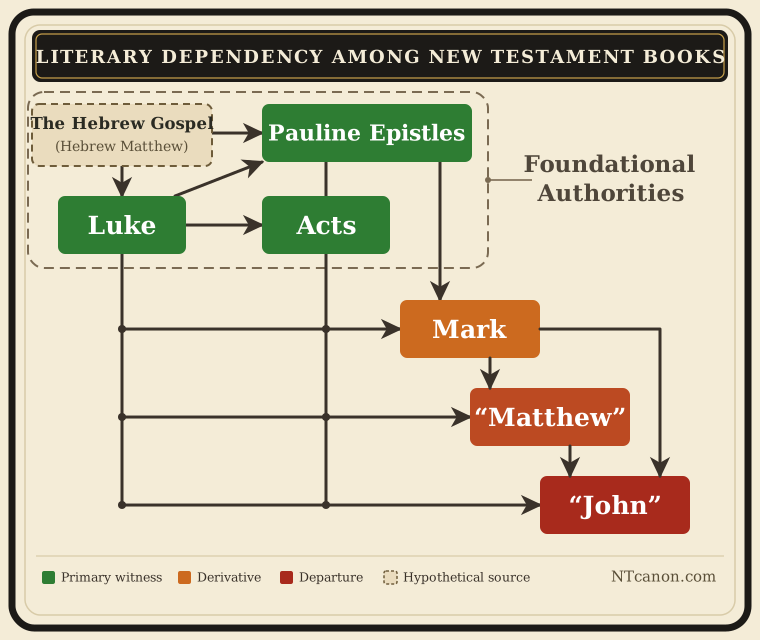
- That primitive Hebrew narrative appears to have supplied the foundational order and framework (Grundtext) of the Third Gospel, leaving only some 177 double-tradition verses shared with Matthew unaccounted for without recourse to a hypothetical “Q” sayings document.
- Conversely, canonical Matthew’s polished Greek, symmetrical catechetical design, heightened Christological titles, and post-70 historical horizon establish Matthean posteriority as the culminating stage of the Synoptic tradition.
The distinct and unusually high number of Semitisms in Special Luke is most plausibly explained by Luke’s reliance on the Hebrew Gospel for those parts of his Gospel not shared in common with Matthew and/or Mark. … A plethora of evidence, including factors related to the design, style, vocabulary, and historical allusions in canonical Matthew, argue for Matthean Posteriority, i.e., that the Gospel [of Matthew] was the final and consummate Gospel in the Synoptic tradition. (James R. Edwards, The Hebrew Gospel and the Development of the Synoptic Tradition, Grand Rapids, MI: Wm. B. Eerdmans Publishing Co., 2009, pp. 260–261)