Luke Primacy
Answering Luke-Acts Objections
Critical scholarship on Luke-Acts has raised a familiar series of historical, geographical, text-critical, and literary objections against the accuracy of the third Gospel and the Acts of the Apostles. The entries below examine twelve principal objections raised in historical-critical literature and evaluate each against the Greek text, epigraphic and papyrological discoveries, archaeological fieldwork, and ancient Greco-Roman historiographical conventions.
1. Luke 2:1 — Imperial Registration Decrees under Augustus
“In those days a decree went out from Caesar Augustus that all the world should be registered.” (Luke 2:1, ESV)
Objection
Critical historians such as Emil Schürer and Raymond E. Brown have argued that Roman sources record no single, simultaneous Empire-wide census encompassing all provinces and client kingdoms under Caesar Augustus (Emil Schürer, The History of the Jewish People in the Age of Jesus Christ [175 B.C.–A.D. 135], rev. ed. Geza Vermes, Fergus Millar, and Matthew Black, Vol. 1 [Edinburgh: T&T Clark, 1973], pp. 399–416; Raymond E. Brown, The Birth of the Messiah: A Commentary on the Infancy Narratives in the Gospels of Matthew and Luke, updated ed. [New York: Doubleday, 1993], pp. 547–549).
Answer
First, the phrase πᾶσαν τὴν οἰκουμένην (“all the inhabited world”) is standard Hellenistic hyperbole for the Roman Empire as an administrative sphere (cf. Acts 11:28; 17:6; 24:5), not an assertion that every province and client territory completed enrollment on the identical calendar date. Second, Luke’s complementary infinitive ἀπογράφεσθαι (apographesthai, “to be registered”) stands in the present middle/passive infinitive rather than the aorist, naturally expressing an ongoing imperial policy of periodic provincial registrations inaugurated under Augustus.
| Greek (SBLGNT) | Transliteration | Morphology | Gloss |
|---|---|---|---|
| Ἐγένετο δὲ | Egeneto de | Verb — 2nd Aorist Middle Ind. 3rd Sg. (γίνομαι) + Conj. | Now it came to pass |
| ἐν ταῖς ἡμέραις ἐκείναις | en tais hēmerais ekeinais | Prep. + Dat. Fem. Pl. Phrase | in those days |
| ἐξῆλθεν δόγμα | exēlthen dogma | Verb — 2nd Aorist Active Ind. 3rd Sg. (ἐξέρχομαι) + Nom. Neut. Sg. | a decree went out |
| παρὰ Καίσαρος Αὐγούστου | para Kaisaros Augoustou | Prep. + Gen. Masc. Sg. | from Caesar Augustus |
| ἀπογράφεσθαι | apographesthai | Verb — Present Middle/Passive Infinitive (ἀπογράφω) | to be registered / enrolled |
| πᾶσαν τὴν οἰκουμένην. | pasan tēn oikoumenēn | Adj. + Art. + Noun — Acc. Fem. Sg. | all the inhabited [Roman] world. |
Augustus systematically reorganized demographic and fiscal registration across the Empire. In his official funerary record, the Res Gestae Divi Augusti (§8), Augustus notes three comprehensive empire-wide censuses (lustra) of Roman citizens conducted in 28 BC, 8 BC, and AD 14 (Augustus, Res Gestae Divi Augusti 8, trans. Frederick W. Shipley, Loeb Classical Library 152 [Cambridge, MA: Harvard University Press, 1924], pp. 356–359), while Roman historians document provincial property and population assessments introduced across Gaul, Spain, Syria, and Egypt during his principate (Cassius Dio, Roman History 53.22.5; 54.25.1; Tacitus, Annals 1.11, describing Augustus’s autograph breviarium totius imperii cataloging the resources and populations of both provinces and allied kingdoms; cf. Flavius Josephus, Jewish Antiquities 17.42, recording an empire-wide loyalty oath to Augustus and Herod taken throughout Judea c. 3 BC). Papyrological evidence from Roman Egypt likewise attests a regular cycle of household census declarations (kat’ oikian apographai) extending back into Augustus’s reign, as summarized by Roger S. Bagnall and Bruce W. Frier:
| Regnal Year of Augustus (Egypt) | Julian Years | Attested Census Activity |
|---|---|---|
| 20 | 11/10 BC | Declarations |
| 27 | 4/3 BC | Declarations |
| 34 | AD 4/5 | Declarations |
| 35 | AD 5/6 | Establishment of registers |
| 41 | AD 11/12 | Declarations |
| 42 | AD 12/13 | Establishment of registers |
Luke’s statement that Augustus decreed provincial registrations across the Roman world thus comports closely with Augustan administrative history.
2. Luke 2:2 — The Governorship and Census of Quirinius
“This was the first registration when Quirinius was governor of Syria.” (Luke 2:2, ESV; or “This registration took place before Quirinius was governing Syria,” ESV margin)
Objection
Following Eduard Zeller, Emil Schürer, and Raymond E. Brown, critics argue that Luke places Jesus’ birth both in the reign of Herod the Great (Luke 1:5; died 4 BC) and during the Syrian governorship and Judean property assessment of Publius Sulpicius Quirinius, which Flavius Josephus dates to AD 6 following the deposition of Herod Archelaus (Jewish Antiquities 17.355–18.2; 18.26)—producing an apparent ten-year chronological discrepancy (Schürer, History of the Jewish People, rev. ed., Vol. 1 [1973], pp. 399–427; Brown, Birth of the Messiah, updated ed. [1993], pp. 549–556).
Answer
Classical, philological, epigraphic, and Josephan studies have developed four distinct lines of resolution—any one of which removes the alleged contradiction.
1. Syntax of πρώτη (prōtē) and ἡγεμονεύοντος (hēgemoneuontos) in Luke 2:2
| Greek (SBLGNT) | Transliteration | Morphology | Gloss |
|---|---|---|---|
| αὕτη [ἡ] | hautē [hē] | Demonstrative Pron. (+ Art.) — Nom. Fem. Sg. | This |
| ἀπογραφὴ | apographē | Noun — Nom. Fem. Sg. | registration / census |
| πρώτη | prōtē | Adjective — Nom. Fem. Sg. (πρῶτος, comparative force in Koine) | first / prior to |
| ἐγένετο | egeneto | Verb — 2nd Aorist Middle Ind. 3rd Sg. (γίνομαι) | took place |
| ἡγεμονεύοντος | hēgemoneuontos | Verb — Present Active Participle, Gen. Masc. Sg. (ἡγεμονεύω) | governing / exercising command |
| τῆς Συρίας Κυρηνίου. | tēs Syrias Kyrēniou | Art. + Gen. Fem. Sg. + Proper Noun Gen. Masc. Sg. | of Syria, Quirinius. |
Luke was thoroughly acquainted with Quirinius’s famous AD 6 Judean tax assessment and the resulting uprising of Judas the Galilean, which he explicitly cites in Acts 5:37 (“in the days of the census,” ἐν ταῖς ἡμέραις τῆς ἀπογραφῆς). As F. F. Bruce, Nigel Turner, and Stanley E. Porter have argued, Hellenistic Greek frequently employs the superlative πρῶτος in place of πρότερος with a genitive complement to mean “prior to” or “before” (cf. John 1:15, 30, πρῶτός μου ἦν, “he was before me”; John 15:18, ἐμὲ πρῶτον ὑμῶν). Construing πρώτη with the genitive participial phrase ἡγεμονεύοντος τῆς Συρίας Κυρηνίου yields the sense reflected in the ESV marginal note: “This registration took place before Quirinius was governing Syria”—expressly distinguishing the earlier Herodian-era enrollment from Quirinius’s notorious AD 6 provincial census (F. F. Bruce, The New Testament Documents: Are They Reliable?, 5th rev. ed. [Downers Grove, IL: InterVarsity Press / Grand Rapids: Wm. B. Eerdmans, 1960], p. 86; Nigel Turner, A Grammar of New Testament Greek, Vol. 3: Syntax [Edinburgh: T&T Clark, 1963], p. 32; Nigel Turner, Grammatical Insights into the New Testament [Edinburgh: T&T Clark, 1965], pp. 23–24; Stanley E. Porter, Idioms of the Greek New Testament, 2nd ed. [Sheffield: JSOT Press, 1994], pp. 134–135; Stanley E. Porter, “The Reasons for the Lukan Census,” in Paul, Luke and the Graeco-Roman World: Essays in Honour of Alexander J. M. Wedderburn, ed. Alf Christophersen et al., JSNTSup 217 [Sheffield: Sheffield Academic Press, 2002], pp. 165–188).
2. Epigraphic Evidence for a Twice-Held Command in Syria
Even on the traditional rendering (“This was the first registration when Quirinius was governing Syria”), our prosopographical record of Publius Sulpicius Quirinius leaves ample room for an earlier Syrian command under Augustus. As Sir William M. Ramsay observed regarding the securely dated milestones of Quirinius’s career:
“The only certain dates in the life of Quirinius are his consulship in B.C. 12, his second government of Syria beginning in A.D. 6, his prosecution of his former wife Domitia Lepida in A.D. 20, and his death and public funeral in A.D. 21.” (Sir William M. Ramsay, Was Christ Born at Bethlehem? A Study on the Credibility of St. Luke [London: Hodder & Stoughton, 1898], p. 227; cf. Ramsay, The Bearing of Recent Discovery on the Trustworthiness of the New Testament [London: Hodder & Stoughton, 1915], pp. 275–300)
Between his consulship in 12 BC and his AD 6 legateship, Quirinius commanded Roman forces in the eastern Mediterranean against the Homonadensians in the Taurus mountains of Cilicia-Galatia (Strabo, Geography 12.6.5; Tacitus, Annals 3.48). Crucially, the fragmentary Latin Lapis Tiburtinus (CIL XIV 3613 = ILS 918, discovered near Tivoli in 1764 and housed in the Museo Pio Cristiano of the Vatican Museums) commemorates an Augustan consular general who subdued a mountain people, received triumphal ornaments, governed Asia as proconsul, and iterum Syriam et Phoenicen optinuit—governed Syria and Phoenicia as imperial legate of the deified Augustus a second time. Following Theodor Mommsen’s attribution of this inscription to Quirinius, Ramsay and subsequent scholars such as Joseph M. Holden and Norman L. Geisler have argued that Quirinius held imperial authority in Syria on two occasions: first in connection with the Homonadensian war in the final decade BC, and a second time beginning in AD 6 (Joseph M. Holden and Norman L. Geisler, The Popular Handbook of Archaeology and the Bible [Eugene, OR: Harvest House, 2013], p. 154).
3. Concurrent Provincial Officials and the Breadth of ἡγεμονεύω
Critics frequently object that Gaius Sentius Saturninus (c. 9–6 BC) and Publius Quinctilius Varus (c. 6–4 BC) occupied the ordinary Syrian legateship during the final years of Herod’s reign. Yet Luke does not use a narrow technical noun for a senatorial legatus Augusti pro praetore; he uses the broad circumstantial participle ἡγεμονεύοντος (from ἡγεμονεύω, “to lead, command, exercise governing authority”). Luke uses the identical verb in Luke 3:1 for Pontius Pilate, an equestrian prefect, just as Greek imperial documents such as Augustus’s Cyrene Edicts (SEG IX 8, 7–6 BC) and Roman decrees preserved by Josephus (Jewish Antiquities 14) apply general governing verbs and participles to varied provincial magistrates. Flavius Josephus himself applies the noun ἡγεμών concurrently to both the senatorial Syrian legate Gaius Sentius Saturninus and the equestrian procurator Volumnius (Jewish Antiquities 16.277, 280, 283 [16.9.1–3]), and describes multiple Roman officials presiding jointly at Herod’s Berytus tribunal:
“Caesar had ordered the court to be assembled... The presidents sat first, as Caesar’s letters had appointed, who were Saturninus, and Pedanius, and their lieutenants that were with them, with whom was the procurator Volumnius.” (Flavius Josephus, The Jewish War 1.27.2 [§538], trans. William Whiston)
Historians of the early Principate have similarly observed—comparing Tacitus’s remark on divided provincial administration in Agricola 15.2—that imperial procurators and special military or fiscal commissioners stood nearly alongside ordinary legates in provincial eyes (The Cambridge Ancient History, Vol. X: The Augustan Empire, 44 B.C.–A.D. 70, ed. S. A. Cook, F. E. Adcock, and M. P. Charlesworth [Cambridge: Cambridge University Press, 1934], p. 201). Quirinius could therefore be accurately described by Luke as exercising governing authority (ἡγεμονεύοντος) in Syria as a special military or census commissioner even while Saturninus or Varus oversaw ordinary civil administration.
4. Reassessing Josephus’s Chronology of Quirinius
Finally, the critical objection treats Flavius Josephus’s placement of Quirinius’s census solely in AD 6 (Jewish Antiquities 18.1–2, 26) as an unassailable benchmark against which Luke must be judged. While Josephus is an indispensable and generally conscientious historian where his sources can be checked (E. P. Sanders, Judaism: Practice and Belief, 63 BCE–66 CE [London: SCM Press / Philadelphia: Trinity Press International, 1992], p. 8; Everett Ferguson, Backgrounds of Early Christianity, 3rd ed. [Grand Rapids: Wm. B. Eerdmans, 2003], p. 457), specialists in Josephan historiography widely recognize the uneven, composite structure of Antiquities, especially in Books 18–20 (Seth Schwartz, Josephus and Judaean Politics [New York: Columbia University Press, 1990], p. 197; John M. G. Barclay, Flavius Josephus: Translation and Commentary, Vol. 10: Against Apion [Leiden: Brill, 2007], p. 361; Daniel R. Schwartz, “Many Sources but a Single Author: Josephus’s Jewish Antiquities,” in A Companion to Josephus, ed. Honora Howell Chapman and Zuleika Rodgers [Chichester: Wiley-Blackwell, 2016], p. 40).
Elsewhere in Jewish Antiquities, Josephus misdates the construction of the Samaritan temple on Mount Gerizim to the era of Alexander the Great (Reinhard Pummer, The Samaritans in Flavius Josephus, TSAJ 129 [Tübingen: Mohr Siebeck, 2009], p. 43), displaces the third-century BC Tobiad saga into a later chronological setting (Dov Gera, “Unity and Chronology in the Jewish Antiquities,” in Flavius Josephus: Interpretation and History, ed. Jack Pastor, Pnina Stern, and Menahem Mor, JSJSup 146 [Leiden: Brill, 2011], pp. 125–147, esp. pp. 141–145), states that Herod the Great was fifteen years old when appointed governor of Galilee—almost certainly off by a decade (Emil Schürer, rev. Geza Vermes, Fergus Millar, and Matthew Black, The History of the Jewish People in the Age of Jesus Christ, Vol. 1 [Edinburgh: T&T Clark, 1973], p. 275)—and occasionally duplicates episodes found in overlapping sources and assigns them to two different dates (Daniel R. Schwartz, Agrippa I: The Last King of Judaea, TSAJ 23 [Tübingen: Mohr Siebeck, 1990], pp. 11–14; Daniel R. Schwartz, Studies in the Jewish Background of Christianity, WUNT 60 [Tübingen: Mohr Siebeck, 1992], pp. 202–217). Drawing on these source-critical patterns, John H. Rhoads has argued in detail that Josephus conflated parallel records from the crises following Herod the Great’s death (4 BC) and Archelaus’s banishment (AD 6), misdating Quirinius’s Syrian administration and census, whereas Luke preserves the accurate historical synchronism (John H. Rhoads, “Josephus Misdated the Census of Quirinius,” Journal of the Evangelical Theological Society 54, no. 1 [March 2011]: 65–87).
3. Luke 2:3–4 — Ancestral Domicile Registration in Judea
“And all went to be registered, each to his own town. And Joseph also went up from Galilee, from the town of Nazareth, to Judea, to the city of David, which is called Bethlehem, because he was of the house and lineage of David.” (Luke 2:3–4, ESV)
Objection
Critics such as Emil Schürer and Raymond E. Brown contend that Roman census procedure registered inhabitants at their ordinary place of residence or principal estate rather than requiring a resident of Nazareth in Galilee to travel south to an ancestral Judean town (Schürer, History of the Jewish People, rev. ed., Vol. 1 [1973], pp. 411–413; Brown, Birth of the Messiah [1993], pp. 549–550).
Answer
Provincial administration in the Roman East routinely accommodated local social structures and required absentees to return to their registered home districts (idia) for household enrollment. Direct papyrological illustration comes from Papyrus London 904 (P.Lond. III 904, lines 18–38; British Library), preserving a census edict issued in AD 104 by Gaius Vibius Maximus, Roman prefect of Egypt:
“Gaius Vibius Maximus, Prefect of Egypt [says]: Seeing that the time has come for the house-to-house census, it is necessary to compel all those who for any cause whatsoever are residing out of their districts to return to their own homes, that they may both carry out the regular order of the census and may also attend diligently to the cultivation of their allotments.” (P.Lond. III 904, lines 18–31, in A. S. Hunt and C. C. Edgar, eds., Select Papyri, Vol. 2: Public Documents, Loeb Classical Library 282 [London: Heinemann / Cambridge, MA: Harvard University Press, 1934], no. 220, pp. 108–109; cf. F. F. Bruce, The New Testament Documents: Are They Reliable?, 5th rev. ed. [Downers Grove, IL: InterVarsity Press / Grand Rapids: Wm. B. Eerdmans, 1960], pp. 86–87)
Within Herod’s client kingdom—where ancestral clan registries and family land patrimony remained foundational, and where Joseph may well have retained ancestral property interests at Bethlehem—an enrollment conducted “each to his own town” (εἰς τὴν ἑαυτοῦ πόλιν, Luke 2:3) accords naturally with documented eastern Mediterranean practice (cf. I. Howard Marshall, The Gospel of Luke: A Commentary on the Greek Text, NIGTC [Grand Rapids: Wm. B. Eerdmans, 1978], pp. 101–102).
4. Luke 3:1 — Pontius Pilate’s Title and Lysanias Tetrarch of Abilene
“In the fifteenth year of the reign of Tiberius Caesar, Pontius Pilate being governor of Judea, and Herod being tetrarch of Galilee, and his brother Philip tetrarch of the region of Ituraea and Trachonitis, and Lysanias tetrarch of Abilene...” (Luke 3:1, ESV)
Objection 1: Pilate’s Official Title
Critics have occasionally objected that Luke describes Pontius Pilate with the general governing verb ἡγεμονεύοντος (cognate with ἡγεμών, “governor”) rather than the technical Greek equivalent of Pilate’s equestrian rank, prefect (Latin praefectus, Greek ἔπαρχος, eparchos—confirmed on the first-century Pilate Stone unearthed at Caesarea Maritima in 1961, AE 1963, no. 104).
Answer
Prior to AD 41/44, the equestrian governors of Judea officially bore the military-administrative title praefectus Iudaeae (Greek ἔπαρχος), whereas under Claudius and his successors the title shifted to procurator (Greek ἐπίτροπος). In first-century literary Koine, however, ἡγεμών and its cognate verb ἡγεμονεύω functioned as the standard overarching Greek designation for a Roman provincial governor regardless of whether his specific rank was legatus, proconsul, praefectus, or procurator. Flavius Josephus repeatedly calls Pilate ἡγεμών (Jewish Antiquities 18.55 [18.3.1]; cf. 18.177 [18.6.5]), just as Matthew 27:2 styles him ὁ ἡγεμών (whereas Tacitus, writing in Latin under Trajan after procurator had become standard, retrojects procurator onto Pilate in Annals 15.44.3). Luke’s terminology is wholly idiomatic and historically exact.
Objection 2: Lysanias Tetrarch of Abilene
Nineteenth-century critics such as David Friedrich Strauss and Bruno Bauer accused Luke of a sixty-year chronological blunder in naming “Lysanias tetrarch of Abilene” in the fifteenth year of Tiberius (AD 28/29), claiming that Luke confused him with Lysanias son of Ptolemy Mennaeus, ruler of Chalcis, whom Mark Antony executed at Cleopatra’s instigation around 36 BC (Flavius Josephus, Jewish Antiquities 15.92; Jewish War 1.248; Cassius Dio, Roman History 49.32.5).
Answer
First, the earlier Lysanias ruled Chalcis as king rather than Abilene as tetrarch, and Josephus himself later distinguishes “Abila, which had been the tetrarchy of Lysanias” from Chalcis under Claudius (Jewish Antiquities 19.275; 20.138). Second, Greek dedicatory inscriptions discovered at Abila (modern Suk Wadi Barada, eighteen miles northwest of Damascus) decisively vindicated Luke’s precision. An inscription carved during the joint Augustan titulature of Tiberius and Livia (“Julia Augusta,” AD 14–29) records that Nymphaios, a freedman of “Lysanias the tetrarch” (Νυμφαῖος ... Λυσανίου τετράρχου ἀπελεύθερος), built a road and erected a temple “for the salvation of the Lords Augusti” (CIG III 4521 [cf. 4523] = Wilhelm Dittenberger, Orientis Graeci Inscriptiones Selectae [OGIS], Vol. 2 [Leipzig: S. Hirzel, 1905], no. 606; see Colin J. Hemer, The Book of Acts in the Setting of Hellenistic History, ed. Conrad H. Gempf, WUNT 49 [Tübingen: J. C. B. Mohr (Paul Siebeck), 1989], p. 161; Marshall, Gospel of Luke [1978], pp. 133–134). A younger Lysanias thus governed Abilene as tetrarch precisely during Tiberius’s reign.
5. Luke 3:2 — The High Priesthood of Annas and Caiaphas
“During the high priesthood of Annas and Caiaphas, the word of God came to John the son of Zechariah in the wilderness.” (Luke 3:2, ESV)
Objection
“Any person being acquainted with the history and polity of the Jews, must have known that there never was but one high priest at a time...” (Robert Taylor, The Diegesis: Being a Discovery of the Origin, Evidences, and Early History of Christianity, 3rd ed. [Boston: J. P. Mendum, 1845], p. 126)
Answer
Remarkably, the critical Greek text of Luke 3:2 (ἐπὶ ἀρχιερέως Ἄννα καὶ Καϊάφα, NA28 / SBLGNT; cf. Acts 4:6) employs the singular noun ἀρχιερέως (“in the time of High Priest Annas and Caiaphas”) rather than the plural, demonstrating Luke’s exact awareness that Jewish law recognized only one high-priestly office. Annas (Ananus son of Seth) served officially from AD 6 until Pilate’s predecessor Valerius Gratus deposed him in AD 15, after which five of Annas’s sons and his son-in-law Joseph Caiaphas (AD 18–36) successively occupied the office (Flavius Josephus, Jewish Antiquities 18.26, 34–35; 20.198). Because Mosaic law regarded the high priesthood as a lifelong consecration (Num 35:25), first-century Judeans continued to accord Annas both the title “high priest” and senior patriarchal influence behind the reigning Roman appointee Caiaphas (cf. Acts 4:6; John 18:13, 24). Flavius Josephus employs the exact same dual usage when pairing a reigning high priest with a living former incumbent:
“...but he sent two others of those that were of the greatest power among them, and both Jonathan and Ananias, the high priests...” (Flavius Josephus, The Jewish War 2.12.6 [§243], trans. William Whiston)
6. Luke 3:23–38 — The Lukan Genealogy of Jesus
“23 Jesus, when he began his ministry, was about thirty years of age, being the son (as was supposed) of Joseph, the son of Heli, 24 the son of Matthat, the son of Levi, the son of Melchi, the son of Jannai, the son of Joseph, 25 the son of Mattathias, the son of Amos, the son of Nahum, the son of Esli, the son of Naggai, 26 the son of Maath, the son of Mattathias, the son of Semein, the son of Josech, the son of Joda, 27 the son of Joanan, the son of Rhesa, the son of Zerubbabel, the son of Shealtiel, the son of Neri, 28 the son of Melchi, the son of Addi, the son of Cosam, the son of Elmadam, the son of Er, 29 the son of Joshua, the son of Eliezer, the son of Jorim, the son of Matthat, the son of Levi, 30 the son of Simeon, the son of Judah, the son of Joseph, the son of Jonam, the son of Eliakim, 31 the son of Melea, the son of Menna, the son of Mattatha, the son of Nathan, the son of David, 32 the son of Jesse, the son of Obed, the son of Boaz, the son of Sala, the son of Nahshon, 33 the son of Amminadab, the son of Admin, the son of Arni, the son of Hezron, the son of Perez, the son of Judah, 34 the son of Jacob, the son of Isaac, the son of Abraham, the son of Terah, the son of Nahor, 35 the son of Serug, the son of Reu, the son of Peleg, the son of Eber, the son of Shelah, 36 the son of Cainan, the son of Arphaxad, the son of Shem, the son of Noah, the son of Lamech, 37 the son of Methuselah, the son of Enoch, the son of Jared, the son of Mahalaleel, the son of Cainan, 38 the son of Enos, the son of Seth, the son of Adam, the son of God.” (Luke 3:23–38, ESV)
Objections
- Royal messianic prophecy traced David’s dynastic promise through Solomon (2 Sam 7:12–16; 1 Chr 22:9–10), whereas Luke 3:31 traces descent through David’s son Nathan.
- Because Luke 1:34–35 affirms Jesus’ virginal conception apart from Joseph—and Luke 3:23 itself adds parenthetically “as was supposed” (ὡς ἐνομίζετο)—a genealogy traced through Joseph appears disconnected from Jesus’ biological lineage.
- Early Alexandrian manuscripts and modern critical editions include names such as Admin (between Amminadab and Arni in 3:33; cf. Septuagintal Cainan in 3:36) absent from the Masoretic Hebrew Old Testament, producing a symmetrical seventy-seven-generation total (eleven sevens from God to Jesus) shaped by hebdomadic numerology.
- Ending an ascending human genealogy with “the son of Adam, the son of God” (3:38) places God within a sequence of human ancestors.
Answer
Commentators who defend the genealogy as Lukan address these points by appealing either to levirate/legal paternal succession (a proposal reaching back to Julius Africanus’s Epistula ad Aristidem, preserved in Eusebius, Ecclesiastical History 1.7.1–16) or to Marian descent through Heli (see the surveys in I. Howard Marshall, The Gospel of Luke, NIGTC [1978], pp. 157–165, and Darrell L. Bock, Luke 1:1–9:50, BECNT [Grand Rapids: Baker, 1994], pp. 348–362), while interpreting “son of Adam, son of God” in terms of Adam’s direct creation rather than physical procreation.
Alongside those traditional harmonizations, however, there are notable text-critical and internal literary reasons to question whether Luke 3:23b–38 stood in the earliest form of Luke’s Gospel. Although the vast majority of Greek witnesses contain the genealogy, two noteworthy manuscripts omit it: the fourth/fifth-century Codex Washingtonianus (W / 032) omits Luke 3:23b–38 (recording Jesus’ age at baptism in 3:23a and proceeding directly to 4:1), and the thirteenth-century Minuscule 579 (Paris, Bibliothèque nationale de France, Gr. 97—famous for preserving ancient Alexandrian readings akin to Codex Vaticanus and 𝔓75 in Luke) omits Luke 3:23–38. In Kurt and Barbara Aland’s textual classification, both manuscripts belong to Category III—witnesses possessing an independent, distinctive textual character of special value for reconstructing the early history of transmission (Kurt Aland and Barbara Aland, The Text of the New Testament: An Introduction to the Critical Editions and to the Theory and Practice of Modern Textual Criticism, trans. Erroll F. Rhodes, 2nd rev. ed. [Grand Rapids: Wm. B. Eerdmans, 1989], pp. 106, 109, 146, 159).
When this minority manuscript evidence is weighed alongside Luke’s literary design, four internal considerations suggest that the genealogy may be an early secondary interpolation:
- Scope of the Lukan Prologue (Luke 1:1–4; Acts 1:1): In Luke 1:1–4, the evangelist sets out to compose an orderly narrative (καθεξῆς) of the events fulfilled among the apostolic eyewitnesses, retrospectively summarized in Acts 1:1 as “all that Jesus began to do and teach.” A primordial seventy-seven-name register stretching back to Adam lies well outside the eyewitness historical horizon defined in Luke 1:1–4.
- Tension with Messianic Apologetic Certainty: Tracing Joseph’s line through Nathan rather than Solomon sits uneasily with Luke’s stated purpose of furnishing Theophilus with ἀσφάλεια (“certainty,” Luke 1:4) regarding the apostolic proclamation of Jesus as Davidic Messiah.
- Disruption of the Baptism–Temptation Sequence (Luke 3:21–22 → 4:1–2): In biographical order, a birth genealogy belongs at the beginning of a life (as in Matt 1:1–17) or alongside the nativity narrative in Luke 1–2. Instead, Luke 3:23b–38 intrudes abruptly between Jesus’ anointing with the Holy Spirit at his baptism (Luke 3:21–22) and his Spirit-led departure from the Jordan into the wilderness (“And Jesus, full of the Holy Spirit, returned from the Jordan and was led by the Spirit in the wilderness,” Luke 4:1)—severing the continuous narrative thread preserved in Mark 1:9–13. Without 3:23b–38, Luke 3:22–23a transitions seamlessly into 4:1.
- Contrast Between Empirical Historiography and Hebdomadic Numerology: Throughout Luke-Acts, the author writes as a sober Hellenistic historian grounding his narrative in verifiable public synchronisms (Luke 2:1–2; 3:1–2) and eyewitness testimony rather than artificial eleven-by-seven (77) numerological schemes incorporating unverified post-exilic names and Septuagintal expansions (Admin, Cainan). Taken together with the omissions in W (032) and 579, these anomalies lend weight to viewing Luke 3:23b–38 as a later pre-canonical addition rather than part of Luke’s original composition.
7. Luke 7:1–5 — First-Century Synagogues in Pre-70 Galilee
“After he had finished all his sayings in the hearing of the people, he entered Capernaum. Now a centurion had a servant who was sick and at the point of death, who was highly valued by him. When the centurion heard about Jesus, he sent to him elders of the Jews, asking him to come and heal his servant. And when they came to Jesus, they pleaded with him earnestly, saying, ‘He is worthy to have you do this for him, for he loves our nation, and he is the one who built us our synagogue.’” (Luke 7:1–5, ESV)
Objection
Drawing on an older minimalist hypothesis advanced by Howard Clark Kee (“The Transformation of the Synagogue after 70 C.E.,” New Testament Studies 36 [1990]: 1–24), radical critic Robert M. Price argued that dedicated synagogue buildings in Galilee prior to AD 70 are an anachronism invented by the Evangelists:
“A major collision between the gospel tradition and archaeology concerns the existence of synagogues and Pharisees in pre-70 C.E. Galilee. Historical logic implies that there would not have been any, since Pharisees fled to Galilee only after the fall of Jerusalem.” (Robert M. Price, The Incredible Shrinking Son of Man: How Reliable Is the Gospel Tradition? [Amherst, NY: Prometheus Books, 2003], p. 14)
Answer
Archaeological excavations across Galilee, Golan, and Judea have decisively overturned this objection. Beneath the monumental fourth/fifth-century white limestone synagogue at Capernaum, Franciscan excavators uncovered massive first-century black basalt foundation walls and cobbled pavements matching the footprint of an early Roman public assembly hall (Virgilio C. Corbo, Cafarnao I: Gli edifici della città [Jerusalem: Franciscan Printing Press, 1975], pp. 113–169). Reporting on the discovery, archaeologist James F. Strange and Hershel Shanks concluded:
“The first-century Capernaum synagogue in which Jesus preached has probably been found. Because more than one synagogue may have existed in Capernaum at this time, we cannot be sure that this new find was Jesus’ synagogue. But this recently discovered first-century building is certainly a likely candidate... The conclusion that this was a first-century A.D. synagogue seems inescapable.” (James F. Strange and Hershel Shanks, “Synagogue Where Jesus Preached Found at Capernaum,” Biblical Archaeology Review 9, no. 6 [Nov./Dec. 1983]: 24–31)
Subsequent fieldwork has multiplied the evidence beyond dispute. Archaeologists have now excavated multiple purpose-built pre-AD 70 first-century synagogues in Galilee and adjacent regions—most notably at Gamla (destroyed by Roman forces in AD 67), Magdala / Migdal on the western shore of the Sea of Galilee (unearthed in 2009 with pre-70 coins and the carved Magdala Stone depicting the Jerusalem Temple menorah), Khirbet Qana, and Modi’in (Khirbet Umm el-Umdan)—corroborating both the pre-70 Jerusalem Theodotus Inscription (CIJ II 1404 = CIIP I.1 9, commemorating the building of a synagogue for the reading of the Law and teaching of the commandments) and Josephus’s description of a spacious first-century Galilean assembly hall (proseuchē) at Tiberias (Life 277, 280; see Lee I. Levine, The Ancient Synagogue: The First Thousand Years, 2nd ed. [New Haven: Yale University Press, 2005], pp. 45–80; Anders Runesson, Donald D. Binder, and Birger Olsson, The Ancient Synagogue from Its Origins to 200 C.E.: A Source Book, AJEC 72 [Leiden: Brill, 2008], pp. 25–118; Richard Bauckham, ed., Magdala of Galilee: A Jewish City in the Hellenistic and Roman Period [Waco, TX: Baylor University Press, 2018], pp. 107–134). Moreover, Luke 7:5’s detail of a Gentile Roman centurion acting as civic benefactor (euergetēs) of a local Jewish synagogue aligns seamlessly with epigraphic evidence for Gentile “God-fearers” funding first-century synagogues (e.g., Julia Severa at Acmonia, CIJ II 766 = MAMA VI 264).
8. Luke 24:50–51 vs. Acts 1:3, 12 — Timing and Location of the Ascension
Objection
Critical commentators such as Ernst Haenchen and Bart D. Ehrman contend that Luke 24:50–51 places Jesus’ ascension from Bethany on the evening of Easter Sunday, whereas Acts 1:3, 12 places his ascension forty days later from the Mount of Olives near Jerusalem (Ernst Haenchen, The Acts of the Apostles: A Commentary [Philadelphia: Westminster Press, 1971], pp. 139–146; Bart D. Ehrman, Jesus, Interrupted: Revealing the Hidden Contradictions in the Bible [New York: HarperOne, 2009], pp. 46–47).
Answer
1. Narrative Compression (Telescoping) of Time
Luke 24:44–51 never states that all of Jesus’ post-resurrection instruction and departure transpired on Easter night. Rather, verses 44 and 50 introduce unmarked transitions (Εἶπεν δὲ πρὸς αὐτούς, “Then he said to them”; Ἐξήγαγεν δὲ αὐτούς, “And he led them out”) without temporal adverbs binding them to a single evening. In ancient Greco-Roman biography and historiography, authors routinely practiced compression (telescoping) at the close of a scroll, summarizing related scenes concisely while reserving explicit chronological spacing (“appearing to them during forty days,” Acts 1:3) for the opening of the sequel volume. Compare the rhetorical and historiographical principles discussed by Lucian of Samosata, Quomodo historia conscribenda sit (How to Write History) 56–57; Cicero, De Oratore 3.27.104–105; Quintilian, Institutio Oratoria 8.4; and the comprehensive study of ancient biographical compression in Michael R. Licona, Why Are There Differences in the Gospels? What We Can Learn from Ancient Biography (Oxford: Oxford University Press, 2017), pp. 20–24, 172–173.
2. Topographical Harmony of Bethany and the Mount of Olives
“And he led them out as far as Bethany, and lifting up his hands he blessed them. While he blessed them, he parted from them and was carried up into heaven.” (Luke 24:50–51, ESV)
“Then they returned to Jerusalem from the mount called Olivet, which is near Jerusalem, a Sabbath day’s journey away.” (Acts 1:12, ESV)
Far from naming rival locations, “as far as Bethany” (ἕως πρὸς Βηθανίαν, literally “out toward / as far as the vicinity of Bethany”) and “from the mount called Olivet” describe the exact same contiguous ridge east of Jerusalem. Bethany lay on the southeastern slope of the Mount of Olives roughly fifteen stadia (about 1.7 miles) from Jerusalem (John 11:18), whereas the crest of the Mount of Olives stood five to six stadia (roughly 0.6–0.7 miles, within a rabbinic Sabbath day’s journey of 2,000 cubits) east of the city across the Kidron Valley (Flavius Josephus, Jewish Antiquities 20.169; Jewish War 5.70). Luke himself explicitly links Bethany and Bethphage with the Mount of Olives at Luke 19:29 (“when he drew near to Bethphage and Bethany, at the mount that is called Olivet”). Leading the disciples up over the eastern brow of Olivet where the district of Bethany began and returning from Mount Olivet to Jerusalem are topographically identical.
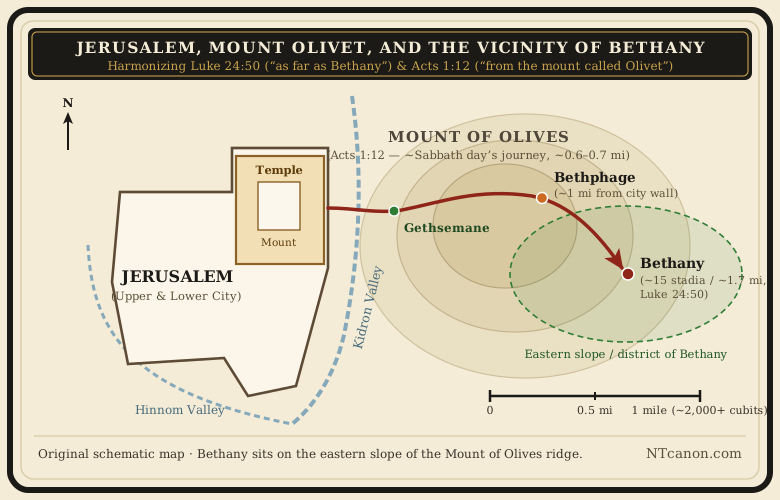
9. Acts 9, 22, and 26 (and Galatians 1) — Paul’s Damascus Road Conversion and Early Itinerary
Objection 1: Variations Across the Three Damascus Road Accounts (Acts 9, 22, 26)
Critics such as Ernst Haenchen and Bart D. Ehrman point to three alleged contradictions among Luke’s third-person narrative of Saul’s conversion (Acts 9:1–19) and Paul’s two defense speeches recounting the event in Jerusalem (Acts 22:6–16) and before King Agrippa II at Caesarea (Acts 26:12–18) (Haenchen, Acts of the Apostles [1971], pp. 322–329; Ehrman, Jesus, Interrupted [2009], pp. 54–56):
- Acts 9:7 vs. Acts 22:9: In Acts 9:7 Paul’s companions “heard the voice (ἀκούοντες μὲν τῆς φωνῆς) but saw no one,” whereas in Acts 22:9 they “saw the light but did not hear (τὴν δὲ φωνὴν οὐκ ἤκουσαν) the voice of the one who was speaking to me.”
- Acts 9:7 vs. Acts 26:14: In Acts 9:7 the companions “stood speechless (εἱστήκεισαν ἐνεοί),” whereas in Acts 26:14 Paul recalls, “when we had all fallen to the ground (πάντων τε καταπεσόντων ἡμῶν εἰς τὴν γῆν).”
- Acts 9:6, 10–18 and 22:10–16 vs. Acts 26:16–18: In chapters 9 and 22 Paul is sent into Damascus where Ananias mediates his healing and instructions, whereas in chapter 26 Paul places the Gentile commission directly in Jesus’ speech without mentioning Ananias.
Answer
- Case Syntax and Semantic Range of ἀκούω (Acts 9:7 vs. 22:9): First, the notion that a single careful author inadvertently contradicted his own chapter 9 narrative in chapter 22 overlooks a classic Greek grammatical distinction. The verb ἀκούω encompasses both bare auditory sensation (“hear a sound”) and intelligible comprehension (“understand what is spoken”; see Frederick William Danker, The Concise Greek-English Lexicon of the New Testament [Chicago: University of Chicago Press, 2009], s.v. ἀκούω, p. 16; cf. 1 Cor 14:2). In classical and literary Hellenistic Greek, ἀκούω governing the genitive (ἀκούοντες μὲν τῆς φωνῆς, Acts 9:7) characteristically denotes hearing an inarticulate sound or voice, whereas ἀκούω governing the accusative (τὴν δὲ φωνὴν οὐκ ἤκουσαν τοῦ λαλοῦντός μοι, Acts 22:9) denotes comprehending the articulate message spoken (Friedrich Blass and Albert Debrunner, A Greek Grammar of the New Testament and Other Early Christian Literature, trans. and rev. Robert W. Funk [Chicago: University of Chicago Press, 1961], §173; C. K. Barrett, A Critical and Exegetical Commentary on the Acts of the Apostles, Vol. 1, ICC [Edinburgh: T&T Clark, 1994], pp. 450–451; Craig S. Keener, Acts: An Exegetical Commentary, Vol. 2 [Grand Rapids: Baker Academic, 2013], pp. 1639–1641). Paul’s fellow travelers heard the sound of the heavenly voice without understanding its words (compare John 12:28–29).
- Idiomatic Force of εἱστήκεισαν ἐνεοί (Acts 9:7 vs. 26:14): In Greek idiom, the pluperfect εἱστήκεισαν with a predicate adjective (“stood speechless / dumbfounded”) frequently means “had come to a halt, frozen in astonishment,” rather than asserting posture in contrast to kneeling or falling; alternatively, the companions fell at the initial blinding flash (Acts 26:14) and rose stunned while Saul remained blind on the ground until led by the hand into Damascus (Acts 9:8; F. F. Bruce, The Acts of the Apostles: The Greek Text with Introduction and Commentary, 3rd rev. ed. [Grand Rapids: Wm. B. Eerdmans, 1990], p. 235; Keener, Acts, Vol. 2 [2013], p. 1641).
- Forensic Compression in Acts 26:16–18: Speaking before the devout Jerusalem crowd in Acts 22:12, Paul naturally highlighted Ananias as “a devout man according to the law, well spoken of by all the Jews who lived there.” Addressing the Roman governor Festus and King Agrippa II in Acts 26, where a Damascene Jewish intermediary carried no apologetic weight, Paul compressed the commission delivered through Christ’s prophetic envoy directly into Christ’s summons—a routine technique of Greco-Roman speech and biography (Licona, Why Are There Differences in the Gospels? [2017], pp. 20–24; Keener, Acts, Vol. 4 [2015], pp. 3516–3519).
Objection 2: Post-Conversion Itinerary in Acts 9:23–26 vs. Galatians 1:15–18
Critics likewise argue that in Galatians 1:16–18 Paul insists he did not go immediately up to Jerusalem to consult the earlier apostles—departing instead into Arabia, returning to Damascus, and visiting Jerusalem only “after three years”—whereas Acts 9:23–26 allegedly depicts Paul hurrying straight from Damascus to Jerusalem shortly after his conversion (Haenchen, Acts of the Apostles [1971], pp. 333–336; Ehrman, Jesus, Interrupted [2009], pp. 51–53).
Answer
“When many days had passed, the Jews plotted to kill him, but their plot became known to Saul. They were watching the gates day and night in order to kill him, but his disciples took him by night and let him down through an opening in the wall, lowering him in a basket. And when he had come to Jerusalem, he attempted to join the disciples. And they were all afraid of him, for they did not believe that he was a disciple.” (Acts 9:23–26, ESV)
“But when he who had set me apart before I was born, and who called me by his grace, was pleased to reveal his Son to me, in order that I might preach him among the Gentiles, I did not immediately consult with anyone; nor did I go up to Jerusalem to those who were apostles before me, but I went away into Arabia, and returned again to Damascus. Then after three years I went up to Jerusalem to visit Cephas and remained with him fifteen days.” (Galatians 1:15–18, ESV)
Luke himself places an explicit elastic time-marker at Acts 9:23: “When many days were fulfilled” (Ὡς δὲ ἐπληροῦντο ἡμέραι ἱκαναί)—a Semitic Greek idiom used in the Septuagint specifically for a span of three years (1 Kings 2:38–39 LXX, where Shimei dwells in Jerusalem “many days” [ἡμέρας ἱκανάς], defined in the next verse as “at the end of three years”). Luke selectively omits Paul’s Nabataean (“Arabian”) sojourn, which lay outside his narrative focus on the Damascus–Jerusalem–Antioch axis, while Acts 9:25’s account of Saul being lowered through an opening in the Damascene wall in a basket interlocks independently with Paul’s own recollection in 2 Corinthians 11:32–33 under King Aretas IV of Nabataea (F. F. Bruce, The Book of the Acts, rev. ed., NICNT [Grand Rapids: Wm. B. Eerdmans, 1988], pp. 193–195; Colin J. Hemer, The Book of Acts in the Setting of Hellenistic History [1989], pp. 182, 253–254).
10. Acts 16:1–3 vs. Galatians 2:3 — The Circumcision of Timothy and the Non-Circumcision of Titus
Objection
Since F. C. Baur and the Tübingen school, critical scholars such as Philipp Vielhauer and Ernst Haenchen have argued that Acts 16:1–3—where Paul circumcises Timothy “because of the Jews who were in those places”—contradicts the authentic Paul of Galatians 2:3–5 and 5:2, who refused to allow his Gentile co-worker Titus to be circumcised at Jerusalem (F. C. Baur, Paul, the Apostle of Jesus Christ, Vol. 1 [London: Williams & Norgate, 1873], pp. 129–131; Philipp Vielhauer, “On the ‘Paulinism’ of Acts,” in Studies in Luke-Acts, ed. Leander E. Keck and J. Louis Martyn [Nashville: Abingdon, 1966], pp. 40–41; Haenchen, Acts of the Apostles [1971], pp. 479–482).
Answer
The objection conflates two fundamentally different legal, ethnic, and theological situations:
- Gentile Convert vs. Son of a Jewish Mother: Titus was an uncircumcised Greek Gentile (Ἕλλην ὤν, Gal 2:3) whose circumcision was demanded by “false brothers” at Jerusalem as a condition of covenant salvation—a demand that compromised “the truth of the gospel” (Gal 2:4–5). Notice that Luke himself has just narrated that exact Jerusalem victory in Acts 15:1–29, and in the very next verse after Timothy’s circumcision Paul and Timothy deliver the apostolic decree exempting Gentiles from circumcision (Acts 16:4)! Timothy, by contrast, was the son of a believing Jewish mother and a Greek father (Acts 16:1; cf. 2 Tim 1:5). In the eyes of local Jewish synagogue communities who knew his parentage, an uncircumcised son of a Jewish mother appeared to be an apostate Jew rather than a Gentile believer (Shaye J. D. Cohen, The Beginnings of Jewishness: Boundaries, Varieties, Uncertainties [Berkeley: University of California Press, 1999], pp. 263–269, 363–366).
- Missionary Accommodation vs. Soteriological Compulsion (1 Cor 9:19–23): Because Paul regarded circumcision in itself as adiaphoron—“neither circumcision counts for anything nor uncircumcision” (1 Cor 7:19; Gal 5:6; 6:15)—he resisted circumcision uncompromisingly whenever Judaizers demanded it as necessary for justification (Gal 2:3–5; 5:2), yet freely practiced voluntary Jewish accommodation to remove needless social stumbling blocks in synagogue evangelism: “To the Jews I became as a Jew, in order to win Jews” (1 Cor 9:20). As Heinrich August Wilhelm Meyer observed in his classic exegetical commentary, Paul circumcised Timothy out of missionary accommodation toward unconverted Jews rather than doctrinal concession to Christian Judaizers; had Judaizers demanded Timothy’s circumcision as obligatory for salvation, Paul would have refused them just as resolutely as he did in the case of Titus (H. A. W. Meyer, Critical and Exegetical Handbook to the Acts of the Apostles, trans. Paton J. Gloag, rev. William P. Dickson [New York: Funk & Wagnalls, 1883], p. 305, on Acts 16:3; cf. C. K. Barrett, A Critical and Exegetical Commentary on the Acts of the Apostles, Vol. 2, ICC [Edinburgh: T&T Clark, 1998], pp. 760–762).
11. Acts 17 vs. 1 Thessalonians 3 and Romans 1 — Paul’s Ministry and Speech in Athens
Objection 1: Paul’s Companions in Athens (Acts 17:14–16 vs. 1 Thessalonians 3:1–2)
Critics such as Kirsopp Lake and Bart D. Ehrman argue that Acts 17:14–16; 18:5 portrays Paul traveling to Athens alone while Silas and Timothy remain behind in Macedonia until rejoining him in Corinth, contradicting 1 Thessalonians 3:1–2, which indicates that Timothy was with Paul in Athens and was sent from Athens back to Thessalonica (Kirsopp Lake, “The Chronology of Acts,” in The Beginnings of Christianity, Part I, Vol. 5 [London: Macmillan, 1933], pp. 466–467; Ehrman, Jesus, Interrupted [2009], pp. 56–57).
Answer
“Then the brothers immediately sent Paul off on his way to the sea, but Silas and Timothy remained there. Those who conducted Paul brought him as far as Athens, and after receiving a command for Silas and Timothy to come to him as soon as possible, they departed.” (Acts 17:14–15, ESV)
“Therefore when we could bear it no longer, we were willing to be left behind at Athens alone, and we sent Timothy, our brother and God’s coworker in the gospel of Christ, to establish and exhort you in your faith...” (1 Thessalonians 3:1–2, ESV)
Far from standing in conflict, Acts 17:14–15 and 1 Thessalonians 3:1–2 form one of the classic undesigned coincidences analyzed by William Paley and Colin J. Hemer. Acts 17:15 explicitly notes that Paul sent word back to Berea commanding Silas and Timothy “to come to him as soon as possible” (ὡς τάχιστα). Timothy answered that urgent summons, joined Paul in Athens, and was promptly dispatched by Paul back to Thessalonica to strengthen the newly planted church—leaving Paul once again “alone at Athens” (1 Thess 3:1–2)—before both Silas (returning from Macedonia) and Timothy (returning from Thessalonica) rejoined Paul after he had moved on to Corinth (Acts 18:5; 1 Thess 3:6; see William Paley, Horæ Paulinæ; or, The Truth of the Scripture History of St. Paul Evinced [London: R. Faulder, 1790], Ch. IX, no. 4; F. F. Bruce, 1 & 2 Thessalonians, WBC 45 [Waco, TX: Word Books, 1982], pp. xxv–xxvi, 59–61; Colin J. Hemer, The Book of Acts in the Setting of Hellenistic History [1989], pp. 259–260).
Objection 2: Pagan Ignorance in the Areopagus Speech (Acts 17:30 vs. Romans 1:18–23)
Philipp Vielhauer and Bart D. Ehrman further contend that the Areopagus speech in Acts 17:22–31 treats pagan idolatry gently as excusable ignorance (“The times of ignorance God overlooked,” Acts 17:30) arising from an earnest quest for the divine (17:27), contradicting Romans 1:18–23, where Paul argues that pagans knew the Creator yet willfully suppressed the truth and stand “without excuse” (ἀναπολόγητοι) under divine wrath (Vielhauer, “On the ‘Paulinism’ of Acts” [1966], pp. 34–37; Ehrman, Jesus, Interrupted [2009], pp. 102–105).
Answer
“So Paul, standing in the midst of the Areopagus, said: ‘Men of Athens, I perceive that in every way you are very religious. For as I passed along and observed the objects of your worship, I found also an altar with this inscription: “To the unknown god.” What therefore you worship as unknown, this I proclaim to you. The God who made the world and everything in it, being Lord of heaven and earth, does not live in temples made by man, nor is he served by human hands, as though he needed anything, since he himself gives to all mankind life and breath and everything. And he made from one man every nation of mankind to live on all the face of the earth, having determined allotted periods and the boundaries of their dwelling place, that they should seek God, and perhaps feel their way toward him and find him. Yet he is actually not far from each one of us, for “In him we live and move and have our being”; as even some of your own poets have said, “For we are indeed his offspring.” Being then God’s offspring, we ought not to think that the divine being is like gold or silver or stone, an image formed by the art and imagination of man. The times of ignorance God overlooked, but now he commands all people everywhere to repent, because he has fixed a day on which he will judge the world in righteousness by a man whom he has appointed; and of this he has given assurance to all by raising him from the dead.’” (Acts 17:22–31, ESV)
As Bertil Gärtner, Colin J. Hemer, and Craig S. Keener have demonstrated, the difference between Acts 17:22–31 and Romans 1:18–32 is rhetorical and situational rather than doctrinal (Bertil Gärtner, The Areopagus Speech and Natural Revelation, ASNU 21 [Uppsala: C. W. K. Gleerup, 1955], pp. 133–169; Hemer, Book of Acts [1989], pp. 421–424; Craig S. Keener, Acts: An Exegetical Commentary, Vol. 3 [Grand Rapids: Baker Academic, 2014], pp. 2625–2675):
- Missionary Captatio Benevolentiae vs. Epistolary Indictment: Romans 1:18–3:20 is an internal theological indictment written to Christians in Rome proving universal human sinfulness apart from Christ. Before the civic Council of the Areopagus in Athens, Paul opens with a classic Greco-Roman rhetorical hook—citing an Athenian altar dedicated “To an unknown god” (cf. Pausanias, Description of Greece 1.1.4; Philostratus, Life of Apollonius of Tyana 6.3) and quoting Greek philosophical verse, including his fellow Cilician Aratus’s Phaenomena 5 (“For we are indeed his offspring”)—to establish common ground with Stoic and Epicurean hearers.
- Substantive Pauline Unity on Idolatry, Forbearance, Repentance, and Judgment: Even before the Areopagus, Paul directly repudiates idol manufacture (17:29) and summons “all people everywhere to repent (μετανοεῖν)” in view of coming universal judgment by the resurrected man whom God appointed (17:30–31)—a call to repentance that presupposes moral accountability rather than innocence, closely echoing Paul’s summary of Gentile conversion in 1 Thessalonians 1:9–10 (“how you turned to God from idols to serve the living and true God, and to wait for his Son from heaven, whom he raised from the dead”). Conversely, in his epistles Paul himself speaks of pre-Christian paganism as “not knowing God” (Gal 4:8; 1 Cor 1:21; 1 Thess 4:5) and expressly parallels Acts 17:30 (“The times of ignorance God overlooked”) in Romans 3:25–26, stating that in divine forbearance (ἐν τῇ ἀνοχῇ τοῦ θεοῦ) God “had passed over (πάρεσιν) former sins” prior to the revelation of Christ’s righteousness.
12. The Claim That Luke-Acts Depends on Flavius Josephus
Objection
A minority stream of critical scholarship—championed in the late nineteenth and early twentieth centuries by Max Krenkel and F. C. Burkitt, and revived in recent decades by Steve Mason and Richard I. Pervo—argues that the author of Luke-Acts drew historical information directly from the writings of Flavius Josephus, particularly his twenty-book Jewish Antiquities completed in Rome in AD 93/94 (Jewish Antiquities 20.267). If Luke depended on Antiquities, the composition of Luke-Acts would have to be dated after AD 93 rather than in the early 60s (Max Krenkel, Josephus und Lucas: Der schriftstellerische Einfluss des jüdischen Geschichtschreibers auf den christlichen [Leipzig: Haessel, 1894]; F. C. Burkitt, The Gospel History and Its Transmission, 3rd ed. [Edinburgh: T&T Clark, 1911], pp. 105–110; Steve Mason, Josephus and the New Testament, 2nd ed. [Peabody, MA: Hendrickson, 2003 (1st ed. 1992)], pp. 185–229, 251–295; Richard I. Pervo, Dating Acts: Between the Evangelists and the Apologists [Santa Rosa, CA: Polebridge Press, 2006], pp. 149–199).
Answer
Whenever two first-century historians narrate public life across Judea, Galilee, and Syria under the Herodian dynasty and Roman prefects or procurators, overlap in named rulers, famines, and provincial disturbances is inevitable. What tests literary dependence is whether Luke reproduces Josephus’s distinctive redactional sequence, figures, and vocabulary. Across every alleged touchpoint, close comparison points in the opposite direction—toward independent access to first-century Palestinian and eastern Mediterranean traditions:
- Quirinius’s Census (Luke 2:1–2; Acts 5:37) and Lysanias of Abilene (Luke 3:1): Had Luke learned of Quirinius’s census exclusively from Jewish Antiquities 18.1–2, 26, he would never have linked an enrollment with the closing period of Herod the Great’s reign (Luke 1:5; 2:1–2); likewise, Luke’s synchronization of “Lysanias tetrarch of Abilene” with Tiberius’s fifteenth year (Luke 3:1) matches the contemporary Abila inscriptions (OGIS 606) rather than copying Josephus’s later Claudian notices concerning “the tetrarchy of Lysanias” (Jewish Antiquities 19.275; 20.138).
- Pilate’s Slaughter of Galileans at Sacrifice (Luke 13:1): Attempts to derive Luke 13:1 by conflating Josephus’s accounts of Pilate’s standards incident at Caesarea (Jewish War 2.169–174; Jewish Antiquities 18.55–59), his aqueduct riot in Jerusalem (J.W. 2.175–177; Ant. 18.60–62), his suppression of Samaritans at Mount Gerizim in AD 36 (Ant. 18.85–87), or Archelaus’s Passover massacre in 4 BC (J.W. 2.8–13; Ant. 17.213–218) break down on every detail of date, victim identity, and setting. Luke preserves an independent Jerusalem memory absent from Josephus’s selective sketch of Pilate’s rule (Josef Blinzler, “Die Niedermetzelung von Galiläern durch Pilatus,” Novum Testamentum 2 [1957]: 24–49; I. Howard Marshall, The Gospel of Luke, NIGTC [1978], p. 553).
- Theudas and Judas the Galilean in Gamaliel’s Speech (Acts 5:36–37 vs. Ant. 20.97–102): Proponents of dependence argue that because Josephus narrates the prophetic movement of a Theudas under Cuspius Fadus (c. AD 44–46, Ant. 20.97–99) and shortly afterward notes the execution of the sons of Judas the Galilean with a backward glance at Judas’s AD 6 census revolt (Ant. 20.102), Luke misread Antiquities 20 and placed Theudas chronologically prior to Judas and onto Gamaliel’s lips in the mid-30s. Yet Luke provides concrete independent data missing from Josephus—specifically that Gamaliel’s Theudas rallied “about four hundred men” (ὡσεὶ τετρακοσίων, Acts 5:36), whereas Josephus claims Theudas persuaded “the majority of the masses” (Ant. 20.97)—while omitting Josephus’s signature Jordan-parting motif. Given the profusion of uncataloged uprisings around Herod’s death (Ant. 17.269–285) and the frequency of shared names among Judean rebels, Gamaliel most plausibly cites an earlier insurgent named Theudas (or else Josephus misdated his dossier; see I. Howard Marshall, The Acts of the Apostles: An Introduction and Commentary, TNTC [Leicester: Inter-Varsity Press / Grand Rapids: Wm. B. Eerdmans, 1980], pp. 122–123; Colin J. Hemer, The Book of Acts in the Setting of Hellenistic History [1989], pp. 94–99, 162–163; Craig S. Keener, Acts, Vol. 2 [2013], pp. 1233–1242).
- The Claudian Famine (Acts 11:28–30 vs. Ant. 20.51–53, 101): Both historians record severe famine in Judea during Claudius’s reign (cf. Suetonius, Claudius 18.2; Tacitus, Annals 12.43), yet share zero narrative particulars: Josephus focuses on Queen Helena of Adiabene importing grain from Alexandria and figs from Cyprus under Fadus and Tiberius Julius Alexander (c. AD 45–48), whereas Luke recounts Agabus’s prophecy at Antioch and the relief mission of Barnabas and Saul (Hans Conzelmann, Acts of the Apostles: A Commentary on the Acts of the Apostles, trans. James Limburg, A. Thomas Kraabel, and Donald H. Juel, Hermeneia [Philadelphia: Fortress Press, 1987], p. 90; Hemer, Book of Acts [1989], pp. 105, 164–165).
- The Death of Herod Agrippa I at Caesarea (Acts 12:20–23 vs. Ant. 19.343–350): Both writers confirm that Agrippa I accepted divine acclamation while arrayed in radiant royal robes at Caesarea in AD 44 and died painfully shortly thereafter, yet their accounts are manifestly independent: Luke frames the audience around a commercial dispute with Tyre and Sidon and reports that an angel of the Lord struck Agrippa so that he was “eaten by worms” (σκωληκόβρωτος), whereas Josephus sets the scene at festival games in Caesar’s honor, describes an owl perched on an overhead rope as an omen of doom, and narrates five days of agonizing abdominal pain (Conrad Gempf, “Acts,” in New Bible Commentary: 21st Century Edition, ed. D. A. Carson et al., 4th ed. [Leicester / Downers Grove, IL: InterVarsity Press, 1994], pp. 1084–1085; Hans-Josef Klauck, Magic and Paganism in Early Christianity: The World of the Acts of the Apostles, trans. Brian McNeil [Edinburgh: T&T Clark, 2000], p. 43).
- The Egyptian Prophet and Provincial Royals (Acts 21:38; 24:24; 25:13, 23 vs. J.W. 2.261–263; Ant. 20.139–145, 169–172): In Acts 21:38 the Roman tribune asks Paul whether he is the Egyptian who recently led “four thousand men of the Assassins (sikarioi)” into the desert; Josephus, by contrast, gives 30,000 followers in Jewish War 2.261 (and 400 slain plus 200 captured in Antiquities 20.171) without identifying them as sikarioi—impossible to explain as Lukan copying from Josephus (Marshall, Acts [1980], p. 371; Hemer, Book of Acts [1989], pp. 96, 125). Likewise, Luke’s accurate incidental mentions of Felix’s Jewish wife Drusilla (Acts 24:24) and King Agrippa II appearing beside his sister Berenice (Acts 25:13, 23; cf. Ant. 20.139–145; Juvenal, Satires 6.156–160) reflect ordinary first-century public knowledge of the Herodian house rather than archival dependence on Rome in the 90s.
For these reasons, the overwhelming majority of New Testament and Josephan scholars reject Lukan literary dependence on Josephus. Emil Schürer famously remarked that either Luke had not read Josephus at all or else had forgotten everything he had read (Emil Schürer, A History of the Jewish People in the Time of Jesus Christ, Div. I, Vol. 2 [Edinburgh: T&T Clark, 1890], pp. 355–356; quoted in Norval Geldenhuys, Commentary on the Gospel of Luke, NICNT [Grand Rapids: Wm. B. Eerdmans, 1951], p. 31). Specialists across the critical spectrum—including Henry J. Cadbury (“The Identity of the Editor of Luke and Acts,” in The Beginnings of Christianity, Part I, Vol. 2, ed. F. J. Foakes Jackson and Kirsopp Lake [London: Macmillan, 1922], pp. 355–358), E. Earle Ellis (The Gospel of Luke, NCB, rev. ed. [London: Marshall, Morgan & Scott, 1974], p. 55), John A. T. Robinson (Redating the New Testament [London: SCM Press, 1976], p. 88), Colin J. Hemer (Book of Acts [1989], pp. 94–99), Donald Guthrie (New Testament Introduction, 4th rev. ed. [Downers Grove, IL: InterVarsity Press, 1990], pp. 363–364), Gregory E. Sterling (Historiography and Self-Definition: Josephos, Luke-Acts and Apologetic Historiography, NovTSup 64 [Leiden: Brill, 1992], pp. 365–366), Heinz Schreckenberg and Kurt Schubert (Jewish Historiography and Iconography in Early and Medieval Christian Literature, CRINT III.2 [Assen: Van Gorcum / Minneapolis: Fortress Press, 1992], p. 51), Martin Hengel and Anna Maria Schwemer (Paul Between Damascus and Antioch: The Unknown Years, trans. John Bowden [London: SCM Press / Louisville: Westminster John Knox, 1997], p. 325), Daniel Marguerat (The First Christian Historian: Writing the ‘Acts of the Apostles’, trans. Ken McKinney, Gregory J. Laughery, and Richard Bauckham, SNTSMS 121 [Cambridge: Cambridge University Press, 2002], p. 79), and Larry R. Helyer (Exploring Jewish Literature of the Second Temple Period: A Guide for New Testament Students [Downers Grove, IL: InterVarsity Press, 2002], p. 362)—concur that direct literary dependence cannot be demonstrated. Even Steve Mason candidly acknowledged this scholarly consensus:
“Neither position has much of a following today, because of the significant differences between the two works in their accounts of the same events.” (Steve Mason, Josephus and the New Testament [Peabody, MA: Hendrickson, 1992], p. 185; cf. 2nd ed. [2003], p. 253)
Rather than borrowing from Josephus in the mid-90s, the author of Luke-Acts wrote decades earlier from direct familiarity with first-century Judean and Mediterranean civic realities, closing Acts while Paul remained alive in Roman custody c. AD 62 (Acts 28:30–31; see Historical Reliability of Luke-Acts).