Issues with John
Luke→John, Johannine Dependence on Luke
Patristic Testimony and the Modern Debate Over Luke and John
Both early patristic testimony and modern historical criticism agree that the Fourth Gospel was composed after the Gospel of Luke. Already in the late second century, the Muratorian Fragment (lines 2–34) enumerates Luke as the third Gospel and John as the fourth, an order likewise affirmed by Irenaeus of Lyons (Adversus haereses 3.1.1), Clement of Alexandria (quoted in Eusebius, Historia ecclesiastica 6.14.5–7), and Origen of Alexandria (c. 185–c. 253 CE), who states repeatedly that the Gospel "according to John" was written "last of all" (Eusebius, Hist. eccl. 6.25.4–6).
During the middle decades of the twentieth century, however—following the influential form-critical studies of Percival Gardner-Smith (Saint John and the Synoptic Gospels [Cambridge: Cambridge University Press, 1938]) and C. H. Dodd (Historical Tradition in the Fourth Gospel [Cambridge: Cambridge University Press, 1963])—many scholars hypothesized that the Fourth Evangelist worked strictly from an independent oral stream without direct literary knowledge of Matthew, Mark, or Luke. Over the past six decades, that independence hypothesis has been systematically dismantled. Alongside the massive evidence for Johannine use of Mark, a substantial body of philological and redaction-critical scholarship has demonstrated a direct literary relationship between the Gospel of Luke and the Gospel of John.
In his foundational monograph The Traditions Common to the Gospels of Luke and John, Supplements to Novum Testamentum 7 (Leiden: E. J. Brill, 1963), pp. 1–101, John A. Bailey conducted a pericope-by-pericope examination of every narrative and sayings tradition shared uniquely by Luke and John over against Mark and Matthew, concluding that in crucial episodes—especially the anointing of Jesus and the Passion and Resurrection narratives—the Fourth Evangelist knew and drew directly upon Luke's finished Gospel. In the same year, Pierson Parker cataloged extensive Lukan–Johannine contacts ("Luke and the Fourth Evangelist," New Testament Studies 9 [1963]: 317–336), followed by F. Lamar Cribbs, who documented more than sixty non-Markan agreements between Luke and John ("St. Luke and the Johannine Tradition," Journal of Biblical Literature 90, no. 4 [1971]: 422–450; "A Study of the Contacts That Exist Between St. Luke and St. John," in Society of Biblical Literature 1973 Seminar Papers, vol. 2 [Cambridge, MA: SBL, 1973], pp. 1–93).
Subsequent redaction-critical work by Frans Neirynck, Maurits Sabbe, and the Leuven School (collected in Adelbert Denaux, ed., John and the Synoptics, Bibliotheca Ephemeridum Theologicarum Lovaniensium 101 [Leuven: Leuven University Press / Peeters, 1992]) and by Manfred Lang (Johannes und die Synoptiker: Eine redaktionsgeschichtliche Analyse von Joh 18–20 vor dem markinischen und lukanischen Hintergrund, FRLANT 182 [Göttingen: Vandenhoeck & Ruprecht, 1999]) demonstrated that features demonstrably created by Luke's own editorial hand when revising Mark reappear inside John 12 and John 18–20. Although a minority of scholars—most notably Mark A. Matson (In Dialogue with Another Gospel? The Influence of the Fourth Gospel on the Passion Narrative of the Gospel of Luke, SBLDS 178 [Atlanta: Society of Biblical Literature, 2001]) and Barbara Shellard (New Light on Luke: Its Purpose, Sources and Literary Context, JSNTSup 215 [Sheffield: Sheffield Academic Press, 2002])—attempted to reverse the arrow of dependence by arguing that Luke used an early form of John, detailed evaluations by Neirynck (1992), Lang (1999), D. Moody Smith (John Among the Gospels, 2nd ed. [Columbia: University of South Carolina Press, 2001]), Andrew F. Gregory (The Reception of Luke and Acts in the Period before Irenaeus, WUNT 2/169 [Tübingen: Mohr Siebeck, 2003]; cf. Gregory, "The Third Gospel and the Fourth Gospel," 2006), Helen K. Bond, and James W. Barker (John's Use of Matthew [Minneapolis: Fortress Press, 2015], pp. 1–14) have underscored why directionality runs decisively from Luke to John: where shared motifs reflect characteristic Lukan style and redactional concerns attested across both Luke and Acts, Luke cannot have borrowed his own pervasive stylistic habits from isolated verses in John.
Building upon this literary-critical trajectory, Keith L. Yoder has contributed three focused intertextual studies examining how the Fourth Evangelist creatively transformed Lukan narratives of Mary, Martha, Lazarus, and the sinful woman's footwashing:
- Keith L. Yoder, "From Luke to John: Lazarus, Mary, and Martha in the Fourth Gospel" (paper presented at the Eastern Great Lakes Biblical Society Annual Meeting, 2011; University of Massachusetts Amherst)—analyzing the dense structural and verbal links connecting Luke 10:38–42 and Luke 16:19–31 with John 11:1–45 and 12:1–8.
- Keith L. Yoder, "Mimesis: Foot Washing from Luke to John" (conference and repository study, University of Massachusetts Amherst, 2016)—arguing that the footwashing of John 13:1–17 functions as a literary mimesis (creative imitation) modeled upon Luke 7:36–50 alongside Luke 22:24–27.
- Keith L. Yoder, "One and the Same? Lazarus in Luke and John," Novum Testamentum 64, no. 2 (2022): 184–209 (DOI: 10.1163/15685365-bja10018)—demonstrating how the beggar Lazarus of Luke 16:19–31 and the Bethany Lazarus of John 11–12 are linked by ordered narrative, lexical, and structural correspondences that illuminate John's relocation of the temple cleansing to chapter 2.
Overview: Eighteen Literary Contacts Between Luke and John
Even where verbatim Greek overlap between John and Luke is less concentrated than between John and Mark, the two Gospels share striking structural, narrative, and redactional agreements absent from Matthew and Mark—such as omitting any direct narration of Jesus' baptism by John, omitting a formal nocturnal Sanhedrin trial with witnesses, portraying Jesus' ministry among Samaritans, and locating the Easter Sunday appearances to the gathered disciples in Jerusalem rather than Galilee. Below are eighteen specific cases examined in this study:
- Speculation Whether John the Baptist Was the Christ (Luke 3:15–16 → John 1:19–20, 26–27; cf. Acts 13:25)
- The Miraculous Catch of Fish and Simon Peter (Luke 5:1–11 → John 21:1–14)
- The Anointing of Jesus' Feet and the Sisters Martha and Mary (Luke 7:36–50; 10:38–42 + Mark 14:3–9 → John 12:1–8)
- Footwashing as Humble Table Service (Luke 7:36–50; 22:24–27 → John 13:1–20)
- Martha, Mary, and Lazarus Raised from the Dead (Luke 10:38–42; 16:19–31 → John 11:1–45; 12:1–8)
- The Holy Spirit Teaching Disciples What to Say and Remember (Luke 12:12 → John 14:26)
- "Hating" One's Own Life (Luke 14:26 → John 12:25)
- Acclamation as "King" for Miracles and Pharisaic Protest at Jerusalem (Luke 19:37–40 → John 12:12–19)
- Teaching Early in the Temple and Lodging on the Mount of Olives (Luke 21:37–38 → John 8:1–2)
- The Woman Caught in Adultery and Its Lukan Linguistic Profile (John 7:53–8:11; cf. f13 after Luke 21:38)
- Satan Entering into Judas Iscariot (Luke 22:3 → John 13:2, 27)
- Upper-Room Farewell Discourse, Table Service, and Denial Prediction (Luke 22:14–38 → John 13–17)
- Departure to a Customary Place and the Servant's Right Ear (Luke 22:39–53 → John 18:1–12)
- Informal Preliminary Hearing Before Jewish High-Priestly Authorities (Luke 22:54–71 → John 18:13–28)
- Pilate's Threefold Declaration of Innocence (Luke 23:1–25 → John 18:28–19:16)
- Crucifixion Details and the Unused New Tomb (Luke 23:26–56 → John 19:17–42)
- Two Angels, Peter Inspecting the Linen Cloths, and Easter Evening in Jerusalem (Luke 24:1–43 → John 20:1–23)
- Showing Jesus' Hands and Wounds to Overcome Doubt (Luke 24:36–40 → John 20:19–20, 24–29)
1. Speculation About John the Baptist (Luke 3:15–16 → John 1:19–20, 26–27)
As John A. Bailey demonstrated (The Traditions Common to the Gospels of Luke and John [Leiden: E. J. Brill, 1963], ch. 2, pp. 29–31), the earliest narrative contact between Luke and John occurs in their presentation of John the Baptist. In Mark 1:7–8 and Matthew 3:11, the Baptist proclaims the "mightier one" whose sandals he is unworthy to untie without any question regarding whether John himself might be the Messiah. Only Luke—both in his editorial transition at Luke 3:15–16 and in Paul's synagogue speech at Pisidian Antioch in Acts 13:25—links the sandal saying directly to popular expectation and explicit denial that John was the Christ. The Fourth Gospel dramatizes that exact Lukan connection into an official delegation from Jerusalem (John 1:19–27):
Luke 3:15–16 (RSV): 15 As the people were in expectation, and all men questioned in their hearts concerning John, whether perhaps he were the Christ, 16 John answered them all, "I baptize you with water; but he who is mightier than I is coming, the thong of whose sandals I am not worthy to untie; he will baptize you with the Holy Spirit and with fire."
Acts 13:25 (RSV): 25 "And as John was finishing his course, he said, 'What do you suppose that I am? I am not he. No, but after me one is coming, the sandals of whose feet I am not worthy to untie.'"
John 1:19–20, 26–27 (RSV): 19 And this is the testimony of John, when the Jews sent priests and Levites from Jerusalem to ask him, "Who are you?" 20 He confessed, he did not deny, but confessed, "I am not the Christ." ... 26 John answered them, "I baptize with water; among you stands one whom you do not know, 27 even he who comes after me, the thong of whose sandal I am not worthy to untie."
Because Luke 3:15 exhibits characteristic Lukan redactional vocabulary (compare Acts 13:25), Bailey (1963, pp. 30–31) and Neirynck (1992) note that the messianic disclaimer originated in Luke–Acts and was subsequently expanded into dramatic dialogue in John 1:19–27.
2. A Miraculous Catch of Fish (Luke 5:1–11 → John 21:1–14)
Neither Mark (1:16–20) nor Matthew (4:18–22) narrates a fishing miracle. By contrast, both Luke 5:1–11 (at the Galilean call of Simon Peter) and the Johannine Epilogue in John 21:1–14 (a post-resurrection appearance by the Sea of Tiberias) recount a miraculous catch of fish sharing striking narrative architecture (Bailey 1963, ch. 3, pp. 32–36; Frans Neirynck in Denaux, ed., 1992):
- Fruitless Night of Toil: The fishermen labor all night on the Sea of Galilee and catch nothing (di' holēs nyktos kopiasantes ouden elabomen, Luke 5:5 // en ekeinē tē nykti epiasan ouden, John 21:3).
- Jesus' Command and Overwhelming Haul: At Jesus' instruction to cast the net, they enclose so vast a shoal of fish that the net is strained to breaking point—tearing in Luke (dierrēgnyto ta diktya, 5:6) while pointedly "not torn" despite 153 large fish in John (ouk eschisthē to diktyon, 21:11, an unmistakable heightening of the Lukan detail).
- Assistance from Companions and Focal Role of Simon Peter: Companions in the boat assist with hauling the catch ashore (Luke 5:7 // John 21:6–8), and Simon Peter acts as the narrative focal point—falling at Jesus' knees in awe ("Depart from me, for I am a sinful man, O Lord," Luke 5:8) or plunging into the sea upon recognizing "It is the Lord!" (John 21:7), followed in both chapters by a pastoral commission (catching people alive in Luke 5:10; tending Jesus' sheep in John 21:15–17).
3. The Anointing of Jesus and the Sisters Mary and Martha (Luke 7:36–50; 10:38–42 + Mark 14:3–9 → John 12:1–8)
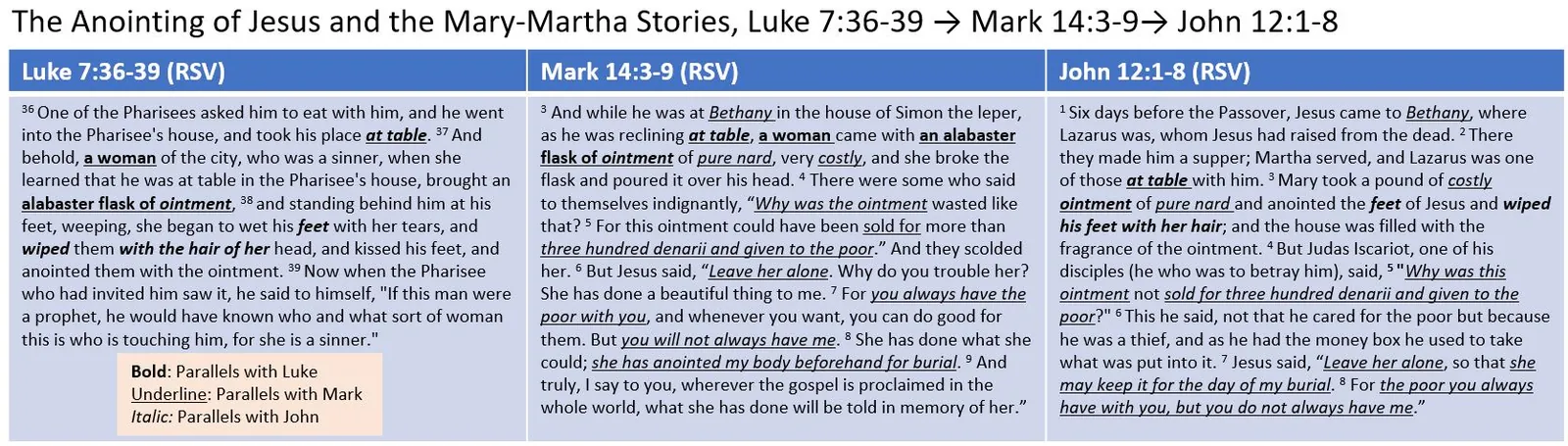
Perhaps the clearest single proof in the entire New Testament that the Fourth Evangelist combined Mark and Luke at the literary level is the Bethany anointing in John 12:1–8 (analyzed in detail by Bailey 1963, ch. 1, pp. 1–28; Macgregor 1928, p. x; Neirynck 1992; and Yoder 2011). On one side, John's indebtedness to Mark 14:3–9 (closely followed by Matt 26:6–13) is indisputable:
- Both set the banquet at Bethany shortly before Passover (Mark 14:1, 3 // John 12:1).
- Both employ the extraordinary Greek phrase myrou nardou pistikēs ("ointment of pure/genuine nard," Mark 14:3 // John 12:3). Notably, the rare adjective pistikēs occurs only in Mark 14:3 and John 12:3—not in Luke 7:37, which speaks simply of an alabaster flask of ointment (alabastron myrou).
- Both price the ointment at precisely three hundred denarii (triakosiōn dēnariōn) that might have been "given to the poor" (Mark 14:5 // John 12:5).
- In both, Jesus defends the woman by linking her act to the preparation for his burial and echoing Deuteronomy 15:11: "For you always have the poor with you" (tous ptōchous gar pantote echete meth' heautōn, Mark 14:7–8 // John 12:7–8).
Yet into this unmistakably Markan Passion-week framework, the Fourth Evangelist splices two narrative strands found exclusively in the Gospel of Luke:
- Anointing Jesus' Feet and Wiping Them with Her Hair (from Luke 7:37–38): In Mark 14:3 (and Matt 26:7), the woman pours the nard over Jesus' head (katacheen autou tēs kephalēs). In Luke 7:38 and John 12:3 alone, the woman anoints Jesus' feet and wipes them with her hair: Luke 7:38 reads tais thrixin tēs kephalēs autēs exemassen ("she wiped them with the hair of her head"), and John 12:3 reads exemaxen tais thrixin autēs tous podas autou ("she wiped his feet with her hair"; anticipated in John 11:2). The Greek verb ekmassō ("to wipe") occurs only five times in the entire New Testament—twice in Luke 7 (vv. 38, 44) and three times in John (11:2; 12:3; 13:5). Crucially, as Bailey (1963, pp. 2–9) demonstrated, this motif is completely natural in Luke 7:38, where the weeping penitent wets Jesus' dusty feet with her tears, wipes the tears away with her unbound hair, kisses his feet, and then applies ointment. In John 12:3, where no tears are mentioned, Mary pours a pound of priceless spikenard onto Jesus' feet and immediately wipes the costly perfume off with her hair! That narrative incongruity ("editorial fatigue") reveals that John conflated Mark 14:3 with Luke 7:38.
- Martha Serving and Her Sister Mary at Jesus' Feet (from Luke 10:38–42): Whereas Mark's woman at Bethany is anonymous and Luke 7's woman is an unnamed Galilean sinner, John identifies the anointer as Mary and introduces her sister Martha serving at table ("Martha served," diēkonei, John 12:2)—directly recalling Luke's famous vignette of Martha distracted with much serving (diakonian, Luke 10:40) while her sister Mary sits at the Lord's feet (para tous podas tou kyriou, Luke 10:39; cf. John 11:1–2, 20, 32).
4. Footwashing at the Supper (Luke 7:36–50; 22:24–27 → John 13:1–20)
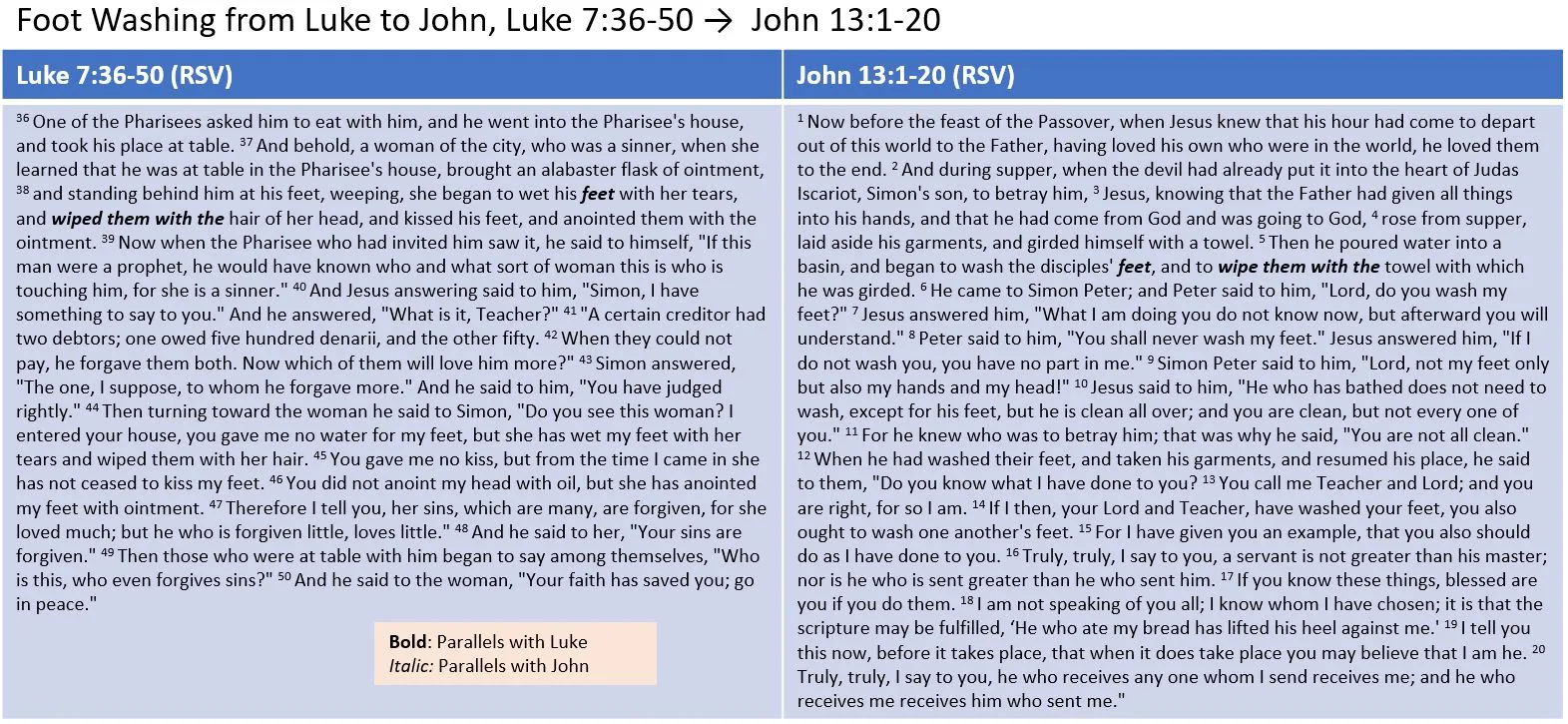
In John 13:1–20, where the Fourth Gospel omits the Synoptic words of Eucharistic institution at the Last Supper, it narrates instead Jesus rising from the table, wrapping a towel (lention) around his waist, pouring water into a basin, washing his disciples' feet, and wiping them dry (ekmassein, John 13:5—the same rare Lukan verb used in Luke 7:38, 44 and John 12:3). Critical scholarship has identified a double Lukan catalyst behind this uniquely Johannine scene:
- Dramatization of Luke's Last Supper Saying on Table Service (Luke 22:24–27): Alone among the Synoptics, Luke places the disciples' dispute over greatness at the Last Supper table itself (rather than on the road to Jerusalem as in Mark 10:41–45 // Matt 20:24–28) and formulates Jesus' response specifically in terms of reclining at dinner versus serving at table: "For who is the greater, one who reclines at table [ho anakeimenos] or one who serves [ho diakonōn]? Is it not the one who reclines at table? Yet I am among you as one who serves" (Luke 22:27). As Bailey (1963, pp. 52–54) and C. K. Barrett observed, John 13:4–17 transforms Luke's Last Supper maxim into an unforgettable symbolic action performed by Jesus himself during the meal ("I have given you an example, that you also should do just as I have done to you," John 13:15).
- Mimetic Inversion of Luke 7:36–50: In "Mimesis: Foot Washing from Luke to John" (2016), Keith L. Yoder further argues that John 13:1–17 mirrors the sequential plot architecture of Luke 7:36–50—a banquet setting, a socially transgressive act of footwashing and wiping (ekmassō, Luke 7:38, 44 // John 13:5), an indignant objection from an interlocutor (Simon the Pharisee in Luke 7:39 // Simon Peter in John 13:6–8), a pedagogical dialogue on cleansing/forgiveness, and a concluding summons to love and imitation (Luke 7:41–50 // John 13:12–17, 34–35)—inverting roles so that Jesus now performs for his disciples the humble hospitality once rendered to him in Luke 7.
5. Martha, Mary, and Lazarus (Luke 10:38–42; 16:19–31 → John 11:1–45; 12:1–8)
The raising of Lazarus from four days in the tomb (John 11:1–45) stands at the structural pivot of the Fourth Gospel, precipitating the Sanhedrin's plot to put Jesus to death (11:46–53)—yet Mark, Matthew, and Luke show complete silence regarding so stupendous a public miracle just two miles outside Jerusalem during Jesus' final approach to the city. Remarkably, however, the Gospel of Luke is the only other Gospel in the New Testament that names a figure called Lazarus—in Jesus' parable of the Rich Man and Lazarus (Luke 16:19–31)—and the only Synoptic Gospel that knows the sisters Martha and Mary (Luke 10:38–42). Notice how Luke 16:27–31 concludes:
Luke 16:27–31 (RSV): 27 And he said, "Then I beg you, father, to send him [Lazarus] to my father's house— 28 for I have five brothers—that he may warn them, lest they also come into this place of torment." 29 But Abraham said, "They have Moses and the prophets; let them hear them." 30 And he said, "No, father Abraham; but if some one goes to them from the dead, they will repent." 31 He said to him, "If they do not hear Moses and the prophets, neither will they be convinced if some one should rise from the dead [ean tis ek nekrōn anastē]."
Since the nineteenth century, critical scholars have observed that John 11–12 brings together Luke's two special traditions—giving Martha and Mary of Luke 10:38–42 a brother named Lazarus who actually dies and rises from the dead, only for the chief priests and Pharisees to fulfill Abraham's closing verdict in Luke 16:31 by plotting to kill both Jesus and the risen Lazarus rather than believing (John 11:46–53; 12:10–11; cf. John 5:45–47 on disbelieving Moses!). In his 2011 EGLBS paper ("From Luke to John: Lazarus, Mary, and Martha in the Fourth Gospel") and his 2022 Novum Testamentum article ("One and the Same? Lazarus in Luke and John," NovT 64 [2022]: 184–209), Keith L. Yoder reinforced this literary link by mapping eighteen ordered lexical and structural correspondences across Luke 10:38–42, Luke 16:19–31, and John 11–12:
| Shared Narrative / Lexical Element | Gospel of Luke | Sequential Order | Gospel of John |
|---|---|---|---|
| 1. Setting in a "certain village" (kōmē) | Luke 10:38 | ✓ | John 11:1 (cf. 11:30) |
| 2. Named sisters "Mary" and "Martha" | Luke 10:38–39 | ✓ | John 11:1 (cf. 11:5; 12:2–3) |
| 3. Mary "sitting" in the house | Luke 10:39 | — | John 11:20 |
| 4. Mary "at the feet" of Jesus | Luke 10:39 | — | John 11:32 (cf. 12:3) |
| 5. Jesus addressed/referred to as "Lord" (Kyrios) | Luke 10:39–41 | ✓ | John 11:2–3, 21, 32 |
| 6. Martha characterized by "serving" (diakoneō) | Luke 10:40 | ✓ | John 12:2 |
| 7. Martha speaks to Jesus first | Luke 10:40 | ✓ | John 11:21 |
| 8. Mary silent or secondary until single turn | Luke 10:39–42 | N/A | John 11:32; 12:3 |
| 9. Incipit formula "Now a certain man..." (tis) | Luke 16:19–20 (cf. 10:38) | ✓ | John 11:1 |
| 10. Personal name "Lazarus" (unique in NT) | Luke 16:20 | ✓ | John 11:1; 12:1 |
| 11. Physical affliction followed by Lazarus's death | Luke 16:20–22 | ✓ | John 11:1–4, 14 |
| 12. Lazarus wholly silent and passive throughout | Luke 16:19–31 | N/A | John 11:1–45; 12:1–11 |
| 13. Idiom "lifted up his eyes" (ēren tous ophthalmous) | Luke 16:23 | ✓ | John 11:41 |
| 14. Direct address "Father" (Pater) | Luke 16:24, 27, 30 | ✓ | John 11:41 |
| 15. Motif of "five brothers" / fivefold adelphos & adelphē | Luke 16:28 | ✓ | John 11:2, 19, 21, 23, 32 (and 11:2, 3, 5, 28, 39) |
| 16. Petition to send/call Lazarus from the dead | Luke 16:27–28, 30 | ✓ | John 11:41–43 |
| 17. Petition denied (Luke) / divinely granted (John) | Luke 16:29, 31 | ✓ | John 11:41–44 |
| 18. Outcome: hardened unbelief despite one rising from the dead | Luke 16:31 | ✓ | John 11:45–53; 12:10–11 |
Yoder (2022, pp. 191–204) highlights how in both narratives Lazarus never utters a single word and remains entirely passive—afflicted by sores or illness, dying, and laid at a gate or in a tomb—while in John 12:1–6 Judas Iscariot ("having the moneybag" and pilfering what was put into it) serves as a dramatic foil analogous to Luke's callous Rich Man opposite the silent Lazarus reclining beside Jesus.
6. The Holy Spirit as Teacher (Luke 12:12 → John 14:26)
In the Synoptic saying on Spirit-inspired defense before authorities, Mark 13:11 ("it is not you who speak, but the Holy Spirit") and Matthew 10:19–20 ("what you are to say will be given to you... the Spirit of your Father speaking through you") speak of the Spirit speaking in believers. Only Luke 12:12 introduces the verb "will teach you" (didaxei hymas)—a distinctive formulation echoed directly in the Paraclete promise of John 14:26 (Bailey 1963, ch. 4, pp. 37–38):
Luke 12:12 (RSV): "For the Holy Spirit will teach you [to gar hagion pneuma didaxei hymas] in that very hour what you ought to say."
John 14:26 (RSV): "But the Counselor, the Holy Spirit, whom the Father will send in my name, he will teach you all things [ekeinos hymas didaxei panta], and bring to your remembrance all that I have said to you."
7. "Hating" One's Own Life (Luke 14:26 → John 12:25)
Across the Synoptic tradition, the paradox of losing and saving one's life appears in Mark 8:35, Matthew 10:39; 16:25, and Luke 9:24; 17:33, while the demand to prefer Jesus above family appears in Matthew 10:37 ("Whoever loves father or mother more than me..."). Only in Luke 14:26 is the stark Semitic hyperbole "hate" (miseō) applied explicitly to "one's own life" (tēn psychēn heautou)—and the only other passage in the entire New Testament that speaks of "hating one's life" is John 12:25, which fuses the Lukan "hate one's life" phrasing with the Synoptic lose/keep saying (Bailey 1963, ch. 4, pp. 37–38):
Luke 14:26 (RSV): "If any one comes to me and does not hate his own father and mother and wife and children and brothers and sisters, yes, and even his own life [eti te kai tēn psychēn heautou], he cannot be my disciple."
John 12:25 (RSV): "He who loves his life loses it, and he who hates his life [ho misōn tēn psychēn autou] in this world will keep it for eternal life."
8. The Triumphal Approach to Jerusalem (Luke 19:37–40 → John 12:12–19)
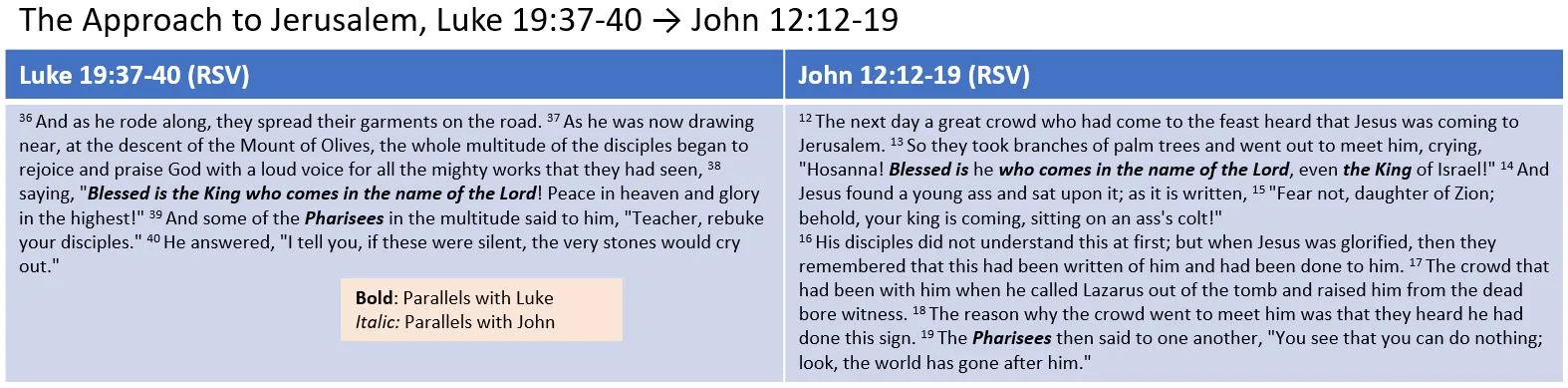
In their accounts of Jesus' royal entry into Jerusalem, Luke 19:37–40 and John 12:12–19 share three significant non-Markan agreements absent from Mark 11:1–10 and Matthew 21:1–9 (Bailey 1963, ch. 5, pp. 39–46):
- Acclamation Explicitly Grounded in Jesus' Miracles: Neither Mark nor Matthew links the crowd's palm-entry chant to Jesus' miracles. In Luke 19:37, the multitude of disciples praises God "for all the mighty works that they had seen" (peri pasōn hōn eidon dynameōn); in John 12:17–18, the crowd goes out to meet him specifically because they heard he had performed the sign of calling Lazarus from the tomb.
- Insertion of the Title "the King" (ho basileus) into Psalm 118:26: Whereas Mark 11:9–10 ("Blessed is he who comes in the name of the Lord! Blessed is the coming kingdom of our father David!") and Matthew 21:9 do not call Jesus "the King" in the Psalm 118:26 cry, both Luke 19:38 ("Blessed is the King who comes in the name of the Lord!"—Eulogēmenos ho erchomenos, ho basileus en onomati kyriou) and John 12:13 ("Blessed is he who comes in the name of the Lord, even the King of Israel!"—kai ho basileus tou Israēl) explicitly insert the royal title ho basileus.
- Immediate Pharisaic Reaction to the Crowd's Acclamation: Alone among the four Gospels, both scenes conclude immediately with a hostile or alarmed reaction by the Pharisees at the crowd's enthusiasm (Luke 19:39, "Some of the Pharisees in the crowd said to him, 'Teacher, rebuke your disciples'" // John 12:19, "The Pharisees then said to one another, 'You see that you can do nothing; look, the world has gone after him'").
9. Daily Temple Teaching and Nights on the Mount of Olives (Luke 21:37–38 → John 8:1–2)
In Luke 21:37–38, concluding Jesus' public Jerusalem teaching prior to Passion night, Luke summarizes Jesus' daily rhythm in terms remarkably close to the transitional verses standing at the head of the Pericope Adulterae in John 8:1–2:
Luke 21:37–38 (RSV): 37 And every day he was teaching in the temple, but at night he went out and lodged on the mount called Olivet. 38 And early in the morning [orthrize] all the people [pas ho laos] came to him in the temple to hear him.
John 8:1–2 (RSV): 1 But Jesus went to the Mount of Olives. 2 Early in the morning [orthrou] he came again to the temple; all the people [pas ho laos] came to him, and he sat down and taught them.
Whereas Mark 11:19 mentions simply going "out of the city" in the evening (and Matt 21:17 names Bethany), only Luke 21:37–38 and John 8:1–2 pair Jesus' evening retreat to the Mount of Olives with returning at dawn (orthrize / orthrou) as "all the people" (pas ho laos) gather to hear him teach in the temple.
10. The Woman Caught in Adultery (John 7:53–8:11) and Its Lukan Style
Text-critically, the Pericope Adulterae (John 7:53–8:11) is absent from all the earliest Greek witnesses to the Fourth Gospel—including Papyri 𝔓66 and 𝔓75, Codex Sinaiticus (א), and Codex Vaticanus (B)—as well as from Origen's and Chrysostom's commentaries on John, and its vocabulary and syntax stand sharply at odds with genuine Johannine Greek. Strikingly, an important family of Byzantine-Caesarean minuscules—Family 13 (f13, the Ferrar Group, including MSS 13, 69, 124, 346, 543)—places this exact story not in John at all, but immediately after Luke 21:38!
Building upon earlier lexical investigations by Henry J. Cadbury (1917) and Frederick A. Schilling (1955), Kyle R. Hughes ("The Lukan Special Material and the Tradition History of the Pericope Adulterae," Novum Testamentum 55, no. 3 [2013]: 232–251, esp. pp. 238–243) has demonstrated that John 7:53–8:11 exhibits a dense cluster of distinctively Lukan vocabulary and grammatical constructions ("Lukanisms"):
- Orthrou ("at daybreak," John 8:2): Elsewhere in the New Testament, the noun orthros occurs exclusively in Luke–Acts (Luke 24:1; Acts 5:21—where it likewise describes entering the temple at dawn to teach!—alongside the cognate verb orthrizō solely in Luke 21:38).
- Paraginomai ("to arrive," John 8:2): A strongly favored Lukan verb occurring 28 times in Luke–Acts (out of 37 New Testament occurrences), compared with three times in Matthew (including paraginomai eis + accusative of place in Matt 2:1 and Acts 9:26) and only once each in Mark (14:43) and canonical John (3:23).
- Pas ho laos ("all the people," John 8:2): Occurs 15 times in Luke–Acts (including the exact parallel at Luke 21:38!), only once in Matthew (27:25), and nowhere in Mark or the rest of the Fourth Gospel; more broadly, laos appears 84 times in Luke–Acts versus only twice in Mark and twice in the rest of John (11:50; 18:14).
- Teaching While Seated (kathisas edidasken, John 8:2): Pairing a form of kathizō with didaskō in the same clause is characteristic of Luke–Acts (Luke 5:3, kathisas edidasken; Acts 18:11; cf. Matt 5:1–2).
- Purpose Clause "That They Might Have a Charge to Bring Against Him" (hina echōsin katēgorein autou, John 8:6): Closely echoes Luke 6:7 (hina heurōsin katēgorein autou, altering Mark 3:2); indeed, the present active infinitive katēgorein appears elsewhere in the New Testament exclusively in Luke–Acts (Luke 6:7; 23:2; Acts 24:2, 19; 28:19).
- Apo tou nyn ("from now on," John 8:11): A signature Lukan idiom occurring six times in Luke–Acts (Luke 1:48; 5:10; 12:52; 22:18, 69; Acts 18:6) and elsewhere in the New Testament only once in Paul (2 Cor 5:16)—never in Matthew, Mark, or the rest of John (which uses ap' arti instead: John 1:51; 13:19; 14:7; 16:32).
- Narrative Parataxis Versus de: Whereas the Fourth Evangelist heavily favors oun ("therefore") and asyndeton, John 7:53–8:11 links nearly every sentence with the postpositive particle de, matching Lukan narrative style.
Assessing this converging stylistic and manuscript evidence, Raymond E. Brown observed in his classic Anchor Bible commentary:
In general, the style is not Johannine either in vocabulary or grammar. Stylistically, the story is more Lucan than Johannine. Nor is the manuscript evidence unanimous in associating the story with John. One important group of witnesses places the story after Luke 21:38, a localization which would be far more appropriate than the present position of the story in John, where it breaks up the sequence of the discourses at Tabernacles. (Raymond E. Brown, The Gospel According to John (I–XII), Anchor Bible 29 [Garden City, NY: Doubleday, 1966], p. 336)
Whether the pericope circulated originally within pre-Lukan ("L") tradition, stood in an early form of Luke prior to ascetic/penitential excisions in the second century, or was framed with Lukan bridge language modeled on Luke 21:37–38 ("Jesus went to the Mount of Olives. Early in the morning he came again to the temple," John 8:1–2), its linguistic profile attests once again the deep entanglement of Lukan and Johannine textual history.
Key Text-Critical Studies on John 7:53–8:11 and Luke 21:37–38:
- Henry J. Cadbury, "A Possible Case of Lukan Authorship (John 7:53–8:11)," Harvard Theological Review 10, no. 3 (1917): 237–244.
- Frederick A. Schilling, "The Story of Jesus and the Adulteress," Anglican Theological Review 37 (1955): 91–106.
- Raymond E. Brown, The Gospel According to John (I–XII), Anchor Bible 29 (Garden City, NY: Doubleday, 1966), pp. 332–338.
- Joseph A. Fitzmyer, The Gospel According to Luke (X–XXIV), Anchor Bible 28A (Garden City, NY: Doubleday, 1985), pp. 1358, 1555–1556.
- Kyle R. Hughes, "The Lukan Special Material and the Tradition History of the Pericope Adulterae," Novum Testamentum 55, no. 3 (2013): 232–251 (DOI: 10.1163/15685365-12341425).
11. Satan Entering into Judas Iscariot (Luke 22:3 → John 13:2, 27)
In Mark 14:10–11 and Matthew 26:14–16, Judas Iscariot goes to the chief priests entirely on human initiative without any mention of Satan or the devil. Alone in the entire New Testament, Luke 22:3 and John 13:2, 27 attribute Judas's betrayal explicitly to Satan entering into him (Bailey 1963, ch. 6, pp. 47–49; Lang 1999):
Luke 22:3 (RSV): "Then Satan entered into Judas [Eisēlthen de Satanas eis Ioudan] called Iscariot, who was of the number of the twelve."
John 13:2, 27 (RSV): 2 "And during supper, when the devil had already put it into the heart of Judas Iscariot, Simon's son, to betray him..." 27 "Then after the morsel, Satan entered into him [tote eisēlthen eis ekeinon ho Satanas]. Jesus said to him, 'What you are going to do, do quickly.'"
Two indicators confirm that directionality runs from Luke to John: (1) renewing Satan's assault at the Passion forms an intentional narrative inclusio with the ending of Luke's temptation narrative ("when the devil had ended every temptation, he departed from him until an opportune time," Luke 4:13; cf. Luke 22:31, 53); and (2) the noun Satanas occurs six times in Luke–Acts, whereas John 13:27 is the sole occurrence of the word Satanas anywhere in the entire Gospel and Epistles of John! The Fourth Evangelist clearly retained Luke's exact wording in 13:27 while expressing the same thought in his own preferred idiom (diabolos, cf. John 6:70; 8:44; 1 John 3:8, 10) in 13:2 (Bailey 1963, pp. 47–49).
12. The Last Supper: Farewell Discourse, Table Service, and Peter's Denial (Luke 22:14–38 → John 13–17)
Whereas Mark (14:18–26) and Matthew (26:21–30) bring the Last Supper quickly to a close immediately after the betrayal announcement and Eucharistic words, moving Jesus and the disciples out to the Mount of Olives before any further conversation, Luke 22:14–38 and John 13–17 share four striking structural agreements at the supper table itself (Bailey 1963, ch. 7, pp. 50–58; Cribbs 1971, pp. 431–433):
- Extended Upper-Room Farewell Discourse: Luke gathers an authentic farewell discourse (Luke 22:21–38) inside the upper room at the meal—providing the exact structural precedent that the Fourth Evangelist expands on a monumental scale in the Farewell Discourses of John 13:31–17:26.
- Jesus as the Humble Servant at Table: As noted in Section 4 above, Luke relocates the disciples' dispute over greatness into the Last Supper and formulates Jesus' response around serving at table ("Yet I am among you as one who serves [hōs ho diakonōn]," Luke 22:24–27)—the precise motif dramatized in Jesus' washing of the disciples' feet at the meal in John 13:4–17.
- Prediction of Peter's Threefold Denial Inside the Upper Room: In Mark 14:26–31 and Matthew 26:30–35, Jesus predicts Peter's denial after leaving the upper room while walking to the Mount of Olives. In Luke 22:31–34 and John 13:36–38 alone, the prediction takes place during the supper inside the upper room, and their wording agrees remarkably against Mark's "twice" (Mark 14:30): Luke 22:34 reads ou phōnēsei sēmeron alektōr heōs tris me aparnēsē ("the cock will not crow this day, until you three times deny that you know me"), and John 13:38 reads ou mē alektōr phōnēsē heōs hou arnēsē me tris ("the cock will not crow, till you have denied me three times").
- Intercessory Prayer for Disciples' Faith: Within that upper-room exchange, Luke records Jesus' explicit assurance of intercessory prayer for Simon Peter's perseverance in faith ("Simon, Simon, behold, Satan demanded to have you, that he might sift you like wheat, but I have prayed for you that your faith may not fail," Luke 22:31–32), anticipating Jesus' extended high-priestly prayer in John 17:9–21 asking the Father to keep his disciples from the evil one (17:15) and sanctify them in unity.
13. Departure to the Arrest and the Servant's Right Ear (Luke 22:39–53 → John 18:1–12)
From the conclusion of the supper through Jesus' arrest, Luke 22:39–53 and John 18:1–12 exhibit a cluster of positive and negative agreements against Mark 14:26–52 and Matthew 26:30–56 (Bailey 1963, ch. 8, pp. 59–66; Lang 1999):
- Both note explicitly that the disciples followed/entered with Jesus upon leaving the supper (Luke 22:39 // John 18:1).
- Omission of the Name "Gethsemane": Whereas Mark 14:32 and Matthew 26:36 name "a place called Gethsemane," neither Luke ("at the place," 22:40) nor John ("a garden," 18:1) uses the name Gethsemane.
- A Place Jesus Customarily Frequented: Luke 22:39 notes editorially that Jesus went out to the Mount of Olives "as was his custom" (kata to ethos, linking back to Luke 21:37), which John 18:2 turns into the narrative explanation for how Judas knew where to find him ("for Jesus often met there with his disciples").
- Judas's Kiss Downplayed or Eliminated: In Mark 14:45 and Matthew 26:49, Judas actually kisses Jesus; in Luke 22:47–48 Judas approaches to kiss him while Jesus forestalls or rebukes the gesture, and in John 18:2–8 the kiss disappears altogether as Jesus steps forward to confront the cohort himself.
- The High Priest's Servant's "Right Ear": Mark 14:47 and Matthew 26:51 state simply that the bystander cut off the servant's "ear." Alone among the four Evangelists, Luke 22:50 (to ous autou to dexion) and John 18:10 (to ōtarion to dexion) specify that it was his right ear! Specifying "the right" anatomical side is a classic Lukan medical/stylistic signature: when adapting Mark 3:1 (a man with a withered hand), Luke 6:6 redactionally inserts "his right hand" (hē cheir autou hē dexia; cf. Luke 1:11; Acts 3:7)—proving that John inherited "the right ear" from Luke's redaction of Mark (Bailey 1963, pp. 62–63; Neirynck 1992).
- Omission of the Markan Flight of All the Disciples: Neither Luke nor John reproduces Mark 14:50–52 (// Matt 26:56b), where all the disciples forsake Jesus and flee.
14. Examination Before the Jewish Authorities (Luke 22:54–71 → John 18:13–28)
In Mark 14:55–64 and Matthew 26:59–66, the full Sanhedrin convenes at night to conduct a formal capital trial featuring conflicting witnesses, the charge that Jesus threatened to destroy the temple, the high priest tearing his garments, and a formal nocturnal condemnation to death for blasphemy. Both Luke 22:54–71 and John 18:13–28 depart strikingly from Mark's nocturnal trial structure (Bailey 1963, ch. 9, pp. 67–78): neither narrates a nighttime Sanhedrin trial with false witnesses, the temple-destruction accusation, or a formal death sentence during the night, and Luke–Acts elsewhere uniquely associates Annas directly with the office of high priest alongside Caiaphas (Luke 3:2, "in the high-priesthood of Annas and Caiaphas"; Acts 4:6, "Annas the high priest and Caiaphas"), matching Annas's prominent role in John 18:13, 19–24.
15. The Trial Before Pontius Pilate (Luke 23:1–25 → John 18:28–19:16)
Across the Roman trial before Pontius Pilate, Luke 23:1–25 and John 18:28–19:16 share remarkable structural and verbal agreements absent from Mark 15:1–15 and Matthew 27:11–26 (Bailey 1963, ch. 10, pp. 79–86; Lang 1999):
- Pilate's Threefold Declaration of Jesus' Innocence: Neither Mark nor Matthew has Pilate pronounce a formal verdict of "I find no crime/guilt in him." In Luke 23:4, 14–15, 22, Pilate declares three times, "I find no crime in this man" (ouden heuriskō aition en tō anthrōpō toutō, v. 4; cf. vv. 14, 22). In John 18:38b; 19:4, 6, Pilate likewise pronounces three times in nearly identical Greek, "I find no crime in him" (egō oudemian heuriskō en autō aitian)! Because Luke's threefold verdict is tightly woven into Luke's special Herod Antipas episode (Luke 23:6–15) and matches Acts' apologetic motif of Roman officials pronouncing Christian defendants innocent of capital charges (Acts 13:28; 18:14–15; 23:29; 25:25; 26:31–32), John's adoption of Luke's redactional pattern is unmistakable.
- Scourging Linked to Attempted Release: In Mark 15:15 and Matthew 27:26, Pilate scourges Jesus only after condemning him to crucifixion. In Luke 23:16, 22 ("I will therefore chastise him and release him") and John 19:1–12, disciplinary scourging/chastisement is framed as an intermediate measure aimed at satisfying the accusers so Pilate can release Jesus.
- Explicit Political Charge Regarding Kingship and Caesar: Luke 23:2 ("forbidding us to give tribute to Caesar, and saying that he himself is Christ a king") parallels the explicit political leverage applied in John 19:12 ("If you release this man, you are not Caesar's friend; every one who makes himself a king sets himself against Caesar").
- Abrupt Introduction of Barabbas and Identical Crowd Cries: Both introduce Barabbas abruptly in the crowd's cry without Mark's preliminary explanation (Luke 23:18–19 // John 18:39–40); both employ the imperative of airō ("Away with this man!" Aire touton, Luke 23:18 // "Away with him, away with him!" Aron aron, John 19:15; cf. Acts 21:36; 22:22); and both double the cry "Crucify, crucify!" (Staurou, staurou auton, Luke 23:21 // Staurōson staurōson, John 19:6, 15, versus single imperatives in Mark 15:13–14).
16. Crucifixion, Death, and Burial in an Unused Tomb (Luke 23:26–56 → John 19:17–42)
In the crucifixion and burial scenes, Luke 23:26–56 and John 19:17–42 converge in both positive details and shared omissions over against Mark 15:21–47 (Bailey 1963, ch. 11, pp. 87–91):
- Both report the crucifixion of two others with Jesus—"one on either side" (enthen kai enthen / enteuthen kai enteuthen)—immediately upon reaching Golgotha/The Skull (Luke 23:33 // John 19:18), whereas Mark 15:27 delays mentioning the two robbers until several verses later.
- Both use the pluperfect heistēkeisan ("stood by") of Jesus' acquaintances and women watching at the cross (Luke 23:49 // John 19:25).
- Both omit Mark's wine mingled with myrrh (Mark 15:23), the passersby mocking Jesus over destroying the temple (Mark 15:29–30), and the Aramaic cry of dereliction, Eloi, Eloi, lema sabachthani (Mark 15:34 // Matt 27:46).
- A New Tomb Where No One Had Ever Yet Been Laid: Whereas Mark 15:46 mentions only a rock-hewn tomb (and Matt 27:60 adds the single adjective "new," kainō), Luke 23:53 ("where no one had ever yet been laid," hou ouk ēn oudeis oupō keimenos) and John 19:41 ("a new tomb where no one had ever been laid," en hō oudepō oudeis ēn tetheimenos) share a remarkable triple-negative relative clause emphasizing that the tomb had never previously held a corpse, immediately followed in both Gospels by a notice that it was the Jewish Day of Preparation (Paraskeuē, Luke 23:54 // John 19:42; cf. Luke 19:30, "on which no one has ever yet sat," another triple-negative Lukan redactional touch!).
17. Empty Tomb and Jerusalem Easter Appearances (Luke 24:1–43 → John 20:1–23)
In Chapter 24 of Luke and Chapter 20 of John, the two Gospels depart fundamentally from Mark 16:1–8 and Matthew 28:1–20 by anchoring the entire cycle of Easter Sunday resurrection appearances in Jerusalem rather than Galilee, while sharing an extraordinary sequence of narrative agreements (Bailey 1963, ch. 12, pp. 92–101; Neirynck 1992; Lang 1999):
- Two Angels at the Tomb: Mark 16:5 has a single young man in a white robe and Matthew 28:2–5 has a single angel of the Lord; Luke 24:4 ("two men stood by them in dazzling apparel") and John 20:12 ("she saw two angels in white, sitting where the body of Jesus had lain") both feature two angelic figures inside/at the tomb.
- Peter Running to the Tomb, Stooping In, and Seeing the Linen Cloths: In Luke 24:12 (attested by the oldest Alexandrian and Western witnesses, including 𝔓75, א, A, B, and supported by Luke 24:24) and John 20:3–10, Peter runs to the tomb upon hearing the women's/Mary's report, stoops down to peer inside (parakypsas blepei ta othonia, Luke 24:12 // parakypsas blepei keimena ta othonia, John 20:5!), sees the linen wrappings (ta othonia—a noun absent from Mark and Matthew), and returns home marveling (apēlthen pros heauton, Luke 24:12 // apēlthon oun palin pros autous, John 20:10). Here John expands Luke's single-verse Peter notice by introducing the Beloved Disciple in friendly footrace competition alongside Simon Peter.
- Easter Sunday Evening Appearance in Jerusalem with "Peace to You!": On the evening of that same first day of the week in Jerusalem, Jesus suddenly stands in the midst of the gathered disciples (estē en mesō autōn, Luke 24:36 // estē eis to meson, John 20:19) and greets them with the identical words, "Peace to you!" (Eirēnē hymin, Luke 24:36 // John 20:19, 21, 26), followed in both accounts by showing his bodily wounds, the disciples' joy (chara, Luke 24:41 // echarēsan, John 20:20), a missionary commission, the forgiveness of sins (aphesin hamartiōn, Luke 24:47 // aphēte tas hamartias, John 20:23), and the promise or bestowal of the Holy Spirit (Luke 24:49 // John 20:22)!
18. Inspecting Jesus' Hands and Wounds (Luke 24:36–40 → John 20:19–20, 24–29)
Among the Synoptic Gospels, only Luke 24:37–40 depicts the risen Jesus inviting his startled disciples to inspect and touch his physical wounds—"See my hands and my feet, that it is I myself; handle me, and see [psēlaphēsate me kai idete]; for a spirit has not flesh and bones as you see that I have. And when he had said this, he showed them his hands and his feet" (Luke 24:39–40). In John 20:19–20, 24–29, the Fourth Evangelist splits that single Lukan demonstration across two consecutive Sunday evenings: first showing the gathered disciples "his hands and his side" (20:20, adapting Luke's "hands and feet" to match the uniquely Johannine spear-thrust of John 19:34), and then dramatizing the Lukan motif of skeptical disciples demanding tactile proof ("handle me, and see," Luke 24:39) into the unforgettable figure of doubting Thomas ("Put your finger here, and see my hands; and put out your hand, and place it in my side," John 20:27; Bailey 1963, pp. 95–100).
Shared Macro-Motifs Across Luke–Acts and John
Beyond these eighteen specific narrative and verbal contacts, broader thematic affinities reinforce the Fourth Evangelist's acquaintance with the Lukan achievement (Cribbs 1971, pp. 444–450; Gregory 2003):
- Interest in Samaria and Samaritan Faith: Whereas Matthew 10:5 instructs the Twelve to "enter no town of the Samaritans" and Mark never mentions Samaritans at all, Luke–Acts repeatedly highlights Jesus' compassionate engagement with Samaritans (Luke 9:51–56; the Good Samaritan in 10:30–37; the grateful Samaritan leper in 17:11–19) and narrates the early Jerusalem church's breakthrough mission in Samaria (Acts 1:8; 8:4–25)—a post-Easter horizon that John 4:4–42 (esp. vv. 35–38, "I sent you to reap that for which you did not labor") reads directly back into Jesus' own lifetime.
- Prominence of Named Women Disciples: Both Luke (8:1–3; 10:38–42; 23:27–31, 49, 55; 24:1–11) and John (4:7–42; 11:1–45; 12:1–8; 19:25; 20:1–18) accord women disciples—specifically Martha, Mary, and Mary Magdalene—a sustained theological voice and resurrection witness unparalleled in Mark and Matthew.
- Pneumatology and Apostolic Witness: Just as Luke binds his Gospel to Acts through the risen Christ's promise of the Holy Spirit empowering the disciples to bear witness from Jerusalem (Luke 24:47–49; Acts 1:8; 2:1–4), John weaves the Spirit-Paraclete's teaching and testifying ministry alongside the disciples' witness ("he will bear witness to me; and you also are witnesses," John 15:26–27; 20:21–23) into the climax of Jesus' mission.
Conclusion
Taken cumulatively, the philological, redactional, and structural evidence leaves little room for doubt: the Fourth Evangelist was not writing in splendid isolation from the Synoptic tradition, nor can John be dated prior to Luke. Time and again—from John the Baptist's messianic disclaimer and Mary's wiping of Jesus' feet with her hair, to Satan entering Judas, the servant's right ear, Pilate's threefold verdict of innocence, the unused tomb, Peter peering at the linen cloths, and the risen Jesus greeting his disciples with "Peace to you!" on Easter evening in Jerusalem—the Fourth Gospel presupposes, conflates, and creatively transforms traditions bearing the unmistakable stamp of Luke's own redactional hand.