Lukan Priority
Lukan Priority and the Jerusalem School
The Jerusalem School and Priority of a Lukan Proto-Narrative
Founded in Jerusalem in the mid-1980s out of decades of collaborative research begun in the 1960s, the Jerusalem School of Synoptic Research brought together Jewish and Christian scholars working directly in the land, languages, and Second Temple sources of first-century Judea and Galilee. As summarized on the consortium’s archived home page, its members described themselves as “Jewish and Christian scholars collaborating in the land and language of Jesus; bringing historical, linguistic and critical expertise to bear on the synoptic gospels” (Jerusalem School of Synoptic Research, “Home,” archived Jan. 18, 2015, jerusalemschool.org). Their joint work rests on three foundational commitments:
- Recognizing Hebrew (alongside Aramaic and Greek) as an essential linguistic matrix for the earliest Jesus tradition;
- Reading Jesus’ words and deeds within the concrete setting of Second Temple and early rabbinic Jewish culture; and
- Tracing Semitic idioms and syntax beneath the Greek text of Matthew, Mark, and Luke in order to establish the direction of literary dependence among the Synoptic Gospels.
On its methodology statement, the consortium summarized this philological approach to the Synoptic Problem:
Tracing the linguistic and cultural data within the Synoptic Gospels leads to insights into their literary relationships. The Synoptic Gospels provide linguistic, literary, social, geographical and cultural clues to their internal structure and development. The evangelists composed their works in Greek, yet Semitic idioms are readily evident in all three. The gospels’ Greek and Semitic linguistic elements and Jewish cultural items must be identified, carefully traced through the three gospels, and then incorporated into a theory of synoptic relationships. These relationships become an important framework for reading the individual gospels. (“Methodology,” Jerusalem School of Synoptic Research, retrieved Sept. 26, 2009; archived Jan. 18, 2015)
Much of the consortium’s ongoing scholarship is published through Jerusalem Perspective. Although Lukan priority is often associated specifically with the Jerusalem School, its modern scholarly lineage reaches back to the early twentieth-century Anglican scholar William Lockton (1878–1937), an important forerunner predating the school by four decades. In a 1922 essay (“The Origin of the Gospels,” Church Quarterly Review 94 [July 1922]: 216–239) and subsequent monographs such as The Three Traditions in the Gospels (London: Longmans, Green, 1926), Lockton argued that Luke stood first among the Synoptic Gospels, that Mark drew upon Luke, and that Matthew subsequently drew upon both Mark and Luke.
Unaware at first of Lockton’s work, the American Baptist scholar Robert Lisle Lindsey (1917–1995) arrived independently at Lukan priority in Jerusalem during the early 1960s while preparing a modern Hebrew translation of Mark (A Hebrew Translation of the Gospel of Mark, Jerusalem: Dugith Publishers, 1969; 2nd ed., 1973; cf. Lindsey, “A Modified Two-Document Theory of the Synoptic Dependence and Interdependence,” Novum Testamentum 6, no. 4 [1963]: 239–263). Translating Mark’s Greek back into idiomatic Hebrew, Lindsey noticed hundreds of distinctively non-Semitic Greek expressions—such as Mark’s characteristic connective καὶ εὐθύς (“and immediately”)—that were absent from the parallel Lukan accounts. Conversely, where Luke and Matthew agreed against Mark in the Triple Tradition (the “minor agreements”), their shared wording consistently reverted cleanly into Hebrew.
These philological observations led Lindsey to conclude that canonical Mark could not be the primitive source behind Luke. Instead, Luke faithfully preserved an early, literal Greek translation of a Hebrew life of Jesus—a substratum Lindsey termed the “Proto-Narrative” (PN)—whereas Mark paraphrased and dramatized Lukan material. Building on Lindsey’s work, David N. Bivin summarized the core directional claim of the Jerusalem School Hypothesis: Luke was composed first among the extant Synoptic Gospels, Mark used Luke, and Matthew subsequently used Mark alongside an anthology of Hebraic-Greek Jesus traditions without needing to copy canonical Mark’s non-Semitic editorialisms blindly (David N. Bivin, “A New Solution to the Synoptic Problem,” Jerusalem Perspective, orig. 1991; rev. 2022, jerusalemperspective.com/2573/). Alongside Lindsey and Bivin, scholars including David Flusser, Halvor Ronning, W. Richard Stegner, and Brad H. Young have developed major linguistic, literary, and statistical arguments for Lukan priority.
Lindsey and His Discovery of the Priority of Luke
In the introduction to A Hebrew Translation of the Gospel of Mark (2nd ed., Jerusalem: Dugith Publishers, 1973), Lindsey recounts how comparing Matthew, Mark, and Luke side by side in a Greek synopsis overturned his long-held assumption of Markan priority. Having assumed that Luke, as Paul’s companion writing for Gentile readers, would have Hellenized his sources most heavily, Lindsey discovered the opposite:
I therefore turned to a story-by-story, word-by-word, study of the Synoptic Gospels of Matthew, Mark, and Luke. … To my surprise it turned out that Luke’s Gospel contained almost none of the non-Hebraic expressions so common in Mark! … Having long supposed that Luke, as the non-Jewish companion of Paul, tended to modify his text to make it more understandable to Greeks of pagan background, I was even more surprised to note that the Lukan text was almost always easier to translate to idiomatic Hebrew than was Mark. After several more years of study in which this observation has been confirmed again and again, I today find my early supposition amusing, but the point is that I was quite unprepared to suppose that of all the Synoptists Luke should prove to be the best in preservation of earlier texts. (Robert Lisle Lindsey, A Hebrew Translation of the Gospel of Mark, 2nd ed. [Jerusalem: Dugith Publishers, 1973], p. 12)
On the same page, Lindsey noted a second striking pattern concerning Matthew: wherever Matthew ran parallel to Mark in Triple Tradition stories, many of Mark’s Hebrew retroversion difficulties reappeared in Matthew, whereas wherever Matthew ran parallel to Luke without Mark (Double Tradition) or stood alone, Matthew’s Greek translated back into Hebrew nearly as smoothly as Luke’s (Lindsey 1973, p. 12). Thus Lindsey recognized that “Luke should prove to be the best in preservation of earlier texts,” while Matthew combined dependence on Mark with access to a Hebraic-Greek narrative tradition closely aligned with Luke (whether canonical Luke or Proto-Luke).
Lindsey’s Reassessment of the Synoptic Problem
Tracing this disparity across the entire synoptic corpus forced Lindsey to question whether canonical Mark could have stood behind both Matthew and Luke:
Without quite realizing it and quite without intending it, I thus found myself questioning whether our Mark could, in fact, be the principal narrative source standing equally behind Matthew and Luke in their so-called Markan portions. It looked as if Luke had universally copied more faithfully whatever Greek sources he had and that these had been translated earlier from a Hebrew source or sources, or at least from some Semitic document or documents so much like Hebrew that in retranslation it was impossible to tell the difference. (Lindsey 1973, pp. 12–13)
Because Matthew carries over many distinctively Markan redactional expressions while Luke shows virtually no trace of them, Lindsey inferred that Matthew stood downstream from Mark, whereas Luke—or a primitive Lukan narrative—stood upstream from both.
Minor Agreements
In synoptic criticism, “minor agreements” denote shared words, phrases, or omissions in which Matthew and Luke agree with one another against Mark within Triple Tradition episodes. Lindsey observed that these agreements repeatedly preserve literal Greek renderings of Hebrew idioms belonging to what he termed the Proto-Narrative, indicating that Matthew was “dependent on a text like Luke (if not Luke)” alongside Mark (Lindsey 1973, p. 17). Summarizing his analysis (pp. 17–18), Lindsey highlighted four consequences of the minor agreements:
- They demonstrate Luke’s reliance on an ancient non-Markan narrative rather than on canonical Mark.
- They expose Mark’s editorial habits by revealing the precise Semitic words and phrases Mark replaced with his own Greek paraphrases.
- They illuminate Matthew’s conflationary technique—what Lindsey called a “Weave Effect,” in which an evangelist alternates phrases from two parallel texts.
- They disclose the character of the underlying Proto-Narrative itself: a Greek text bearing light editorial seams yet preserving “a highly literal Greek translation of a Hebrew original” (Lindsey 1973, p. 18).
Comparing all three Gospels across the Triple Tradition, Lindsey noted a “great difference between Matthew and Luke as to the amount of their respective dependence on Mark” and emphasized that “the text of Luke turns out to be Semitically better than either Mark or Matthew in the Triple Tradition” (Lindsey 1973, p. 19).
Markan Cross-Factor
Lindsey coined the term Markan Cross-Factor to describe a structural inversion between pericope order and verbal agreement across the Synoptics (a pericope being an individual, self-contained narrative episode or discourse unit). In the Triple Tradition (Matthew–Mark–Luke), all three Gospels largely share Mark’s sequence of pericopae, yet Matthew and Luke rarely agree verbatim for more than a few consecutive words. Conversely, in the Double Tradition (Luke–Matthew without Mark), Matthew and Luke diverge widely in narrative placement yet “show such a high verbal identity in about two-thirds of the common verses that we have to suppose one author is copying from the other or both are copying with great fidelity from some common document” (Lindsey 1973, p. 20).
As Lindsey observed, “It is obvious that the Gospel of Mark is somehow responsible for the particular pattern the evidence takes, and the only question is how” (p. 21). In Lindsey’s picturesque phrase, Matthew and Luke appear to “treat Mark’s pericopae order with respect, but his wording like a rejected wife” (p. 22). Once Mark is placed in the middle of the synoptic sequence, this inversion becomes transparent: Mark followed the narrative sequence of his Lukan/Proto-Narrative source while thoroughly paraphrasing its wording, and Matthew subsequently followed Mark’s narrative framework where Mark was present while preserving the earlier Lukan wording where Mark was absent.
Key Questions
Reflecting on why scholarship had long overlooked Lukan priority, Lindsey noted how unexamined assumptions about Luke’s Gentile background had obscured the linguistic data:
For instance, the fact that Luke preserves a Greek text which normally retranslates easily to Hebrew and almost always fails to give even a hint of an expression which could be interpreted as the remnant of a Markan non-Hebraism should have led me to suspect that Luke is uninfluenced by Mark and derives his usually excellent translation-text directly from a proto-source. I should also have asked why a writer like Mark, who enjoyed re-writing as much as he did, should not have been deliberately changing the wording not only of his proto-narrative but also of Luke, thus becoming the creator of the strange verbal distance between Matthew and Luke. (Lindsey 1973, p. 26)
Whereas Luke maintains a consistent Hebraic-Greek translation register, Matthew repeatedly appears “to be weaving together Markan redactic phrases and PN expressions” (Lindsey 1973, p. 27), corroborating the priority of the Lukan tradition.
Summary Basis for Proto-Lukan Priority
In his foreword to Lindsey’s volume, Hebrew University professor David Flusser (1917–2000) demonstrated how Second Temple Jewish legal custom (halakhah, the body of Jewish religious law governing Sabbath and daily observance) confirms Luke’s historical and philological priority over Mark and Matthew. Examining the healing of the man with the withered hand (Luke 6:6–11; cf. Mark 3:1–6; Matthew 12:9–14), Flusser noted that healing solely by spoken word violated no Sabbath prohibition, so Jesus’ critics had no legal grounds for capital proceedings—precisely as Luke 6:11 reports, whereas Mark 3:6 and Matthew 12:14 prematurely introduce a plot to destroy him:
In the story Jesus’ opponents watch to see if he will heal a man on the Sabbath in a way opposed to the halacha. None of the Synoptists suggest that there was any open criticism of Jesus’ action. There is no discoverable reason why there should have been such a criticism, for this kind of healing (by command) was not in opposition to the halacha. Yet both Mark and Matthew, in almost identical words, state that “the Pharisees (Mark adds also ‘the Herodians’) took counsel against Jesus to destroy him.” Luke significantly says only that Jesus’ opponents “discussed among themselves” what to do “to” Jesus. … Mark, however, takes the phrase to mean that “they counselled with each other” with a view to doing what a later group of high priests would counsel together to do, namely, destroy Jesus. Mark has leapt ahead to a later event and attributed motives of a later time to the detractors of Jesus. (David Flusser, “Foreword,” in Robert Lisle Lindsey, A Hebrew Translation of the Gospel of Mark, 2nd ed. [Jerusalem: Dugith Publishers, 1973], p. 5)
From such comparisons, Flusser drew three methodological conclusions regarding synoptic order:
The first [lesson] is that any normal philological reasoning would indicate the priority or greater authenticity of Luke’s accounts. Water does not flow uphill. It is simply impossible to believe that the Matthaean-Markan account could be changed secondarily into the Lukan form. … The second lesson is that understanding of the language usages of Jesus’ time can quite often throw immediate light on questions of originality in our Gospels. The third is that Matthew is indeed secondary to Mark and Mark to Luke, for only in such an order of dependence can we see how Matthew can accept the secondary oddity of the Markan text. (Flusser, “Foreword,” in Lindsey 1973, p. 5)
Flusser pointed to Jesus’ hearing before the Jewish council (Luke 22:66–71; cf. Mark 14:55–64; Matthew 26:59–66) as a second decisive test case. Unlike Mark 14:63–64 and Matthew 26:65–66—where the high priest tears his garments, charges Jesus with blasphemy on undefined legal grounds, and secures a formal capital verdict (“all condemned him as deserving death”)—Luke records neither a torn garment, nor a charge of blasphemy, nor a formal Sanhedrin death sentence (matching Luke’s three passion predictions in Luke 9:22, 44; 18:31–33), but rather a preliminary interrogation before delivering Jesus to Pilate:
The accusation of blasphemy is absent from Luke, as is the Markan reference to the tearing of the high priest’s clothes. There is only an interrogation by the high priests and a most remarkable description of Jesus’ dialogue with the priests the rabbinic sophistication of which is not less astounding than the Hebrew word order and idiom of the account. There is every reason to accept the Lukan version in preference to that of Matthew and Mark. (Flusser, “Foreword,” in Lindsey 1973, pp. 6–7)
Jerusalem School Hypothesis
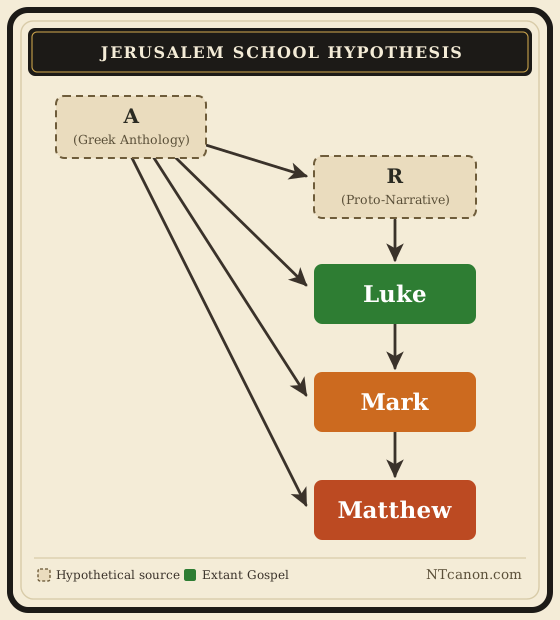
As refined by Lindsey and David N. Bivin, the Jerusalem School Hypothesis traces the Synoptic Gospels back to an original Hebrew biography of Jesus that was translated literally into Greek at an early stage (Bivin, “A New Solution to the Synoptic Problem,” Jerusalem Perspective, rev. 2022, jerusalemperspective.com/2573/). From that Greek translation arose two intermediate documents:
- Anthology (A): A topically arranged collection of sayings, parables, and pronouncement stories excerpted from the Greek translation without preserving its original narrative sequence.
- Reconstruction (R): A connected Greek narrative that restored chronological and biographical order by comparing the Anthology against the underlying Hebrew-to-Greek life of Jesus. Compare also James R. Edwards’s independent patristic and linguistic case for an early Hebraic source preserved uniquely in Special Luke (The Hebrew Gospel and the Development of the Synoptic Tradition [Grand Rapids, MI: Wm. B. Eerdmans, 2009]).
On this stemma, Luke alone had direct access to Reconstruction (R) alongside Anthology (A). Combining those two overlapping sources explains two prominent features of Luke’s Gospel highlighted by Bivin (“LOY Excursus: Sources of the ‘String of Pearls’ in Luke’s Gospel,” Jerusalem Perspective, jerusalemperspective.com/21115/): first, the eleven Lukan doublets—sayings that appear twice in Luke because one instance entered via R and the other via A (Luke 8:16 // 11:33; 8:17 // 12:2; 8:18 // 19:26; 9:3–5 // 10:3–12; 9:23 // 14:27; 9:24 // 17:33; 9:26 // 12:9; 9:46 // 22:24; 11:43 // 20:46; 12:11–12 // 21:14–15; and 14:11 // 18:14); and second, why Matthew and Luke exhibit near-verbatim agreement when both draw from Anthology (A), yet diverge sharply where Luke follows Reconstruction (R).
Mark subsequently drew upon Luke and Anthology (A), selectively omitting large discourse blocks while dramatizing individual narratives. Finally, Matthew drew upon Mark for narrative structure while supplementing and correcting Mark from Anthology (A) (or, on the closely related Matthean Posteriority model, directly from Luke as well). Like both the Two-Source Hypothesis and the Farrer-Goulder-Goodacre Hypothesis, the Jerusalem School Hypothesis affirms that Matthew used Mark, while reversing the relationship between Mark and Luke.
Summarizing decades of comparative research in light of Lindsey’s findings, David Flusser stated his conclusion succinctly:
My experience, chiefly based on the research of R. L. Lindsey, has shown me that Luke mostly preserves, in comparison to Mark (and to Matthew, when depending on Mark), the original tradition, and that Mark has rewritten his source (or sources) and so unfavorably influenced Matthew. (David Flusser, “The Last Supper and the Essenes,” Immanuel 2 [Spring 1973]: 23–27, at p. 25)
But Mark Is Shorter than Luke?
Advocates of Markan priority frequently appeal to Mark’s shorter overall book length as evidence of primitivity. In Jesus and His Jewish Parables: Rediscovering the Roots of Jesus’ Teaching (Mahwah, NJ: Paulist Press, 1989), Brad H. Young cautions that overall book brevity cannot be equated with narrative primitivity:
Mark’s shorter length can also have the effect of an optical illusion that leads the researcher to the conclusion that the longer gospels are following the shorter. This illusion must be verified or refuted by other facts. (Brad H. Young, Jesus and His Jewish Parables: Rediscovering the Roots of Jesus’ Teaching [Mahwah, NJ: Paulist Press, 1989], p. 135)
As Young observes, an action-centered epitome omitting extensive Jewish legal and parabolic discourses suited a Greco-Roman audience far less invested in rabbinic instruction than in miracle narratives:
A shortened edition of the gospel could have performed some important functions. For one thing, it certainly could have provided an effective tool for communicating the gospel to Hellenistic society. The instruction of Jesus would probably be less important to a non-Jewish, pagan audience. Conversely, the miracles and activities of Jesus would be considered a better vehicle of communication. (Young 1989, p. 138)
Consistent with this Hellenistic orientation, Mark alone contains two miracle stories featuring physical thaumaturgic gestures absent from Luke and Matthew—applying spittle to heal the deaf-mute in the Decapolis (Mark 7:32–35) and applying spittle in a two-stage healing of the blind man at Bethsaida who initially sees people looking like walking trees (Mark 8:22–26)—motifs with well-known Greco-Roman parallels such as Emperor Vespasian’s reported spittle healing at Alexandria (Tacitus, Histories 4.81; Suetonius, Vespasian 7.2; Dio Cassius, Roman History 65.8; cf. literature cited in Young 1989, p. 158 n. 41).
Regarding pericope order across the three Gospels, Young likewise notes that placing Mark as the editorial mediator between Luke and Matthew accounts cleanly for the sequential data:
It is also quite possible to suggest that Mark is the mediator between Matthew and Luke, and that Mark altered the arrangement of the earliest gospel and then influenced the sequence of pericopes in the remaining gospel … the data from the study of sequential order of the three synoptics can be comprehensibly accounted for by explaining that Mark omitted much of Luke’s gospel and somewhat rearranged Luke’s material. Then Matthew followed Mark’s order. (Young 1989, pp. 135–136)
Halvor Ronning corroborated this observation statistically in a four-part study (see Statistical Validation of Lukan Priority), noting that while Mark is the shortest Gospel in total book length because he omits extensive sayings and parables, his individual shared narratives are longer and more dramatized than their Lukan parallels roughly eighty percent of the time:
Due to this ‘targumic’ activity the stories Mark told are almost always (literally 80% of the time) longer than the parallel accounts in Luke and Matthew. Mark is the longest Gospel, not the shortest in terms of the actual stories he decided to incorporate. Mark is shortest only in terms of overall length, but that is only because of the stories and sayings he chose to omit. Mark’s expansionist style fits his character as a sophisticated targumic story teller. (Halvor Ronning, “A Statistical Approach to the Synoptic Problem: Part 4—Non-Linear Hypotheses,” Jerusalem Perspective, 2016)
Jerusalem School References
- William Lockton, “The Origin of the Gospels,” Church Quarterly Review 94 (July 1922): 216–239.
- Robert Lisle Lindsey, “A Modified Two-Document Theory of the Synoptic Dependence and Interdependence,” Novum Testamentum 6, no. 4 (1963): 239–263 (reissued online as “A New Two-Source Solution to the Synoptic Problem,” Jerusalem Perspective).
- Robert Lisle Lindsey, A Hebrew Translation of the Gospel of Mark, 2nd ed. (Jerusalem: Dugith Publishers, 1973), Introduction, pp. 9–84.
- Robert Lisle Lindsey, “Introduction to A Hebrew Translation of the Gospel of Mark,” Jerusalem Perspective (2014).
- Robert Lisle Lindsey, “My Search for the Synoptic Problem’s Solution (1959–1969),” Jerusalem Perspective (2013).
- Robert Lisle Lindsey, “Measuring the Disparity Between Matthew, Mark and Luke,” Jerusalem Perspective (2015).
- David Flusser, “Foreword,” in Robert Lisle Lindsey, A Hebrew Translation of the Gospel of Mark, 2nd ed. (Jerusalem: Dugith Publishers, 1973), pp. 1–8.
- David Flusser, “The Last Supper and the Essenes,” Immanuel 2 (Spring 1973): 23–27.
- David Flusser, “Character Profile: Who Was John Mark?,” Jerusalem Perspective (2013).
- Brad H. Young, Jesus and His Jewish Parables: Rediscovering the Roots of Jesus’ Teaching (Mahwah, NJ: Paulist Press, 1989).
- David N. Bivin, “Selected Examples of Rewriting in Mark’s Account of Jesus’ Last Week,” Jerusalem Perspective (2004; published in print in R. Steven Notley, Marc Turnage, and Brian Becker, eds., Jesus’ Last Week, Leiden: Brill, 2006, pp. 211–224).
- David N. Bivin, “A New Solution to the Synoptic Problem,” Jerusalem Perspective (orig. 1991; rev. 2022).
- David N. Bivin, “LOY Excursus: Mark’s Editorial Style,” Jerusalem Perspective (2021).
- David N. Bivin and Joshua N. Tilton, “LOY Excursus: Catalog of Markan Stereotypes and Possible Markan Pick-ups,” Jerusalem Perspective (2023).
- Halvor Ronning, “A Statistical Approach to the Synoptic Problem: Part 1—Triple Tradition,” Jerusalem Perspective (2015); “Part 2—Double Tradition” (2016); “Part 3—Single Tradition” (2016); and “Part 4—Non-Linear Hypotheses” (2016).
- W. Richard Stegner, “The Priority of Luke: An Exposition of Robert Lindsey’s Solution to the Synoptic Problem,” Jerusalem Perspective (2020).