Luke Primacy
Historical Reliability of Luke-Acts
Scholarly Quotes Pertaining to Luke-Acts
Bruce, F.F.. The New Testament Documents: Are They Reliable? Kingsley Books. Kindle Edition.
Luke inherited the high traditions of Greek historical writing, and had access to various excellent sources of information about the events with which he dealt, besides being himself present at some of the incidents which he narrated. We have already mentioned some sources, written and oral, on which he may have drawn. The value of his work may be realized if we compare our relatively ample knowledge of the progress of Christianity before AD 60 with our ignorance of it for many years after that date. Indeed, after Luke there arose no writer who can really be called a historian of the Christian Church until Eusebius (p. 58)
The accuracy which Luke shows in the details we have already examined extends also to the more general sphere of local colour and atmosphere. He gets the atmosphere right every time. (p. 63).
Now, all these evidences of accuracy are not accidental. A man whose accuracy can be demonstrated in matters where we are able to test it is likely to be accurate even where the means for testing him are not available. Accuracy is a habit of mind, and we know from happy (or unhappy) experience that some people are habitually accurate just as others can be depended upon to be inaccurate. Luke’s record entitles him to be regarded as a writer of habitual accuracy. (p. 64).
The historical trustworthiness of Luke has indeed been acknowledged by many biblical critics whose standpoint has been definitely liberal. And it is a conclusion of high importance for those who consider the New Testament from the angle of the historian. For the writings of Luke cover the period of our Lord’s life and death, and the first thirty years of the Christian Church, including the years in which Paul’s greatest missionary work was accomplished and the majority of his extant letters were written. The two parts of Luke’s history really bind the New Testament together, his Gospel dealing with the same events as the other Gospels, and his Acts providing the historical background to the Epistles of Paul. The picture which Luke gives us of the rise of Christianity is generally consonant with the witness of the other three Gospels and of Paul’s letters. And he puts this picture in the frame of contemporary history in a way which would inevitably invite exposure if his work were that of a romancer, but which in fact provides a test and vindication on historical grounds of the trustworthiness of his own writings, and with them of at least the main outline of the origins of Christianity presented to us in the New Testament as a whole. (pp. 65-66)
Keener, Craig S.. Between History and Spirit: The Apostolic Witness of the Book of Acts. Cascade Books, an Imprint of Wipf and Stock Publishers. Kindle Edition.
Dating
“Although a substantial minority of scholars continue to date Luke-Acts in the 60s, contending that Luke omits Paul’s death because it had not yet occurred when he wrote, and a smaller number date the work, or part of it, in the early second century, the majority of scholars favor the final three decades of the first century, with most clustering in the mid-range of 70–90.” (page. 3) [Footnote 4: Pervo, Dating Acts, 359-63, lists roughly 31 scholars for the 60s; 48 in the 70s-80s; 20 in the 90s; and 11 for c. 100 or later.]
Luke as Historiography
“Many scholars argue, I believe persuasively, that Luke writes a two-volume work that includes both biography and historiography. Treating the two books together thus invites a brief exploration of the character of ancient historiography, and of where Luke-Acts falls in the broader range of this genre.” (p. 4)
“Because historians told cohesive stories and did not simply recite annals, rhetoric was essential to their enterprise. Some allowed more rhetorical embellishment than others, but all were interested in cohesive compositions.” (pp. 5-6)
“Luke proves accurate where we would most expect this for a good ancient historian. Thus, for example, the we-narratives, which claim eyewitness information, frequently offer the most detailed scenes and sequences in Acts. Wherever Paul’s letters provide a chronological sequence for the events of Paul’s life and mission, the sequence in Acts proves nearly identical. Indeed, the correspondences of considerable information even in the earlier chapters in Acts with external sources is remarkable.” (p. 11)
Luke's Preface
“Alone among the Gospels, Luke offers what appears very much like the prefaces found in histories, a preface that (with most scholars) presumably includes both of his volumes in its purview. That this preface includes Luke’s claim to investigate or have close acquaintance with his information (Luke 1:3) fits historical works... Whatever may be said of the preface’s style, the content it promises for the work is telling. A good introduction should summarize what is to follow, and Luke’s summary of what will follow is explicitly historical: “an orderly narrative of the things fulfilled among us” (Luke 1:1, 3)." (p. 12)
“In 1:3, Luke claims to be “thoroughly acquainted” with the events he narrates, language used to affirm a writer’s familiarity with prior reports and the writer’s reliability on the subject. Investigation of the sources, including travel to interview witnesses, belonged to the best tradition of Hellenistic historiography.” (p. 15)
Reflections
“I have endeavored to show that Luke’s chosen genre and his expressed intentions lead us to expect that he handled accurately, by the standards of his era, the sources available to him. Luke has historiographic (as well as biographic) intention; while ancient historiography had essential rhetorical and literary interests, it also focused on information. Luke indicates that he made use of various oral and written sources no longer available to us, but most of which remained for examination in his own day.” (p. 17)
“Many [of Luke's] sources probably stemmed from the first generation, when some eyewitnesses remained alive and in prominent positions in the church. I thus believe that a healthy measure of skepticism is in order regarding allegations of the first-century church’s rapid amnesia. With W. D. Davies, it is helpful to note that probably only a single lifespan “separates Jesus from the last New Testament document. And the tradition in the Gospels is not strictly a folk tradition, derived from long stretches of time, but a tradition preserved by believing communities who were guided by responsible leaders, many of whom were eyewitnesses of the ministry of Jesus.” (p. 18)
“In view of such factors as those surveyed above, I believe that there is reason to suppose that Luke not only has interest in retelling historical information, but that much of the information to which he had access ultimately stems from fundamentally reliable and eyewitness sources.” (p. 19)
William Mitchell Ramsay, The Bearing of Recent Discovery on the Trustworthiness of the New Testament (p.222) London: Hodder and Stoughton, 1915
“Luke is a historian of the first rank not merely are his statements of fact trustworthy; he is possessed of the true historic sense; he fixes his mind on the idea and plan that rules in the evolution of history, and proportions the scale of his treatment to the importance of each incident. He seizes the important and critical events and shows their true nature at greater length, while he touches lightly or omits entirely much that was valueless for his purpose. In short, this author should be placed among with the very greatest of historians.”
Articles for the Reliability of Luke-Acts
December 20, 2018, Greg Boyd
IS THE BOOK OF ACTS HISTORICALLY ACCURATE?
Blue Letter Bible Commentary, Don Stewart
Books for the Reliability of Luke-Acts
Reference Excerpts ReferenceThe Authenticity of the Gospel of St. Luke
Its Bearing Upon the Evidences of the Truth of Christianity
Arthur Charles Hervey, 1890
Lord Arthur Charles Hervey (Born 20 August 1808) was an English bishop who served as Bishop of Bath and Wells from 1869 to 1894. Hervey was a good linguist, and wrote some antiquarian papers. He was one of the committee of revisers of the Authorized Version of the Old Testament, which sat 1870–1884, and in 1885 received the honorary degree of D.D. from the university of Oxford in recognition of his services. He contributed largely to William Smith’s Dictionary of the Bible and to the Speaker’s Commentary. Besides sermons and lectures, charges and pamphlets, he was author of The Genealogies of our Lord (1853).
Amazon Link
“In considering the authenticity of the Gospel of St. Luke, and the sources of his information, and the special opportunities enjoyed by him of acquiring a thorough knowledge of the facts and truths of Christianity, and the consequent claims he has upon our confidence, I spoke throughout as I should speak of any secular author, and without any reference to the inspiration of the writer.” (p.151)
“If I have provided by many “infallible proofs,” by external and internal evidence, that this Gospel was written by Luke the Physician, the beloved friend and companion of St. Paul, before the year A.D. 63 (and probably about A.D. 60), and that its authenticity carries with it the truth of the Christian religion, then I have a right to claim the full acceptance of the Christian faith by all before whom this evidence is laid, as the necessary act of a rational mind, and as the solemn duty of a reasonable moral agent.” (p.150)
Reference Excerpts ReferenceThe Bearing of Recent Discovery on the Trustworthiness of the New Testament
William Mitchell Ramsay, 1915
Sir William Mitchell Ramsay, FBA ( Born 1851) was a Scottish archaeologist and New Testament scholar. By his death in 1939 he had become the foremost authority of his day on the history of Asia Minor and a leading scholar in the study of the New Testament. Ramsay was educated in the Tübingen school of thought (founded by F. C. Baur) which doubted the reliability of the New Testament, but his extensive archaeological and historical studies convinced him of its historical accuracy. From the post of Professor of Classical Art and Architecture at Oxford, he was appointed Regius Professor of Humanity (the Latin Professorship) at Aberdeen. Ramsay also gained three honorary fellowships from Oxford colleges, nine honorary doctorates from British, Continental and North American universities and became an honorary member of almost every association devoted to archaeology and historical research.
“Luke is a historian of the first rank not merely are his statements of fact trustworthy; he is possessed of the true historic sense; he fixes his mind on the idea and plan that rules in the evolution of history, and proportions the scale of his treatment to the importance of each incident. He seizes the important and critical events and shows their true nature at greater length, while he touches lightly or omits entirely much that was valueless for his purpose. In short, this author should be placed among with the very greatest of historians.” (p. 222)
Reference Excerpts ReferenceThe Book of Acts in the Setting of Hellenistic History
Colin J. Hemer (1990)
The Acts of the Apostles is the New Testament book that contains the most obvious ties to its cultural and historical milieu. Yet, until very recently, the trend has been for 20th-century authors to bypass discussion of the relation of Acts to the world and history around it. In this book, Colin Hemer examines various strands of interlocking data, ranging from the epistles of Paul to records of the corn fleet that sailed from Alexandria. The wealth of new literary, epigraphic, and papyrological data brings fresh light to numerous details as well as to the central question of Luke’s conception of Paul’s visit to Jerusalem. The result is a broader understanding of the Hellenistic world in general and a greater appreciation for Acts as a coherent and consistent product of its day.
Amazon Link
One way we can have confidence that the documents of the New Testament are historically accurate is to check any factual claims against the historical and archaeological evidence we have from the same period of time. This is exactly what classical scholar and historian Colin Hemer did in his The Book of Acts in the Setting of Hellenistic History. Hemer was able to confirm 84 facts in the last sixteen chapters of the Book of Acts.
Scholar and historian Colin Hemer has identified 84 facts in the last 16 chapters of the Book of Acts that have been confirmed by historical and/or archaeological research.
They are as follows:
1. the natural crossing between correctly named ports [Acts 13:4-5]
2. the proper port [Perga] along the direct destination of a ship crossing from Cyprus [13:13]
3. the proper location of Lycaonia [14:6]
The Horæ Paulinæ, or the Truth of the Scripture History of St Paul
Carried out and illustrated in a continuous history of the apostolic labours and writings of St. Paul, on the basis of the Acts, with intercalary matter of sacred narrative supplied from the Epistles, and elucidated in occasional dissertations
William Paley, D.D (1840)
William Paley (July 1743 – 25 May 1805) was an English clergyman, Christian apologist, philosopher, and utilitarian. He is best known for his natural theology exposition of the teleological argument for the existence of God in his work Natural Theology or Evidences of the Existence and Attributes of the Deity, which made use of the watchmaker analogy.
His first essay was in the field of Christian apologetics, Horae Paulinae, or the Truth of the Scripture History of St Paul which compared Paul’s Epistles with the Acts of the Apostles, making use of “undesigned coincidences” to argue that these documents mutually supported each other’s authenticity. Some have said this book was the most original of Paley’s works. It was followed in 1794 by the celebrated View of the Evidences of Christianity, which was also added to the examinations at Cambridge, remaining on the syllabus until the 1920s.
Online Archive Book Link
A blog on Christian Apologetics Alliance by Tim McGrew is based in large part on this work. Here are the relevant blog entries:
UNDESIGNED COINCIDENCES IN SCRIPTURE
UNDESIGNED COINCIDENCES: PART 2
UNDESIGNED COINCIDENCES: PART 3
UNDESIGNED COINCIDENCES: PART 4
UNDESIGNED COINCIDENCES: PART 5
UNDESIGNED COINCIDENCES: PART 6
Reference Excerpts ReferenceLuke: Historian and Theologian
I. Howard Marshall , 1998
Ian Howard Marshall (Born 1934) was a Scottish New Testament scholar. He was Professor Emeritus of New Testament Exegesis at the University of Aberdeen, Scotland. He was formerly the chair of the Tyndale Fellowship for Biblical and Theological Research; he was also president of the British New Testament Society and chair of the Fellowship of European Evangelical Theologians. Marshall identified as an Evangelical Methodist. He was the author of numerous publications, including 2005 Gold Medallion Book Award winner New Testament Theology.
Amazon Link
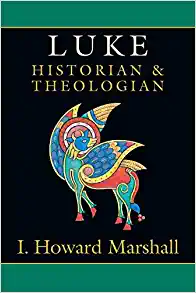
Apart from the apostle Paul, Luke is arguably the most influential force in the canon of the New Testament. His Gospel and Acts occupy almost a third of the New Testament, and together their narrative voice carries us over a span of more than sixty years, from the birth of Jesus to the imprisonment of Paul in Rome. It is difficult to imagine our understanding of the New Testament period without Luke’s writings. For this reason, the question of Luke’s historical reliability has been repeatedly investigated. In this study Howard Marshall affirms Luke’s trustworthiness as a historian. But Luke is more than a historian. He is also a theologian who finds his interpretive key in the great theme of salvation. Marshall provides us with a lucid guide to Luke’s theology of salvation as it is unfurled in Gospel narrative, but always with a eye on its ongoing development in the companion work, the Acts of the Apostles. A postscript assesses the course of Lukan studies during the decade of 1979-1988.
Reference Excerpts ReferenceActs (New Cambridge Bible Commentary)
Craig S. Keener, 2020
As the earliest narrative source for the origins of Christianity, Acts is of unrivalled importance for understanding early Christianity and the mission that originally brought it from Judea and Galilee to gentiles, and even the heart of the Roman Empire. This volume is an abridged version of Keener’s monumental, four-volume commentary on Acts, the longest and one of the most thorough engagements with Acts in its ancient setting. Sensitive to the work’s narrative unity, Keener’s commentary is especially known for its direct engagement with the wide range of ancient Jewish and Greco-Roman sources. The original commentary cited some 45,000 references from ancient extrabiblical sources to shed light on the Book of Acts. This accessible edition, aimed at students, scholars, and pastors, makes more widely available the decades of research that Keener has devoted to one of the key texts of Early Christianity.
Craig Keener (PhD, Duke University) is professor of New Testament at Asbury Theological Seminary. Six of his many books have won national awards, and his books together have sold more than one million copies. His books include heavily academic works (such as his four-volume Acts commentary) and popular ones (such as The IVP Bible Background Commentary: New Testament).
Amazon Link
Review
‘Craig S. Keener, already the author of the longest and one of the most carefully researched commentaries on the Acts of the Apostles (4 volumes consisting of 4,459 pages!) has now managed to produce a much shorter version (635 pages) without sacrificing the virtues of the earlier commentary. This one-volume commentary reflects the author’s remarkable familiarity with a vast number of primary sources (drawn from both Judaism and the Greco-Roman world), as well as an astonishing number of secondary sources in the major European languages. This ‘summary’ will make Keener’s significant contribution to the study of Acts available to a broader audience.’ David E. Aune, Walter Professor of New Testament and Christian Origins, emeritus, University of Notre Dame‘Keener’s four-volume commentary on Acts has become a standard work. All readers will welcome this one-volume abridgement of the longer commentary which still contains all the key discussions, as well as the wealth of information from ancient sources, contained in the longer work. Keener’s work is essential reading for all seeking to read Luke’s work in its original historical context.’ Christopher Tuckett, Emeritus Professor, University of Oxford