Issues with John
Progressive Embellishment of John
Introduction
As further substantiated in other articles on this site, John is the latest gospel and is the most innovative of the four. It is not considered a Synoptic gospel on account of its unique literary design and structure, generally does not follow the same sequence and framework of particular scenes exhibited in Luke, Mark, and Matthew. Besides a few miracles and accounts which pertain to Jesus' last few days from the last supper through the burial, very little in John parallels the three prior Gospels. Here we analyze the few exceptions where there is a clear parallel with John and the Synoptic Gospels.
The lack of parallels with John should be a red flag to anyone who is looking at the Gospel of John critically in assessing the historical reliability of this “spiritual” gospel. It has been established in scholarship for over 100 years now, that John should be considered as a secondary supplemental source for information about Jesus; that it is not the place to go for finding the historical Jesus. This article will shed light on why the case for the poor reliability of John has largely been made and settled. The affirmation that John is not a reliable witness to the historical Jesus has been made most recently by the great theologian and scholar James D.G. Dunn (James D. G. Dunn, Jesus Remembered, Christianity in the Making, Vol 1 (2019) Page 165-167).
Craig Keener, an even more contemporary Scholar who is known for citing more sources than other scholars, also acknowledged the contradiction of John with the Synoptics in his two-volume commentary on John, stating:
A close examination of the Fourth Gospel reveals that John has rearranged many details, apparently in the service of his symbolic message. This is especially clear in the Passion Narrative, where direct conflicts with the presumably widely known passion tradition fulfill symbolic narrative functions. John’s long discourses are of a different genre than the sayings collections in Q or even Mark’s long “apocalyptic” discourse. Such features naturally invite us to question the nature of this Gospel’s historicity; certainly he is not writing a work of the exact historiographic nature of Luke-Acts.
(Keener, Craig S.. The Gospel of John : 2 Volumes (pp. 42-43). Baker Publishing Group. Kindle Edition.)
Methodology
In this article, we will examine eight cases of progressive embellishment of all four Gospels, looking specifically at Gospel parallels which also include John. The methodology of the analysis is as follows:
- Identify parallels that John shares with the Synoptic Gospels in which John appears to be a significantly embellished and where there are notable conflicts with the Synoptic Gospels
- Calculate the number of Greek words for each parallel data set
- Create a parallel table for each case displayed in RSV English translation. Place the parallel texts side by side in the typical order of shortest to longest (Luke→Mark→ Matt→ John)
- Format the table to show common words shared between parallel texts. Formatting should be neutral in the sense of simply identifying words matching Luke, Mark, and Matthew. Consider variations of the same word that vary in number (singular vs. plural), or tense or mood as a match, unless there is a significant implication resulting from the difference.
- Identify specific differences between parallel texts, including embellishments and inconsistencies. Identify incompatibilities.
- Document the nature of each significant difference observed, such as
- Adding of sensational details
- Increase in severity
- Change from narration to increased dialogue and dramatization
- Adding of clarifying details –such as to resolve ambiguities associated with the more primitive text
- Editorial changes indicating the adoption of multiple source text into a more polished and well-developed revised text.
- A change in the narrative due to literary, philosophical, or polemical objectives.
- Identify and analyze each inconsistency observed. Pay special attention to major incompatibilities between John and other Gospels. Describe the problems posed by the inconsistency.
- Characterize the relative size/expansion of parallel texts and summarize the major findings of progressive embellishment observed for each case analyzed.
- Tabulate the total number of Greek words for all cases analyzed and present the macro results for the entire study.
- Summarize conclusions based on data and analysis
Parallels Examined
8 parallels with John and the Synoptic Gospels were identified and examined. They are as follows:
- Jesus Predicts His Betrayal, Luke 22:21-23→ Mark 14:18-21→ Matt 26:21-25 → John 13:21-27
- Betrayal With a Kiss? Luke 22:47-53→ Mark 14:43-52→ Matt 26:47-56 → John 18:1-12
- Questioning by Pilate, Luke 23:3-4→ Mark 15:2-5→ Matt 27:11-14 → John 18:33-38
- Witnesses to the Crucifixion, Luke 23:49→ Mark 15:40-41→ Matt 27:55-56 → John 19:25-27
- Burial of Jesus, Luke 23:53→ Mark 15:46→ Matt 27:59-60 → John 19:38-41
- Cleansing of the Temple, Luke 19:45→ Mark 11:15-17→ Matt 21:10-13 → John 2:13-22
- Feeding of 5000, Luke 9:12-17→ Mark 6:35-44→ Matt 14:15-21 → John 6:4-14
- Walking on the Sea, Luke → Mark 6:47-52→ Matt 14:22-33 → John 6:16-21
1. Jesus Predicts His Betrayal
Luke 22:21-23→ Mark 14:18-21→ Matt 26:21-25 → John 13:21-27
As shown in the Table 1 below, the account of Jesus predicting his betrayal expands from Luke to John. Mark incorporates core elements of the primitive Lukan text (bold) and becomes more expansive. Matthew incorporates many Markan edits (non-bold underlined text) and makes additional changes. John is the most expansive and embellished of the four. Luke, being the shortest, leaves several questions unanswered that later versions attempt to expound upon. A general tendency of Mark is to dramatize what is in Luke. Mark frequently converts what is sometimes narration into a more interactive dialogue. Seen below, the exposure of the traitor is increasingly dramatic from Luke to Mark to Matthew to John:
- Luke 22:21-23
- Jesus states that the betrayer is with him at the table, and pronounces a woe to that man
- Mark 14:18-21
- Not only is the betrayer at the table, but is one who is dipping bread with him.
- The disciples not only wonder who it might be, they take turns asking “Is it I?”
- The woe is expanded upon, “It would have been better for that man if he had not been born.”
- Matthew 26:21-25
- Matthew incorporates the significant Markan revisions and adds the explicit identification of Judas as the traitor. According to Matt 26:25 Judas asks “Is it I?” and Jesus responds “You have said so.”
- John 13:21-27
- Here the story is radically changed. Rather than Judas being identified through questioning of Jesus (Matt 26:25), Jesus identifies Judas in an even more dramatic way. This is by pronouncing “It is he to whom I shall give this morsel when I have dipped it” and then proceeding to dip the morsel and give it to Judas.
- This is an entirely different methodology than that of Matthew 26:25.
- John includes the further embellishment of additional narration followed by Jesus saying to Judas, “What you are going to do, do quickly.”
- John, further, adds references to particular disciples (Peter and the disciple who Jesus loved).
- There is a general tendency in John to attribute quotes and actions to particular disciples which are not personally identified in the Synoptics, while also adding additional details.
- Verisimilitude is a narrative technique of describing things in extreme detail to make fiction more believable. It is the quality of appearing to be true or real.
- The editor(s) of John often gives the false impression of this later work being more accurate by engaging in verisimilitude.
- Inconsistencies:
- If Judas was specifically identified at the last supper, it is only reasonable that the earlier traditions of Luke and Mark would have stated it.
- Judas being identified by question and answer in Matt 26:25 is incompatible with Jesus identifying the traitor by handing over the morsel to Judas in John 13:26
- Expansion: The number of Greek words in the parallel texts are 46, 76, 87, and 155 respectively for Luke, Mark, Matthew, and John. This corresponds to a repeated pattern of expansion from the earliest version of the story (Luke) to the latest (John)
2. Betrayal With a Kiss?
Luke 22:47-53→ Mark 14:43-52→ Matt 26:47-56 → John 18:1-12
Table 2 below is most revealing of how the Synoptics show progressive embellishment, whereas in contrast, the editor(s) of John radically change the story. The account of Jesus being betrayed expands from Luke to John, but with respect to John, we have an entirely unique account of the events which is incompatible with the Synoptics. Mark incorporates core elements of the primitive Lukan text (bold) and further expands. Matthew incorporates many Markan edits (non-bold underlined text) and makes additional changes. John is the most expansive and embellished of the four. Luke, being the least expansive, exhibits some ambiguity that later versions attempt to resolve and clarify. Again, we see the tendency of Mark to dramatize what is in Luke by increasing the amount of dialogue. The drama is increased from Luke to Mark and from Matthew to John to enhance the story:
- Luke 22:47-53
- Luke mentions an attempted kiss, but is not clear that Judas actually kissed Jesus.
- The words which are attested by all three Synoptics are in reference to coming “out as against a robber with swords and clubs” and with the statement “day after day, in the temple”, “you did not seize / lay hands on me.”
- The Lukan account ends with the mysterious statement “But this is your hour, and the power of darkness” (Luke 22:53)
- Mark 14:43-52
- Incorporated in the text is the explanation of a plot to identify Jesus with a kiss by Judas (Mark 14:44)
- A further enhancement is that Judas says “Master” and kisses Jesus, adding to the dramatic interaction of the two. (Mark 14:45)
- Mark gives the explicit indication that Luke lacks. That is, after the identifying kiss, “they immediately seized Jesus.” (Mark 14:46)
- Mark replaces the more mystical words of Jesus in Luke 22:53 of “this is your hour and the power of darkness” with “But let the scriptures be fulfilled.” (Mark 14:50)
- Matthew 26:47-56
- Matthew incorporates core Lukan text and many significant Markan revisions, and expands on details lacking in Mark and Luke.
- Embellishments in Matthew include:
- The word “Hail” (Greetings) before Master (Rabbi) of Matt 26:49
- Jesus saying, “Friend, why are you here?” (Matt 26:50)
- Matthew 26:52, a warning that “all who take the sword will perish by the sword”
- The further statement that Jesus could appeal to his Father if he wanted to and that “he will at once send me more than twelve legions of angels” (Matt 26:53)
- John 18:1-12
- John incorporates more of an introduction to the specific scene. This is because, unlike the Synoptics being a continuation of a prior scene of Jesus praying in the garden, the arrest as framed in John is a new scene.
- The biggest departure from the Synoptics in John, is the means by which Jesus is identified. There is no mention of an attempted kiss in John, rather according to John, Jesus assertively asks the crowd, “Whom do you seek?” (John 18:4)
- Unlike the Synoptics, Jesus identifies himself, in response to them indicating “Jesus of Nazareth” is the one whom they are seeking, Jesus says “I am he” (John 18:5-6)
- John exhibits the additional sensational claim that when Jesus answered, “I am he,” that “they drew back and fell to the ground” (John 18:6) This is a spectacular detail that would not be omitted from the earlier Gospels if it were true.
- What is most peculiar is that Jesus asks the same question a second time, with the same answer, giving the impression to the reader, that he is more assertively turning himself in. (John 18:7)
- John changes the final words of Jesus in the scene to, “Shall I not drink the cup which the Father has given me?” This is a more cryptic way of saying “this has taken place, that the Scriptures might be fulfilled” of Mark and Matthew.
- Inconsistencies:
- The major incompatibility is the account of how Jesus is identified between the Synoptic gospels, verses John. The plot of the attempted kiss is completely replaced by the author(s) of John. Rather than being identified by Judas, John portrays Jesus as assertively asking the crowd and self-identifying. (John 18:4-8)
- A major inconsistency has to do with sensational details in John which are not attested by the other Gospels, Most especially, Jesus saying “I am” twice, and the soldiers falling back to the ground. (John 18:5-8)
- Another inconsistency is that, according to Mark 14:46 and Matt 26:50, the soldiers immediately seize Jesus after he is identified. According to John, Jesus is seized at the end of the events; after a longer dialogue and the incident of the high priest's slave having his ear cut off. (John 18:8-12)
- Expansion: The number of Greek words in the parallel texts are 124, 140,189, and 218 respectively for Luke, Mark, Matthew, and John. This corresponds to a repeated pattern of expansion from the earliest to the latest tradition. With respect to John, the core details of earlier tradition are replaced by and large with a revisionist narrative.
3. Questioning by Pilate
Luke 23:3-4→ Mark 15:2-5→ Matt 27:11-14 → John 18:33-38
Table 3 below, shows another great example of progressive embellishment. In this case, John radically expands the story and, in doing so, introduces an incompatibility with other Gospels. Mark again incorporates core elements of the primitive Lukan text (bold) and further clarifies that there were no additional answers given by Jesus after Jesus's first and only response. Contrary to the explicit statements of Mark 15:5 and Matthew 27:14 that Jesus gave no further answer, John depicts Jesus as having an extended philosophical dialogue with Pilate.
- Luke 23:3-4
- The core statement that Jesus made is here. Pilate asked him, “are you the King of the Jews?” and he answered him, “you have said so” (Luke 23:3). This statement is affirmed in all four gospels.
- Mark 15:2-5
- Mark (and Matthew) gives the explicit indication that Jesus made “no further answer,” despite Pilate extending to him the opportunity and attempting to probe further
- Matthew 27:11-14
- Matthew is more emphatic about Jesus giving no answer, “not even to a single charge.” Not only did the governor wonder as in Mark, but the governor wondered “greatly” (Matt 27:14)
- John 18:33-38
- Here we find a radical expansion of dialogue, whereas according to Mark and Matthew there wasn't any further dialogue because “Jesus made no further answer” (Mark 15:5).
- Here the author of John is recasting Jesus as he does elsewhere, as someone who engages in long cryptic and philosophical dialogues.
- Rather than the incident ending with the governor wondering greatly if Jesus is guilty of the many charges, John ends the dialogue with Pilate asking “What is truth?” (John 18:38)
- Inconsistencies:
- The principal incompatibility is with Mark 15:4-5 and Matt 27:13-14 indicating Jesus gave no further answers after answering Pilate's first question in opposition to the extended dialogue of John 18:34-38
- Expansion: The number of Greek words in the parallel texts are 36, 48, 60, and 144 respectively for Luke, Mark, Matthew, and John. This corresponds to a repeated pattern of expansion from the earliest to the latest tradition.
4. Witnesses to the Crucifixion
Luke 23:49→ Mark 15:40-41→ Matt 27:55-56 → John 19:25-27
Table 4 below, shows another example of progressive embellishment (at least with respect to Mark and John). In this case, John exhibits different claims being made, resulting in another incompatibility with other Gospels. Mark and Matthew incorporate core elements of the primitive Lukan text (bold) and further clarifies what women were witnesses. John incorporates a scene of the women being by the cross and Jesus speaking directly to his mother.
- Luke 23:49:
- Luke only mentions acquaintances and women who “stood at a distance and saw these things.”
- Mark 15:40-41:
- Mark is more specific about women and affirms the women were “looking on from afar.”
- Matthew 27:55-56:
- Matthew is also more detailed than Luke, but more concise than Mark. Matthew is clearly a hybrid of Luke and Mark on account of the non-bold underlined text adopted from Mark and the “Who and followed.. from Galilee” adopted from Luke 23:49.
- Matthew also affirms the women were “looking on from afar”
- John 19:25-27:
- Although all three synoptic Gospels affirm the woman stood at a distance, more specifically, “from afar,” John incorporates an account of the women standing by the cross.
- According to John 19:26-27, Jesus even speaks to his mother. This account is not attested by any of the other gospels.
- Inconsistencies:
- The major inconsistency is that Mark and Matthew claim the women were “looking on from afar” whereas John puts them right by the cross within speaking distance of Jesus hanging on the cross.
- Expansion:
- The number of Greek words in the parallel texts are 18, 43, 37, and 63 respectively for Luke, Mark, Matthew, and John. Here again we see the typical pattern of expansion from the earliest to the latest tradition. In some cases, Matthew dials back from Mark while also incorporating text from Mark. While not being longer than Mark, Matthew is still clearly in this case a hybrid text that has been polished.
5. Burial of Jesus
Luke 23:53→ Mark 15:46→ Matt 27:59-60 → John 19:38-41
Table 5 below, shows another example of progressive embellishment. In this case, John suggests that Jesus was not only wrapped in a clean linen shroud but was bound with spices, “a mixture of myrrh and aloes, about a hundred pound's weight”. Reference to such an enormous weight of spices results in another inconsistency with other Gospels that make no mention of it or of Nicodemus. While Mark and Matthew incorporate core elements of the primitive Lukan text (in bold), John is a completely revised account except the reference to “a tomb where no one had ever been laid.” (John 19:41) This is a good example to illustrate the literary dependence of John on Luke.
- Luke 23:53
- Virtually the entire verse is used else where. The first half in Mark and Matthew, and the last part in John 19:41.
- There is no mention of a stone that was rolled against the door to seal the tomb. This is a strong indication that Luke is a more primitive tradition because of later efforts to eliminate the possibility that the body of Jesus could have been stolen.
- Mark 15:46
- Mark adds the significant detail about a stone rolled at the door of the tomb
- Matthew 27:59-60
- Matthew certainly incorporates the stone of the door that Mark does. This detail was to counter those who might suggest that the body was stolen.
- John 19:38-41
- Although a stone is not mentioned here in John, a stone is mentioned in the very next verse (John 20:1), the account when Mary Magdalene arrives at the tomb.
- John embellishes the burial account to including bringing spices “a mixture of myrrh and aloes, about a hundred pounds weight” (John 19:39) This is an extraordinary large amount, a significant detail that shouldn't be lacking in all the other gospels if it were true.
- This quantity is clearly much more than could have been placed in the linen which surrounded the body (Ellicott's Commentary for English Readers)
- A notable Jew, Jacob Amram objected that this was enough for two hundred dead bodies, and that it could not be carried with less than the strength of a mule, and therefore not by Nicodemus. (Jacob Aben Amram, porta veritatis No. 1040. apud Kidder, Demonstration of the Messiah, part 3. p. 65, 66. Ed. fol.)
- This is such an immense quantity that some speculate it was intended as a layer for the spot on which the body was to lie (Jamieson-Fausset-Brown Bible Commentary)
- This amount would have been very costly (Gill's Exposition of the Entire Bible)
- The editor of John also adds Nicodemus to the story, a character that is mentioned in no place in Luke, Mark, or Matthew.
- Inconsistencies:
- The extraordinary weight of the mixture of spices is exclusive to John and not substantiated by earlier witnesses. This is a most probable example of an embellishment.
- Expansion:
- The number of Greek words in the parallel texts are 18, 26, 33, and 96 respectively for Luke, Mark, Matthew, and John. This corresponds to a repeated pattern of expansion from the earliest to the latest tradition. Here in John, there is also evidence of a dependency on Luke.
6. Cleansing of the Temple
Luke 19:45→ Mark 11:15-17→ Matt 21:10-13 → John 2:13-22
Table 6 below, shows another example of progressive embellishment. In this case, the main observation to make is a graduated increase in aggressive and disruptive behavior described of Jesus and the more severe implication of his actions. Luke's modest account, that he “began to drive out those who sold,” is the most plausible of the four. Such an account is that Jesus caused a disturbance, but not one so significant that it would have resulted in a full stoppage of the temple activities. The over the top account in John of Jesus making a whip of cords, driving out sheep and oxen, flipping tables and chairs, and pouring out coins is the most extreme.
- Luke 19:45
- Luke is the least dramatic of the four portrayals. No mention here of driving out animals, turning over tables or pouring out coins. What is indicated by Luke is that at least Jesus attempted to drive out those who sold.
- The core statement Jesus made, “It is written, 'My house shall be a house of prayer', but you have made it a den of robbers, is preserved in all four gospels in one way or another, John being the weakest match.
- Mark 11:15-17
- Mark escalates what is described in Luke in three ways:
- Not only did Jesus begin to drive out those who sold, but also those who bought
- The description of overturning the tables of the money-changers and the seats is one of a more violent scene.
- The statement, “he would not allow anyone to carry anything through the temple” is especially noteworthy. Not only is Jesus said to be driving buyers and sellers out, overturning tables and chairs causing a mess, Jesus is also said not to have permitted anyone to take anything.
- Jesus causing such a chaotic and disruptive scene would have likely gotten him arrested.
- Mark escalates what is described in Luke in three ways:
- Matthew 21:10-13
- Matthew incorporates the magnified claims of Mark and takes it a step further by replacing “he entered the temple and began to drive out” that Jesus “drove out all who sold and bought.” (Matt 21:12) The implication here is that Jesus didn't only start a disturbance, but that he completely emptied the temple of the buyers and sellers, completely shutting things down. Without the ability of people to purchase animals for their sacrifices, they would be unable to make sacrifices.
- John 2:13-22
- Of the four gospels, John is the most violent and extreme in the description:
- Jesus is described as having drove them out after “making a whip of cords” (John 2:15)
- Not only are sellers and buyers are driven out, but sheep and oxen as well. (John 2:15)
- Not only does Jesus overturn the tables of the money-changers, “he poured out the coins”. (John 2:15)
- The most significant change is not details seen in the retelling of the story in John as compared to the Synoptic Gospels, but rather where the story is placed in Jesus' ministry. The editor(s) of John choose to place the story near the beginning of Jesus' ministry rather than before Jesus' trial and crucifixion according to the Synoptic gospels. In John, the cleansing of the temple is completely out of its historical context. Why does John exhibit this most radical change?
- The editor(s) decided to replace the cleansing of the temple as being the pivotal story which leads the Jews conspiring to get Jesus arrested, with the story of the Raising of Lazarus, and the fame that resulted from it. That is, according to the prior Synoptic Gospels, the cleansing of the temple is the cause of Jesus getting arrested. This is in opposition to John, which indicates that it was because of the fame associated with the raising of Lazarus.
- The cleansing of the temple, was seen to be a good fit to put in a portion of John that featured a cluster of events that take place in reference to four (4) Jewish institutions. The Fourth Gospel was devised to feature these four (4) Jewish institutions near the very beginning of the book, right after the introduction (Chapter 1).
- The first half of John, known as the “Book of Signs,” up to Chapter 11-12, was structured in such a way to conform to literary and philosophical objectives rather than a chronological telling of events. The editor(s) of John dramatically restructured those events incorporated from the Synoptic gospels.
- For a greater appreciation of the devised literary structure of John, see the article, Devised Literary Structure of John
- According to John 2:18-22, which immediately follows, Jesus makes a prophetic proclamation in John that “Destroy this temple, and in three days I will raise it up.”
- References to “destroy this temple” are only mentioned during the trial and crucifixion of Jesus in Mark (Mark 14:58-59, Mark 15:29-30) and Matthew (Matt 26:61, Matt 27:40) and not at all in Luke.
- The “destroy this temple” prophecy is in response to the Jews asking for a sign. The editor(s) of John uses the scene of the cleansing of the temple in the earlier chapters (Book of Signs). The editor(s) further makes use of the occasion for Jesus to make reference to his resurrection being a sign that will be given. What follows in John 3 are even more references to the resurrection not substantiated early in the Synoptic Gospels.
- Of the four gospels, John is the most violent and extreme in the description:
- Inconsistencies:
- The biggest incompatibility is the placement of the cleansing of the temple completely out of sequence and replacing its historical position (in close juxtaposition with Jesus being arrested) with the story of the raising of Lazarus. The editor(s) of John drastically changed the Jesus story based on a revisionist literary and philosophical agenda.
- A most discernible embellishment is the elevated level of aggression and disturbance described of Jesus in the later Gospels as compared to Luke 19:45, simply “he began to drive out those who sold.” Any action that is more severe than the description in Luke would have likely gotten Jesus arrested during that time for shutting down temple activities.
- Another significant incompatibility is Mark 11:16, “and he would not allow anyone to carry anything” with John 2:15 “he drove them all, with the sheep and oxen, out of the temple.” Mark gives the indication that people left empty-handed, which appears to be in conflict with John.
- Expansion:
- The number of Greek words in the parallel texts are 9, 65, 72, and 153 respectively for Luke, Mark, Matthew, and John. Here we see some modest increase in the number of words from the earliest to the latest tradition.
- We see a clear trend of increased severity of Jesus' actions, with John being the most violent description of the four.
- In this particular case, the misplacement of the story in John is even more significant than expansion or embellishment.
7. Feeding of 5000
Luke 9:12-17→ Mark 6:35-44→ Matt 14:15-21 → John 6:4-14
Table 7 below, shows another example of a four way parallel. In this case, most of the core details are the same, but there is a trend of increased number of words and detail from Luke to John, although, in this case, Matthew is shorter than Mark and Luke. Despite Matthew being shorter, it can still be seen as clearly a hybrid text with elements of Luke and Mark. Matthew exhibits more of a concise and polished end product. John is the most problematic of the four on account of the discrepancy in quoting Jesus words. The most significant observation we shall see is the revision of the story by the author(s) of John to fit a devised symbolic and literary structure unique to John.
- Luke 9:12-17
- Here we see the core text widely used in the later parallel accounts.
- Mark 6:35-44
- Mark expands on the text and adds more dialogue, further dramatizing the scene.
- Mark 6:37 quotes the disciples as saying, “Shall we go and buy two hundred denarii worth of bread, and give it to them to eat?” (Mark 6:37)
- Matthew 14:15-21
- Although Matthew incorporates several details from Mark, the parallel in Matthew lacks the reference to two hundred denarii that Mark exhibits.
- Matthew has a few indications of Lukan dependence, including “the crowds,” “left over,” and “about” five thousand men.
- John 6:4-14
- John 6:7 includes a reference to “two hundred denarii” but quotes the disciples very differently than Mark 6:37. This raises an inconsistency in Jesus words between John and Mark
- The striking differences of the passage with respect to John are the bookends of the passage of John 6:4-6 and John 6:14. These bookend verses tell us that this passage is given a larger and more symbolic meaning in John than in the Synoptic gospels. According to the Synoptics, the miracle rose about out of an unanticipated and spontaneous need to feed the crowds. According to John, this is one of seven signs, and that there was some foreknown purpose that it would be validation of Jesus' ministry.
- The passage is appropriated in John to fit into the literary design of the Fourth Gospel. The first Part of John, includes an arrangement of the 7 signs, incorporated for the express purpose of validating Jesus' ministry. This first half of John is commonly understood as the “Book of Signs.” The Book of Signs has two clusters of events, the first events (after the introduction, starting in chapter 2) take place in reference to 4 Jewish institutions, and the second set of events take place in reference to 4 Jewish feasts.
- The feeding of 5000 is placed in the cluster of events in reference to the 4 Jewish feasts.
- The editor chooses Passover to frame the feeding of 5000. This is the day appropriated in John for the story to occur, as indicated in John 6:4 “the Passover, the feast of the Jews, was at hand.”
- The second clue of the unique revisionism of the story in John is the note by the narrator, “This he said to test him, for he himself knew what he would do” (John 6:6) indicating that the miracle would be more than just to feed the crowd, but rather would have a hidden foreknown purpose of being a sign to validate Jesus ministry.
- The final indication of this intended re-appropriation of the story is the last verse, of John 6:14, “When the people saw the sign which he had done, they said, “this is indeed the prophet who is to come into the world!”” The key word in this passage is “sign”. None of the gospels use this parallel in this manner and frame it the way that is exhibited in John.
- Another famous example of Jesus foreknowing a sign to be performed in John is the raising of Lazarus, in which Jesus deliberately waits to come to Lazarus' aid until days after he is dead. (John 11:1-15). According to the framework of John, the Lazarus story is the pivotal story entering the passion week (Jesus' last seven days). However, the story is not substantiated at all in the earlier Synoptic Gospels of Luke, Mark, and Matthew.
- To more fully appreciate how the story of the Feeding of 5000 is adapted into the devised literary structure of John, see the YouTube video Cracking the Matrix of John, Decoding the Fourth Gospel, Review of Tim Mackie's Overview
- John 6:14, claims that the people, seeing this sign, resulted in them saying, “This is indeed the prophet who is come into the world.” Most commentaries recognize that this designation as “The Prophet” corresponds to the Messiah (Christ) that they were expecting. However, according to Luke, Mark, and Matthew, the people had all sorts of other ideas about who Jesus was. It was Peter who had a special revelation that Jesus was the Christ. (Luke 9:18-22, Mark 8:28-30, Matt 16:13-18)
- Inconsistencies:
- As noted above, the story is adapted by John to fit on a particular holy day and have a higher symbolic application in John, that it doesn't originally exhibit in the previous Gospels.
- Jesus is identified as the Messiah (Christ) much earlier in his public ministry in John than in Luke, Mark, and Matthew.
- Beyond that, the two quotes referencing two hundred denarii do not harmonize between Mark and John
- Mark 6:37, “And they said to him, “Shall we go and buy two hundred denarii worth of bread, and give it to them to eat?””
- John 6:7, “Philip answered him, “Two hundred denarii would not buy enough bread for each of them to get a little.””
- Expansion:
- The number of Greek words in the parallel texts are 124, 146, 120, and 178 respectively for Luke, Mark, Matthew, and John. This corresponds to a repeated pattern of expansion from the earliest to the latest tradition. More than just an embellishment, the editor(s) of John symbolically weave the story into a larger, devised literary framework.
8. Walking on the Sea
Luke → Mark 6:47-52→ Matt 14:22-33 → John 6:16-21
Table 8 below, shows another example of progressive embellishment, a progression toward a more and more spectacular account which is not even substantiated at all in Luke. The account of Jesus Walking on the Sea is introduced in Mark. Matthew adds the additional account of Peter also walking on the water. The Fourth Gospel incorporates the walking on water story as one of the seven signs within its devised literary structure. However, the editor(s) of John takes the embellishment an enormous step further. Not only does John indicate that Jesus walked on water, but when Jesus got into the boat, it states “immediately the boat was at the land to which they were going.” Here we have an even more spectacular account of teleportation!
- Luke
- Luke does not substantiate this account
- Mark 6:47-52
- In Mark, the account of Jesus walking on water is introduced in the Synoptic tradition. Matthew and John incorporate elements of the Markan narrative.
- Matthew 14:22-33
- In Matthew, a major additional account is added of Peter getting out of the boat and also walking on water! (Matt 14:28-31)
- John 6:16-21
- The editor(s) embellishes the Markan account differently than Matthew. Rather than featuring Peter walking on water, according to John, the boat teleports to land as soon as Jesus gets in the boat. This claim is every bit, if not more, fabulous than the accounts of walking on water. If this claim were true, this would have been something so sensational it wouldn't have been omitted in the earlier Gospels.
- John appears to have some clear literary dependence on Mark, including the underlined text of “when evening came” and “they saw… walking on the sea.”
- Inconsistencies:
- The accounts of Matthew and John especially are too sensational to be lacking in Luke and Mark, if they are true.
- Most likely, all the later accounts of Mark, Matthew, and John are non-historical later additions to the Gospel tradition.
- Expansion:
- The number of Greek words in the parallel texts are 0, 111, 188, and 87 respectively for Luke, Mark, Matthew, and John. In this case, John does not exhibit more words than Mark and Matthew, but rather an additional claim of the boat teleporting to land, something even more spectacular than walking on water!
Greek word Count Analysis
Now that we have reviewed the eight parallel cases of progressive embellishment in depth, let's look at the combined word count for these cases. The figure below, shows a tabulation of the number of Greek words for each parallel case and for all the cases combined are presented for Luke, Mark, Matthew, and John. This data reveals the general pattern of progressive expansion and embellishment.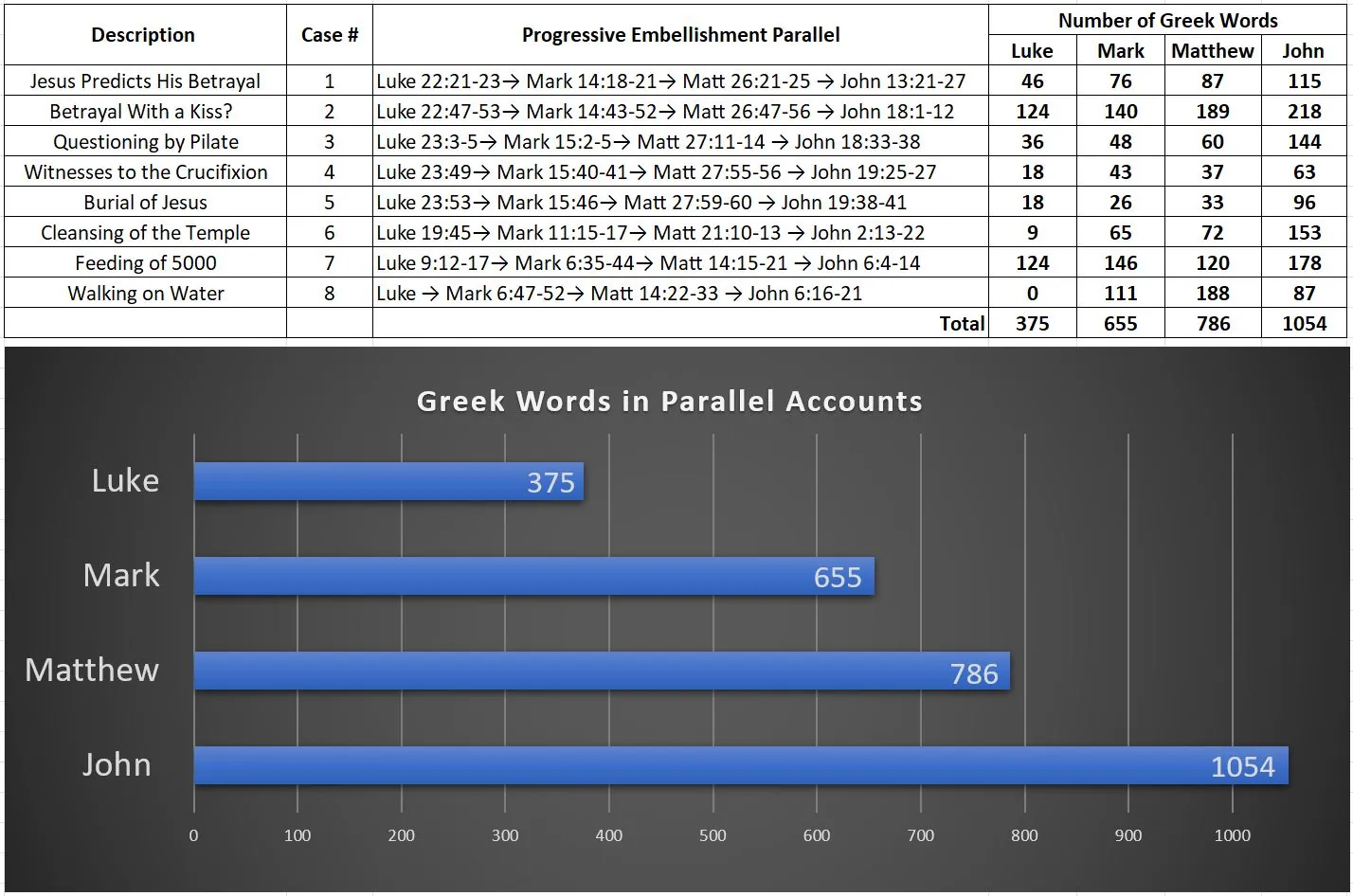
Conclusion
As shown above, the trend in these parallel passages is for Luke to be the shortest text, followed by Mark, Matthew, and John respectively. The examination demonstrates that John exhibits the most embellishment by adding sensational details, further dramatizing, expanding upon the story, or restructuring it. The order from least to most Greek words is consistent with the order in which the Gospels were written, as according to the Jerusalem School Hypothesis, and as extensively documented in LukePrimacy.com.. To summarize, the following conclusions can be made based on the data and analysis:
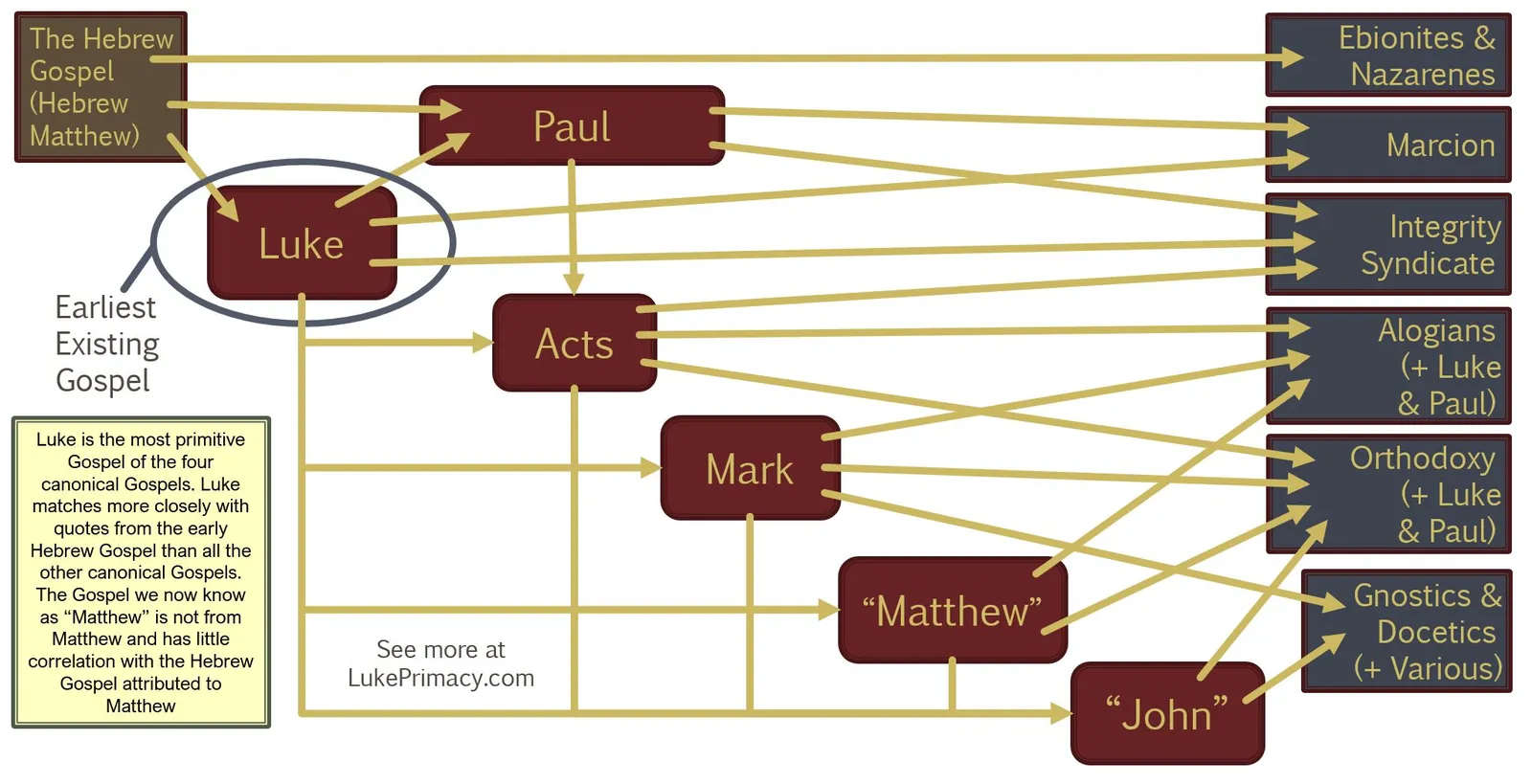
- Lukan priority is demonstrated. Luke is the earliest and most primitive of the four canonical Gospels. The Markan parallels are typically more highly embellished and expanded accounts that also further dramatize the story by adding more dialogue of Jesus with various individuals. Yet, Mark shows dependency on Luke.
- Matthean Posteriority is demonstrated with respect to the synoptic Gospels. Matthew was written after Mark and Luke, and is typically more embellished than both. Matthew is a hybrid of Mark and Luke, taking unique elements from both and further expanding.
- John, being a much later tradition, is clearly more embellished than all the Synoptic Gospels. The parallel stories in John are radically changed, often with claims and details that are incompatible and inconsistent with the Synoptic Gospels. The editor(s) of John took creative license in adding sensational accounts not attested elsewhere. The narrative in John restructured the narrative accounts to fit a devised literary structure. John exhibits the signs of a work that is intended to be more for the purposes of evangelism, having literary, rhetorical, and philosophical aims, rather than providing an accurate account of a historical narrative.
- John is not to be trusted as a primary source for the historical Jesus, but only as a secondary source that exemplifies later tradition.
- Luke, being the most primitive text, does not exhibit the embellishment of Mark and Matthew. Luke can be trusted with a higher level of reliability than the other gospels. For more on this, see LukePrimacy.com.
- Below is a diagram mapping out the interrelationships of the Gospels according to the findings in this paper and also based on other articles on this site Luke Primacy.com.