Issues with John
Contested Status of John
Paul’s Primary Affinity with the Lukan Tradition and Silence on John
Across the entire Pauline corpus, there is no quotation of, or literary dependence upon, the Fourth Gospel. By contrast, Paul’s letters repeatedly intersect with narrative traditions, sayings of Jesus, liturgical formulations, and theological motifs that appear specifically in Luke-Acts. Whether one dates Luke-Acts prior to Paul’s later correspondence or views Paul and his companion Luke (Colossians 4:14; Philemon 24; 2 Timothy 4:11) as drawing upon a shared Jerusalem-Antiochian gospel tradition (“Proto-Luke”), the Pauline witness consistently aligns with the Lukan presentation of Jesus’ words and redemptive work rather than with Johannine innovations.
1. Quoting the Lukan Saying of Jesus as “Scripture” in 1 Timothy 5:18
In 1 Timothy 5:18, the text pairs a Torah precept from Deuteronomy 25:4 with a saying of Jesus under the single introductory formula “For the Scripture says” (λέγει γὰρ ἡ γραφή): “You shall not muzzle an ox when it treads out the grain,” and, “The laborer deserves his wages” (Ἄξιος ὁ ἐργάτης τοῦ μισθοῦ αὐτοῦ). Whereas Matthew’s parallel reads “deserves his food” (τῆς τροφῆς αὐτοῦ, Matthew 10:10) and the Fourth Gospel contains no parallel at all, the Greek wording in 1 Timothy 5:18 matches Luke 10:7 verbatim. As Wayne A. Grudem observes concerning the significance of applying γραφή (“Scripture”) to this Lukan saying:
The first quotation in 1 Timothy 5:18 is found in Deuteronomy 25:4, but the second quotation, “The laborer deserves his wages,” is found nowhere in the Old Testament. It does occur, however, in Luke 10:7 (with the exact same words in the Greek text). [...] Someone might object that Paul could be quoting an oral tradition of Jesus’ words rather than Luke’s Gospel, but it is doubtful that Paul would call any oral tradition “Scripture,” since the word (Gk. graphē, “writing”) is always in New Testament usage applied to written texts, and since Paul’s close association with Luke makes it very possible that he would quote Luke’s written Gospel.1
Even among critical commentators who assign the Pastoral Epistles to a Pauline circle rather than to Paul’s own dictation, 1 Timothy 5:18 remains striking early testimony that Pauline churches treated the Lukan wording of Jesus’ teaching—not Johannine discourse—as written Scripture alongside Deuteronomy.2
2. The Kerygmatic Sequence of 1 Corinthians 15:3–6 and Luke 24
In 1 Corinthians 15:3–6, Paul recites the foundational pre-Pauline kerygma that he himself had received and transmitted:
3 For I delivered to you as of first importance what I also received: that Christ died for our sins in accordance with the Scriptures, 4 that he was buried, that he was raised on the third day in accordance with the Scriptures, 5 and that he appeared to Cephas, then to the twelve. 6 Then he appeared to more than five hundred brothers at one time, most of whom are still alive, though some have fallen asleep. (1 Corinthians 15:3–6 ESV)
While the refrain “in accordance with the Scriptures” (κατὰ τὰς γραφάς) refers primarily to the prophetic witness of the Hebrew Bible, it is specifically Luke-Acts that frames the risen Christ’s own instruction around that identical scriptural hermeneutic—demonstrating from Moses, the Prophets, and the Psalms that it was necessary for the Christ to suffer and rise from the dead on the third day (Luke 24:25–27, 44–47; Acts 2:25–32; 13:27–39; 17:2–3). Even more tellingly, Paul’s sequence of resurrection appearances—first to Cephas (Simon Peter) individually, and immediately thereafter to the gathered core of disciples (1 Corinthians 15:5)—coheres directly with Luke 24:34, 36, where the Jerusalem disciples announce, “The Lord has risen indeed, and has appeared to Simon!” right before Jesus stands in their midst. By contrast, Matthew 28:9–10, 16–20 and Mark 16:7 direct the disciples away from Jerusalem to Galilee for their reunion, while John 20–21 places Mary Magdalene first, omits any prior individual appearance to Peter, and splits appearances between Jerusalem and a secondary Galilean appendix.3
3. The Institution of the Lord’s Supper (1 Corinthians 11:23–25 // Luke 22:19–20)
Paul’s account of the Last Supper in 1 Corinthians 11:23–25 aligns closely with the longer text of Luke 22:19–20 against the Markan/Matthean form (Mark 14:22–24; Matthew 26:26–28): only Paul and Luke include the anamnesis mandate (“Do this in remembrance of me”) and designate the cup after supper as “the new covenant in my blood” (ἡ καινὴ διαθήκη ἐν τῷ ἐμῷ αἵματι). Meanwhile, the Fourth Gospel omits the eucharistic institution from its Last Supper narrative altogether (John 13:1–30), relocating sacramental imagery to the Capernaum synagogue monologue (John 6:51–58). James D. G. Dunn highlights the antiquity and independence of this shared Pauline-Lukan tradition:
Paul himself records the tradition authorizing the Lord’s Supper as the account of the last supper of Jesus with his disciples, which Paul himself received and passed on to the Corinthians at the foundation of their church. A comparison of this tradition with its variant versions is instructive. Two features of this common tradition call for comment:
First, there were clearly two slightly (but significantly) different versions of the form and wording used at the last supper among the churches. One we may call the Mark/Matthew version; the other was common to Paul and Luke. It should be fairly evident even from the brief comparison that neither can be completely derived from the other. The most obvious explanation of their otherwise striking closeness is that they come from a common source or tradition. There is a dispute as to which is likely to have been closer to the common original. But since Paul makes so little use on his own behalf of the “new covenant” tradition (the emphasis on which constitutes the most distinctive feature of the Paul/Luke version of the cup word), the case for seeing the Paul/Luke version as closer to the original form probably has the edge.4
4. Eschatological Watchfulness in 1 Thessalonians 5:2–6 and Luke 21:34–36
One of the sharpest lexical links between Paul’s earliest correspondence and the Lukan tradition occurs in 1 Thessalonians 5:2–6 and Luke 21:34–36, a closing parenetic section of the Olivet Discourse absent from both Mark 13 and Matthew 24. As Douglas J. Moo notes:
Both have as their subject the Day, which, it is warned, will come upon those unprepared suddenly and unexpectedly (“as a trap,” Luke 21:34); both emphasize that there will be no escape (cf. Luke 21:35); both encourage believers to watch in light of that coming “Day”; both use the same verb (ἐφίστημι) and the same adjective, αἰφνίδιος (“suddenly”) of the “Day”—and the latter is used only in these two places in biblical Greek.5
The convergence encompasses both conceptual sequence and rare Greek vocabulary: (1) both passages take the eschatological “Day” as their subject (“that day,” Luke 21:34, looking back to the coming of the Son of Man in 21:27; “the day of the Lord,” 1 Thessalonians 5:2); (2) both warn that this Day overtakes the unprepared unexpectedly—like a snare (ὡς παγίς, Luke 21:34–35) or a thief in the night (1 Thessalonians 5:2, 4); (3) both stress the impossibility of escape for the unready (Luke 21:35–36; 1 Thessalonians 5:3); (4) both employ the verb ἐφίστημι (“come suddenly upon,” ἐπιστῇ in Luke 21:34; ἐφίσταται in 1 Thessalonians 5:3) paired with the rare Greek adjective/adverbial form αἰφνίδιος (“sudden, unexpected”), which appears nowhere else in the New Testament; and (5) both exhort believers to remain awake and avoid drunkenness (μέθη, Luke 21:34; μεθύοντες / νήφωμεν, 1 Thessalonians 5:6–7).6
5. Affinity with Pauline Soteriology and Teaching on the Law
Among the Gospels, Luke-Acts also exhibits the closest theological affinity with Paul’s teaching on the Law, the human heart, and justification by grace. Passages unique to Luke—such as the parable of the Pharisee and the tax collector who goes home “justified” (δεδικαιωμένος, Luke 18:9–14) and Jesus’ rebuke of self-justifying Pharisees in Luke 16:14–18—converge directly with Acts 13:38–39, Acts 15:8–11, Romans 2:12–29, Romans 3:19–31, and Galatians 2:15–21 in affirming that God knows the heart (Luke 16:15; Acts 15:8; Romans 2:29), that the proclamation of the kingdom marks a decisive redemptive-historical transition beyond the era of the Law and the Prophets without nullifying the Law’s moral demand (Luke 16:16–18; Romans 3:21, 31), and that salvation is extended by grace through faith to Jew and Gentile alike (Acts 15:9–11).
Gaius of Rome and the “Alogi”: Early Orthodox Rejection of the Fourth Gospel
Far from enjoying immediate, unchallenged canonical status across all churches, the Fourth Gospel provoked explicit historical and theological opposition within mainstream ecclesiastical circles in the late second and early third centuries. According to Eusebius of Caesarea, Gaius (or Caius)—described as a learned “ecclesiastical man” active at Rome under Bishop Zephyrinus (199–217 CE)—composed a published disputation against the Phrygian Montanist leader Proclus (Hist. eccl. 2.25.6–7; 3.28.1–2; 6.20.3).7 In countering Montanist appeals to the Johannine Paraclete promises and the Apocalypse, Gaius rejected the apostolicity of both Revelation and the Fourth Gospel, attributing them instead to the heretic Cerinthus. R. Alan Culpepper summarizes the historical significance of Gaius’s critique:
When others began to use the Gospel of John, Gaius, a presbyter and noted orthodox scholar at Rome, rejected the Gospel and denied that it was written by an apostle. Gaius was an opponent of the Montanists, an enthusiastic group in Asia Minor who based their claims regarding the Spirit on John. While his basic concerns seem to have been theological, Gaius sought to discredit John by carefully noting its historical discrepancies and the places where it contradicted the synoptic Gospels. Gaius is significant because he shows that the authority of John was not so firmly established that it could not be challenged by one of the leaders of the church. The form of his argument is also telling: he sought to discredit the Gospel of John by showing that it contradicted the synoptic Gospels, which by implication served as the standard by which a gospel could be judged.8
Our knowledge of Gaius and of the broader second-century critics of the Johannine writings comes chiefly through two patristic refutations: Hippolytus of Rome’s lost treatise Heads against Gaius (Capita contra Gaium; cf. his Defense of the Gospel according to John and the Apocalypse), fragments of which survive in the twelfth-century Syriac Commentary on the Apocalypse by Dionysius bar Salibi, and Epiphanius of Salamis’s lengthy fourth-century heresy notice in Panarion 51.9 Epiphanius coined the polemical nickname Alogi (Ἄλογοι)—a Greek double entendre meaning both “irrational” and “opponents of the Logos”—for those who rejected the Gospel of John and the Apocalypse (Panarion 51.3.1–6). Preserving Hippolytus’s testimony, Dionysius bar Salibi reports that “a man appeared, named Caius, saying that the Gospel is not by John, nor the Apocalypse, but that it is by Cerinthus the heretic,” and records how Gaius contrasted the Fourth Gospel’s opening scenes and eschatology against the Synoptic accounts, prompting Hippolytus to construct elaborate harmonizations.10
Crucially, Epiphanius preserves the concrete comparative arguments deployed by these critics (Panarion 51.4.5–12; 51.18–22): they pointed out that whereas the Synoptics narrate Jesus’ birth, baptism, and forty-day wilderness temptation before his Galilean ministry, the Fourth Gospel passes immediately from the Word becoming flesh and John’s testimony at the Jordan to the wedding at Cana on “the third day” (John 1:14, 29–43; 2:1–11), and records multiple Jerusalem Passovers where the Synoptics know only one. Even more revealing is Epiphanius’s reluctant concession that, apart from rejecting the Johannine books, these critics were otherwise doctrinally orthodox: “for they themselves appear to believe just as we do” (δοκοῦσι γὰρ καὶ αὐτοὶ τὰ ἴσα ἡμῖν πιστεύειν, Panarion 51.4.5), differing sharply from both Ebionites and Docetists.11 Although modern scholars debate whether Epiphanius’s “Alogi” constituted an organized Asian group in the 170s CE (as J. N. Sanders and T. E. Pollard maintained) or primarily reflect Hippolytus’s refutation of Gaius and allied anti-Montanist critics at Rome (as Charles E. Hill argues), the testimony confirms that educated Roman churchmen around 200 CE could still treat the Synoptic Gospels as the normative historical benchmark and reject the Fourth Gospel where it diverged from them.12
George Park Fisher on the Orthodoxy and Objections of the Alogi (1890)
In a classic historical study—“Some Remarks on the Alogi,” Papers of the American Society of Church History 2, no. 1 (1890): 1–9—George Park Fisher examined Epiphanius’s testimony alongside the analyses of Theodor Zahn and Adolf von Harnack, emphasizing that the Alogi accepted the three Synoptic Gospels and were not adoptionists:
Zahn in his History of the New Testament Canon (1888)13 interprets Alogi as meaning simply those who cast away the Logos Gospel. One or two sentences in Epiphanius which bear on the point are certainly loose and ambiguous. But what he says (in c. xxviii [Panarion 51.28]) appears to affirm that they rejected the Logos-idea. (p. 3)
[Did the Alogi] hold that Jesus was a mere man in their conception of the person of Christ? They accepted the first three Gospels, and, of course, the miraculous conception. “Hippolytus, in his polemic, has merely warned us against the consequences which were not to be avoided from their rejection of the Logos. That the party actually drew these consequences he nowhere distinctly avers, and even Epiphanius does not here venture on perfectly definite assertions. Hence there is no ground for ascribing to them a denial of the miraculous conception; and the formula ψιλὸς ἄνθρωπος [‘mere man’], the party could not have used.”14 Epiphanius, in the midst of his denunciation, remarks that, with the exception of their views on the writings of John, the Alogi were in agreement with the orthodox (c. iii., p. 424 [Panarion 51.4.5]). (pp. 3–4)
At first, it seems strange that they should have attributed the Fourth Gospel to Cerinthus, a Judaizing Gnostic. But when we look at the objections of an internal character which, according to Epiphanius, they brought against its Apostolic authorship, we find that prominent among them is the idea that because the Gospel makes no mention of the birth and baptism of Christ, its author meant to teach that the heavenly Christ, called by the author the Logos, descended upon the man Jesus and united himself with him. This interpretation is one which the modern assailants of the Johannine authorship have not suggested, but it may help to account for the conjecture of the Alogi as to its authorship, since, according to Irenaeus, Hippolytus, and other authorities,15 this Gnostic speculation relative to the heavenly Christ was a part of the creed of Cerinthus. (p. 4)
Among the other critical objections of the Alogi was the alleged discrepancy between the Synoptics and John in respect to the number of Passovers kept by Jesus, and thus as to the duration of his ministry. One thing that they said about the Apocalypse was that there was no Church at Thyatira at the time when it was written [Panarion 51.33.1]. But, as was remarked, the objections of this class were, in all probability, an after-thought, the antipathy to the writings bearing the name of John having had its start in a doctrinal motive. (p. 5)
A question to be considered is whether Theodotus, the Currier, had a connection with the Alogi. Epiphanius (Haer. 54) styles him an offshoot of this heresy. Harnack renders this statement literally, and considers it entitled to credence. One argument is the probable classification of Theodotus by Hippolytus under the same rubric with the Alogi. Zahn contends that Theodotus had no real connection with them. Theodotus was from Byzantium. Caius, the probable author of the “Little Labyrinth,” quoted by Eusebius (Hist. eccl. 5.28), styles Theodotus “the inventor” of the heresy that Christ was a mere man. What is especially important, Hippolytus, in the Refutatio omnium haeresium (7.35), expressly states it to be the doctrine of Theodotus that, at the baptism of Jesus, Christ descended upon him in the form of a dove [...] Leaving this point of the real or imaginary relation of Theodotus to the Alogi, as not essential in our present inquiry, it is certain that he received John’s Gospel. Epiphanius cites a comment by him on John 8:40 (Panarion 54.1.8). We do not hear that Theodotus rejected the Apocalypse, or any other New Testament book. (pp. 5–6)
The Ebionites and Jewish-Christian Gospel Traditions
Jewish-Christian communities of the second through fourth centuries likewise stood entirely outside the sphere of Johannine authority, relying instead upon gospel traditions rooted in the Synoptic—and frequently Lukan—narrative stream. Patristic writers from Irenaeus onward applied the Hebrew-derived name Ebionites (from ’ebyônîm, “the poor”) to Torah-observant Jewish believers in Jesus as Messiah who rejected his pre-existence and divine ontology, viewing him as a righteous human prophet anointed by the Spirit at his baptism (Irenaeus, Adv. haer. 1.26.2; cf. Justin Martyr, Dialogue with Trypho 47).16 Origen (De principiis 4.3.8; Contra Celsum 2.1; 5.61) and Eusebius (Hist. eccl. 3.27.1–6) noted internal diversity among Ebionite groups—observing that while some rejected the virgin birth, another subgroup accepted Jesus’ virginal conception while still refusing the doctrine of a pre-existent Logos—yet all patristic witnesses agree that they used only a Jewish-Christian Synoptic-type gospel and excluded both Paul and the Fourth Gospel.17
Although Irenaeus (Adv. haer. 1.26.2), Eusebius (Hist. eccl. 3.27.4), and Epiphanius (Panarion 30.3.7; 30.13.2) variously associated the Ebionite gospel with a truncated “Matthew” or with the Gospel according to the Hebrews, closer philological inspection reveals pronounced Lukan features across the surviving Jewish-Christian gospel fragments.18 Analyzing the patristic citations attributed to the Semitic Gospel according to the Hebrews, Pierson Parker argued in 1940 that its non-Markan character and distinctive affinities pointed not to canonical Matthew, but to a Proto-Lukan substratum:
[T]he presence in this gospel of Lukan qualities and parallels, the absence from it of definitive [...] Markan elements [...] all point to one conclusion, viz., that the source of the Gospel according to the Hebrews [...] was most closely related to sources underlying the non-Markan parts of Luke, that is, Proto-Luke.19
Equally striking are the Greek fragments quoted by Epiphanius from the Jewish-Christian gospel used directly by fourth-century Ebionites—customarily distinguished by modern scholars as the Gospel of the Ebionites, a Greek Synoptic harmony (Panarion 30.13.2–8; 30.22.4).20 Those fragments repeatedly draw upon details distinctive to canonical Luke rather than Matthew or John: they introduce John’s ministry under Herod king of Judea and Caiaphas the high priest using Lukan chronological synchronization (Panarion 30.13.6; cf. Luke 1:5; 3:1–2), describe the Spirit descending “in the form of a dove” coupled with the heavenly voice “Today I have begotten you” as attested in the Western text (Codex Bezae) of Luke 3:22 (Panarion 30.13.7–8), and adapt Jesus’ distinctive Lukan statement about desiring to eat the Passover, “Where do you want us to prepare for you to eat the Passover?” answered via Luke 22:15 (ἐπιθυμίᾳ ἐπεθύμησα, recast ascetically as a question in Panarion 30.22.4). Neither in the Semitic Gospel according to the Hebrews nor in Epiphanius’s Greek Ebionite fragments is there any trace of Johannine narrative or Logos theology.
Marcion’s Euangelion and the Lukan Framework
A third major second-century witness to the centrality of the Lukan-Pauline nexus—and the non-use of the Fourth Gospel—is Marcion of Sinope (c. 85–c. 160 CE), the shipowner from Pontus who broke with the Roman church around 144 CE and established a widespread network of congregations across the Mediterranean.21 Grounding his theology in a radical antithesis between the Creator God of the Hebrew Scriptures and the hitherto unknown Father revealed by Jesus Christ, Marcion compiled the earliest attested closed two-part Christian scriptural collection: a single written Euangelion (“Gospel”) alongside an Apostolikon comprising ten letters of Paul (excluding the Pastorals). Tellingly, although certain Johannine sayings contrasting Moses and Jesus (such as John 1:17–18 or 10:8) might superficially have suited Marcion’s dualism, Marcion made no use of the Fourth Gospel, anchoring his Euangelion exclusively in a shorter text corresponding to canonical Luke (beginning with Jesus’ descent to Capernaum in the fifteenth year of Tiberius, Luke 3:1; 4:31).22
Whereas early heresiologists—Irenaeus (Adv. haer. 1.27.2), Tertullian (Adversus Marcionem 1.18; 4.2–5), and Epiphanius (Panarion 42)—accused Marcion of mutilating canonical Luke with a “penknife” to excise birth narratives and Old Testament fulfillment passages, modern textual and source criticism has debated four principal models for the literary relationship between Marcion’s Euangelion and canonical Luke:23
- The Patristic Redaction Model: Marcion edited an existing text of canonical Luke (a view maintained in nuanced text-critical form by Sebastian Moll, Dieter T. Roth, and Judith M. Lieu, while recognizing that Marcion’s exemplar already reflected an early second-century Western-type Lukan text).
- The Common-Source (“Proto-Luke”) Model: First proposed by Johann Salomo Semler (1783) and developed in modern scholarship by John Knox (1942), Joseph B. Tyson (2006), and Jason D. BeDuhn (2013), this view holds that Marcion’s Euangelion and canonical Luke represent two divergent developments of an earlier, shorter “Proto-Luke”—canonical Luke having been expanded (notably in Luke 1–2 and anti-Marcionite/ecclesiastical redactions) to form Luke-Acts.
- The Lukan Expansion Model: Tracing back to nineteenth-century Tübingen scholars such as Albert Schwegler (1846), this hypothesis argues that Marcion’s shorter gospel preceded canonical Luke directly, and that canonical Luke is an expanded catholicizing edition of that base text.
- The Marcionite Priority Model: Advanced in recent decades by Matthias Klinghardt and Markus Vinzent, this reconstruction contends that the pre-canonical Euangelion preserved by Marcion stood at the very fountainhead of written Gospel composition, prior to Mark, Matthew, canonical Luke, and John alike.
Whichever of the first three historical reconstructions one adopts, Marcion’s mid-second-century collection powerfully corroborates two conclusions: in Pauline-oriented circles of the early second century, the Lukan gospel form held singular authority alongside Paul’s letters, whereas the Fourth Gospel enjoyed no comparable standing.
Justin Martyr: Preference for the Synoptics and Reserve Toward John
Even within proto-orthodox apologetics at Rome in the 150s CE, Justin Martyr’s extensive writings (First Apology, Second Apology, and Dialogue with Trypho) display an overwhelming reliance upon the Synoptic Gospels—especially Matthew and Luke—coupled with an enigmatic reserve toward the Fourth Gospel. As Benjamin Wisner Bacon observed in The Fourth Gospel in Research and Debate (1910), even conservative defenders of Johannine authorship such as James Drummond had to confront the extreme disparity between Justin’s Synoptic citations and his near-silence on John:
The relatively voluminous treatises of Justin Martyr (153–160 A.D.) form a class by themselves for all students of the external evidence. The surprising non-appearance of the Fourth Gospel among his recognized authorities, at least in a degree approximating his “more than one hundred” employments of the Synoptics, is one of the admitted difficulties of the supporters of tradition. Drummond, Character and Authorship, p. 100,24 counts “somewhere about 170 citations from or references to the Gospels.” Among these he probably includes what he regards as “three apparent quotations” from John. [...] Abbott, on the other hand, meets the alleged traces of the Fourth Gospel in Justin by an analysis even more thorough than Drummond’s, resulting in the following summary:25
Edwin A. Abbott’s synthesis in Encyclopaedia Biblica (1901) sets out why Justin, despite championing a Logos Christology, repeatedly argues from Old Testament texts and Synoptic “Memoirs of the Apostles” where a single recognized quotation from the Fourth Gospel would have clinched his case:
It appears, then, that (1) when Justin seems to be alluding to John, he is really alluding to the Old Testament, or Barnabas, or some Christian tradition different from John, and often earlier than John; (2) when Justin teaches what is practically the doctrine of the Fourth Gospel, he supports it, not by what can easily be found in the Fourth, but by what can hardly, with any show of reason, be found in the Three; (3) as regards Logos-doctrine, his views are alien from John. These three distinct lines of evidence converge to the conclusion that Justin either did not know John, or, as is more probable, knew it, but regarded it with suspicion, partly because it contradicted Luke his favorite Gospel, partly because it was beginning to be freely used by his enemies the Valentinians. (4) It may also be fairly added that literary evidence may have weighed with him. He seldom or never quotes (as many early Christian writers do) from apocryphal works. The title he gives to the Gospels (‘Memoirs of the Apostles’) shows the value he set on what seemed to him the very words of Christ noted down by the apostles. Accepting the Apocalypse as the work of (Trypho 81) the Apostle John he may naturally have rejected the claim of the Gospel to proceed from the same author. This may account for a good many otherwise strange phenomena in Justin’s writings. He could not help accepting much of the Johannine doctrine, but he expressed it, as far as possible, in non-Johannine language; and, where he could, he went back to earlier tradition for it, such as he found, for example, in the Epistle of Barnabas.26
Even where modern scholars such as Charles E. Hill argue against J. N. Sanders and Helmut Koester that Justin knew the Fourth Gospel alongside the Synoptics (pointing especially to the regeneration saying in First Apology 61.4–5; cf. John 3:3–5), the contrast remains undeniable: Justin names John the Apostle explicitly as author of the Apocalypse (Dialogue 81.4), never names him as author of a Gospel, and never quotes distinctive Johannine discourses verbatim as authoritative “Memoirs” on par with Matthew and Luke. (For fuller examination, see Justin Martyr Favored Luke Over John.)27
Irenaeus and the Muratorian Fragment: Defending a Disputed Gospel
When the Fourth Gospel finally receives explicit apologetic defense in the last quarter of the second century, our earliest witnesses inadvertently confirm that its reception had met resistance. In Adversus haereses 3.11.8–9 (c. 180 CE), immediately after arguing from cosmic analogies (the four winds and four living creatures) that there can be neither more nor fewer than four Gospels, Irenaeus explicitly acknowledges Christians who rejected the Gospel of John. As George Park Fisher notes:
Irenaeus, Adv. haer. 3.11.9, is a well-known passage in which he sets forth with so much emphasis the fact that there are four, and only four, Gospels having any just title to acceptance or any acknowledged authority in the Church. In this connection, he refers to those who represent that there are more, or that there are less than four. He makes mention of Marcion and proceeds to remark: “Others again, that they may set at naught the gift of the Spirit, which in the last times has been poured out on the human race by the will of the Father, do not admit that speciem”—that is to say, that aspect of the “fourfold Gospel” to which he has referred—“which is according to the Gospel of John, in which the Lord promised that He would send the Paraclete; but they set aside at once both the Gospel and the prophetic spirit.”28
Irenaeus gives no name to these dissentients. He does not imply that they had any organization. There is no reason to doubt that they are the class to whom Epiphanius gives the nickname of “Alogi.” [...] They appeared, in all probability, somewhere about 170,—perhaps a few years earlier. (pp. 1–2)
A similar apologetic anxiety surfaces in the Muratorian Fragment (lines 9–34, traditionally dated to Rome c. 170–200 CE). Whereas the Fragment treats Luke straightforwardly in a few lines (lines 2–8), it devotes twenty-six lines to justifying the Fourth Gospel—narrating a legend in which John’s fellow disciples and bishops urged him to write, fasted together for three days, and received a revelation given to the Apostle Andrew that “while all of them should review [or certify] it, John should write down everything in his own name” (recognoscentibus cunctis Ioannes suo nomine cuncta describeret, lines 14–16), followed by an explicit reassurance that believers’ faith is not harmed even though “different beginnings are taught in the various Gospel books” (lines 16–20). Such an elaborate collective-certification narrative presupposes pointed criticism of John’s solitary departures from the Synoptic beginnings.29
Clement of Alexandria and Origen: John as a Symbolic “Spiritual Gospel”
Even in Alexandria, where the Fourth Gospel gained enthusiastic theological embrace, early catechetical masters accounted for its stark divergence from the Synoptics by classifying it as a symbolic or “spiritual” composition rather than a straightforward historical chronicle. Preserving a tradition from Clement of Alexandria’s lost Hypotyposeis (c. 200 CE), Eusebius reports that “John, last of all, conscious that the bodily [or outward] facts (τὰ σωματικά) had been set forth in the Gospels, was urged on by his acquaintances, and, divinely moved by the Spirit, composed a spiritual Gospel (πνευματικὸν ποιῆσαι εὐαγγέλιον)” (Hist. eccl. 6.14.7).30
What Clement implied by contrasting Synoptic “outward facts” with John’s “spiritual Gospel” was stated with unflinching candor by his successor Origen of Alexandria (c. 185–c. 253 CE)—often described by patristic historians as “the greatest genius the early church ever produced.”31 Confronting the irreconcilable chronological clash between John’s early Temple cleansing (John 2:13–22) and the Synoptic Temple cleansing in Jesus’ final week, Origen declared in Book 10 of his Commentary on the Gospel of John (10.3–5 [§§10–20]) that anyone who inspects the four Gospels strictly for literal historical agreement faces shipwreck unless he recognizes that the Evangelists—and John preeminently—intended to tell spiritual truth through altered outward narratives, “preserving the spiritual truth in what one might call the bodily falsehood” (σωζομένου πολλάκις τοῦ ἀληθοῦς πνευματικοῦ ἐν τῷ ὡς ἂν εἴποι τις σωματικῷ ψεύδει, Comm. Jo. 10.4.20). (For Origen’s own words and detailed examples, see Origen: Commentary on John.)32
Synthesis: Scriptural Authorities and Gospel Relationships
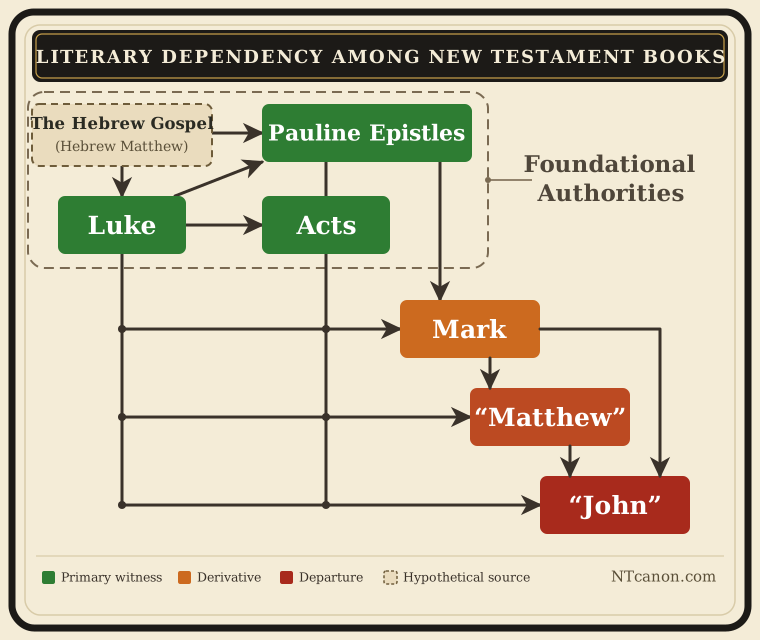
Taken together, the Pauline, patristic, and sectarian evidence surveyed above converges on five historical conclusions regarding the early standing of Luke-Acts and the contested reception of the Fourth Gospel:
- Early Contestation of John: Across the second and early third centuries, the Fourth Gospel was either unused or actively contested by diverse Christian movements—including Gaius of Rome and the “Alogi,” Jewish-Christian Ebionite communities, and Marcionite congregations—as Irenaeus (Adv. haer. 3.11.9) and the Muratorian Fragment both attest.
- Orthodox Synoptic Standard: Critics such as Gaius of Rome were doctrinally anti-heretical churchmen who accepted the Synoptic Gospels and judged the Fourth Gospel defective precisely because its chronology and narrative sequence contradicted the Synoptic witness.
- Pauline Attestation of the Lukan Stream Alone: The Pauline corpus exhibits repeated verbal, liturgical, and kerygmatic intersections with Luke-Acts (1 Timothy 5:18 // Luke 10:7; 1 Corinthians 15:3–5 // Luke 24:25–47; 1 Corinthians 11:23–25 // Luke 22:19–20; 1 Thessalonians 5:2–6 // Luke 21:34–36) while showing complete silence toward distinctive Johannine traditions.
- Centrality of the Lukan Gospel Form: Diverse second-century witnesses—from Justin Martyr’s harmonization of Synoptic “Memoirs” to Marcion’s Euangelion and Lukan-shaped Jewish-Christian gospel fragments—confirm the foundational reach of the Lukan narrative framework.
- Derivative Symbolic Character of John: As recognized already by Clement and Origen in Alexandria and confirmed by modern redaction criticism, the Fourth Gospel represents a later theological and symbolic reworking dependent upon prior Synoptic tradition rather than a primary apostolic chronicle of Jesus’ earthly ministry.33
Notes
- Wayne A. Grudem, Systematic Theology: An Introduction to Biblical Doctrine (Grand Rapids, MI: Zondervan, 1994), pp. 61–62. ↩
- See I. Howard Marshall, in collaboration with Philip H. Towner, A Critical and Exegetical Commentary on the Pastoral Epistles, International Critical Commentary (Edinburgh: T. & T. Clark, 1999), pp. 614–617; cf. John P. Meier, A Marginal Jew: Rethinking the Historical Jesus, Vol. 1 (New York: Doubleday, 1991), p. 122. ↩
- On the close alignment between 1 Corinthians 15:5 (“appeared to Cephas, then to the twelve”) and Luke 24:34, 36, see Joseph A. Fitzmyer, The Gospel According to Luke (X–XXIV), Anchor Bible 28A (Garden City, NY: Doubleday, 1985), pp. 1569–1570, and Anthony C. Thiselton, The First Epistle to the Corinthians, NIGTC (Grand Rapids: Eerdmans, 2000), pp. 1197–1205. ↩
- James D. G. Dunn, The Theology of Paul the Apostle (Grand Rapids, MI: Eerdmans, 1998), pp. 606–607 (§22.2, “The Lord’s Supper”). ↩
- Douglas J. Moo, “The Case for the Posttribulation Rapture Position,” in Three Views on the Rapture: Pre-, Mid-, or Post-Tribulation?, ed. Stanley N. Gundry (Grand Rapids, MI: Zondervan, 1996 [orig. 1984]), p. 185. ↩
- For detailed lexical analysis of Luke 21:34–36 and 1 Thessalonians 5:2–7, see David Wenham, Paul: Follower of Jesus or Founder of Christianity? (Grand Rapids, MI: Eerdmans, 1995), pp. 306–312, and François Bovon, Luke 3: A Commentary on the Gospel of Luke 19:28–24:53, Hermeneia (Minneapolis: Fortress Press, 2012), pp. 128–131. ↩
- Eusebius, Historia ecclesiastica 2.25.6–7; 3.28.1–2; 6.20.3. ↩
- R. Alan Culpepper, The Gospel and Letters of John, Interpreting Biblical Texts (Nashville: Abingdon Press, 1998), p. 289. ↩
- John Gwynn, “Hippolytus and His ‘Heads against Caius,’” Hermathena 6, no. 14 (1888): 397–418; Epiphanius of Salamis, Panarion 51, in The Panarion of Epiphanius of Salamis: Books II and III, De Fide, trans. Frank Williams, 2nd rev. ed., Nag Hammadi and Manichaean Studies 79 (Leiden: Brill, 2013), pp. 25–67. ↩
- Dionysius bar Salibi, Commentary on the Apocalypse, ed. and trans. Gwynn, “Hippolytus and His ‘Heads against Caius,’” pp. 401–405. ↩
- Epiphanius, Panarion 51.3.1–6; 51.4.5–12; 51.18.1–51.22.11; cf. Francis P. Havey, “Alogi,” in The Catholic Encyclopedia, Vol. 1 (New York: Robert Appleton, 1907), pp. 331–332. ↩
- Compare J. N. Sanders, The Fourth Gospel in the Early Church (Cambridge: Cambridge University Press, 1943), pp. 55–65; T. E. Pollard, Johannine Christology and the Early Church, SNTSMS 13 (Cambridge: Cambridge University Press, 1970), pp. 42–46; J. D. Smith, Gaius and the Controversy over the Johannine Literature (Ph.D. diss., Yale University, 1979); and Charles E. Hill, The Johannine Corpus in the Early Church (Oxford: Oxford University Press, 2004), pp. 172–204. ↩
- Theodor Zahn, Geschichte des neutestamentlichen Kanons, Vol. 1 (Erlangen: A. Deichert, 1888), pp. 220–262. ↩
- Johann Jakob Herzog and Gustav Leopold Plitt, eds., Real-Encyklopädie für protestantische Theologie und Kirche, 2nd ed., Vol. 10 (Leipzig: J. C. Hinrichs, 1882), p. 185; cf. Adolf von Harnack, Lehrbuch der Dogmengeschichte, Vol. 1 (Freiburg: J. C. B. Mohr, 1886), p. 619. ↩
- Irenaeus, Adversus haereses 1.26.1; Hippolytus, Refutatio omnium haeresium 7.33.1–2. ↩
- Irenaeus, Adv. haer. 1.26.2; Justin Martyr, Dialogue with Trypho 47; cf. Oskar Skarsaune and Reidar Hvalvik, eds., Jewish Believers in Jesus: The Early Centuries (Peabody, MA: Hendrickson, 2007), pp. 419–462. ↩
- Origen, De principiis 4.3.8; Contra Celsum 2.1; 5.61; Eusebius, Hist. eccl. 3.27.1–6. ↩
- On the unity versus plurality of Jewish-Christian gospels, compare James R. Edwards, The Hebrew Gospel and the Development of the Synoptic Tradition (Grand Rapids: Eerdmans, 2009) (building on Edward B. Nicholson, The Gospel According to the Hebrews, London: C. Kegan Paul, 1879), with Petri Luomanen, Recovering Jewish-Christian Sects and Gospels, Vigiliae Christianae Supplements 110 (Leiden: Brill, 2012), and Andrew F. Gregory, The Jewish-Christian Gospel Tradition, WUNT 2/471 (Tübingen: Mohr Siebeck, 2017). ↩
- Pierson Parker, “A Proto-Lukan Basis for the Gospel According to the Hebrews,” Journal of Biblical Literature 59, no. 4 (1940): 471–478, at p. 478. ↩
- Epiphanius, Panarion 30.13.2–8; 30.22.4; edited and analyzed in Gregory, Jewish-Christian Gospel Tradition (2017), pp. 171–215, and Bart D. Ehrman and Zlatko Pleše, The Apocryphal Gospels: Texts and Translations (Oxford: Oxford University Press, 2011), pp. 210–215. ↩
- Justin Martyr, First Apology 26.5; 58.1–2; Irenaeus, Adv. haer. 1.27.2–4; Tertullian, Adversus Marcionem 1.18–19; 4.1–5; De praescriptione haereticorum 30; Rhodon in Eusebius, Hist. eccl. 5.13.3–4. ↩
- Tertullian, Adversus Marcionem 4.2–5, 7; Epiphanius, Panarion 42.9–12; Judith M. Lieu, Marcion and the Making of a Heretic: God and Scripture in the Second Century (Cambridge: Cambridge University Press, 2015), pp. 183–233. ↩
- See respectively: (1) Sebastian Moll, The Arch-Heretic Marcion, WUNT 250 (Tübingen: Mohr Siebeck, 2010), pp. 90–102; Dieter T. Roth, The Text of Marcion’s Gospel, NTTSD 49 (Leiden: Brill, 2015); Lieu, Marcion and the Making of a Heretic (2015), pp. 188–209; (2) Johann Salomo Semler, preface to Thomas Townson’s Abhandlungen über die vier Evangelien (Leipzig, 1783); John Knox, Marcion and the New Testament: An Essay in the Early History of the Canon (Chicago: University of Chicago Press, 1942); Joseph B. Tyson, Marcion and Luke-Acts: A Defining Struggle (Columbia: University of South Carolina Press, 2006); Jason D. BeDuhn, The First New Testament: Marcion’s Scriptural Canon (Santa Rosa, CA: Polebridge Press, 2013), pp. 78–98; (3) Albert Schwegler, Das nachapostolische Zeitalter in den Hauptmomenten seiner Entwicklung, Vol. 1 (Tübingen: L. F. Fues, 1846), pp. 260–284; and (4) Matthias Klinghardt, “Markion vs. Lukas: Plädoyer für die Wiederaufnahme eines alten Falles,” New Testament Studies 52 (2006): 484–513, and The Oldest Gospel and the Formation of the Canonical Gospels, 2 vols. (Leuven: Peeters, 2021); Markus Vinzent, Marcion and the Dating of the Synoptic Gospels (Leuven: Peeters, 2014). ↩
- James Drummond, An Inquiry into the Character and Authorship of the Fourth Gospel (London: Williams & Norgate, 1903), p. 100. ↩
- Benjamin Wisner Bacon, The Fourth Gospel in Research and Debate (New York: Moffat, Yard & Co., 1910; 2nd ed. New Haven: Yale University Press, 1918), p. 21. ↩
- Edwin A. Abbott, “Gospels,” in Encyclopaedia Biblica, ed. T. K. Cheyne and J. Sutherland Black, Vol. 2 (London: Adam & Charles Black; New York: Macmillan, 1901), col. 1837 (§107) (Internet Archive). ↩
- Compare Sanders, Fourth Gospel in the Early Church (1943), pp. 27–32, and Helmut Koester, Ancient Christian Gospels: Their History and Development (Philadelphia: Trinity Press International, 1990), pp. 360–361, with Hill, Johannine Corpus in the Early Church (2004), pp. 312–351. ↩
- George Park Fisher, “Some Remarks on the Alogi,” Papers of the American Society of Church History 2, no. 1 (1890): 1–2, quoting Irenaeus, Adversus haereses 3.11.9. ↩
- Muratorian Fragment, lines 9–34; see Bruce M. Metzger, The Canon of the New Testament: Its Origin, Development, and Significance (Oxford: Clarendon Press, 1987), pp. 191–201, 305–306, and R. Alan Culpepper, John, the Son of Zebedee (1994), pp. 125–128. ↩
- Clement of Alexandria, Hypotyposeis, Book 6, quoted in Eusebius, Hist. eccl. 6.14.7. ↩
- John Anthony McGuckin, The Westminster Handbook to Origen (Louisville, KY: Westminster John Knox Press, 2004), p. 25. ↩
- Origen, Commentarii in evangelium Joannis 10.3–5 (§§10–20); ET Ronald E. Heine, Origen: Commentary on the Gospel according to John, Books 1–10, Fathers of the Church 80 (Washington, DC: Catholic University of America Press, 1989), pp. 257–260. ↩
- On Johannine literary knowledge and transformation of the Synoptic Gospels, see C. K. Barrett, The Gospel According to St. John, 2nd ed. (Philadelphia: Westminster Press, 1978), pp. 42–54; Frans Neirynck, Jean et les Synoptiques, BETL 49 (Leuven: Leuven University Press, 1979); Andrew T. Lincoln, The Gospel According to Saint John, Black’s New Testament Commentary (London: Continuum, 2005), pp. 26–39; and Mark Goodacre, The Fourth Synoptic Gospel: John’s Knowledge of Matthew, Mark, and Luke (Grand Rapids: Eerdmans, 2025). ↩