Issues with Mark
The Spurious Emergence of Markan Priority
Introduction
Few assumptions in modern biblical scholarship are treated as more settled than Markan (or Marcan) priority—the hypothesis that the Gospel of Mark was the earliest of the canonical Gospels and served as a primary written source for both Matthew and Luke. Yet a growing body of historical, philological, and statistical research demonstrates that this consensus rests on inconclusive arguments and nineteenth-century extra-scientific pressures rather than unambiguous literary proof.
Tracing how Markan priority rose from a minority conjecture to textbook orthodoxy requires examining both the intellectual history of the Synoptic Problem and the internal logic of the arguments popularized in the English-speaking world by Burnett Hillman Streeter. Two landmark critical studies anchor that reassessment: William R. Farmer's The Synoptic Problem: A Critical Analysis (1964) and Hans-Herbert Stoldt's History and Criticism of the Marcan Hypothesis (1977; English trans. 1980).1 In the preface to his 1964 volume, Farmer recounted how his own classroom teaching forced him to re-examine an inherited scholarly tradition:
The genesis of this book can be traced to the determination to understand how it could be that I once stood before my students and assured them in good conscience that Mark was the earliest Gospel. It was not because of the arguments I then adduced in class. In fact, I distinctly recall feeling that there was a subtlety to the argument from order for Marcan priority which I had never mastered. But the thought never crossed my mind that the argument was itself inconclusive. I used the argument without fully understanding it because it was an unquestioned part of an unquestioned tradition… How had my teachers come to pass on to me the view that Mark was the earliest Gospel? This question led me back to investigate the history of the synoptic problem.2
Early Modern Source Criticism and the Ur-Gospel
Modern source criticism of the Gospels took shape in late eighteenth- and early nineteenth-century Germany as scholars began challenging the traditional Augustinian sequence (Matthew–Mark–Luke–John). A decisive turning point came with critical scrutiny of canonical Matthew. Following earlier source proposals by Gotthold Ephraim Lessing, Johann Gottfried Eichhorn, and Friedrich Schleiermacher, Friedrich Lebrecht Sieffert argued forcefully in 1832 that canonical Greek Matthew could not be the unaltered composition of an eyewitness apostle.3
In nineteenth-century German university theology—especially after David Friedrich Strauss's Life of Jesus Critically Examined (1835–1836) and Ferdinand Christian Baur's Tübingen School dated the canonical Gospels deep into the second century as tendentious theological constructs—the loss of direct apostolic authorship for Matthew created an acute historical and doctrinal crisis.4 If the church's flagship Gospel postdated the eyewitness generation, Protestant historians needed an alternative documentary bridge back to the historical Jesus.
To supply that bridge, German critics appealed to various forms of an Urevangelium (“Ur-Gospel” or primal Gospel)—a hypothetical lost written source (whether a primitive Aramaic/Hebrew narrative, an early sayings collection, or an Ur-Markus) posited behind the canonical Synoptics.5 By reconstructing an earlier documentary layer beneath Matthew, Mark, and Luke, mediating and liberal theologians could concede critical objections against the canonical Gospels in their final form while still claiming reliable access to earliest apostolic tradition. That apologetic and historiographical dynamic paved the way directly for the Two-Document Hypothesis combining Markan priority with a hypothetical sayings source (“Q”).
The Emergence of Markan Priority
For more than half a century after Lessing and Eichhorn, advocates of an Ur-Gospel generally resisted identifying canonical Mark itself as the earliest Gospel, largely because Mark lacked the extensive sayings material shared by Matthew and Luke. That obstacle was bypassed in 1838 when Christian Hermann Weisse (alongside Christian Gottlob Wilke on Mark alone) proposed pairing canonical Mark as the narrative framework with a second lost source—an apostolic collection of Jesus' sayings (Logia, later designated Q)—used independently by Matthew and Luke.6
In 1863, Heinrich Julius Holtzmann synthesized and popularized this Two-Document framework (initially via an Ur-Markus A and sayings source Λ) in a massive linguistic commentary on the Synoptic tradition.7 As both Farmer and Stoldt demonstrated in detail, Holtzmann's synthesis won rapid institutional allegiance across late nineteenth-century German Protestant faculties not because he had proved Mark's priority without circularity, but because his two reconstructed primitive sources offered liberal historicism exactly the portrait of Jesus it sought.8
On the one hand, elevating Mark—a Gospel lacking both a virgin-birth narrative and concrete resurrection-appearance stories (ending abruptly at Mark 16:8 in the oldest codices)—allowed liberal theologians during the era of the German Kulturkampf to set aside key supernaturalist dogmas of confessional orthodoxy. On the other hand, treating Mark and Q as early, substantially reliable historical monuments gave university theologians a defensible bulwark against radical skeptics and Tübingen critics on their left.9 Wrapped in Holtzmann's exhaustive lexical tables, the Marcan hypothesis acquired the aura of an assured result of “scientific” criticism.
The Legacy of B. H. Streeter
What Weisse and Holtzmann accomplished in nineteenth-century Germany, Oxford scholar Burnett Hillman Streeter consolidated for twentieth-century Anglophone scholarship in The Four Gospels: A Study of Origins (1924; reprinted eleven times through 1964).10 Expanding the Two-Document Hypothesis into a “Four-Document Hypothesis” (Mark, Q, special Matthean source M, and special Lukan source L), Streeter framed the case for Markan priority in five classic points:11
- Shared content: Matthew reproduces over ninety percent of Mark's substance (much of it with close verbal correspondence), while Luke includes slightly more than half of Mark's subject matter.
- Verbal distribution in Triple Tradition: Across Triple-Tradition episodes, more than half of Mark's exact words reappear either in Matthew and Luke jointly or in one of the two individually.
- Sequence of episodes: Mark's relative order of pericopes regularly aligns with Matthew and Luke; whenever Matthew departs from Mark's sequence Luke normally supports Mark, and whenever Luke departs from Mark's sequence Matthew normally supports Mark.
- Alleged primitivity of language and candor: Mark displays rougher Greek syntax, preserves transliterated Aramaic expressions, and includes potentially awkward statements about Jesus and the disciples that Matthew and Luke allegedly smoothed out or omitted.
- Distribution of Markan and non-Markan blocks: The different ways Matthew and Luke interweave non-Markan sayings with Triple-Tradition narrative look to Streeter as though two independent editors were each combining a single written Markan document with separate sayings sources.
The “Lachmann Fallacy” in Streeter's Arguments from Content and Order
As Abbot B. C. Butler demonstrated in 1951—and as Cambridge scholar G. M. Styler (himself a defender of Markan priority) frankly conceded in 1962—Streeter's first three arguments are logically neutral regarding direction of literary dependence.12 Named the “Lachmann fallacy” after Karl Lachmann's 1835 essay on Synoptic order, the error consists in confusing Mark's status as the medial (“middle”) text between Matthew and Luke with proof that Mark was the earliest text.13
Specifically, the observation that Matthew and Luke rarely depart from Mark's sequence at the exact same point is satisfied equally well by any linear or conflationary stemma in which Mark stands as an intermediary or conflator:
- If Mark conflated Matthew and Luke (the Griesbach/Two-Gospel stemma), Mark would naturally agree in sequence with whichever Gospel he was following at a given juncture.
- Conversely, under Lukan priority and Matthean posteriority (Luke → Mark → Matthew, with Matthew also consulting Luke or shared pre-Lukan tradition), whenever Mark retained Luke's order all three agree; whenever Mark departed from Luke's order and Matthew followed Mark's narrative thread, Matthew and Mark agree against Luke; and whenever Matthew reverted to Luke's sequence where Mark had transposed a unit, Luke and Matthew agree against Mark.
Arguments (1), (2), and (3) therefore establish only that Mark occupies a medial literary position in the Triple Tradition—not that Mark wrote first. Reviewing Streeter's presentation, Farmer observed:
Streeter and his contemporaries failed to perceive this fundamental and elemental logical fallacy in their basic argument for the priority of Mark. No review of the history of the Synoptic Problem will be adequate that does not help the critic understand this oversight of an entire generation of New Testament scholars, and that does not explain why conscientious investigators even today are reluctant to entertain seriously the thought that the two-document hypothesis might be less than an assured result of nineteenth-century criticism.14
Alleged Linguistic Evidence that Mark Is Primitive
Once the formal arguments from shared wording and sequence are recognized as reversible, the case for Markan priority rests heavily on Streeter's fourth claim: that Mark's colloquial Greek, Latinisms, and transliterated Aramaic words prove its greater antiquity.15
Streeter inherited this linguistic argument directly from Edwin A. Abbott's influential encyclopedic articles on “Gospels” in the ninth edition of the Encyclopædia Britannica (1879) and the Encyclopædia Biblica (1901).16 Abbott highlighted nine colloquial Greek words or constructions in Mark condemned by the second-century Atticist lexicographer Phrynichus Arabius, arguing that Matthew and Luke refined Mark's vulgar diction.17 Yet as Farmer pointed out, eight of those nine expressions appear elsewhere in the New Testament (including John, Acts, and the Pauline letters), and seven of the nine are used by Matthew or Luke-Acts themselves! Atticist purists like Phrynichus compiled proscription lists in the second century precisely because Hellenistic writers of that era increasingly used colloquial Koine forms.18 Nor does literary history support any universal rule that rough syntax precedes polished prose; as E. P. Sanders demonstrated empirically across post-canonical Christian texts and manuscript traditions, later redactors just as readily colloquialize, popularize, or dramatize smoother sources.19
Even more tellingly, Abbott noted two grammatical “barbarisms” in Mark (such as eperōtan with an unusual case construction and colloquial interrogative uses of hoti) while conceding that both idioms “are common in the Acta Pilati, and perhaps indicate Latin influence.”20 Since the apocryphal Acts of Pilate (later incorporated into the Gospel of Nicodemus) is an indisputably post-canonical Greek composition saturated with Latinized administrative idiom, Mark's grammatical kinship with it points away from primitive Jerusalem tradition toward a Romanized Hellenistic milieu.
Cuthbert Hamilton Turner—an Oxford patristic and textual scholar closely contemporary with Streeter—documented Latin's structural imprint on Mark's prose. Asking “Whence did Mark derive his occasional use of an order of words so fundamentally alien to the Greek language?”, Turner answered:
Greek puts the emphatic words in the forefront of the sentence, and the verb therefore cannot be left to the last. Latin, on the other hand, habitually closes the sentence with the verb. The conclusion seems irresistible that… Mark introduces in the Greek of his Gospel a Latinizing order.21
The Historic Present
A prime grammatical illustration is Mark's fondness for the historic present—employing present-tense verbs to narrate past events for vivid dramatic effect. As tabulated by Sir John C. Hawkins and analyzed by Farmer, Mark uses historic presents roughly 151 times, whereas Matthew (despite being nearly two-thirds longer) has 78 instances and Luke's Gospel has only a handful (4 to 9 depending on classification), with Luke's parallel verses testifying against Mark's tense shift almost everywhere and Matthew concurring with Luke against Mark roughly sixty times.22
Streeter assumed that Mark's historic presents reflected vernacular Aramaic influence, yet the construction is ubiquitous in popular Latin narration as well as dramatic Greek storytelling. Maintaining Markan priority requires supposing that both Luke and Matthew systematically purged Mark's Latinisms and vivid presents at a time when Roman linguistic influence in the empire was expanding rather than receding. Under Lukan priority, by contrast, Mark's 151 historic presents fit seamlessly alongside his multiplied amazement verbs and rapid-fire connectives as deliberate storytelling devices introducing theatrical immediacy into Luke's calmer historiographical narrative.
Agreements of Luke and Matthew Against Mark
The single most formidable empirical obstacle to the Two-Document Hypothesis—assuming as it does that Matthew and Luke copied Mark independently of one another—is the existence of hundreds of positive and negative “Minor Agreements” in which Matthew and Luke concur with each other against Mark inside Triple-Tradition pericopes. In chapter 11 of The Four Gospels, Streeter sought to neutralize these agreements by dividing them into four isolated buckets: (1) Irrelevant Agreements, (2) Deceptive Agreements, (3) Mark–Q Overlaps, and (4) Textual Corruptions.23
As Farmer and Stoldt showed, this divide-and-conquer procedure begs the question by assuming Markan priority at the outset and examining individual words in artificial isolation from the dense clusters in which they actually occur.24
Streeter's Claim of “Deceptive Agreements”
Under “Deceptive Agreements,” Streeter argued that two independent editors revising Mark's colloquial Greek would naturally hit upon the very same lexical substitutions.25 His flagship example was the verb φέρειν (pherein, strictly “to carry”), which Mark uses repeatedly for bringing persons or animals (e.g., Mark 1:32; 7:32; 9:17, 19, 20; 11:2, 7; 12:15–16; 15:22), whereas Luke and Matthew agree in writing forms of ἄγειν (agein, “to lead”) in parallel scenes (such as the Colt episode, Luke 19:30, 35 // Matt 21:2, 7 vs. Mark 11:2, 7).
Yet Luke had no stylistic taboo against using φέρειν for bringing an animal or a person on a litter: he writes φέρετε (“bring the fattened calf”) in Luke 15:23 and φέροντες in Luke 5:18 (and Acts 5:16; 14:13). Had φέρειν stood before Luke in his primary Gospel source, he had no grammatical compulsion to eradicate it. Rather, using φέρειν broadly in the sense of “bring/lead” reflects developing Hellenistic Koine usage that Mark turned into a personal lexical stereotype ten times over.26
Other words dismissed by Streeter as vulgarisms demanding independent correction actually appear in John, Acts, the Septuagint, and literary Greek writers such as Plutarch (Life of Antony 33). Conversely, Mark's Latin military loanword κεντυρίων (kenturiōn, Mark 15:39, 44, 45—where Luke and Matthew write Greek ἑκατοντάρχης / ἑκατόνταρχος) reappears prominently in the second-century apocryphal Gospel of Peter (8.31; 9.38; 11.45, 46, 49). Summarizing this lexical evidence, Farmer wrote:
Mark's Greek seems to reflect certain features of later Hellenistic Greek usage at points where the Greek of Matthew and Luke do not, and that Mark at this point shared this characteristic with second-century Greek literature in general, and with Latinized Hellenistic Greek literature in particular, and interestingly enough with second century Apocryphal Gospel literature.27
Case Study: Minor Agreements in the Healing of the Paralytic
The Healing of the Paralytic (Luke 5:17–26 // Mark 2:1–12 // Matt 9:1–8) illustrates why Streeter's piecemeal dismissal of Minor Agreements collapses when an entire pericope is inspected side by side.28
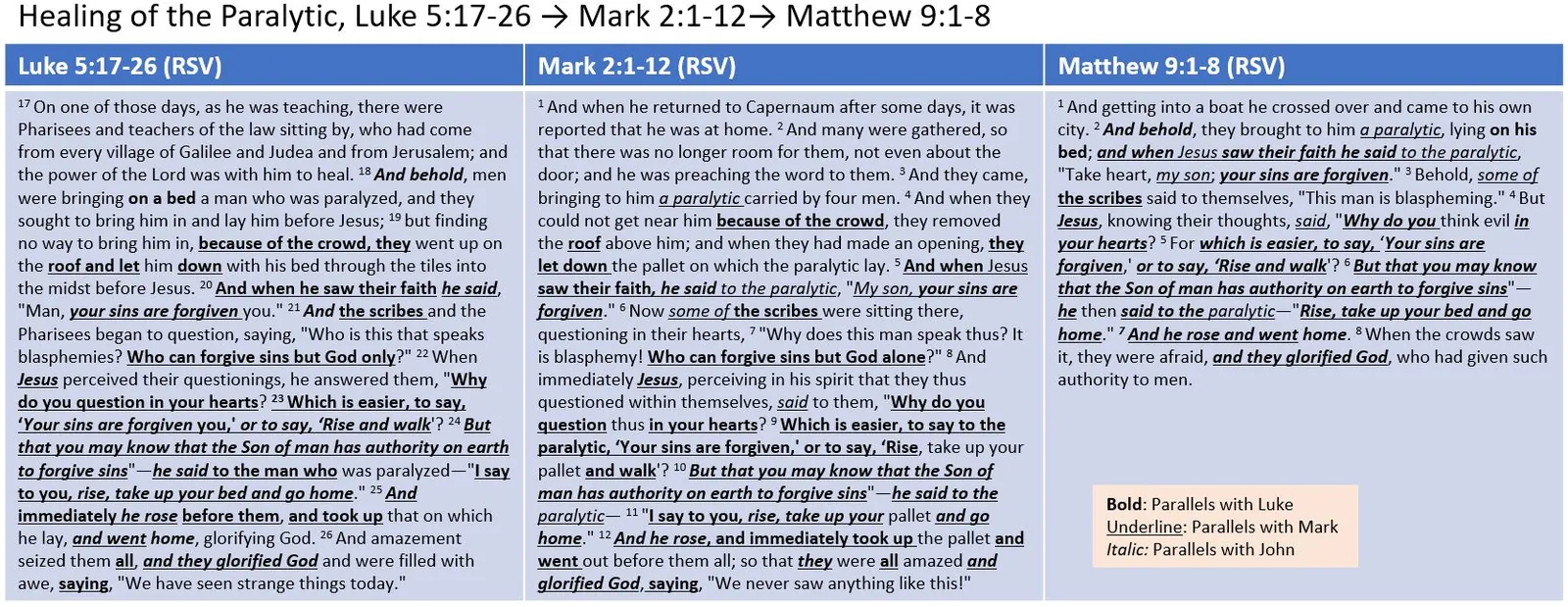
Within this single twelve-verse episode, Luke and Matthew share an interlocking web of positive and negative agreements against Mark:
- Verbatim five-word clause: Matthew 9:7 and Luke 5:25 share the exact five-word Greek sequence ἀπῆλθεν εἰς τὸν οἶκον αὐτοῦ (“he departed to his home”), completely absent from Mark 2:12 (“he went out before them all”). As Farmer noted, this clause does not stand alone, “but is part of an extensive web of interrelated minor agreements, each of which when considered by itself might appear dismissible as insignificant, but when considered together constitute such a concatenation of agreements of Matthew and Luke against Mark as to seem unlikely to be merely accidental, but rather point to some kind of literary relationship between Matthew and Luke.”29
- Semitic narrative particle ἰδού (“behold”): Both Luke 5:18 and Matthew 9:2 introduce the arrival of the paralyzed man with ἰδού (“And behold…”), which Mark never uses in narrative. Streeter labeled this an “Irrelevant Agreement” on the ground that Matthew (33×) and Luke (16×) liked the word in narrative and happened to insert it at the exact same spot five times.30 Yet that ad hoc plea directly undercuts Streeter's simultaneous claim that Matthew and Luke laboured to make Mark's Greek less Semitic.
- “On a bed” (ἐπὶ κλίνης): Both Luke 5:18 and Matthew 9:2 introduce the paralytic lying “on a bed” (ἐπὶ κλίνης), whereas Mark 2:3 has no noun for bed at all until introducing the colloquial Latin-linked pallet (κράβαττος) in Mark 2:4.
- Identical Greek word order in v. 10: Both Luke 5:24 and Matthew 9:6 place “on earth” immediately before “to forgive sins” (ἐξουσίαν ἔχει ἐπὶ τῆς γῆς ἀφιέναι ἁμαρτίας), whereas Mark 2:10 places ἐπὶ τῆς γῆς at the end of the clause (ἀφιέναι ἁμαρτίας ἐπὶ τῆς γῆς).
- Narrative aorist vs. Mark's historic present: Where Mark writes historic present λέγει (“he says,” Mark 2:5, 8, 10–11), Luke and Matthew agree on past-tense forms (“he said”). Yet Matthew himself uses historic present λέγει fifty times elsewhere in his Gospel, and Luke retains historic presents in Special Luke (e.g., Luke 7:40; 13:8; 16:7, 23, 29; 19:22) and Acts (thirteen times), leaving no credible reason why both would independently purge it at the exact same points.
- Shared omissions of vivid Markan specifics: Both Luke and Matthew lack Mark's colorful details “carried by four men” (Mark 2:3), digging through the mud roof (Mark 2:4a), and repeating κράβαττος inside Jesus' counter-question in Mark 2:9. Since Luke's overall account (Luke 5:17–26) is virtually the same length as Mark's, compression cannot explain why both Evangelists lack Mark's signature embellishments.
Far from signaling apostolic eyewitness memory, Mark's added numerical and physical specifics (“carried by four men,” digging an opening) reflect the well-documented tendency toward scenic concretization also characteristic of post-canonical apocryphal narratives.31
How the Same Parallel Supports Lukan Priority
Companion article Progressive Embellishment: Luke → Mark → Matthew documents thirty-six Triple-Tradition passages displaying a two-stage redactional trajectory from Luke to Mark and from Mark to Matthew. The Healing of the Paralytic exemplifies the same three-step progression: Luke preserves the most understated, unembellished account; Mark expands the dialogue, clarifies ambiguities, and dramatizes the scene; and Matthew then streamlines Mark's narrative while retaining key Markan clarifications alongside original Lukan phrasing.
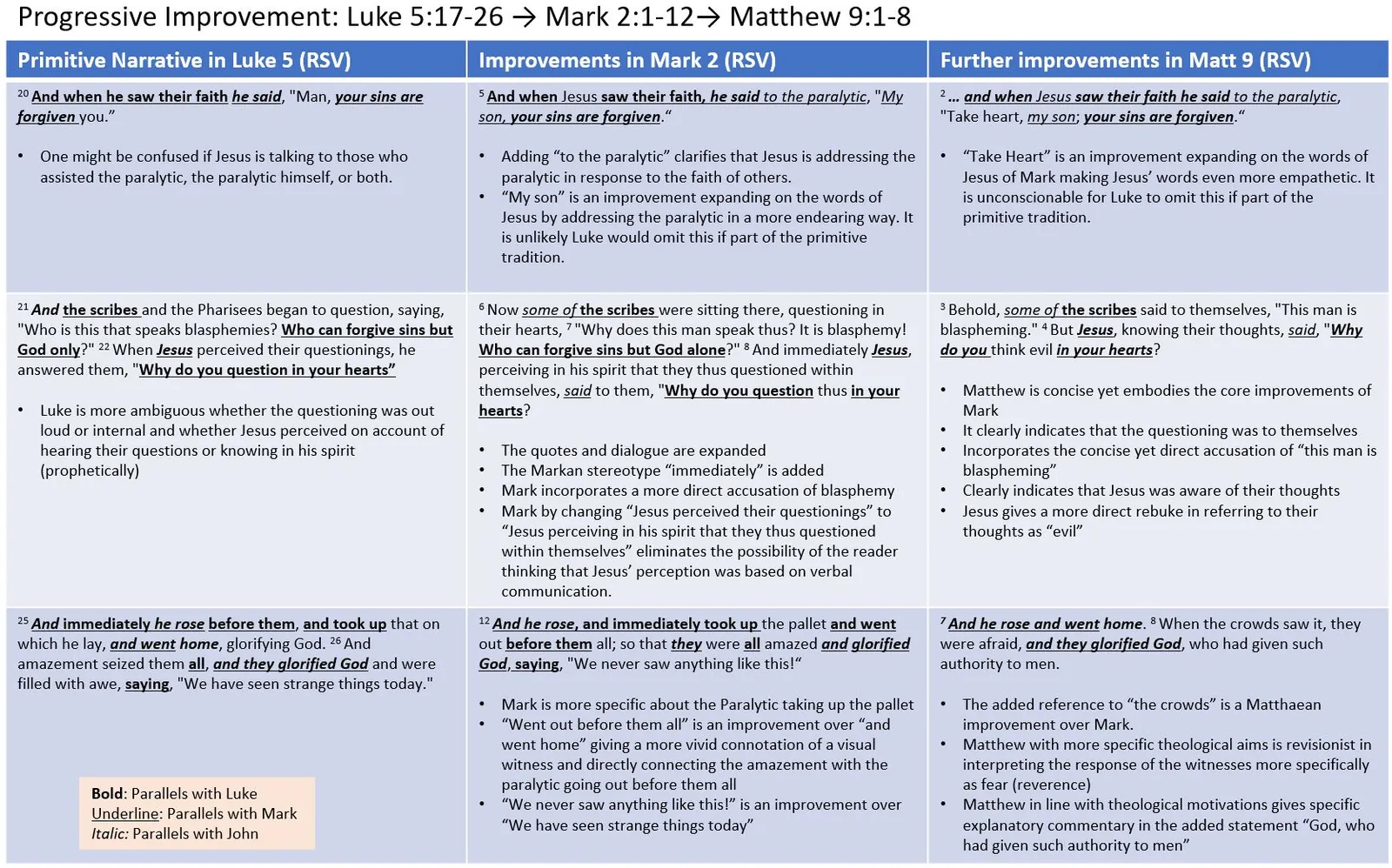
Even though Matthew omits the rooftop-lowering episode to focus concisely on Jesus' authority to forgive sins, Matthew 9:2 retains the telltale clause “And when Jesus saw their faith, he said to the paralytic”—an unmistakable presupposition of the bearers' effort already narrated in Luke 5:18–20 and Mark 2:3–5.
Primitive Lukan Sayings Versus Markan Expansions
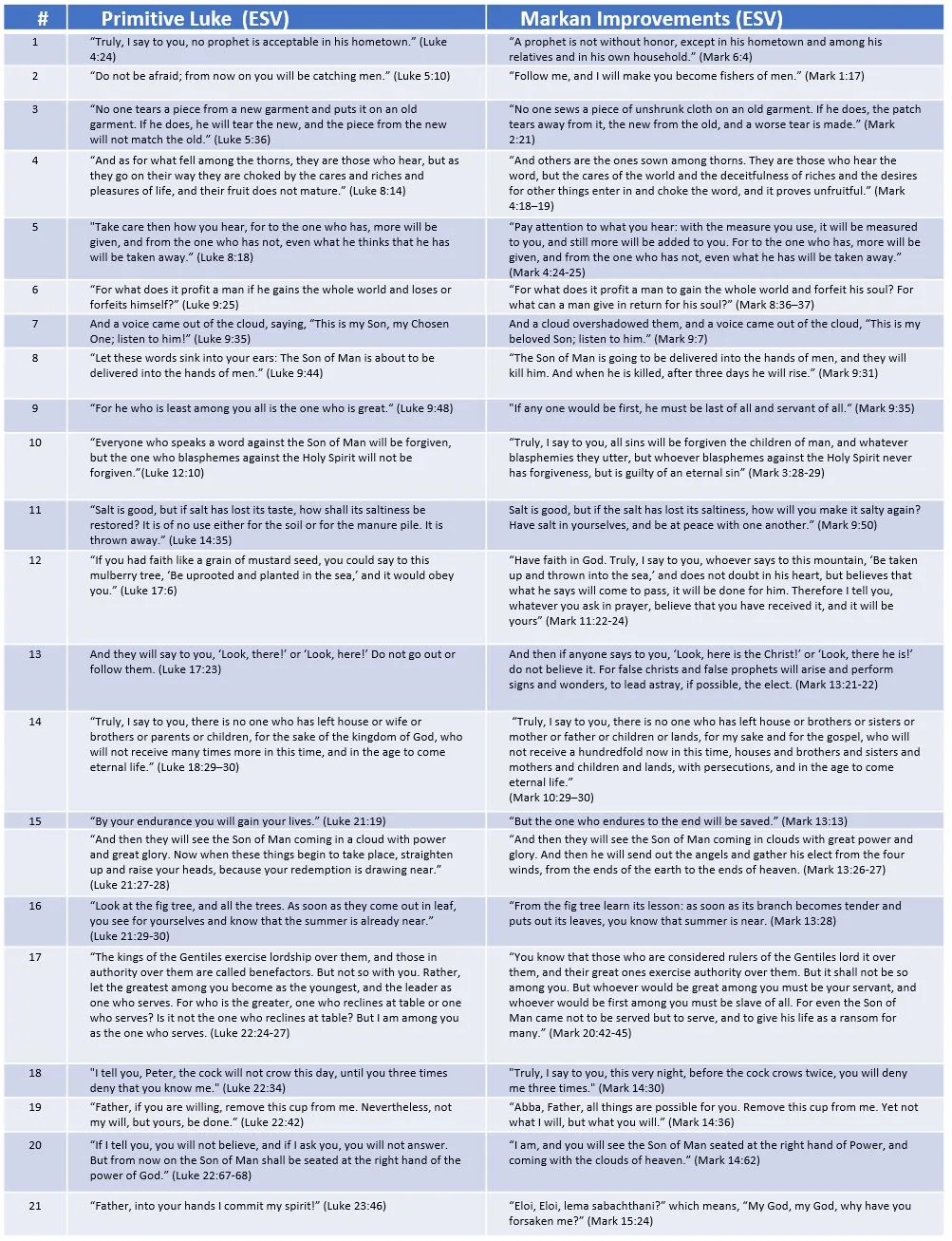
Contrary to the widespread assumption that Mark preserves Jesus' sayings in a rougher, earlier form than Luke, side-by-side comparison of parallel logia repeatedly reveals concise, balanced Semitic-Greek sayings in Luke opposite expanded, explanatory, or polemically sharpened versions in Mark (for comprehensive analysis, see Countering Arguments for Markan Priority and Luke-Over-Mark Passages).
Mark's Transliterated Aramaic Phrases
Following Abbott, Streeter pointed to eight transliterated Semitic expressions in Mark (such as Boanerges, Talitha koum, Korban, Ephphatha, Abba, and Eloi, Eloi, lema sabachthani)—none of which appear in Luke's parallels, and only one place-name (Golgotha) in Matthew's—as proof of Mark's Palestinian primitivity.32
That argument confuses isolated, explicitly translated foreign catchwords with underlying Semitic syntax. In reality, Luke's Greek displays a far deeper concentration of untranslated Hebraisms in clause structure and idiom than Mark (see Validation of Special Luke: Semitisms). Moreover, the fact that Mark must immediately translate every Aramaic phrase into Greek (“which means…”) shows that he was writing for Greek-speaking readers who did not know Aramaic, deploying exotic foreign words for dramatic and thaumaturgical color:
- The post-canonical Acts of Pilate (11.1) introduces a foreign formula on the cross accompanied by the identical explanatory gloss (“which being interpreted means…”) immediately before borrowing Luke 23:46 (“Father, into your hands I commit my spirit”).33
- Irenaeus of Lyons (Against Heresies 1.21.3) criticized second-century Marcosian teachers who recited transliterated Hebrew/Aramaic formulas over initiates “in order the more thoroughly to bewilder” and awe their hearers.
- As form critic Rudolf Bultmann documented, Hellenistic miracle narratives regularly preserved or inserted untranslated foreign wonder-working commands (barbarika onomata) precisely at the moment of physical healing.34
Summarizing the form-critical evidence, Farmer concluded:
The presence in a Gospel of Aramaic terms which are translated for the reader's benefit may be due to one or more of several causes. It is known, for example, that foreign words are sometimes introduced into Hellenistic healing stories (Cf. Bultmann). The presence of Aramaic words in the Greek stories of healing attributed to Jesus can be adequately explained by appeal to this known contemporary literary practice. The presence of such terms in a Gospel, therefore, is by no means a guarantee of the primitivity of that Gospel. The fact that Aramaic words were attributed to Jesus in two healing stories in Mark, whereas no such Aramaic expressions occur in the healing stories of Matthew or Luke, is, on form-critical grounds, as well or better explained as a sign of Hellenistic influence on Mark.35
Allegedly “Offensive” Verses in Mark
In his 1879 Encyclopædia Britannica article, Abbott compiled nine passages in Mark whose bluntness, he argued, later Evangelists toned down:36
- Mark 6:5: “And he could do no mighty work there, except that he laid his hands on a few sick people and healed them” (contrast Matt 13:58, “he did not do many mighty works there”).
- Mark 1:32, 34: Crowds bring “all who were sick,” and Jesus heals “many” (whereas Matt 8:16 and Luke 4:40 report that he healed all of them).
- Mark 3:20–21: Jesus' relatives go out to seize him, saying, “He is out of his mind.”
- Mark 10:35: James and John themselves ask for the seats of glory (whereas Matt 20:20 places the request on their mother's lips).
- Mark 15:44: Pilate is surprised to hear that Jesus has already died.
- Mark 3:15: The Twelve receive authority “to cast out demons” (without Matthew's added clause “and to heal every disease and every affliction,” Matt 10:1).
- Mark 8:24: At Bethsaida, the blind man initially sees people looking “like trees, walking,” so that the miracle is not completed instantaneously but requires a second laying on of hands.
- Mark 11:20–21: The cursed fig tree is noticed withered the next morning rather than withering “at once” as in Matthew 21:19.
- Mark 16:4: The women find the tomb stone already rolled back without an angel descending before onlookers to roll it away (contrast Matt 28:2).
Abbott asserted that such expressions were “likely to be stumbling blocks in the way of weak believers so that they are omitted in the later Gospels, and would not have been tolerated except in a Gospel of extreme antiquity.” Streeter adopted the same argument, writing:
[I]n the same spirit [of reverence] certain phrases which may cause offence or suggest difficulties are toned down or excised. Thus, Mark's “he could do there no mighty work” (Mark 6:5) becomes in Matthew 13:58 “he did not do many mighty works”; while Luke omits the limitation altogether.37
Crucially, however, almost every plausible example on Abbott's and Streeter's list compares Mark with Matthew—supporting Matthean posteriority to Mark (Mark → Matthew), which Lukan priority affirms—while failing to prove Mark's priority over Luke! Indeed, when Streeter added Mark 10:18 (“Why do you call me good? No one is good except God alone”) as a tenth example altered by Matthew 19:17, Luke 18:19 matches Mark verbatim, demonstrating that Luke felt zero doctrinal discomfort with the saying. Conversely, features unique to Mark—such as the two-stage spittle healing of Mark 8:22–26, Jesus' family thinking him beside himself (Mark 3:21), or Pilate wondering at the speed of death—fit Mark's characteristic love of dramatic tension, human-emotion contrasts, and thaumaturgical staging.
Streeter's Tacit Concession: The “Proto-Luke” Hypothesis
Remarkably, when Streeter examined passages where Luke's narrative parallels Mark on the same event (such as the Call of Peter, the Rejection at Nazareth, the Centurion's Servant/Anointing, and the Passion Narrative), he could not deny that Luke repeatedly preserved an independent, often superior form of tradition rather than a mere rewrite of Mark. To rescue Markan priority from that evidence, Streeter adopted Vincent Taylor's and his own “Proto-Luke” hypothesis—positing that Q and L had already merged into a complete pre-Markan Gospel (“Proto-Luke”) that Luke preferred over Mark!38 As Streeter wrote:
A further reason for supposing that Luke found the Q and the L elements in the non-Marcan sections already combined into a single written source [Proto-Luke] is to be derived from a consideration of the way in which he deals with incidents or sayings in Mark, which he rejects in favor of other versions contained either in the Q or the L elements of that source.
It would look, then, as if Luke tends to prefer the non-Marcan to the Marcan version, and this is whether it be the longer or the shorter, and whether it belongs to that element in the source which we can further analyze as being ultimately derived from Q or from the element which we call L. But such a preference, especially where it is a preference in regard to the order of events, is much more explicable if Q and L were already combined into a single document. For the two combined together would make a book distinctly longer than Mark, and would form a complete Gospel. Such a work might well seem to Luke a more important and valuable authority than Mark. But this would not be true of either Q or L in separation. The Conclusion, then, that Q+L lay before the author of the Third Gospel as a single document [Proto-Luke] and that he regarded this as his principal source appears to be inevitable.39
Once Ockham's razor is applied, Streeter's “Proto-Luke” concession gives away the game: Luke's foundational narrative appears older and more authoritative than Mark's not because Luke spliced snippets of Mark into a hypothetical “Proto-Luke,” but because canonical Luke was the earlier Gospel that Mark subsequently abridged and dramatized.
Post-Streeter Dogmatism and the Appeal to Consensus
Whereas nineteenth- and early twentieth-century Synoptic critics often treated their source models with overt tentativeness, the decades following Streeter's 1924 synthesis saw Markan priority harden into an unquestioned guild presupposition. Surveying the mid-twentieth-century literature, Farmer noted:
This shift in the climate of critical opinion toward an attitude of impatient dogmatism on the question of Marcan priority… would appear… to be a post-war development.40
Evaluating how such confidence arose despite the Lachmann fallacy and the unresolved Minor Agreements, Farmer reached three sobering historical conclusions:
The decisive factor in the triumph of the Marcan (or two-document) hypothesis was not any particular scientific argument or series of arguments, however important some of these may have been. The decisive factor in this triumph… was theological.41
Earlier in his historical survey—recalling Gotthold Ephraim Lessing's candid eighteenth-century remark regarding his own Ur-Gospel conjecture (“I myself am often astonished to see how naturally everything proceeds from an observation which I found I had made, without rightly knowing how I came by it”)—Farmer observed that the nineteenth-century convergence around Mark and Q rested “not upon a firm grasp of the primary phenomena of the Gospels themselves, but upon an artificial and deceptive consensus among scholars of different traditions of Gospel criticism.”42 He summarized:
The only sound historical judgment that can be rendered in a critical review of the history of the Synoptic Problem is that “extra-scientific” or “nonscientific” factors exercised a deep influence in the development of a fundamentally misleading and false consensus.43
Once generations of commentaries, redaction-critical monographs, and seminary curricula had been built upon Streeter's foundation, an unspoken sociological deterrent reinforced the paradigm—what Farmer formulated in a memorable sentence: “It is inconceivable that so many scholars could have been so wrong on such a fundamental point for such a long period of time.”44 Yet appeals to majority prestige cannot resolve an empirical literary problem, nor can they erase the hundreds of Minor Agreements of Luke and Matthew against Mark.
Where Synoptic Criticism Stands Today
Throughout the twentieth and twenty-first centuries, substantial critical voices—from H. G. Jameson, William Lockton, Dom John Chapman, B. C. Butler, and Pierson Parker to Austin Farrer, William R. Farmer, Robert L. Lindsey, David Flusser, E. P. Sanders, Hans-Herbert Stoldt, and Mark Goodacre—have exposed fundamental weaknesses in the Streeterian Two-Source edifice.45 Many of the central debates over Markan priority and Q are gathered in Arthur J. Bellinzoni, Jr.'s edited volume The Two-Source Hypothesis: A Critical Appraisal (1985).46
Ironically, even exhaustive mathematical efforts designed to vindicate the Two-Document Hypothesis ended up highlighting Mark's medial status instead. In 1959, Monsignor Bruno de Solages published a monumental 1,128-page statistical synopsis, A Greek Synopsis of the Gospels, intended to place the Two-Document theory on an irrefutable mathematical footing.47 Reviewing Solages's combinatorial graphs, Farmer pointed out what the numbers actually showed:
His work is in fact a monument to the mesmerizing power of the two-document consensus. For what Solages has actually done is to document in exhaustive detail the fact that Mark is in some sense the middle term between Matthew and Luke.48
While differing from both Streeter (Markan priority) and Farmer (Matthean priority), the studies across this site demonstrate why Mark stands as that middle term: Luke preserves the earliest, most Semitic canonical Gospel narrative; Mark subsequently rewrote and dramatized Luke (incorporating pick-ups from Acts and Paul); and Matthew wrote last among the Synoptics, weaving Mark's vivid narrative framework together with Luke and earlier Hebrew Gospel tradition.
Notes
- William R. Farmer, The Synoptic Problem: A Critical Analysis (New York: Macmillan, 1964; repr. Dillsboro, NC: Western North Carolina Press, 1976); Hans-Herbert Stoldt, History and Criticism of the Marcan Hypothesis, trans. Donald L. Niewyk (Macon, GA: Mercer University Press, 1980; German orig. Geschichte und Kritik der Markushypothese, Göttingen: Vandenhoeck & Ruprecht, 1977). ↩
- Farmer, The Synoptic Problem (1964), pp. vii–viii. ↩
- Gotthold Ephraim Lessing, Neue Hypothese über die Evangelisten als blos menschliche Geschichtschreiber betrachtet (written 1778; published in Theologischer Nachlass, Berlin: Christian Friedrich Voss, 1784), pp. 45–72; Johann Gottfried Eichhorn, “Über die drey ersten Evangelien,” Allgemeine Bibliothek der biblischen Litteratur 5 (1794): 759–996; Friedrich Schleiermacher, Über die Schriften des Lukas: Ein kritischer Versuch (Berlin: G. Reimer, 1817), and “Über die Zeugnisse des Papias von unsern beiden ersten Evangelien,” Theologische Studien und Kritiken 5 (1832): 735–768; Friedrich Lebrecht Sieffert, Über den Ursprung des ersten kanonischen Evangeliums: Eine kritische Abhandlung (Königsberg: A. W. Unzer, 1832). See Farmer, The Synoptic Problem, pp. 8–18. ↩
- David Friedrich Strauss, Das Leben Jesu, kritisch bearbeitet, 2 vols. (Tübingen: C. F. Osiander, 1835–1836); Ferdinand Christian Baur, Kritische Untersuchungen über die kanonischen Evangelien, ihr Verhältniss zu einander, ihren Charakter und Ursprung (Tübingen: L. F. Fues, 1847). See Farmer, The Synoptic Problem, pp. 18–35; Stoldt, History and Criticism of the Marcan Hypothesis, pp. 47–60, 146–154. ↩
- Farmer, The Synoptic Problem, pp. 15–26, 36–41. ↩
- Christian Hermann Weisse, Die evangelische Geschichte kritisch und philosophisch bearbeitet, 2 vols. (Leipzig: Breitkopf und Härtel, 1838); cf. Christian Gottlob Wilke, Der Urevangelist, oder exegetisch kritische Untersuchung über das Verwandtschaftsverhältniß der drei ersten Evangelien (Dresden and Leipzig: Gerhard Fleischer, 1838). See Stoldt, History and Criticism of the Marcan Hypothesis, pp. 48–60. ↩
- Heinrich Julius Holtzmann, Die synoptischen Evangelien, ihr Ursprung und geschichtlicher Charakter (Leipzig: Wilhelm Engelmann, 1863). ↩
- Farmer, The Synoptic Problem, pp. 36–47; Stoldt, History and Criticism of the Marcan Hypothesis, pp. 61–132. ↩
- Farmer, The Synoptic Problem, pp. 41–46; Stoldt, History and Criticism of the Marcan Hypothesis, pp. 146–167 (on Liberal Protestant cultural politics and the Kulturkampf). ↩
- Burnett Hillman Streeter, The Four Gospels: A Study of Origins, Treating of the Manuscript Tradition, Sources, Authorship, & Dates (London: Macmillan, 1924; rev. 4th impression 1930; 11th impression 1964). ↩
- Streeter, The Four Gospels, ch. 7 (“The Fundamental Solution”), pp. 151–169 (summary of the five reasons on pp. 151–152). ↩
- B. C. Butler, The Originality of St. Matthew: A Critique of the Two-Document Hypothesis (Cambridge: Cambridge University Press, 1951), ch. 5 (“The Lachmann Fallacy”), pp. 62–71; G. M. Styler, “Excursus IV: The Priority of Mark,” in C. F. D. Moule, The Birth of the New Testament (London: A. & C. Black, 1962), pp. 223–232 (3rd rev. ed., 1981, pp. 285–316). ↩
- Karl Lachmann, “De ordine narrationum in evangeliis synopticis,” Theologische Studien und Kritiken 8 (1835): 570–590; English trans. by N. H. Palmer, “Lachmann's Argument,” New Testament Studies 13, no. 4 (1967): 368–378. ↩
- Farmer, The Synoptic Problem (1964), pp. 51–52; see also pp. 65–74 on the order phenomenon. ↩
- Streeter, The Four Gospels, pp. 162–164; critiqued in Farmer, The Synoptic Problem, pp. 118–130, 159–174. ↩
- Edwin A. Abbott, “Gospels,” in Encyclopædia Britannica, 9th ed., vol. 10 (Edinburgh: Adam and Charles Black, 1879), pp. 789–843 (esp. pp. 791–803); Edwin A. Abbott and Paul Wilhelm Schmiedel, “Gospels,” in Encyclopædia Biblica, ed. T. K. Cheyne and J. Sutherland Black, vol. 2 (London: Adam and Charles Black, 1901), cols. 1761–1898. ↩
- Abbott, “Gospels” (1879), p. 801; cf. Phrynichus Arabius, Die Ekloge des Phrynichos, ed. Eitel Fischer (Berlin: Walter de Gruyter, 1974). ↩
- Farmer, The Synoptic Problem (1964), pp. 121–123. ↩
- E. P. Sanders, The Tendencies of the Synoptic Tradition, Society for New Testament Studies Monograph Series 9 (Cambridge: Cambridge University Press, 1969), pp. 272–279. ↩
- Abbott, “Gospels” (1879), p. 801, quoted in Farmer, The Synoptic Problem (1964), pp. 122–123. For the Greek text of the Acts of Pilate, see J. K. Elliott, The Apocryphal New Testament (Oxford: Clarendon Press, 1993), pp. 164–204. ↩
- Cuthbert Hamilton Turner, “Marcan Usage: Notes, Critical and Exegetical, on the Second Gospel—IX. Stylistic and Grammatical Peculiarities in Mark's Language; Latinisms,” Journal of Theological Studies 29, no. 116 (July 1928): 346–361, at p. 355 (quoted in Farmer, The Synoptic Problem, pp. 123–124). ↩
- Sir John C. Hawkins, Horae Synopticae: Contributions to the Study of the Synoptic Problem, 2nd rev. ed. (Oxford: Clarendon Press, 1909), pp. 143–149; analyzed in Farmer, The Synoptic Problem (1964), pp. 120–121, 133. ↩
- Streeter, The Four Gospels, ch. 11 (“The Minor Agreements of Matthew and Luke Against Mark”), pp. 293–331. ↩
- Farmer, The Synoptic Problem, pp. 118–158; Stoldt, History and Criticism of the Marcan Hypothesis, pp. 13–23, 189–201. ↩
- Streeter, The Four Gospels, pp. 300–305. ↩
- Farmer, The Synoptic Problem (1964), pp. 128–130 (citing inter alia Plutarch, Life of Antony [Vita Antonii] 33, alongside Septuagintal and New Testament parallels). ↩
- Farmer, The Synoptic Problem (1964), p. 130. ↩
- Farmer, The Synoptic Problem (1964), pp. 131–135; cf. Streeter, The Four Gospels, p. 304. ↩
- Farmer, The Synoptic Problem (1964), p. 132. ↩
- Streeter, The Four Gospels, p. 297; critiqued in Farmer, The Synoptic Problem, p. 132. ↩
- Farmer, The Synoptic Problem (1964), p. 134; cf. Sanders, Tendencies of the Synoptic Tradition (1969), pp. 124–189, on growth of personal names and concrete details in post-canonical Gospel traditions. ↩
- Streeter, The Four Gospels, p. 163; Abbott, “Gospels” (1879), p. 802. ↩
- Acts of Pilate 11.1; Irenaeus, Against Heresies (Adversus haereses) 1.21.3 (in Ante-Nicene Fathers, vol. 1, pp. 345–346); cited in Farmer, The Synoptic Problem (1964), pp. 172–173. ↩
- Rudolf Bultmann, The History of the Synoptic Tradition, trans. John Marsh (Oxford: Basil Blackwell, 1963), pp. 221–226. ↩
- Farmer, The Synoptic Problem (1964), p. 172. ↩
- Abbott, “Gospels,” Encyclopædia Britannica, 9th ed., vol. 10 (1879), p. 802b; reviewed in Farmer, The Synoptic Problem (1964), pp. 160–167. ↩
- Streeter, The Four Gospels, p. 162. ↩
- Streeter, The Four Gospels, ch. 8 (“Proto-Luke”), pp. 199–222, quotation at p. 209; cf. Vincent Taylor, Behind the Third Gospel: A Study of the Proto-Luke Hypothesis (Oxford: Clarendon Press, 1926). ↩
- Streeter, The Four Gospels, pp. 211–212. ↩
- Farmer, The Synoptic Problem (1964), p. 177. ↩
- Farmer, The Synoptic Problem (1964), p. 57. ↩
- Farmer, The Synoptic Problem (1964), p. 38, quoting Gotthold Ephraim Lessing, Neue Hypothese über die Evangelisten (§66), on p. 39. ↩
- Farmer, The Synoptic Problem (1964), p. 90. ↩
- Farmer, The Synoptic Problem (1964), p. 195. ↩
- Representative dissenting and revisionist works include H. G. Jameson, The Origin of the Synoptic Gospels: A Revision of the Synoptic Problem (Oxford: Basil Blackwell, 1922); William Lockton, “The Origin of the Gospels,” Church Quarterly Review 94 (1922): 216–239; Dom John Chapman, Matthew, Mark and Luke: A Study in the Order and Purpose of the Three Gospels, ed. John M. T. Barton (London: Longmans, Green, 1937); B. C. Butler, The Originality of St. Matthew (1951); Pierson Parker, The Gospel Before Mark (Chicago: University of Chicago Press, 1953); Austin Farrer, “On Dispensing with Q,” in Studies in the Gospels: Essays in Memory of R. H. Lightfoot, ed. D. E. Nineham (Oxford: Basil Blackwell, 1955), pp. 55–88; Robert Lisle Lindsey, “A Modified Two-Document Theory of Synoptic Dependence and Interdependence,” Novum Testamentum 6, no. 4 (1963): 239–263, and A Hebrew Translation of the Gospel of Mark, 2nd ed. (Jerusalem: Dugith Publishers, 1973); Farmer, The Synoptic Problem (1964); Sanders, Tendencies of the Synoptic Tradition (1969); Stoldt, History and Criticism of the Marcan Hypothesis (1977/1980); and Mark Goodacre, The Case Against Q: Studies in Markan Priority and the Synoptic Problem (Harrisburg, PA: Trinity Press International, 2002). ↩
- Arthur J. Bellinzoni, Jr., ed., with Joseph B. Tyson and William O. Walker, Jr., The Two-Source Hypothesis: A Critical Appraisal (Macon, GA: Mercer University Press, 1985). ↩
- Msgr. Bruno de Solages, A Greek Synopsis of the Gospels: A New Way of Solving the Synoptic Problem, trans. J. Baissus (Leiden: E. J. Brill; Toulouse: Institut Catholique, 1959; French orig. Synopse grecque des évangiles: Méthode nouvelle pour résoudre le problème synoptique, 1958). ↩
- Farmer, The Synoptic Problem (1964), p. 197. ↩