Issues with John
Dating of John P52 Error
𝔓52 and the Modern Dating of the Fourth Gospel
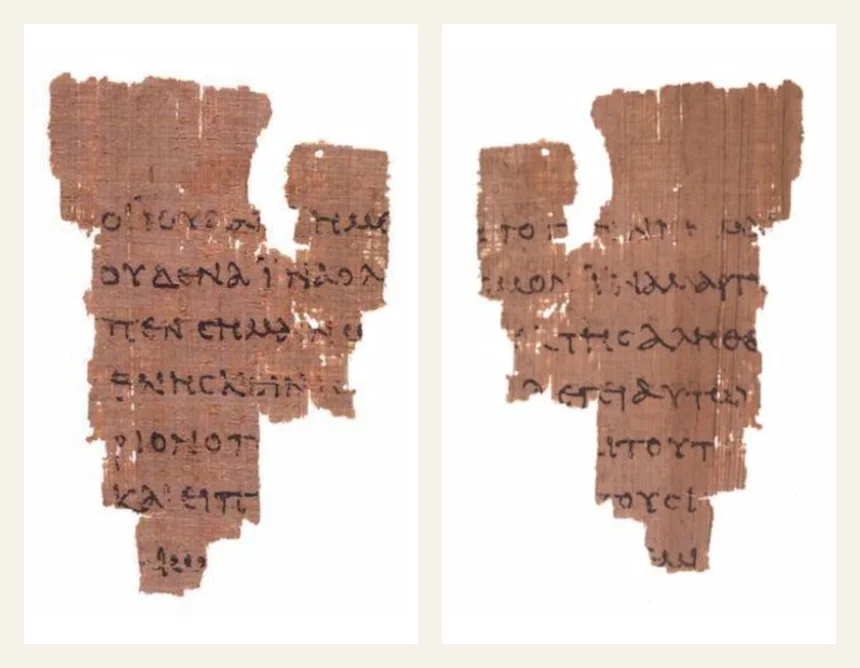
In the late nineteenth and early twentieth centuries, critical scholars debated the date of the Fourth Gospel across a wide chronological spectrum extending from c. 95 CE to c. 150 CE, weighing its literary dependence on the Synoptic Gospels against the striking scarcity of explicit patristic citations prior to the second half of the second century (see Dating of John). After 1935, however, New Testament introductions and commentaries increasingly declared every composition date after c. 100–110 CE impossible on the strength of a single credit-card-sized scrap of papyrus: Rylands Library Papyrus 𝔓52 (P.Ryl. III Gr. 457).1
Measuring roughly 8.9 by 6.0 centimeters, 𝔓52 preserves portions of seven lines from John 18:31–33 on its recto (written along the horizontal fibers) and portions of seven lines from John 18:37–38 on its verso (written across the vertical fibers), demonstrating that the leaf came from a papyrus codex rather than a roll.2 Crucially, 𝔓52 was not excavated in a dated archaeological stratum—nor, despite a widespread popular misconception, was it discovered at Oxyrhynchus. Rather, Bernard P. Grenfell purchased the fragment on the Egyptian antiquities market in 1920 from a dealer sourcing papyri across multiple districts; Colin H. Roberts noted only an unattributed report pointing to either the Fayyum or Oxyrhynchus and judged that rumor of little value, leaving the fragment's findspot and archaeological context unknown.3
When Roberts published the editio princeps of 𝔓52 in 1935, he could estimate its age solely by palaeographical comparison—matching the scribe's heavy-featured round majuscule script against undated literary rolls (above all a Berlin papyrus of Homer's Iliad, P.Berol. inv. 6845, and the newly published Egerton Papyrus 2, P.Lond.Christ. 1) alongside dated Roman-Egyptian cursives from Domitian's reign to Hadrian (P.Lond. inv. 2078 [81–96 CE], P.Fay. 110 [94 CE], Schubart Abb. 34 [before 117 CE], and P.Oslo II 22 [127 CE]), while also recording Sir Frederic G. Kenyon's cautionary observation that partial letterform parallels recurred in a dated 153 CE cursive loan contract (P.Flor. I 1).4 Expressly warning that "any exact dating of book hands is, of course, out of the question" (p. 13), Roberts—supported by Kenyon, Wilhelm Schubart, and H. Idris Bell—proposed a broad fifty-year window across the first half of the second century (100–150 CE). Over the ensuing decades, however, New Testament handbooks hardened Roberts's midpoint ("about 125 CE") into an upper ceiling, subtracted decades for geographical transmission from Asia Minor to Egypt, and treated a first-century composition date for John as palaeographically proven. Over the past four decades, specialist papyrologists—including Andreas Schmidt, Brent Nongbri, Don Barker, and Pasquale Orsini and Willy Clarysse, as well as the John Rylands Research Institute and Library itself—have dismantled that overconfident inference, demonstrating that 𝔓52's palaeographical window extends comfortably into the second half of the second century and even the early third century.5
Summary of Palaeographical Estimates for 𝔓52
Two structural limitations govern every attempt to date 𝔓52. First, because the fragment preserves roughly 114 legible or partially preserved Greek letters across recto and verso and lacks both a scribal colophon and an excavated stratigraphic context, its date rests entirely on handwriting typology—a method for which papyrologists routinely require a tolerance of at least fifty to one hundred years when evaluating literary bookhands. Second, 𝔓52 comes from a codex; while Christian scribes adopted the codex format remarkably early, a date near 100–125 CE would place 𝔓52 among the very earliest extant literary codices of any kind, whereas mid-to-late second- and third-century Christian codices are far more abundantly attested.6
| Authority | Study / Catalogue | Proposed Date Range for 𝔓52 | Methodological Basis |
|---|---|---|---|
| Colin H. Roberts | Editio princeps (1935; BJRL 1936) | 100–150 CE (first half of 2nd c.) | Domitianic–Hadrianic cursives (81–127 CE), Kenyon's 153 CE P.Flor. I 1 caution, P.Berol. inv. 6845, and P.Egerton 2 |
| Andreas Schmidt | Archiv für Papyrusforschung 35 (1989) | c. 170 CE (± 25 years) | Comparison with P.Chester Beatty X and III and the redated P.Egerton 2 + P.Köln VI 255 |
| Brent Nongbri | HTR 98 (2005); God's Library (2018); NTS 66 (2020) | Later 1st / early 2nd to early 3rd century CE | Audit of explicitly dated comparanda, including parallels in c. 152 CE, 184 CE, and Severan-era petitions |
| Don Barker | New Testament Studies 57 (2011) | 2nd or 3rd century CE | Cavallo's "graphic stream" method; long persistence of "round block script" across two centuries |
| Pasquale Orsini & Willy Clarysse | Ephemerides Theologicae Lovanienses 88 (2012) | 125–175 CE (table) / second half of 2nd century CE (conclusion) | Cavallo's Hellenistic bookhand typology applied across pre-fourth-century NT manuscripts |
| John Rylands Research Institute and Library | Digital Collections Catalogue (MS-GREEK-P-00457) |
"Mid to late 2nd century CE" / "nearer to 200 CE" | Institutional catalogue reassessment emphasizing palaeographical uncertainty |
Reassessments by Papyrologists and the John Rylands Library
The John Rylands Research Institute and Library
In its official Digital Collections catalogue entry for P.Ryl. III Gr. 457 (MS-GREEK-P-00457), the John Rylands Research Institute and Library at the University of Manchester records the manuscript's creation date as "mid to late 2nd century CE" and states explicitly that recent specialist research points toward the close of the second century:7
The first editor dated the Fragment to the first half of the second century (between 100–150 CE). The date was estimated palaeographically, by comparing the handwriting with other manuscripts. Recent research points to a date nearer to 200 CE, but there is as yet no convincing evidence that any earlier fragments from the New Testament survive.
Because 𝔓52 carries no written date and its palaeographical window extends near 200 CE, its status as "the oldest surviving New Testament fragment" is no longer unique or uncontested: other undated Oxyrhynchus fragments—such as 𝔓90 (P.Oxy. L 3523, preserving John 18:36–19:7) and 𝔓104 (P.Oxy. LXIV 4404, preserving portions of Matthew 21)—occupy overlapping second- to early third-century palaeographical ranges.8
Andreas Schmidt (1989) and Brent Nongbri (2005, 2018, 2020)
An important catalyst for revisiting Roberts's dating came in 1987, when Michael Gronewald published a Cologne fragment (P.Köln VI 255) belonging to the same codex as Egerton Papyrus 2—one of Roberts's chief Christian comparanda for 𝔓52—revealing an apostrophe placed between double consonants, a scribal convention that pushed the likely date of the Egerton codex down toward c. 200 CE.9 Two years later, Andreas Schmidt re-examined 𝔓52 alongside the redated Egerton fragments and Chester Beatty papyri III and X, proposing a revised date of c. 170 CE, plus or minus twenty-five years.10
In a landmark 2005 Harvard Theological Review study, in his 2018 monograph God's Library: The Archaeology of the Earliest Christian Manuscripts, and in a follow-up 2020 New Testament Studies article, papyrologist Brent Nongbri subjected the entire history of 𝔓52 scholarship to rigorous methodological scrutiny.11 Nongbri pointed out that both ultra-early revisers (such as Philip W. Comfort, who argued for a late first- or very early second-century date) and late revisers (such as Schmidt) committed the same methodological error: attempting to pin down an undated papyrus within a narrow generation by comparing it against other undated literary papyri whose own dates were merely palaeographical estimates.12 Restricting comparison strictly to papyri bearing explicit internal calendar dates, Nongbri reproduced images of Roberts's late first- and early second-century comparanda alongside dated petitions from the second half of the second century and the early third century—most notably P.Mich. inv. 5336 (c. 152 CE) and P.Amh. II 78 (184 CE), as well as Severan-era hands—showing that characteristic letter forms and ligatures in 𝔓52 remained in active use for well over a century. Nongbri summarized his conclusion carefully:
What emerges from this survey is nothing surprising to papyrologists: paleography is not the most effective method for dating texts, particularly those written in a literary hand. Roberts himself noted this point in his edition of 𝔓52. The real problem is the way scholars of the New Testament have used and abused papyrological evidence. I have not radically revised Roberts's work. I have not provided any third-century documentary papyri that are absolute "dead ringers" for the handwriting of 𝔓52, and even had I done so, that would not force us to date 𝔓52 at some exact point in the third century. Paleographic evidence does not work that way. What I have done is to show that any serious consideration of the window of possible dates for 𝔓52 must include dates in the later second and early third centuries. Thus, 𝔓52 cannot be used as evidence to silence other debates about the existence (or non-existence) of the Gospel of John in the first half of the second century. Only a papyrus containing an explicit date or one found in a clear archaeological stratigraphic context could do the work scholars want 𝔓52 to do. As it stands now, the papyrological evidence should take a second place to other forms of evidence in addressing debates about the dating of the Fourth Gospel. (p. 46)13
Returning to the Manchester archives in his 2020 New Testament Studies study ("Palaeography, Precision and Publicity"), Nongbri further documented how early press announcements surrounding Roberts's 1935 booklet encouraged non-specialists to treat a broad palaeographical window as an established early second-century benchmark—a misconception that continues to resurface in popular apologetics despite uniform specialist caution.14
Don Barker (2011)
Drawing on the concept of a "graphic stream" formulated by the Italian palaeographer Guglielmo Cavallo—which prioritizes the overarching structural style and ductus of a script ahead of isolated individual letter shapes—Don Barker re-evaluated 𝔓52 in a 2011 New Testament Studies article.15 Placing 𝔓52 within a conservative "round block script" attested from the late first century onward, Barker observed that this script style exhibited remarkable longevity across Roman Egypt, preventing palaeographers from confining the Rylands fragment to the early second century:
When the general style and individual letter features are kept in close connection and keeping in mind how a scribe writing a documentary text may write a literary text differently, it would seem from the above dated manuscripts, that a date of the second or third century could be assigned to 𝔓52 (P.Ryl. 457). (p. 575)16
Pasquale Orsini and Willy Clarysse (2012)
In 2012, Pasquale Orsini and Willy Clarysse conducted a comprehensive palaeographical review of all Greek New Testament manuscripts previously assigned to the second, third, and early fourth centuries, classifying each hand according to Cavallo's typology of Hellenistic bookhands while criticizing overly early "theological palaeography."17 Although Orsini and Clarysse operate with narrower fifty-year dating brackets than Nongbri or Barker—assigning 𝔓52 a formal tabular range of 125–175 CE (comparable to Stanley E. Porter's mid-second-century estimate)—their own concluding synthesis groups 𝔓52 alongside 𝔓90 and 𝔓104 as manuscripts that "probably all [date to] the second half of the second century" (p. 466).18 Even on Orsini and Clarysse's more confident typology, therefore, 𝔓52 provides no warrant for claiming that the Fourth Gospel was already circulating in Egypt near 100–125 CE.
How New Testament Handbooks Overstated 𝔓52
As Brent Nongbri documented in his 2005 survey of twentieth-century Johannine scholarship, a recurring chain of silent inferences transformed Roberts's tentative 100–150 CE estimate into a rigid dogma.19 Commentators first treated Roberts's midpoint ("about 125 CE") as an established fact, next converted 125 CE from a midpoint into the latest permissible limit (pushing the fragment into 100–125 CE), and finally subtracted twenty-five to forty years to allow the Gospel to travel from Ephesus to Upper or Middle Egypt—thereby declaring mid-second-century reception questions obsolete.20 The excerpts below illustrate how widely this reasoning shaped standard commentaries and text-critical introductions.
D. Moody Smith, John (1999)
In his Abingdon New Testament Commentary, D. Moody Smith explicitly describes how the 1935 publication of 𝔓52 and Egerton Papyrus 2 foreclosed earlier debates over Justin Martyr's silence and mid-second-century publication:21
For a time, particularly in the early part of the twentieth century, the possibility that John was not written, or at least not published, until [the] mid-second century was a viable one. At that time Justin Martyr espoused a logos Christology, without citing the Fourth Gospel explicitly. Such an omission by Justin would seem strange if the Gospel of John had already been written and was in circulation. Then the discovery and publication in the 1930s of two papyrus fragments made such a late dating difficult, if not impossible, to sustain. The first and most important is the fragment of John chapter 18 . . . [𝔓52], dated by paleographers to the second quarter of the second century (125–150); the other is a fragment of a hitherto unknown gospel called Egerton Papyrus 2 from the same period, which obviously reflects knowledge of the Gospel of John. For the Gospel of John to have been written and circulated in Egypt, where these fragments were found, a date no later than the first decade of the second century must be presumed. (p. 39)
Raymond E. Brown, The Gospel According to John (I–XII) (1966)
Raymond E. Brown likewise made 𝔓52—reinforced by Kurt Aland's early second-century label—his decisive argument for fixing 100 CE as the latest plausible date of composition:22
The most conclusive argument against the late dating of John has been the discovery of several 2nd-century papyri texts of John. In 1935 C. H. Roberts published Rylands Papyrus 457 (𝔓52). . . . The dating of this papyrus to 135–150 has been widely accepted; and the latest attempt to date NT papyri by K. Aland . . . assigns to 𝔓52 a date at the "beginning of the 2nd cent." (p. lxxxiii)
Kurt Aland and Barbara Aland, The Text of the New Testament (2nd rev. ed., 1989)
More than any other reference work, Kurt Aland's official manuscript lists—which classified 𝔓52 as Anfang 2. Jahrhundert ("beginning of the 2nd century")—and Kurt and Barbara Aland's standard textbook compressed Roberts's fifty-year span by treating 125 CE not as a midpoint with a twenty-five-year margin on either side, but as the upper ceiling:23
The critical significance of 𝔓52, which preserves only a fragment of John 18, lies in the date of "about 125" assigned to it by the leading papyrologists. Although "about 125" allows for a leeway of about twenty-five years on either side, the consensus has come in recent years to regard 125 as representing the later limit, so that 𝔓52 must have been copied very soon after the Gospel of John was itself written in the early 90s A.D. (p. 85)
Eldon Jay Epp (1989 / 1993)
Relying solely on Roberts and the Alands' assertion of a shifting "consensus," text critic Eldon Jay Epp pushed the copy date of 𝔓52 right back toward the turn of the first century:24
[𝔓52 was] written in the first quarter of the second century, but probably nearer 100 than 125. . . . Though at an earlier time dated 125–150, recent opinion moves it back into the 100–125 period, perhaps very early in that quarter century. (pp. 278–279 and n. 10)
Craig S. Keener (2003) and D. A. Carson (1991 / 2005)
Commentaries by Craig S. Keener and D. A. Carson illustrate how this hardened timeline continued to be invoked at the turn of the twenty-first century—both to push composition back at least twenty-five years before the papyrus and to rule out post-100 CE redaction:25
But far more decisive evidence for John's terminus ad quem has come to light. In 1935 𝔓52, a fragment of the Fourth Gospel dating to the first half of the second century, came to light. The location of this text's discovery far from the Gospel's likely places of origin pushes its proposed date of writing back at least a quarter century; it had thus been in circulation throughout the early second century. Nor does the manuscript allow us to suppose that this represents a pre-Johannine tradition on which John based part of his Gospel, or that substantial redaction (at least in this part of the Gospel) occurred after the date of its copying. As Dibelius notes, "That oldest fragment of the Gospel of John dating from the period 100–140 does not differ by a single word from our printed Greek texts." Metzger, one of the leading text critics of the twentieth century, is more forceful: "𝔓52 proves the existence and use of the Fourth Gospel in a little provincial town along the Nile, far from its traditional place of composition (Ephesus in Asia Minor), during the first half of the second century. . . . This is the earliest attestation available for any sample of early Christian literature and represents a phenomenal discovery." (Keener, 1:142)26
Similarly, D. A. Carson and Douglas J. Moo present 𝔓52 with a single pinpoint year ("dating from AD 130," or "frequently dated c. 125" in Carson's 1991 commentary) as primary external proof against post-first-century dating.27 Note also how both Dibelius's claim ("does not differ by a single word") and Keener's anti-redaction inference overreach the physical evidence: roughly half of each line in 𝔓52 is reconstructed in brackets, and even within its surviving letters scholars have long debated whether the spacing of line 2 on the verso originally omitted the repeated phrase εἰς τοῦτο in John 18:37.28
More Cautious Assessments: C. K. Barrett and James D. G. Dunn
By contrast, several leading British New Testament scholars resisted pressing 𝔓52 beyond its palaeographical limits.29 Already in the first edition of his commentary (1955)—and again in the second edition (1978, pp. 110, 145), where he observed that outside Egerton Papyrus 2 and 𝔓52 "there is no other satisfactory evidence of the existence of the Fourth Gospel before A.D. 150"—C. K. Barrett refused to date 𝔓52 more narrowly than the middle of the second century or to lower the Gospel's terminus ante quem past 140 CE:
The next piece of evidence is the Rylands papyrus, which cannot be dated more precisely than the middle of the second century. It is of course very improbable that the papyrus should be the autograph copy of the gospel, and we may safely push the terminus back as far as A.D. 140, especially since the papyrus may have been written earlier, perhaps twenty or thirty years earlier, than A.D. 150. The wide limits of A.D. 90–140 have now been reached, and it seems impossible to narrow them further without recourse to a hypothesis regarding authorship. John itself is a quite credible product of any date between 90 and 140. None of the attempts made to shift either date is successful. . . . The gospel was not written before A.D. 90 (it appears), nor was the date of its publication later than 140; it must not be assumed that the date of writing and the date of publication were identical; the gospel may have been slow in coming to the notice of the Christian public. Indeed, we cannot be certain that the gospel was widely known in A.D. 140. (1st ed., pp. 108–109)30
Writing in 2015 in the third volume of Christianity in the Making, James D. G. Dunn similarly acknowledged that recent papyrological criticism has undermined the older claim that 𝔓52 decisively locks the Gospel into the first century:31
The textual fragment of John known as 𝔓52 . . . until recently, was thought to provide decisive evidence that the Gospel of John must have been written no later than the first decade of the second century since the fragment was generally dated to about 125 CE. This dating, however, has come under question in recent years and a date around 150 argued for instead. Even so, the fragment found in Egypt implies a Gospel already well circulated beyond its most likely place of origin and initial circulation. So, the most popular date for the Gospel of John in recent scholarship, in the last decade of the first century or around the turn of the century, may well still be the most likely. Here again, however, there can be little confidence and no certainty, and it would be wise not to make any thesis regarding the development of early Christianity depend on a clear and firm date for John's Gospel. (p. 145)
Why Egyptian Provenance and Mediterranean Transit Cannot Rescue an Early Cutoff
Even cautious discussions such as Dunn's often retain one residual assumption from twentieth-century handbooks: that finding a Johannine papyrus in Egypt presupposes decades of slow geographical dispersal from Ephesus, pushing composition well back behind whatever date is assigned to the copy. When tested against ancient documentary and maritime evidence, however, all three premises of that geographical-buffer deduction fail:
- Unproven findspot and contested place of composition: Because Grenfell acquired 𝔓52 from an antiquities dealer without excavation records, its exact Egyptian provenance is unknown. Conversely, assigning the Gospel's composition to Ephesus rests itself on late second-century tradition (Irenaeus, Adversus Haereses 3.1.1, c. 180 CE), whereas major critical scholars such as J. N. Sanders and Helmut Koester have proposed composition in Alexandria or northern Syria—hypotheses that either eliminate or sharply reduce any distance to Egypt.32
- Rapid Greco-Roman maritime and documentary transit: Literary manuscripts did not require generations to cross the Roman Mediterranean. As maritime historian Lionel Casson demonstrated, ships sailing in fair weather routinely covered the route from Asia Minor to Alexandria within one to two weeks, and Eldon Jay Epp's study of dated Greco-Roman letter-carrying papyri shows correspondence moving into and across Middle and Upper Egypt within days or weeks. A concrete Christian control case comes from Oxyrhynchus itself: Irenaeus composed Adversus Haereses far away in Lyons in Gaul around 180 CE, yet if P.Oxy. III 405 is rightly dated by handwriting around 200 CE, a roll copy of Irenaeus's treatise had already reached provincial Middle Egypt within roughly twenty years.33
- What an undated copy can and cannot prove: A manuscript copied around 150, 180, or 200 CE demonstrates only that the work existed by the time that copy was penned. Because the interval separating composition from any surviving copy is unknown—and because rapid Mediterranean travel meant a Christian book did not need twenty-five to forty years to reach Egypt—𝔓52 can neither force the Fourth Gospel back into the first century nor identify an eyewitness author.34
Once 𝔓52 is restored to its proper palaeographical window spanning the second and early third centuries and stripped of unsupported slow-dispersal assumptions, it can no longer serve as a trump card to foreclose internal literary analysis or the second-century patristic reception history examined in Dating of John and Issues with Dating John Before 100 AD.
Notes
- Colin H. Roberts, An Unpublished Fragment of the Fourth Gospel in the John Rylands Library (Manchester: Manchester University Press, 1935); reprinted as "An Unpublished Fragment of the Fourth Gospel in the John Rylands Library," Bulletin of the John Rylands Library 20, no. 1 (1936): 45–55; re-edited as P.Ryl. III 457 in Colin H. Roberts, Catalogue of the Greek and Latin Papyri in the John Rylands Library, Manchester, Vol. 3: Theological and Literary Texts (Manchester: Manchester University Press, 1938), pp. 1–3. ↩
- Roberts, Unpublished Fragment of the Fourth Gospel, pp. 11–12, 24–29. Calculating line lengths and page proportions from the gap between John 18:31–33 (recto) and John 18:37–38 (verso), Roberts estimated that the complete codex page measured roughly 21 × 20 cm and contained approximately eighteen lines per page. ↩
- On Bernard P. Grenfell's 1920 purchase of the lot from an Egyptian antiquities dealer who sourced papyri across multiple districts, see Roberts, Unpublished Fragment of the Fourth Gospel, pp. 12, 24–25 (noting on p. 24 only an unattributed report that "the papyri of the 1920 consignment came either from the Fayum or from Oxyrhynchus," information Roberts himself judged to be of little value); Brent Nongbri, God's Library: The Archaeology of the Earliest Christian Manuscripts (New Haven: Yale University Press, 2018), pp. 138–145, 272–275; and Brent Nongbri, "P52 on the Joe Rogan Experience: Fact Check," Variant Readings, 11 January 2025 (brentnongbri.com). ↩
- Roberts, Unpublished Fragment of the Fourth Gospel, pp. 13–16, comparing the undated Homeric roll P.Berol. inv. 6845 (Berliner Klassikertexte V.1, p. 4; Wilhelm Schubart, Papyri Graecae Berolinenses [Bonn: Marcus & Weber, 1911], plate 19c) and Egerton Papyrus 2 (H. Idris Bell and T. C. Skeat, Fragments of an Unknown Gospel and Other Early Christian Papyri [London: British Museum, 1935]) alongside dated cursives: P.Lond. inv. 2078 (New Palaeographical Society, Series II, Part II, plate 142, reign of Domitian, 81–96 CE), P.Fay. 110 (94 CE; cf. Antonia Sarri, Material Aspects of Letter Writing in the Graeco-Roman World [Berlin: Walter de Gruyter, 2018], p. 132), Schubart, Griechische Paläographie, Abb. 34 (= P.Berol. inv. 6854, before 117 CE), and P.Oslo II 22 (127 CE). On pp. 15–16 Roberts adds that Sir Frederic G. Kenyon pointed out partial letterform similarities in P.Flor. I 1, a cursive loan contract dated 24 March 153 CE (papyri.info), to exemplify the caution required in comparing bookhands with dated documentary cursives, while Kenyon, Schubart, and Bell supported Roberts's fifty-year first-half estimate (p. 16). ↩
- See Andreas Schmidt, "Zwei Anmerkungen zu P. Ryl. III 457," Archiv für Papyrusforschung 35 (1989): 11–12; Brent Nongbri, "The Use and Abuse of 𝔓52: Papyrological Pitfalls in the Dating of the Fourth Gospel," Harvard Theological Review 98, no. 1 (2005): 23–48; Don Barker, "The Dating of New Testament Papyri," New Testament Studies 57, no. 4 (2011): 571–582; Pasquale Orsini and Willy Clarysse, "Early New Testament Manuscripts and Their Dates: A Critique of Theological Palaeography," Ephemerides Theologicae Lovanienses 88, no. 4 (2012): 443–474; Nongbri, God's Library, pp. 138–145; and Brent Nongbri, "Palaeography, Precision and Publicity: Further Thoughts on P.Ryl. III.457 (P52)," New Testament Studies 66, no. 4 (2020): 471–499. ↩
- On the methodological limits of palaeographical dating of literary bookhands and early Christian codices, see Eric G. Turner, The Typology of the Early Codex (Philadelphia: University of Pennsylvania Press, 1977), pp. 1–12, 94–101; Eric G. Turner, Greek Manuscripts of the Ancient World, 2nd ed. rev. P. J. Parsons (London: Institute of Classical Studies, 1987), pp. 18–23; Roger S. Bagnall, Early Christian Books in Egypt (Princeton: Princeton University Press, 2009), pp. 1–24; and Nongbri, God's Library, pp. 47–82, 138–145. ↩
- The John Rylands Research Institute and Library, University of Manchester, Digital Collections, "St John Fragment" (Greek Papyrus 457 / Rylands 𝔓52), shelfmark
MS-GREEK-P-00457, recording "Date of Creation: mid to late 2nd century CE" alongside the curatorial description quoted in the text (digitalcollections.manchester.ac.uk). ↩ - Compare Orsini and Clarysse, "Early New Testament Manuscripts and Their Dates," pp. 466, 470–471 (assigning 𝔓52 to 125–175 CE, 𝔓90 [P.Oxy. L 3523] to 150–200 CE, and 𝔓104 [P.Oxy. LXIV 4404] to 100–200 CE); Nongbri, "Palaeography, Precision and Publicity," New Testament Studies 66 (2020): 471–499; and Nongbri, "P52 on the Joe Rogan Experience: Fact Check" (11 January 2025). ↩
- Michael Gronewald, "Unbekanntes Evangelium oder Evangelienharmonie (Fragment aus dem 'Evangelium Egerton')," in Kölner Papyri (P.Köln), Band 6, Papyrologica Coloniensia 7/6 (Opladen: Westdeutscher Verlag, 1987), pp. 136–145. ↩
- Schmidt, "Zwei Anmerkungen zu P. Ryl. III 457," Archiv für Papyrusforschung 35 (1989): 11–12 (proposing c. 170 ± 25 CE, i.e., roughly 145–195 CE). ↩
- Nongbri, "Use and Abuse of 𝔓52," Harvard Theological Review 98, no. 1 (2005): 23–48; Nongbri, God's Library, pp. 138–145; and Nongbri, "Palaeography, Precision and Publicity," New Testament Studies 66, no. 4 (2020): 471–499. ↩
- Nongbri, "Use and Abuse of 𝔓52," pp. 29–32, critiquing both Schmidt (1989) and Philip W. Comfort and David P. Barrett, The Text of the Earliest New Testament Greek Manuscripts (Wheaton, IL: Tyndale House Publishers, 2001), pp. 355–357 (cf. Philip W. Comfort, Encountering the Manuscripts: An Introduction to New Testament Paleography & Textual Criticism [Nashville: Broadman & Holman, 2005], pp. 106–110, 141–145). ↩
- Nongbri, "Use and Abuse of 𝔓52," Harvard Theological Review 98, no. 1 (2005): 46 (for Nongbri's plate comparisons with P.Mich. inv. 5336 [c. 152 CE], P.Amh. II 78 [184 CE], and early third-century petitions, see pp. 33–45). ↩
- Nongbri, "Palaeography, Precision and Publicity," New Testament Studies 66, no. 4 (2020): 471–499 (responding inter alia to Orsini and Clarysse [2012] and examining archival letters surrounding Roberts's 1935 publication and press reception); cf. Nongbri, "P52 on the Joe Rogan Experience: Fact Check," Variant Readings, 11 January 2025 (brentnongbri.com). ↩
- Barker, "Dating of New Testament Papyri," New Testament Studies 57, no. 4 (2011): 571–582 (esp. pp. 574–575). For Guglielmo Cavallo's palaeographical framework, see Guglielmo Cavallo, Ricerche sulla maiuscola biblica, 2 vols. (Florence: Le Monnier, 1967), and Guglielmo Cavallo and Herwig Maehler, Hellenistic Bookhands (London: Institute of Classical Studies, 2008). ↩
- Barker, "Dating of New Testament Papyri," p. 575. ↩
- Orsini and Clarysse, "Early New Testament Manuscripts and Their Dates," Ephemerides Theologicae Lovanienses 88, no. 4 (2012): 443–474 (esp. pp. 456–457, 466, 470). ↩
- Orsini and Clarysse, "Early New Testament Manuscripts and Their Dates," p. 466 (and table on p. 470). Compare Stanley E. Porter, "Recent Efforts to Reconstruct Early Christianity on the Basis of Its Papyrological Evidence," in Christian Origins and Greco-Roman Culture: Social and Literary Contexts for the New Testament, ed. Stanley E. Porter and Andrew W. Pitts, TENTS 9 (Leiden: Brill, 2013), pp. 71–84. For Nongbri's critique of Orsini and Clarysse's confidence in narrow fifty-year palaeographical slots for undated literary papyri, see Nongbri, God's Library, pp. 56–68, and Nongbri, "Palaeography, Precision and Publicity," pp. 473–486. ↩
- The survey of Smith, Brown, the Alands, Epp, Kysar, Elliott, and Barrett in this and the following section draws on the documentation assembled by Nongbri, "Use and Abuse of 𝔓52," pp. 25–28. ↩
- Compare Robert Kysar, "John, The Gospel of," in The Anchor Bible Dictionary, ed. David Noel Freedman, 6 vols. (New York: Doubleday, 1992), 3:918 ("the latest possible date [of John] has been fixed by the discovery in Egypt of the Rylands Papyrus 457 (𝔓52)"); and J. K. Elliott, "The Biblical Manuscripts of the John Rylands University Library of Manchester," Bulletin of the John Rylands University Library of Manchester 81, no. 2 (1999): 7. ↩
- D. Moody Smith, John, Abingdon New Testament Commentaries (Nashville: Abingdon Press, 1999), p. 39 (as cited in Nongbri, "Use and Abuse of 𝔓52," p. 25). ↩
- Raymond E. Brown, The Gospel According to John (I–XII), Anchor Bible 29 (Garden City, NY: Doubleday, 1966), p. lxxxiii (citing Kurt Aland, "Neue neutestamentliche Papyri II," New Testament Studies 10 [1963–1964]: 62–79; cf. Kurt Aland, "Neue neutestamentliche Papyri II," New Testament Studies 9 [1962–1963]: 307, and Nongbri, "Use and Abuse of 𝔓52," pp. 25–26). ↩
- Kurt Aland and Barbara Aland, The Text of the New Testament: An Introduction to the Critical Editions and to the Theory and Practice of Modern Textual Criticism, trans. Erroll F. Rhodes, 2nd rev. ed. (Grand Rapids: Eerdmans, 1989), pp. 85, 99; cf. Kurt Aland, ed., Kurzgefasste Liste der griechischen Handschriften des Neuen Testaments, 2nd ed., ANTF 1 (Berlin: Walter de Gruyter, 1994), p. 9 ("Anf. II" = Anfang 2. Jahrhundert), and Nongbri, "Use and Abuse of 𝔓52," pp. 26–27. ↩
- Eldon Jay Epp, "The Significance of the Papyri for Determining the Nature of the New Testament Text in the Second Century: A Dynamic View of Textual Transmission" (orig. 1989), reprinted in Eldon Jay Epp and Gordon D. Fee, Studies in the Theory and Method of New Testament Textual Criticism, Studies and Documents 45 (Grand Rapids: Eerdmans, 1993), pp. 278–279 and 279 n. 10 (cf. Nongbri, "Use and Abuse of 𝔓52," p. 27). ↩
- Craig S. Keener, The Gospel of John: A Commentary, 2 vols. (Peabody, MA: Hendrickson Publishers, 2003), 1:142. ↩
- Keener, Gospel of John, 1:142, quoting Martin Dibelius, A Fresh Approach to the New Testament and Early Christian Literature (New York: Charles Scribner's Sons, 1936), p. 98, and Bruce M. Metzger, The Text of the New Testament: Its Transmission, Corruption, and Restoration, 3rd ed. (New York: Oxford University Press, 1992), p. 39 (cf. 4th ed. with Bart D. Ehrman, 2005, pp. 55–56). ↩
- D. A. Carson and Douglas J. Moo, An Introduction to the New Testament, 2nd ed. (Grand Rapids: Zondervan, 2005), p. 229 ("Probably the earliest New Testament fragment that has come down to us is a fragment of John, Papyrus 52, dating from AD 130 and containing a few words from John 18"); cf. D. A. Carson, The Gospel According to John, Pillar New Testament Commentary (Grand Rapids: Eerdmans, 1991), pp. 23–24. ↩
- On the line-length reconstruction of verso line 2 (John 18:37) and the probable omission of the second εἰς τοῦτο by haplography or brevity, see Roberts, Unpublished Fragment of the Fourth Gospel, p. 32; and J. Neville Birdsall, "A Note on the Text of John 18,37 in 𝔓52," Journal of Theological Studies n.s. 47, no. 2 (1996): 598–599. ↩
- Compare Nongbri, "Use and Abuse of 𝔓52," pp. 27–28. ↩
- C. K. Barrett, The Gospel According to St. John: An Introduction with Commentary and Notes on the Greek Text, 1st ed. (London: SPCK; New York: Macmillan, 1955 [repr. 1957]), pp. 108–109; cf. 2nd ed. (London: SPCK; Philadelphia: Westminster Press, 1978), pp. 110, 127–128, 145. ↩
- James D. G. Dunn, Neither Jew nor Greek: A Contested Identity, Christianity in the Making, Vol. 3 (Grand Rapids: Eerdmans, 2015), p. 145. ↩
- For the late second-century Ephesian tradition, see Irenaeus, Adversus Haereses 3.1.1, ANF 1:414. For scholarly hypotheses placing the Fourth Gospel's composition much closer to, or within, Egypt, see J. N. Sanders, The Fourth Gospel in the Early Church: Its Origin and Influence on Christian Theology up to Irenaeus (Cambridge: Cambridge University Press, 1943), pp. 36–55, 84–87 (Alexandria); and Helmut Koester, Ancient Christian Gospels: Their History and Development (London: SCM Press; Philadelphia: Trinity Press International, 1990), pp. 245–246, alongside Koester, Introduction to the New Testament, Vol. 2: History and Literature of Early Christianity, 2nd ed. (New York: Walter de Gruyter, 2000), pp. 191–193 (Syria). ↩
- On Greco-Roman maritime speeds across the eastern Mediterranean, see Lionel Casson, Ships and Seamanship in the Ancient World (Princeton: Princeton University Press, 1971), pp. 281–296; on documented transit times of papyrus letters and literary texts into and across Egypt, see Eldon Jay Epp, "New Testament Papyrus Manuscripts and Letter Carrying in Greco-Roman Times," in The Future of Early Christianity: Essays in Honor of Helmut Koester, ed. Birger A. Pearson et al. (Minneapolis: Fortress Press, 1991), pp. 35–56 (esp. pp. 47–55). On P.Oxy. III 405, preserving fragments of Irenaeus, Adversus Haereses 3.9 and paleographically dated by its editors "not later than the first decade or two of the third century" (c. 200 CE), see Bernard P. Grenfell and Arthur S. Hunt, eds., The Oxyrhynchus Papyri, Part III (London: Egypt Exploration Fund, 1903), pp. 10–11; and Colin H. Roberts, Manuscript, Society and Belief in Early Christian Egypt (London: Oxford University Press for the British Academy, 1979), pp. 23, 53. ↩
- Compare Nongbri, "Use and Abuse of 𝔓52," p. 46; and Nongbri, "P52 on the Joe Rogan Experience: Fact Check" (11 January 2025). ↩